Do you really need to print that?


“”Is there a better way? Can you avoid printing that page?”

Photograph by Annie Sprat, Unsplash

Many project teams use tablets and television screens to project information during meetings for meeting participants to consider and discuss. And while we have cloud storage and the ability to access and edit or markup files from multiple devices, it appears that printing has not yet lost its appeal for some. If you are not yet ready to consider a working day without a printer, here are some ways to be more sustainable with the way you work on a day-to-day basis.

Removing Waste: Recycling

Have you considered what the end-of-life would be for that page you just printed and may be ready to throw into the trash bin soon? Why not set up a special bin for just collecting paper to be recycled? In some locations, secure bins are available which ensures that sensitive papers are securely stored until they are collected by the supplier and recycled.

Refills

Are you making use of a printer cartridge refill scheme? Instead of throwing used cartridges away, there may be suppliers in your area where you can get refills for your used cartridges.

And talking about printing cartridges – can you use only one colour – black? Having multiple colours may generate additional waste and perhaps you can save the colourful displays for virtual online documents?

Materials used

The paper you use for printing, is it made from environmentally-friendly recycled processes? Why not ask your local suppliers to advise you about recycled paper options available to you?

Habits

If you print on both sides of a page, you could be saving on paper usage and you could be lowering the weight of printed documents being shipped to recipients of your printed materials!

Fewer printers

Do you really need so many printers in your office? Or could you lower the ongoing electric power needs of printers and also encourage more physical movement of people during the day. Asking them to walk a little further in order to retrieve printed pages may be a great way to ensure they move out of a sedentary posture and increase blood circulation. Regular breaks and physical movement are great ways to improve physical and mental well–being at work.

Lower energy usage

Ensure that printers are turned off completely at the end of the working day and over weekends and periods of office closures. This ensures that no power is used in standby mode.

Consider digital solutions

Looking at the processes you use in your office – are you printing notifications or informational posters and is there a way to instead share it with colleagues, suppliers or customers digitally? For example – could suppliers download an electronic file from your website showing how you would like invoices prepared?

Understand your data and set improvement targets

Do you know who prints the most pages in the office? Is there an opportunity to engage with someone on printing more sustainably? Not everyone has been exposed to ways they could lower energy usage or how to avoid creating waste.. It could be great to have a discussion with someone about this.. Improving awareness is often the first step towards more sustainable practices at the office.

Getting together to set targets in your office like “We track our number of printed pages, and we strive to lower it by 10% this month compared to the previous month!” can be great ways to keep everyone focused on lowering your environmental footprint as an office..

In most cases, becoming more aware and conscious of ways that we can become less wasteful and generate less waste can be the first step toward being more innovative and finding new ways to positively impact the world and those around us. What will you do today to lower the waste you generate?

Sustainability Awareness Workshop


– Getting creative instead of trashing items –

Single-use packaging is intended to be used only once before being thrown away or recycled. Included in this kind of trash would be food packaging, bottles for laundry detergent and other household goods, straws and boxes for tea bags, etc  From a global perspective, over 90% of trash is estimated to come from single-use materials. The good news in some countries is that over 50% of packaging is recycled.

The upside-down pyramid for waste shows the more preferred ways to deal with it.

When it comes to waste, the best option is preventing the waste from coming into our homes or office buildings, the 2nd best option is to reuse items somehow, and then comes recycling. Increasing awareness in your team is important – of being more responsible with their purchasing choices and choices regarding trash that passes through their homes or at the office. This workshop can improve awareness of how to reuse items instead of discarding them.

Participating in this workshop will show participants how to look at packaging trash from the perspective of reusing it, and creating a new purpose for single-use packaging. You can open the workshop by reflecting on trash and recycling in your city/location and how they could all help to improve those statistics by being more mindful of the items they bring into their homes (avoiding single-use packaging as much as possible) and also to not be so fast to throw away items that had only been used once at the office.

If you are passionate about having a positive impact on the sustainability habits and thinking of others in your organization, in your family, or among friends, why not get 4-6 people to join you in being creative with packaging that would have otherwise been discarded.

Items you can use in the workshop:

Most households would be easily able to collect some items like small carton boxes and items, printed pages that are no longer needed like advertising leaflets thrown in through mailbox slots, and paper-based packaging used for supporting fruits purchased in supermarkets. In the office, there could be boxes that contained pens and pencils or paperclips.

Two ideas to consider for the activity:

Paper Mache (papier-mâché)

You can make the paste using flour and water (see https://kinderart.com/kitchen/papier-mache-recipes/) tear the collected sheets of paper into strips about 1 inch wide and dip them thoroughly into the paste mixture. Strip off the excess mixture from each strip before applying it. It works well if you pull the strip of paper through to the other side between two fingers. Build up the desired new object by applying only one layer at a time and waiting for that to dry before going to a new layer. Dried objects can be sanded to improve the smoothness of the finished project before you apply an environmentally friendly paint design on top. Ideas of items that might be useful include containers for jewelry, organizing loose containers into a neatly contained area, or creating a container for paperclips and other office items that could be cluttering up desk drawers.

Coffee Stirrers

Make sure the used stirring sticks are free of coffee remains that could interfere with the gluing process.  Design ideas could include coasters for cups, glasses, or mugs at the office or at home. You could also build containers for pens or other office supplies. Remember to wait until the glue had dried before putting items on your built items to avoid breakage! And again you might use environmentally friendly paints to finish your coffee stirrer design items.

To limit the space and supplies needed for your workshop team activity, it may be wise to pick one type of project to work on vs trying to cover several types of projects in one space.

Workshop Programme

Welcome, and introductions – if not all participants know each other, allow time for everyone to introduce themselves.

Overview – talk about the reason for the workshop and focus participant attention on sustainability and how sustainability principles relate to the way we think about and how we deal with the packaging associated with purchases. Give them some trash generation and recycling statistics for your local area to help them understand the scale of the issues faced environmentally with how things are going in your area. Introduce the workshop as a way to become more aware and get creative with packaging waste that comes from homes and offices. Creative activities in groups are also great ways to improve the mental health of individuals and feelings of belonging in a team or group.

Activity – introduce the chosen activity and explain the materials available to participants. Make sure people know how much time you have planned for the activity and if there will be follow-up opportunities to complete projects or whether they could take any half-finished projects home to finish them there. Walk around while participants work on their projects and support them with advice where needed. Always make sure that safety is a priority and be sure to explain any dangers such as using cutting devices or opening and closing drawers and cupboard doors in the workshop area.

Closing – when the workshop time is at the end. Thank everyone for participating and being willing to learn new ways of looking at single-use packaging as small steps to help improve the generation of trash in your area. Remind participants of how they could finish up their projects and encourage them to share pictures of completed items with the team/group.

Awareness

The first step to improving any situation is awareness. This kind of team or group activity is a great way to increase awareness of the issues at hand with local trash generation and how each person can make a difference in small ways. Using creative endeavors to address this issue is also enjoyable and can be a great way to improve feelings of mental well-being, which is something we all can use in today’s world.

Will you love it?


Your dream job – will it be all that you are hoping for?

When you consider a job change or a pivot, you may need to go and talk to people who are doing that job or role right now to answer some of your questions. Before you make a change you probably would need to understand the qualifications or certifications that are important and maybe understand what a typical day is like in that role? If you don’t have the certifications that would be a great way to make sure you prioritize getting the most essential certifications first. If you don’t like the way the typical day goes in that other role you are thinking about, perhaps it is not for you? Perhaps it is good to know more before you jump?

Desktop research first

A lot of this information is available online if you, for example, search for those job vacancies online – you can find out which qualifications or certifications are most required for the role you are considering changing towards. The job vacancies can also show what kinds of competencies and skills recruiters are looking for. Just bear in mind, sometimes they just ask for the moon and the stars in job vacancies to try and ensure they get a really good person who can satisfy a long wishlist (hard to do in most cases!) So, desktop research only goes so far…

Who can you talk to?

Knowing how the typical day goes in a role like the one you want, is not usually so easy to find out by doing online internet searches. This is where you would need to look to your own network of contacts – family members, friends, colleagues or ex-colleagues, and others in sports teams or clubs with you. When you have gone through all the people you know, and perhaps you did not find any or enough people who can help you, you may have to start looking online. Use social media platforms to find people who are in the role you would like to have. If you use LinkedIn, you might be able to see if you know someone or through your network may be able to contact someone who does what you would like to do in the future. If you have no direct links to a person you can often still reach out to them via a message. Your objective would be: Find someone who now has or someone who did have your dream role in the past so you can ask him/her some questions about it. That way you can have more clarity regarding how much might you love this role you are dreaming about?

Plan your next steps

Before you approach anyone for a meeting or a discussion around the questions you have, what targets and specific objectives do you want to set for yourself?

How many people you should approach with your questions? (Is 3 enough, or is a minimum of 5 your target? How many experts in this role do you need to talk to?) In some cases, it may be hard to answer the question because you don’t know if the first two people will give you quality answers or not? Set yourself a guideline target if you are not sure. (Tip: 15 may be too many! If you have not identified the right people to talk to, you may end up with too many discussions. If you find the right 3 and they are willing to spend 20 minutes with you on your key questions, it may be enough!)

Make a list of the people you know who may be able to answer the questions- we will talk about them in a moment. And think specifically about how they may be able to help. If you just ask just anyone you know or post it on your social media page, you may not get quality answers so think carefully about how each of the names you write down can help you. Is he/she currently in the role you are thinking of changing to? Is he/she a mentor or guide who can help me work out the steps to take? Is he/she working for a company or department that hires people for the role I am interested in? Was he/she in such a role in the past?

Start listing the specific questions which you would like to have answered. Here are some question options to consider:

The questions are about:

  • Find out what knowledge you might need. Once you know that, you can look for courses or certificates or volunteer options to help you gain the knowledge you need.
  • Which experiences would be important to have demonstrated in the past to get a role/job like this one? If you do not yet have that, how can you get those experiences? (ask for special assignments in your current role or consider a volunteer role)
  • Which key competencies or skills does it take to succeed in this role? How do your competencies and skills compare to that? If you have to fill in some learning gaps, how can you do that?
  • Are you possibly idealizing this role? Are there downsides you have not considered like a lot of travel and being away from your family and friends? Maybe there are some standby or nightshift requirements? Are you aware of that and does that fit in with your decision-making criteria?
  • In the greater scheme of things – how does this role or job contribute to success in a company? Is there something great about this role that you have not yet realized or understood? Does that motivate you to make time to fill in the knowledge and skills gaps that you discovered?

Keep your momentum

Set yourself small tasks to achieve every week to move forward in understanding more about the role/job you are interested to have in the future:.

  1. What will you do and complete this week?
  2. What will you do the week after?
  3. Which day and at what time of the day each week will you check to see how you are doing against your planning (Did you complete the tasks you set yourself to achieve in the last week?)

To succeed at moving forward you need forward planning, checking back at least once per week to see how far you have come on your plan once you have started. And you need to set yourself targets to achieve in the next few days (be specific) to keep your momentum. That is how you keep your plan alive for moving towards your career move or change!

A closer look at STARR answers


In interviews, you are sometimes asked to give an example of how you have demonstrated that you are good at a specific competency. Other times you may be asked to explain how your skills have been useful to teams or organizations in the past. The principle is that the experience you have in specific competencies would have been demonstrated by situations you faced in the past.

It is these examples that the interviewer would be looking for when they ask you to provide your answer in the STARR methodology. Using this approach is your best way to give an example that clearly outlines for the interviewer how you faced a situation, recognized what you needed to do, took action, and achieved good results or outcomes.

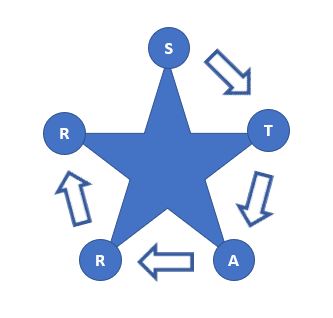
The acronym represents 5 specific topics you need to cover in your answer and if you imagine that 5-star picture in your mind, you may be able to more easily formulate your answers and examples during an interview. It is always a good idea to prepare some examples you can think of before the interview, but you may sometimes need to come up with an answer you did not prepare. Hopefully, this picture and explanation help you succeed with that!

The Acronym

The STARR method works on these headings (in sequence) [it is an acronym for these words]

Situation (when, where, what setting)

Task (what you needed to do, which responsibility you took on)

Action (what you did, which way you used a personal strength or competency)

Result (what was the outcome of your action?)

Reflection (looking back at how it went, what did you learn from it – what went well and what would you do differently if you faced the same situation again?)

Approach

Starting at the top of the star with the letter S, which represents the Situation you were in. This relates to the time when you were able to demonstrate through your actions that you have good proficiency in a specific competency. Once you have completed describing the Situation, you move clockwise to the next letter T. Once you have covered the questions under the letter T, you move clockwise to the next letter, A for action. And so you continue until you finish by including answers to the questions shown under Reflection.

Each of the topics under the STARR letters in the graphic above shows some bulleted questions which will help you ensure you cover the key aspects of that particular term when it comes to your example. from the past.

Example

Here is an example showing how using the questions under each of the topics in the STARR model can be useful in preparing your answers for interviews.

If you need a template to use in formulating your STARR – style examples, click on the link below.

Note:

When you are giving examples, you have to be specific instead of staying with general examples, which is often not convincing to those listening to your answers. . Make a story out of your example and base it on some real event that happened in your past to highlight how you were able to demonstrate a specific skill. Using the STARR methodology makes your story more credible and easier for those listening to you to get a full understanding of the capabilities that you have successfully demonstrated in the past.

Conversation Topics


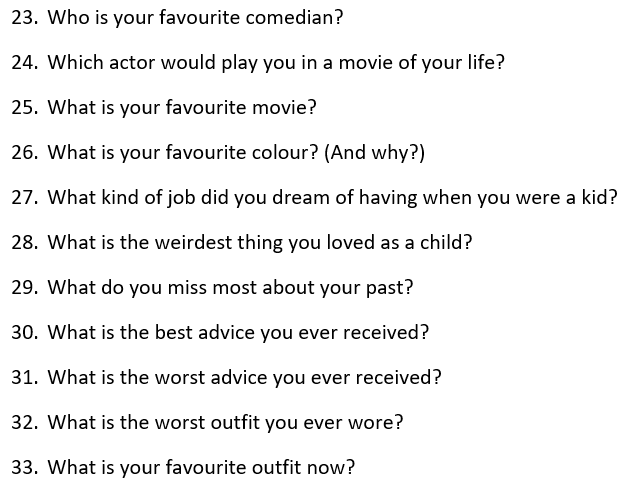
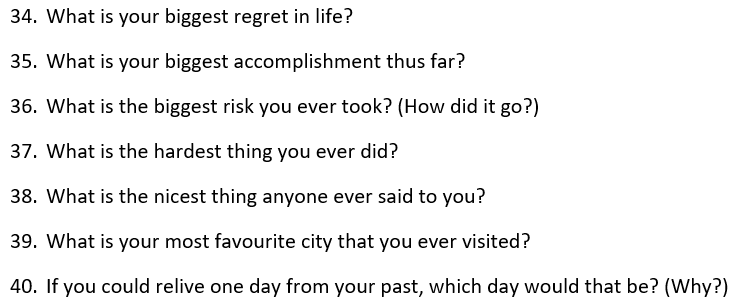
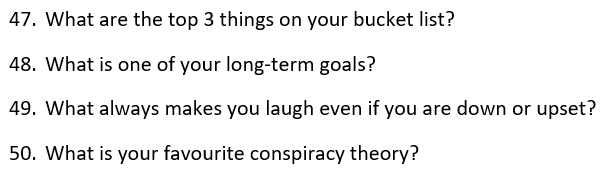
Want to get to know your colleagues or teammates on a project? These may give you ideas for topics to ask about and discuss. Perhaps you are looking for a novel way to get to know your friends or family members better?

Some people have trouble with knowing what to talk about or which topics to ask others about to go beyond the first level of getting to know someone – if we assume the first level would be obvious topics like where are you from, what did you study, what kind of role you are in now, etc.

Pick just a handful of topics at most to avoid the other person feeling interviewed. You could also pick perhaps one to two to ask someone you work with or talk to mostly about work on a regular basis – perhaps just before or after a meeting. It could also be useful during a coffee break. Who knows what surprises you may have in learning to understand someone better?

Be sure to pick the right options for people you barely know – some of the topics are better suited for discussions when you already know someone – like friends or family members. I am sure you will apply common sense and wisdom in selecting fun topics that would match the situation and the person you plan to talk to.

Some of these questions can also be used in group ice breaker exercises or as a fun leg-stretching exercise in the middle of a long day of training or meetings.

Some recruiters like to use a question like these to see how candidates might respond. So, read through these, who knows when you may need to come up with an answer to one of them? 😊

Topics

Mentoring Agreement


Mentoring usually takes place between someone with experience and someone who needs advice and training in specific areas. Starting the process of mentoring duos sometimes skip the step where they talk about how we agree to go through this process together. What is important to you? What is important to me? What can each of us commit to in order for this to work well for both of us?

This free template below helps you to structure a conversation around what the mentor and mentee specifically agree to commit to. How many hours per month/quarter would we like to spend talking through specific topics?

Feel free to add additional items which would be important to discuss during the first meeting when you (mentor and mentee) agree on how to proceed. This kind of discussion may seem unnecessary, but covering these items upfront can save a lot of disappointment and misunderstandings later when items you might have imagined would be obviously included in your mentoring agreement vary from what the other person may have thought. It is not a contractual agreement as much as it is a summary of what you do or don’t want to commit to for the duration of the mentoring relationship.

When it comes to time commitments, it is also advisable to agree for the mentoring process to have a set time period – 12 months or 18 months. And when that time comes, review what has been achieved and learned and whether it makes sense to continue the mentoring relationship or to agree to end it at that time.

Clearly defining the development objectives to be addressed helps to steer the direction of mentoring discussions. What is it that the mentee needs to know, needs to be able to do, and would like to be able to understand? The more detailed this section is, the easier it might be for either the mentor or the mentee to recognize when the mentoring relationship has helped to achieve those outcomes and it may be time to evaluate whether it makes sense to end the mentoring relationship or continue it with new development objectives.
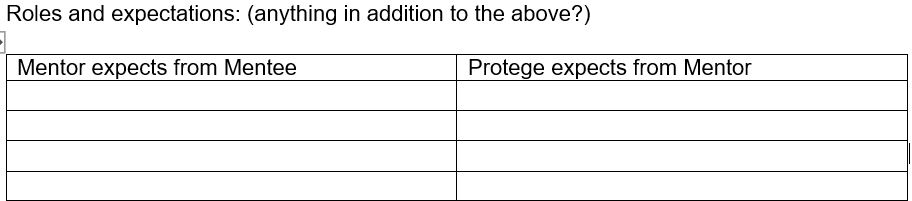
Considering the agreements discussed during the first section, are there any other expectations that each has of the other and which are useful to mention specifically? For example, the mentor may have the expectation that the mentee would devote time to read specific books or articles every week. Are those expectations realistic for the mentee? If he or she has other obligations which may make it difficult to meet that expectation, it is best to discuss them early on to avoid a misalignment later on in the mentoring relationship.

The full template can be downloaded below – it is a *.pdf file and it can be imported into MSWord for edits.

This file can be very useful to ensure that mentors and mentees are aligned early on in their association which gives their mentoring relationship the best chance to be successful!