Office Safety Booklet


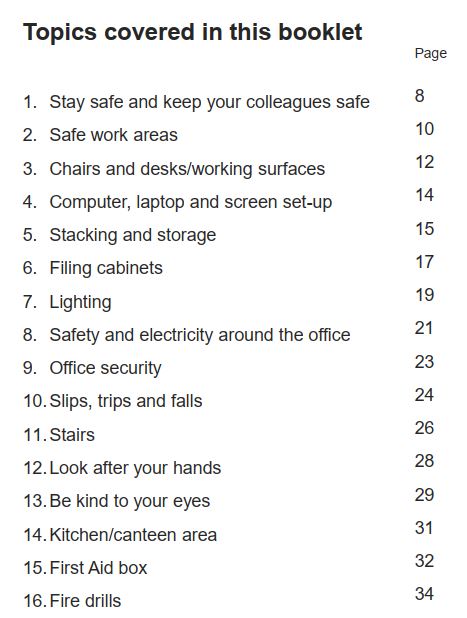
I often come across HR Managers in smaller to mid-sized companies who have a few areas of responsibility outside of HR like for example Office Safety and Facilities. They are often expected to maintain a high level of compliance with constantly changing laws and this can become an unnerving task for some. The free resource that I am sharing today is a general Office Safety booklet. It covers several topics relating to the office environment to create more awareness among employees of the do’s and don’ts around staying safe in the office environment.

You can either print it double-sided from the pdf document and make it available to employees as a booklet or you can send them the electronic document to review if they have just joined the company. It is quite easy to turn the booklet into an orientation and discussion session if you want to use it in that way.

This booklet is not based on any certified course so it is not a replacement for anyone who needs to undergo a formal exam to be certified in some aspect of safety. It simply helps you, as the HR Manager who has to cover Office Safety, to communicate some basic safety aspects to employees and other visitors to your office who may be working there for a period of time.

This booklet could also form the basis for an annual office safety check. Depending on expectations from management or compliance requirements you may need to perform an office safety check once per year. Using this booklet you can easily create a list of items to check based on the various categories of topics covered. For example, you can check how many times an accident or incident happened or almost happened per year based on history. Or you can check how people are working or storing items in the working area – are you seeing tripping or falling hazards?

Let me know if you are getting stuck with the creation of a safety checklist from the booklet!

If your company has an office environment next to a manufacturing or production facility this booklet would not cover several topics that a facility like that would require. There are many more rules around production or manufacturing environments, which are not necessarily covered in this booklet. Examples include how to handle dangerous materials and wearing safety equipment for certain activities. I recommend that you contact an expert in safety for your industry to help you create the right training and awareness materials for an industrial application.

I believe this booklet offers a good start in getting safety principles communicated to office employees and I also recommend that you look for more ways to strengthen your office safety program.

Other considerations:

  • Make sure you can tell employees where to assemble outside during a fire drill and how they would recognize the alarm to trigger an evacuation. Also, make sure they know which routes to follow for an evacuation.
  • Ensure you have a First Aid box that is well-stocked to take care of small incidents and cuts. Check it on a regular basis to make sure you are not running out of anything and also that nothing in there is over the use-by date.
  • Is there someone in your office building where your office is located who offers safety assistance – for example, if an employee had a heart attack or a bad fall? If there is not, should someone from your office get that training?
  • Apart from reading a booklet on safety, how can you make sure that employees think safety first in every activity they consider? This would be even more important if your company has safety or employee well-being as a value or a priority.

Small and mid-sized companies often do not have large budgets for creating office safety awareness and it is my hope that this free resource helps you cover ground that would otherwise have been a tough additional action on your HR Manager to-do-list!

Creating an Annual Communication Plan


comm plan graphic

Unless you are in a senior role in the communications group or department you probably never had to make an annual communication plan before. Recently I  was asked to help two people (one from a mid-sized and the other from a small company) who never had to make an annual communication plan before but were expected to create one now. Perhaps you are also tasked with making one? Or maybe you are asked to comment on one?

The basic idea behind an annual communication plan is to ensure that someone is planning to address targeted communications activities to various groups of people across all the available platforms that are used by the group or organization. The plan should typically include specific mention of dates, details of the intended contents of messages or specific focus areas, and be specific about who is responsible for each of the actions. That way everyone involved in executing activities from the communication plan is aware of his or her role and when deliverables would be due.

Planning to communicate is not the hard part of the assignment as most people are quite creative during brainstorming sessions related to what we can do and how to do it. The hard part is to write it all down so that we all know what will actually happen after we leave the meeting or brainstorming session.  And the next hard part is to apply self-discipline to execute according to the plan and update and review the plan on a regular basis.

The downloadable template above shows various aspects to consider when you look ahead to a year of planned communications. Of course, we know that plans are subject to changes happening around us on the project or changes in the company or in client needs. This means the plan is not static and you should review the plan on a regular basis to add or change items as needed. Remember to share updates you made with other team members who have activities assigned to them.

comms plan first column

The first column in the template contains a few communication channels to consider as you look at the messages you want to share and the intended target groups that your messages should reach. Ensure that you are using the right communication channels that you know to be in broad use by your intended target group of readers. And each of the headings could have multiple options for example meetings could be global meetings, regional meetings and local meetings where you would like the same message or a different version of the main message to be shared.

coms plan headers left side

The columns across the top of the template are mainly there to document who is doing what by when and when you are ready to publish and have published or delivered the message. This helps you measure progress on planned activities and shows where you may need to apply special focus to avoid delays.

comms plan measures.JPG

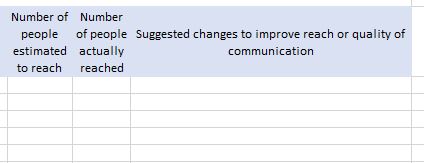
The published date is important, not only to ensure that your intended actions were completed but also to measure the success of your communication activities after the activity has been completed. 

In this simple template, the only measure shown is based on the number of people reached. There are many more ways to measure the outcomes and success of your communication actions including:

  • How many people took a further action after reading or watching (if video) or listening to (if podcast) your message (i.e. liked it, clicked on the button for “more information etc),
  • How many people used it as a reference or highlighted it by linking to it, sharing it or tagging it,
  • How many people visited your website right after you have published or shared a new message?

Add additional columns to your plan (as needed) in order to capture any other important measures that you wish to track per message, date and communication channel.

General tips
  1. Plan to share the same message in many different ways to optimize the number of times and ways that your intended audiences receive the message during a relatively short timespan.
  2. Not every communication message can be forecasted and planned over a 12-month period but without at least a guideline of topics that you would like to share over a 12-month period, the chances of missing opportunities to impact your intended audiences are bigger. Remember, you can always update and make changes when unplanned events occur while you progress through your plan.
  3. Experiment with a mix of ways to communicate – create messages to be shared face-to-face with credible speakers and follow up with something online and perhaps also a film on your website.
  4. Do use metrics to track results against your goals. It is the best way to know what works and what needs to be improved. Having proven successes also adds credibility to your communication plan and activities.

When tasked with creating an Annual Communication Plan, you may never need to become an expert at creating this kind of plan, yet it is still in your best interests to capture your thoughts about planned communication activities, responsibilities, deadlines, and metrics in a concise way. This template is only one way to achieve this. Once you have created the plan in a structured way people can review it, comment on it and manage to it and it ensures alignment within the team as you make progress with your communication objectives.

Choosing between opposites


man on beam final

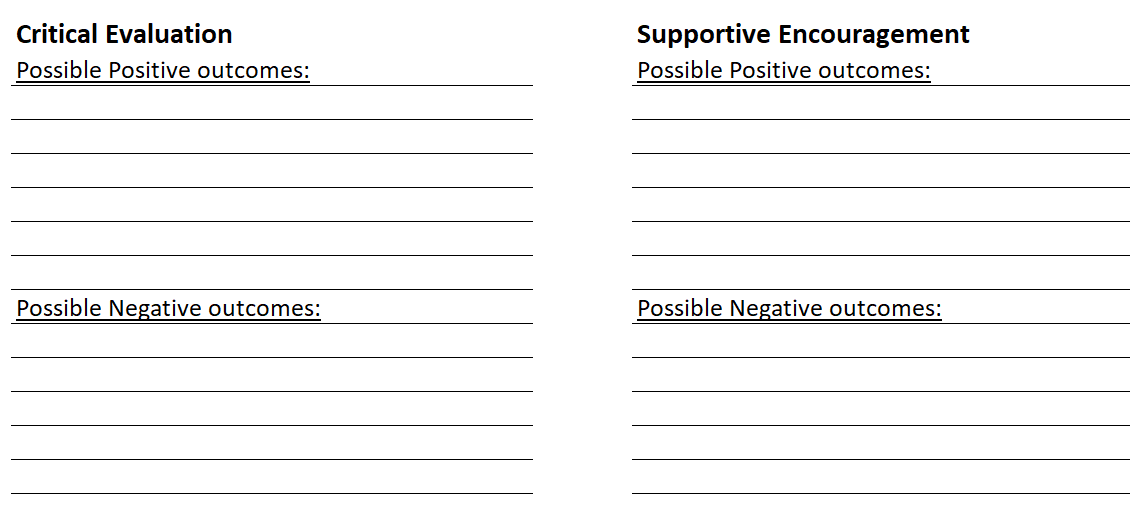
In many diagnostic tools for leaders and teams there is a scale which indicates how far the leader or the team is on a ladder between two opposite behaviors or style preferences. This could be for example critical evaluation on the one end of the scale and compassionate encouragement on the other side of the scale. (see example below).

These kinds of results are often used to coach and develop leaders and teams towards a desired behavior or culture.  In many cases the distinction between the “right” behavior and the “wrong” behavior is more linked to the situation at hand, associated risks and/or the person you have in front of you than a simplistic view of correct behavior. For example it may be less desirable behavior to be overly critical in an evaluation of someone who is new to the role and the company or team.  In another instance where the risks are high and the people on the team very experienced it may be more appropriate to perform a critical evaluation in the event of a major failure to achieve desired outcomes than to offer supportive encouragement.

blog scale graphic

This leads to the concept of managing or working with both of the ends of a linear scale. Choosing both sides in terms of developing leaders and teams can help them to have a bigger capacity to choose the right response depending on the situation.  The key is to develop awareness in them. Encourage leaders and teams to embrace more than one behavior or style to respond to specific situations or a tasks.

If we go back to the example above. You may be coaching someone or guiding a class of developing leaders through an exercise and this approach may be useful. Ask them to first of all identify the extreme ends of a scale of possibilities. Then identify for both extremes – the possible positive outcomes from that approach and also the possible negative outcomes.

blog polarity awareness

In a class situation you can also assign it as an exercise between two or more people to brainstorm together.

Once the exercise is complete you can lead a discussion with examples from the class or the leader you are coaching. When may it be appropriate to use one or the other behavior for the best outcome?  You can also choose to ask groups that had completed the exercise to prepare a demonstration (role-playing) to show the appropriate way to respond to a situation based on an example they discussed in the group. Or you may choose to provide some case-studies where the leader or class have to identify which may be the best approaches. These practical exercises will further help your participants understand the choices that they have as leaders when facing different situations and how to at least evaluate the best path forward before they go into action.

As a followup action you can ask participants or your coachee to capture examples they come across in the next few weeks/months where they had to make a choice between two opposite approaches and used the exercise above to identify the potential positive and negative outcomes. When using this approach one will will not necessarily avoid mistake or guarantee the most effective approach. The process of pausing and considering options will make the leader or team more effective over time and will improve decision-making.

Some examples you could consider for the exercise above:
  • Working independently vs working in groups/teams
  • People focused vs Task focused
  • Having a structured (fixed) approach vs a creative/open approach
  • Formal vs Informal approach to others
  • Monitoring others closely vs holding them accountable for outcomes created

This approach does not invalidate the tests which offer leaders and teams valuable insights into their own typical approaches and style preferences. This is merely another way to approach the outcomes from those tests to help develop more adaptable leaders and teams, which is highly needed in the current environment where change has become a constant and successfully working across borders, cultures and generations have become essential.

Checklists for Stretch Assignments


Stretch assignments are useful for learning and personal growth and development, because they purposefully contain elements that are challenging in areas where the assignee needs to develop. Designed correctly, a stretch assignment confronts one with the necessity  to get out of your comfort zone in order to succeed.

The starting point for designing such an assignment can be multiple data sources:

  • the person’s own development needs compared to established leadership competencies,
  • key proven areas of mastery that a company requires from their leaders to advance to the next level,
  • a mindset or  mindset shift that is required to move the company and its leaders into a new way of operating; or
  • to build competency in specific important areas that are or will be important to the future of the company.

A stretch is not defined in a general way, but rather it is very specific to a person. While a stretch could mean that one requirement is for the person (plus family, if appropriate) to move to an international location, it inevitably would also include other job-related challenges. Examples include supervising more people, having financial performance targets (for someone who has only had functional roles in the past) or having more complexity such as multiple geographical areas to manage. The key balance to maintain when designing stretch assignments is to ensure that the assignee is put under a certain amount of pressure to learn and grow, but not so much pressure that he or she fails.

Mitigating failure risks

There are a few things you can implement to help monitor how things are going with each assignee and to provide a “safety net” for an assignee to get support from.

  1. Assign subject-matter experts as coaches – depending on the scope of the assignment.
  2. Assign a leadership development coach to help the assignee reflect on experiences, frame up challenges and cognitively choose best solutions and explore new ways of operating to be more successful in the assigned areas of responsibility.
  3. Set up internal-company networking events for the assignees to meet, have opportunities to mingle and share experiences and also include a pre-determined learning event tied to overall leadership development objectives within the company.
  4. Set up a structure of communication moments with the “home” organization supervisor and colleagues – this is especially important if you plan to return the assignee to the same organization at the end of the assignment. Maintaining ties would greatly improve a successful return and reintegration after an assignment. Communication moments like these can also greatly help colleagues NOT on assignment to learn from the experiences and best-in-class solutions their colleague on assignment is mastering.

New and challenging assignments often cause assignees to experience some stress. Supporting assignees to successfully navigate through the new challenges means you should pay attention to a change in behavior or performance which could indicate that he or she is stuck on the learning curve. Signs that things are going wrong are important to notice early-on to maximize chances of turning things around and avoiding an assignment disappointment and/or incurring an assignee retention risk. Pre-departure training should be provided to both assignees and their coaches to understand and recognize signs that things may not be going well and to understand ways to become unstuck in every situation.

Some warning signals:

stretch-assignments-signs-of-failure

Expectations for goal achievement by assignees must be specifically captured in a plan and communicated to an assignee along with available rewards for over-achievement of goals. The specific strategic importance of the assignment should also be highlighted as well as the developmental needs to be addressed during the assignment.

Tips for stretch-assignment coordinators:

  1. Ensure that there is a structure that enables assignees to succeed and always follow-through with the check-in points and feedback activities to ensure all is well.
  2. Ensure that all those involved in assignments are clear on the role of management, role and responsibilities of supporting coaches, the role and responsibilities of assignees and the role and responsibilities of assignment supervisors and “home office” supervisors.
  3. Adequately prepare assignees for their assignments: cultural awareness training (for international assignments), language skills (where needed) and if accompanied by family members – consider a session to discuss the practicalities of moving to a new location with those family members present.
  4. Ensure that the assignees get interim feedback on how their assignments are going -at least 3 times per year, but more often if this can be managed. This provides opportunities to refocus and apply new approaches as needed to ensure the assignment is successful.
  5. Provide assignees and stakeholders in assignments ample notification about the end date of an assignment. This assures minimum surprises and helps everyone to plan actions leading to a well-organized return upon assignment completion.

When assignments are successful in achieving or exceeding on all the objectives, assignees should return from their experiences with increased confidence, leadership skills, and maturity. The personal growth and development they experienced should enhance their ability to make better decisions and build stronger interpersonal relationships with those they lead and follow. Being mindful of how to setup and manage stretch assignments can make all of that a reality.

Structured Knowledge Sharing


people-final

Very few companies are planning ahead when it comes to knowledgeable people leaving the company and retiring. The knowledge that is lost to the company when Subject Matter Experts (SMEs) leave can have direct impacts to the top and bottom-line and yet, there appears to be room for improvement in this process.

The need for implementing a structured process for knowledge transfer or sharing can naturally come from any of the following process and review discussions involving HR representatives and Managers:

  • Succession Planning
  • Workforce planning
  • Recognition and Reward reviews
  • Training needs assessment
  • Organizational capability discussions (now and future)

The question is: how are you ensuring that those with recognized expertise in a specific area contribute to the learning of others?

In many cases such a recognized SME needs to be assigned to mentor a more junior employee delivering promising results early in his/her career with the company. However, the time commitment associated with mentoring one to three people individually plus ensuring that the interactions meet content coverage expectations can soon become a concern.  So how do you optimize the knowledge transfer or sharing process, while not taking up too much of the SMEs time doing so?

The solution is to structure the knowledge transfer or knowledge sharing process and to include multiple participants. Ideally participants with an SME should range between 3 and a maximum of 8 people. Structuring sessions where those present interact improves learning as it facilitates discussions leading to deeper understanding and the ability to get into more detail on some topics.

knowledge-transfer-graphic

Preparing the managers

It is helpful to ensure managers (of those attending knowledge-transfer sessions) are prepared and understand the process. When they know the topics that would be covered, they can plan post-session assignments for employees to benefit from the new knowledge and help them retain what they have learned. New knowledge is much easier remembered when it can be applied on-the-job soon after the learning session. This greatly improves the amount of newly acquired knowledge integrated in decision-making and execution of daily work activities at the company.

Measuring learning

  • Adding a pre- and post- survey with questions related to the topic can help you measure the increase in employee knowledge from sessions.
  • You can also use a 360 feedback survey and get feedback from those working with, for and managing the employees before they start attending sessions. It would give you a snapshot of their current strengths and improvement points. Structure the 360 feedback survey to include competencies in the areas that will be covered by the series of sessions to come.

Preparing the Subject Matter Expert

Structuring the discussions that will take place between an SME and assigned participants can be a daunting task for an SME. They often do not realize how much they know about various topics.

The first task would be to unpack the area of knowledge the person has – look at processes, clients, products, technology, developments outside your company, projects that the SMEs are particularly proud of. You can also survey the intended participants to find out what they would like to learn more about. That is the first task – focusing on the highest priority topics over a 6 months trajectory of sessions. As a starting point that would give you a good start and the opportunity to do a process check 6-months later to see what can be better.

Once you have the topics settled for each session, the SME would need some helpful structure to disseminate his or her knowledge in a helpful way as opposed to telling several war stories from the past which leaves session participants confused.

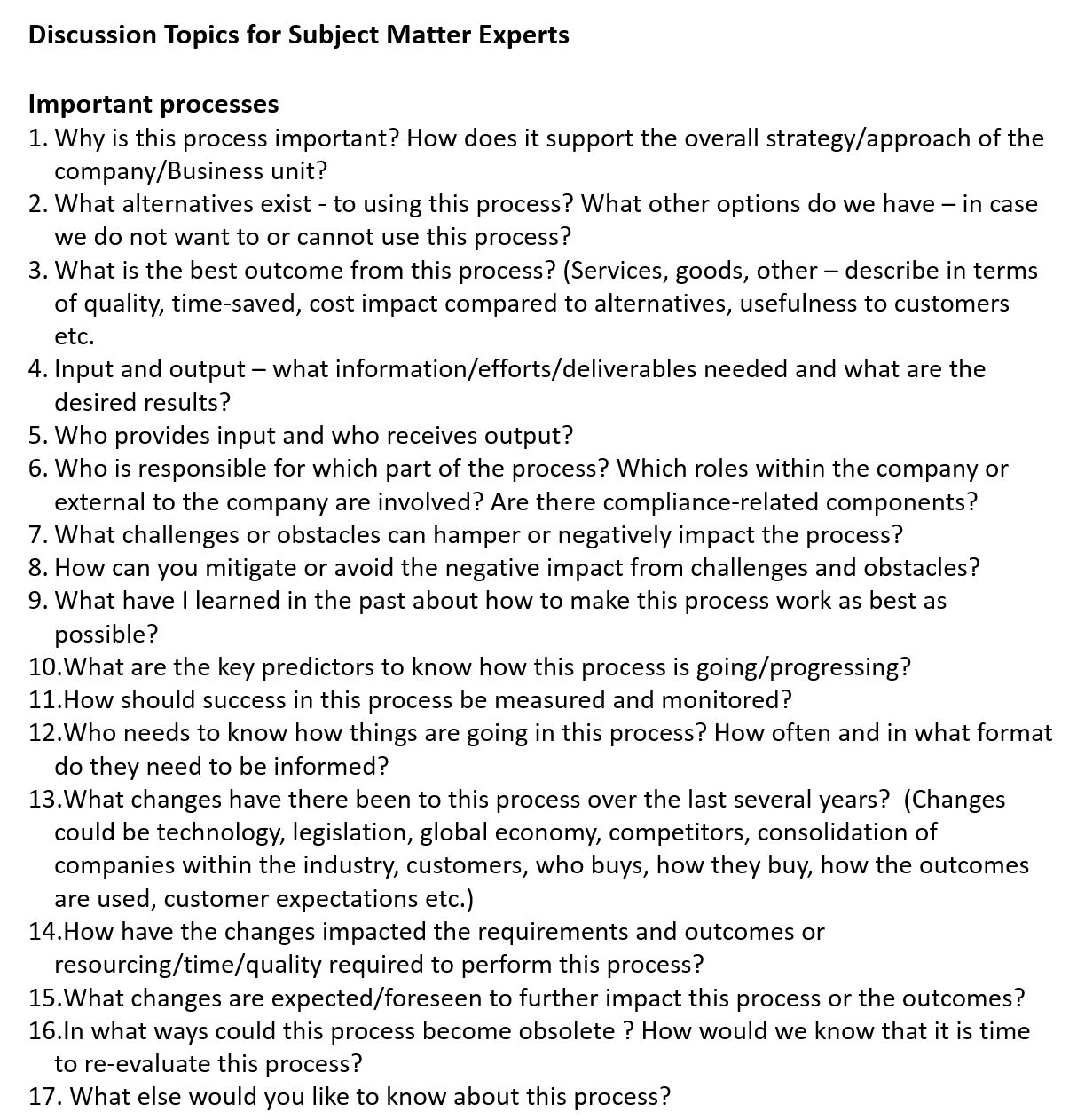
The questions below can be used by the SME to prepare for each session and it could be helpful for him or her to even present the information to the group in this structured way.

discussion-topics-for-smes

Capturing knowledge in a database would be one approach to knowledge sharing, but helping adults learn and know how to apply new knowledge requires that you build in room for questions and discussions in the process. This can be accomplished using face-to-face meetings, video conferencing, and webinars.

The best way to ensure that knowledge is retained and expanding within the company is to apply discipline and structure to knowledge sharing and transfer. This is especially important to do when you consider those who plan to retire in the next two to three years. Involving recognized experts (SMEs) within your company to share their knowledge with others is important for the sustainability of your competitive advantage in the market place. Its is about the things you know about your marketplace, the things you know how to do better and faster than your competition etc. Using the process and approach shared above will help you plan ahead and improve organizational capability over time.

Career Planning Workshop Materials


roads2

People of all career-stages have an interest in growing further in their careers. Not only those below 40 or in fast-track leadership programs care about this. It often happens though that careers develop in a passive way meaning that a person lands in a role that he or she never aspired to. Apparently many people never take the time to consider, analyze or dream about the options and pathways available to them as career options. And they do not use those insights along with their career goals to make clear choices about next steps.

The materials I am sharing today can help you, put together a starter workshop designed to give participants the opportunity to reflect on conscious options to consider or analyze in terms of career planning. I am sharing multiple exercises and it would be up to you to decide what to include given the time you have available for the workshop.

From an attendee perspective this workshop could help participants from any age  (over 14) to get some clarity. Those who are already in steady careers may find it helpful to perhaps fine-tune their own roles in areas where they are not yet fully contributing and adding value according to their own interests and preferences.

Workshop outline:

career-workshop-1
career-workshop-2

The downloadable resource above contains a series of slides that could help you take workshop participants to some basic questions and answers about career development.

Participant worksheets

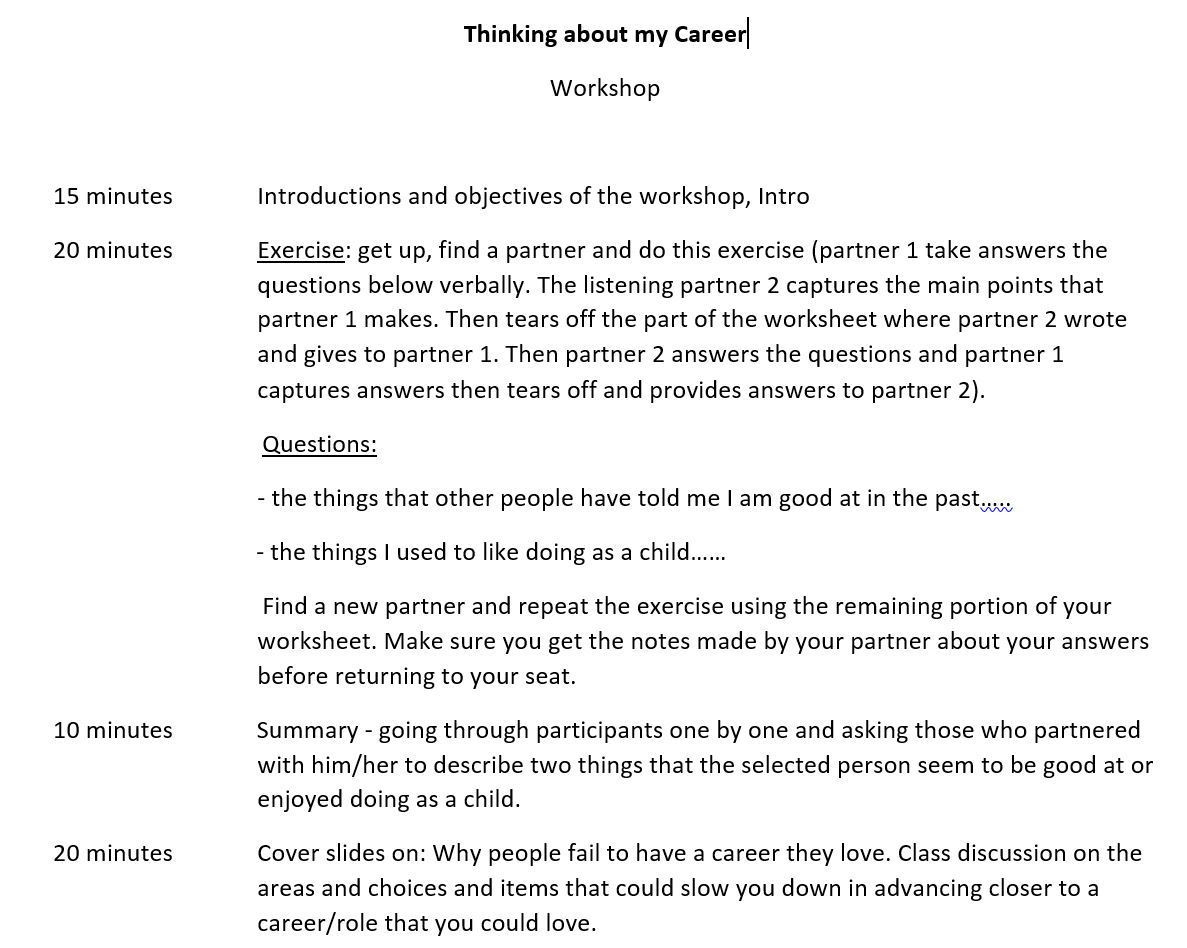
The next downloadable resource contains a workshop outline (segments, timing) and also exercises to help in initial career planning or refocusing workshop.

This workshop works well in non-profit settings, school or open university settings and can also be used in companies where career planning is initiated as a focus area to help employees develop further skills and set development goals.

Team Exercise or Ice Breaker – This Picture Shows…


pix-final

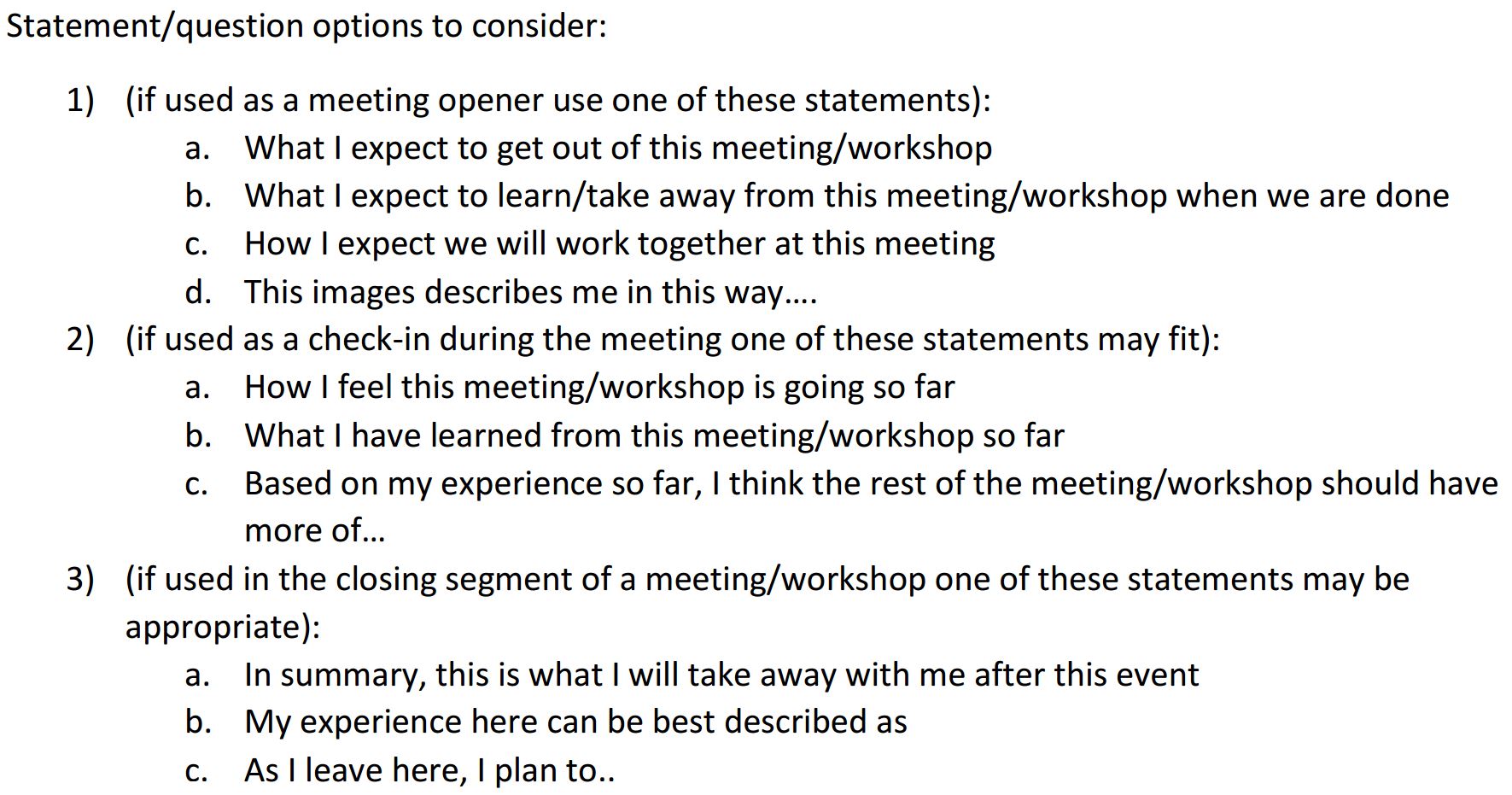
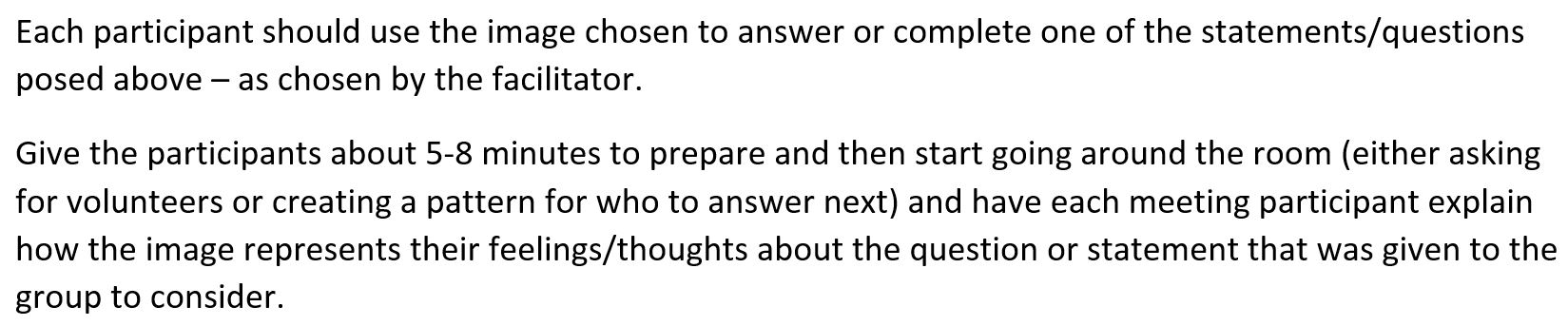
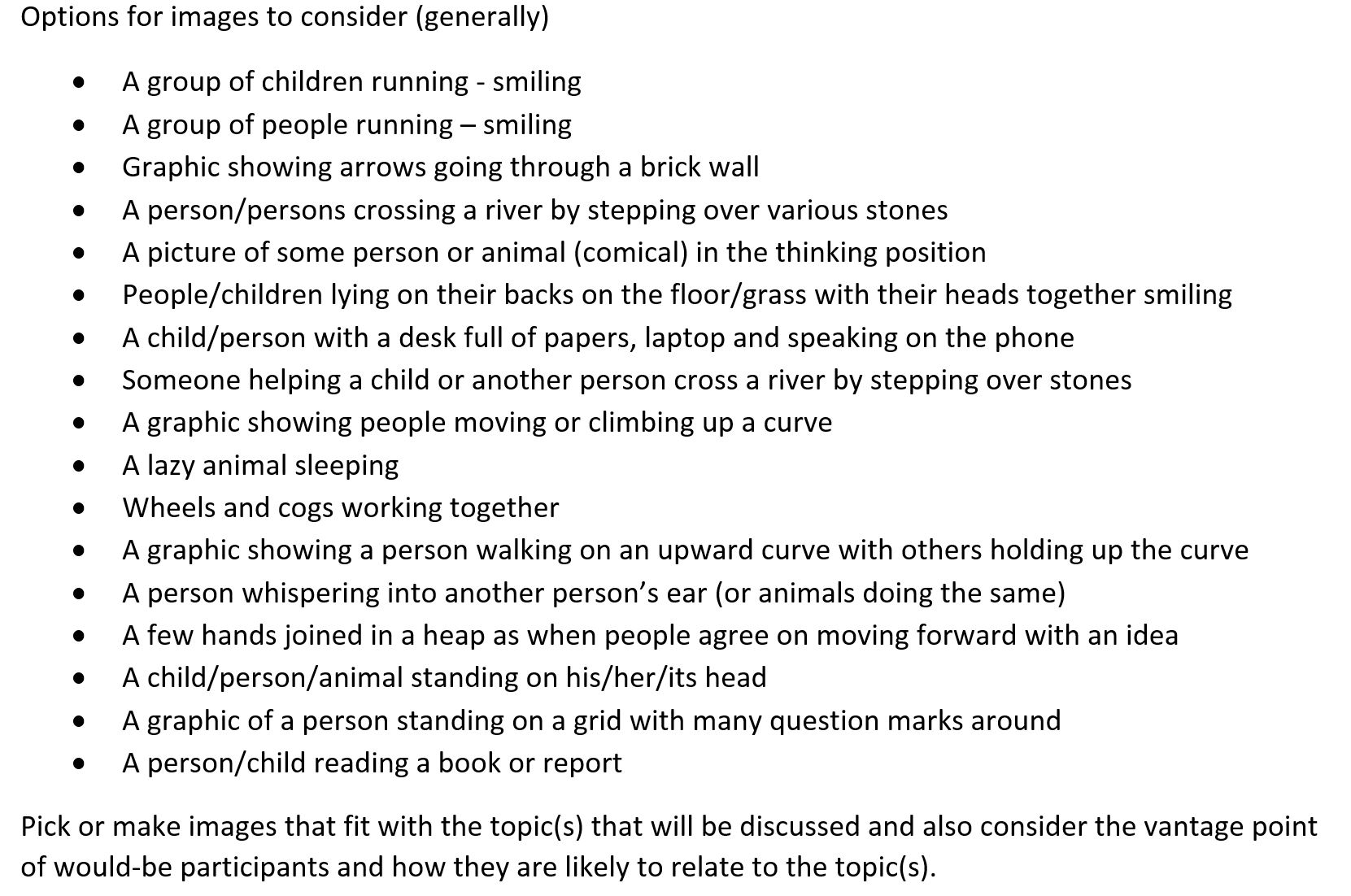
This exercise is very popular with those who prefer working with images and pictures to express and represent their thoughts and feelings. Using images often opens up new ways of communicating, which could bring a creative element to your event and everyone typically enjoys participating in this exercise.

The set-up is simple and the exercise does not take up a lot of time. It is also very versatile in the sense that you can use it in quite a number of different ways to get feedback and input from those you are working with in your event (training, meeting, workshop etc.)  I am sharing some specific options for you as facilitator to consider, but once you start getting creative with it, I am sure you will find many more applications for this exercise.

The information you need for this group or team activity/exercise is shown below:

this-picture-shows-1
this-picture-shows-2
this-picture-shows-3
this-picture-shows-4
this-picture-shows-5
this-picture-shows-6

Tip:

When it comes to selecting pictures get creative or brainstorm with a creative coworker or friend to create or find pictures that may “speak” to your participants given the context of the event or session(s) where this exercise is to be used. If you often facilitate sessions you will probably build up a good set of images to use for an exercise such as this one. More  “out of the box” (unusual) images could potentially lead to richer feedback from individuals to start group/team discussions. This could lead to vastly increased understanding of issues by participants.

Change Management – Getting senior management onboard


change-mgt-overview-blog-pic

Before any organizational change is launched there has to be meetings with executives and senior leaders to ensure alignment around the reason(s) and main principles of the change initiative. Meeting objectives would also typically include getting their support for executing change activities and to help them understand expectations of them as executives and senior leaders during the change period and beyond.

The downloadable slide deck (above) can be used as a basis for creating your messages to senior leaders and executives. The slides helps to explain how change will likely impact the organization and the people plus explaining how leaders can help by being role models and also by actively addressing resistance and other signs of low engagement in those around them.

Use this resource as optional examples to help communicate the specific messages that makes sense for the change management initiative that you may be leading and the meeting participants/audience that you will be facing.

Here are the steps I would suggest you follow:

  1. Be clear on the reasons that your change initiative need to be implemented and how the changes will improve on status quo. (Business case or burning platform)
  2. Did you get executive buy-in from one or more sponsors before your presentation? (Highly recommended – in fact, do not proceed until you have it!)
  3. Consider the presentation you will be doing – who will be there? What do they know and what do you need them to know, understand and do once they leave the presentation?
  4. What impact will the planned changes likely have on the employees at your company and how do you think your targeted audience can help and should act/behave given the change process and desired outcomes?
  5. Review the slides in the resource I am sharing and determine if any of them could help you and support the messages that you would like to communicate to the audience that you will be facing.

Of course these slides are not going to substitute the preparation work you need to do before starting a change initiative, but they may be helpful to use as background or to explain some of the specific change management aspects that may be of particular importance to your audience.

How to Motivate employees and Retain them


What motivates your employees?

Every employee has different reasons for showing up at work and there are different ways to motivate each of the people working with you. Since one size does not fit all, it is best to stop guessing and to find out for sure what it is that makes those reporting to you love their jobs.

Knowing what motivates your direct reports is a great way to ensure you retain your direct reports. Of course having a good professional relationship with each of your direct reports goes a long way to ensuring that issues which may demotivate them are brought up early and resolved in open dialogue and discussion.

The exercise below can be used by you to first establish what you believe would be motivational before you ask your direct reports to complete the exercise below. Understanding that, as their supervisor, you are most likely not going to get it right without their input may further instill the practice in you to always check your assumptions before you engage when it comes to understanding what would motivate others.

The list below contain outcomes that could be motivational to your direct reports in their jobs. This means that these outcomes would keep them interested in continuing to work in this role, for you and in this company.

Instructions:

Rank the list below in terms of 1 to 14 where 1 means “motivates me the most” to 14 which means “this does not motivate me much.” The ranking is not to say that this is how it is RIGHT NOW, but in the perfect environment, what would be the most vs least motivational to the person doing the ranking.

A. Rank these from 1 to 14 – what motivates me most at the top

  • Receiving market-aligned compensation for the job I am doing
  • Recognition for my efforts by my supervisor
  • My work is interesting and challenges me in a positive way
  • The company/job comes with excellent benefits (separate from my annual salary)
  • Pleasant working environment (ambiance, set-up)
  • My supervisor is fair in making decisions and communicating them i.e. promotion, recognition, expectations.
  • The knowledge of my colleagues which is shared with me
  • I have all the information I need to have in order to understand what my priorities are and why I am performing the tasks that I am assigned
  • I understand exactly what my supervisor expects from me
  • I have a great feeling of accomplishment in this role/job
  • This role/job provides me with a lot of learning options, which can lead to promotions in the future
  • I have a chance to contribute to discussions and decisions that impact me
  • The people I work with are great people who make me feel included and valued
  • My opinion is often asked for and is valued by my supervisor

B. Level of current motivation

The next step would be to ask the same employees to rate how much they are currently motivated by the same items from above.  Comparing these answers with the answers in A. can help you identify possible ways in which you can improve the motivation of each employee reporting to you. For example, if someone had a high ranking motivator in A. and that same item gets a low score in B. that means you should look for ways to impact that area to motivate and retain that particular employee.

motivation-ranking

Results – what to do next?

Once you have captured the feedback from those who report to you, have individual discussions with each one of them to determine how you can better impact the areas that they scored as the highest importance in terms of motivation and where potentially their scores for current experience were the lowest.

  • How can I, as your supervisor, help you to have a better experience of this item (high ranking items from A. the list above – especially if that same item has a low score in B.)? _____________________________________________________
  • Are there ways in which you feel that I can remove obstacles or improve your experience in this regard? (see highest ranking items with low scores in exercise B.) ______________________
  • Is there anything that you and I need to discuss or resolve to remove any bad feelings or negativity from the past to move forward on a positive note? _________________________
  • Is there anything that I, as your supervisor, can do better to improve your enjoyment of your job/role at the company?

Be sure to mention (as appropriate – be truthful and honest):

  • I want you to know that I value your contribution and you are an important team member to this project/department.
  • I believe we can achieve great accomplishments in this department/team if we work together and communicate openly about what needs to be done and how to support each other in order to have a better overall outcome for the team/department.
  • I hope you will take the time to let me know of any obstacle that you see which may hinder us in achieving our goals. And I hope you will see any feedback from me in the same light – I want you as an individual to enjoy what you are doing (realizing that not all of our jobs are highly enjoyable – some parts are typically repetitive and maybe mainly administrative) and I want your contribution to the team/department to be clear to you in terms of expectations and how things are going.
  • Is there anything else you would like to bring my attention or which you think we should discuss before we end our meeting?

After the meeting you may want to consider reviewing your notes. Some items may be easy to action, simply by you emailing or calling someone in order to set something up. Other items may not be so straight-forward. For example, someone with a performance that does not meet expectations may ask for an increase. Set up a meeting with your HR Business Partner or representative to talk through the items and set priorities. Always make sure you are able to provide direct individual feedback to each employee on the items you discussed in your individual meetings with them.

Employees are motivated by different aspects of their roles/jobs at the company and there are many ways in which you are able to influence these aspects. The professional relationship you have with your direct employees also greatly impacts whether someone chooses to stay or leave the company/their role.

In the end some employees will leave and you will need to fill those roles by promoting existing employees or hiring new employees. Ultimately, the sign of a good leader is the number of great leaders he or she creates. When they feel the need to leave to move up, applaud them, keep contact with them and congratulate yourself when you see them succeed regardless of where they end up as a result of your great coaching and support.
Tips for new Facilitators


picture2

Being asked to facilitate a group of people to accomplish structured outcomes to a meeting or all-day session can be daunting if it is your first time.. This is especially true when there are strong opposing views within the group. I used to facilitate many sessions for a large global company and worked with a few colleagues who did similar work in other regions. The resource I am sharing contains tips received from my colleagues when I got started as a facilitator years ago. In turn, I have made it available to other new facilitators that I have encountered over the years. Now you can also benefit from this. (see inserts below)
Some assumptions made for these tips to be relevant:

  • As facilitator your workshop/session is part of a process. The session includes exercises designed to produce outcomes that would benefit the team. There is at least one (could be more) manager who have a vested interest in a successful outcome and who will also attend your session. These same managers are aware of the team and session process and have provided input to you in terms of their vision and needs from the process. Note: there may be more than one manager if you are facilitating a group process involving members of a client organization too and which may also be attended by the manager from the client organization.
  • Your role is to facilitate the agreed process and to re-agree next steps should the process somehow not be able to continue as planned or new information/changes trigger you to recognize that a change in timing/agenda should be considered.

TIPS for Facilitators:

tips-facilitator-1
tips-facilitator-2
tips-facilitator-3

How to stimulate participation by session participants?

  • Ask open-ended questions
  • Do a poll – where by raising hands people have to vote for one idea vs one or more other ideas
  • Count to 10 or more before you speak, let them bridge the silence with participation
  • When there is a question to you or a comment, defer it to the group – how does the group feel about this topic/question/statement?
  • Ask direct questions to specific participants whom you know (be sure) have experience in an area or on specific subject matters.
  • Summarize the points raised and ask the group to respond – agree or disagree? Correct or ..?
  • Divide them into pairs for a short discussion on a topic that pertains to what you just covered. (Gets them active after a period of perhaps monologue or exclusive dialogue.)
  • When the group seems lethargic consider an unscheduled short break
  • Do an impromptu energizing exercise (always have two or three of these in your back-pocket to employ when you see the need.
  • Expect some sluggishness in the period right after lunch for about an hour or so. Ensure your session design contains activities for this period – small groups etc.
  • Call it – sometimes a group is unresponsive, because everyone is thinking about an elephant in the room – some topic which should be discussed or settled which may not be on the agenda., but it is occupying the minds of everyone. If you know what it is, ask “Is ….. something we should discuss at this time?” if you do not know ask “Is there another issue that we should be covering at this time which may not be a scheduled topic?” [You would need to check in with the manager to ensure he wants to do it right away or later -schedule a specific date and time when he will deal with it. So call a short break if they tell you that something needs to be settled. To determine the”how” with the manager involved.)

These examples are not exhaustive, but they did help me out during those early years of facilitating sessions with groups and teams. I do trust they will do the same for you!

Cultural Differences Could Impact your Session

From a cultural perspective it is important to take note of cultural differences which may impact team and group dynamics during a facilitated session.

Some tips:

These examples could be tricky situations to navigate successfully, if you are not prepared to structure the process, the introduction and plan for the day in a way to ensure all participants see value in the time spent together. In some cases the answer may not be to have a facilitated session, but instead to have a series of meetings involving specific people from the participant groups. .

  • Some cultures expect the person in the front of the room to be an expert and if the facilitator asked questions of the group, his/her credibility may be at stake – in the mind of such a participant.
  • Valuing the goals that a sub-group brought to to the session, some cultures would expect that these goals may be more important than the goals set out for the session at the start.
  • Some cultures prefer to talk about practical examples during the session while others may prefer to talk about concepts. This could especially be apparent if a culture respects the resolution of disagreements privately instead of in a group context.
  • Physical activity or high-energy participant exercises may be seen as disrespectful or unsuitable behavior for senior level personnel in some cultures.
  • Asking questions or exploring concepts are not common across all cultures. Some participants from other cultures may find that approach alien and uncomfortable. They would expect the facilitator to simply give them the answers instead of asking the group to come up with the answer.

Use THIS LINK to read more about how to understand some cultural dimensions to consider as you plan to facilitate a meeting where there might be participants from multiple cultures.

Here is an example of how people from a Low Power Distance culture may differ from those coming from a High Power Distance culture in a facilitated or training sessions: