Preparing to facilitate a Team Session


201905

The success of team events or sessions can be more predictable when facilitators gather information from invited participants and stakeholders before planning the agenda, activities, and presentations.  Knowing more about the current issues and expectations can greatly enhance your chances of ensuring the team faces what they need to focus on and deal with that in a constructive way.

The source I am sharing, is a list of pre-session interview questions which could help you get a good foundation about the team: what is working, what could be better and how each of the interviewees sees the situations faced by the team.

Some important notes about pre-session interviews:

Starting right
  • If the team members do not know you (the facilitator) yet, be sure to introduce yourself to each interviewee and mention your role in the upcoming planned session. They may have additional questions about your background and experience in this area and why you are working on the planned session. Be prepared to summarize these points before you get into the interview.
  • Make sure you can explain to what degree the responses will be confidential. You would typically want to share a summary of responses with the session attendees to help set the scene on the day and perhaps use that to initiate a discussion or lead into an activity to address something that was mentioned by several participants during the interview. Will you be word-smithing the responses to protect the identity of interviewees? Or will you share the raw data? You need to be transparent about that.
  • Why are you asking? Be sure to explain how the answers and responses will be used to plan the session and help the team move forward and past any obstacles that may be holding them back.
  • Let them know upfront that their questions about the session will be answered during their time with you (the interview).
Planning your approach
  • Will you interview individuals or groups of individuals that work in a specific department or functional group? Think this through carefully with regards to the advantages and disadvantages of this choice before you make that decision.  I usually recommend that the number of session participants is no more than about 20 – 25 people and I prefer to know each individual’s responses before I finalize my planning for the session. This means I interview each person separately. But I can also imagine that the team/project culture and approach could make it useful to interview small sub-groups within the team.
  • In person or online? I prefer to do the interviews in person to allow me the opportunity to ask follow-up questions on the spot. Sitting with someone and talking through the questions gives you the opportunity to also watch their reactions or pauses after each question. This can indicate whether some topics may be sensitive to the interviewee and again you could choose to ask more questions to better understand the issues at hand.
  • The right number of questions. It is important that the interviews do not become exhausting. Accept that you will not be able to ask every single question that you may have for the planned participants before the session. Some questions are best worked out by the group at the session. Be very selective and critical – ask only questions which will help you prepare for the session. The interviews are not intended to replace the planned group/team session.

The questions in the (download available above) resource range from understanding expectations to identifying possible issues that the team needs to address. It includes some questions which may help with understanding possible issues that could pose an obstacle to team success.  Some of the questions are also specifically there to help team session participants envisage themselves being a positive contributor to the success of the session.

I do not suggest that all of the questions would be relevant to every session that you would plan, as the facilitator. Instead, I suggest that you use the ones that make the most sense for the session you are working on and feel free to add additional questions as needed in order to improve your understanding in the relevant areas that the session needs to cover.

Finally, it is important to realize that just the fact that you are asking questions and providing interviewees an opportunity to discuss their thoughts and impressions is in itself already a change management intervention. You are setting the scene for the session and helping to shape participation before the session. This could greatly enhance group dynamics and ensure the success of the planned session.

Reference checks


After interviews have taken place you will want to take a few more steps before you decide whether to make an offer to one of the job candidates you have for a vacancy. You may want to ask candidates to complete assessments or you may want to get the perspectives of their former colleagues before you make a decision.

Additional steps after initial interviews or between rounds of interviews could include:

  • Tests or assessments.
  • Practical exercises like a business case or even a presentation to be made to some senior leaders or experts at your company.
  • Reference checking with former colleagues, former direct reports or former supervisors of the candidate(s).

Checking References

The (download) template I am sharing below contains a few questions to help you understand whether one candidate may be preferred compared to another given their experiences and approaches.

Background checks are used in some countries but can be harder to obtain in countries or regions where data and privacy protection laws exist. In most cases, criminal background and/or financial history information can only be obtained if the prospective employer can show a direct link between the requirements of the role and the information it wishes to obtain. Reference checks are typically easier to conduct in most countries, but be mindful of the kinds of information that you would be reasonably able to obtain given local laws.

Be mindful to:

  • Ensure that you notify any impacted job candidates (i.e. in areas such as Europe) about the data you wish to obtain and how you would process this data to avoid the risk of non-compliance. Job candidates need to know this at the start of the process and they must (actively) agree with your proposal for collecting data before you are able to proceed.
  • Ensure that all data obtained during the recruitment process is archived or destroyed after the process has been completed for a specific vacancy. All HR personnel who deal with such data would need to understand that this also includes any data that have been saved to their individual computers during the process.
  • Make sure the data you wish to obtain is relevant to the hiring decisions you wish to make. And make sure that those who would speak with candidates or possible referees can explain the connection.

Assuming that you have taken all precautions to ensure you are not incurring any risks with your planned reference checking approach, use the questions you have selected (the download template above can help) when you contact the list of referees provided by the job candidate.

You can use the template in a few ways:

  • Set up a time to talk to each referee via phone or Skype and go through the questions, capturing his or her responses.
  • Send each referee a form and ask him/her to complete it and return it to you – typically via email. Be aware that this approach does not offer you much opportunity to ask further questions to clarify without creating a few extra emails to the original string.
  • Set up the questions as an online survey (for example using www.surveymonkey.com) and share the link with referees. Note that data interpretation may be an issue here – not knowing what a referee meant by a specific score or comment. This also means you would have to contact referees again to clarify feedback. One way to improve data interpretation is to build in comment fields to explain scores.

Finally, it is important to understand that a reference check is just one of the data points that could support decision-making related to hiring the best candidate for the vacancy.

Feedback may be incomplete for a number of reasons:

  1. The referee wishes to avoid any unpleasant situation with the former employee and wishes to be cautious in his/her responses.
  2. There may be laws in the country which specifies what referees can or should say and what they cannot comment on.
  3. The previous company may have clear policies about what can be shared by referees, which may be limited to job title and years of employment at the company.

Getting feedback from those who previously worked with a job candidate can still be valuable – understanding how the candidate’s knowledge or work methods would fit in with the job requirements or the company culture. For this reason, it can be good to get more perspectives. Just be aware of possible risks given the changing legal environment as you obtain feedback from referees.

Organize your message


speech

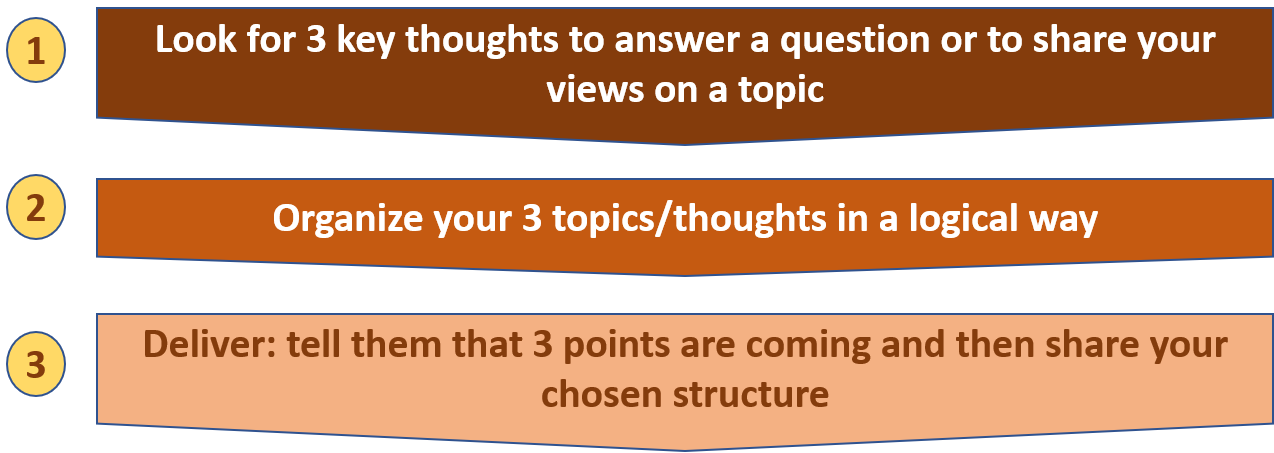
Many of us have heard about the power of three items or 3 key messages, but most people have not been shown how to use this in practice. While it is easy enough to make a list and restrict it to 3 items, picking 3 items that make sense from a logical perspective takes a little more thought. Our minds are highly responsive to patterns. Knowing that we will hear 3 key points and then having somebody deliver the 3 points in a logical fashion is something we are more likely to remember afterward. It comes across as more credible when we are able to recognize a pattern in the delivery of the key points.

Maybe you are coaching someone on how to deliver more impactful messages. Or perhaps you are preparing your own answers to questions in a group setting or you are planning a short speech on an important change initiative or project update? This resource can help you. It aids in formulating your thoughts in a logical way, which enables you to deliver a message that is easy for your audience to interpret and remember.

3 Step process to deliver powerful messages

model org message

The three key ideas you wish to communicate or the three top reasons why you suggest a certain course of action cannot be random or they may still fail to be memorable. The 3 key concepts should be structured in a way that would make sense to others so that they can easily be recalled after people hear them.

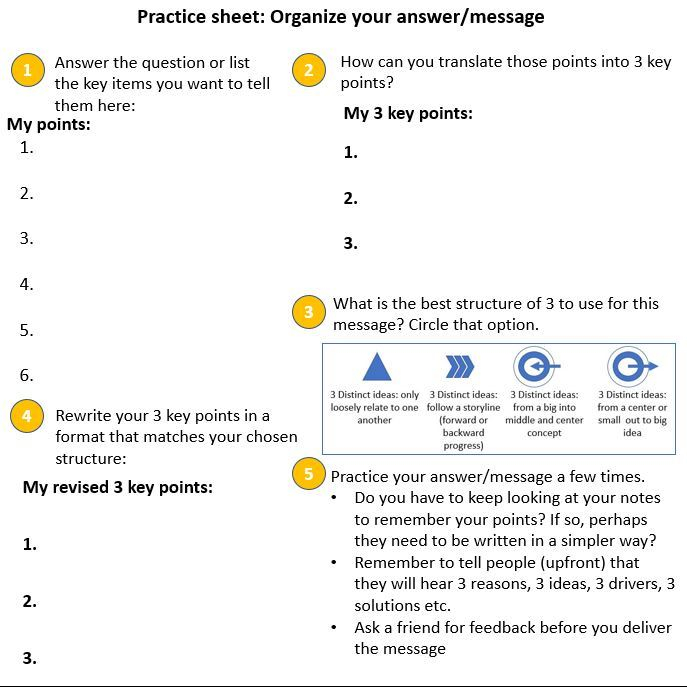
Grouping the 3 points in a logical way:

  • Three linked ideas like quality, time, money/costs; good, bad and ugly (see the specific example in the downloaded document )
  • Forward or backward motion – tell the story sequentially either from the present into the past in 3 steps or from the past into the future in 3 steps. For example: in the past, we used one process which worked, but since then many things changed to where we are today (with challenges and in need for things to change) and in the future, we will have additional challenges which simply requires us to make changes now. (You can fill in the details of your own message to explain the situation when you choose a structure that moves forward or backward in time).
  • Perspective – the 3 concepts move from a big idea to a small idea or from small ideas to big ideas/reasons. For example (out of) from this small team which will be impacted by the change to the bigger team and then to an even bigger group of people who may be impacted. (see the specific example in the downloaded pages)
org message structures

Use the practice sheet or template (included in the download file above) to learn this approach. It helps you to become more familiar with using this way of organizing your message or your answer to a group of people. Once you get used to how it works you will no longer need the template and you should be able to organize your thoughts while you are in the meeting or in transit to the meeting.

organize your message template

Some ideas of where to use this approach:

  • You are in a meeting and they are going around the table collecting everyone’s thoughts on a proposal (You take a moment to quickly organize your own response using this method.)
  • You have been asked to provide an update at a meeting, which starts in a few minutes. (Remembering this approach you are able to jot down your initial thoughts, choose a structure and then revise your points to fit your chosen structure of 3 points to make.)
  • You are attending a conference and have to introduce yourself or someone else (Using the structured way of choosing 3 key aspects to mention, your answer is memorable to the conference attendees.)
  • During lunch, some colleagues ask you why you support a particular proposal. (You easily recall the structured options and formulate a response consisting of 3 key thoughts to share after you have swallowed the food.)

Listening to long unstructured answers in meetings or trying to make sense out of facts presented in a complicated way in a meeting can be a confusing experience. Using a simple structure with only (no more and no less than) 3 key points, makes it much easier for you to avoid the same mistake. Instead, you can use this approach to deliver a message that they will easily understand and remember.

Let me know how this approach works for you or the person that you are coaching!

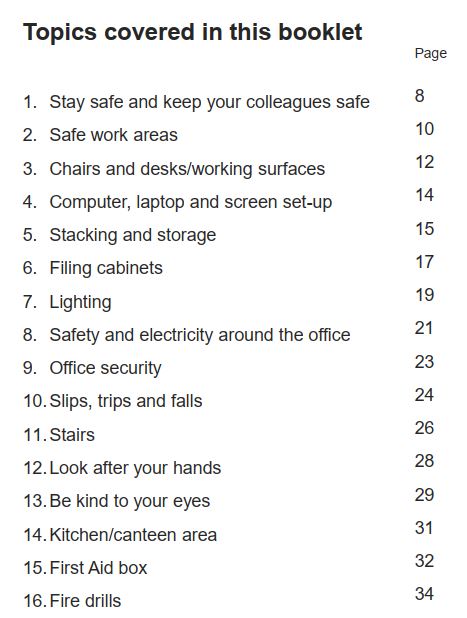
Office Safety Booklet


I often come across HR Managers in smaller to mid-sized companies who have a few areas of responsibility outside of HR like for example Office Safety and Facilities. They are often expected to maintain a high level of compliance with constantly changing laws and this can become an unnerving task for some. The free resource that I am sharing today is a general Office Safety booklet. It covers several topics relating to the office environment to create more awareness among employees of the do’s and don’ts around staying safe in the office environment.

You can either print it double-sided from the pdf document and make it available to employees as a booklet or you can send them the electronic document to review if they have just joined the company. It is quite easy to turn the booklet into an orientation and discussion session if you want to use it in that way.

This booklet is not based on any certified course so it is not a replacement for anyone who needs to undergo a formal exam to be certified in some aspect of safety. It simply helps you, as the HR Manager who has to cover Office Safety, to communicate some basic safety aspects to employees and other visitors to your office who may be working there for a period of time.

This booklet could also form the basis for an annual office safety check. Depending on expectations from management or compliance requirements you may need to perform an office safety check once per year. Using this booklet you can easily create a list of items to check based on the various categories of topics covered. For example, you can check how many times an accident or incident happened or almost happened per year based on history. Or you can check how people are working or storing items in the working area – are you seeing tripping or falling hazards?

Let me know if you are getting stuck with the creation of a safety checklist from the booklet!

If your company has an office environment next to a manufacturing or production facility this booklet would not cover several topics that a facility like that would require. There are many more rules around production or manufacturing environments, which are not necessarily covered in this booklet. Examples include how to handle dangerous materials and wearing safety equipment for certain activities. I recommend that you contact an expert in safety for your industry to help you create the right training and awareness materials for an industrial application.

I believe this booklet offers a good start in getting safety principles communicated to office employees and I also recommend that you look for more ways to strengthen your office safety program.

Other considerations:

  • Make sure you can tell employees where to assemble outside during a fire drill and how they would recognize the alarm to trigger an evacuation. Also, make sure they know which routes to follow for an evacuation.
  • Ensure you have a First Aid box that is well-stocked to take care of small incidents and cuts. Check it on a regular basis to make sure you are not running out of anything and also that nothing in there is over the use-by date.
  • Is there someone in your office building where your office is located who offers safety assistance – for example, if an employee had a heart attack or a bad fall? If there is not, should someone from your office get that training?
  • Apart from reading a booklet on safety, how can you make sure that employees think safety first in every activity they consider? This would be even more important if your company has safety or employee well-being as a value or a priority.

Small and mid-sized companies often do not have large budgets for creating office safety awareness and it is my hope that this free resource helps you cover ground that would otherwise have been a tough additional action on your HR Manager to-do-list!

Creating an Annual Communication Plan


comm plan graphic

Unless you are in a senior role in the communications group or department you probably never had to make an annual communication plan before. Recently I  was asked to help two people (one from a mid-sized and the other from a small company) who never had to make an annual communication plan before but were expected to create one now. Perhaps you are also tasked with making one? Or maybe you are asked to comment on one?

The basic idea behind an annual communication plan is to ensure that someone is planning to address targeted communications activities to various groups of people across all the available platforms that are used by the group or organization. The plan should typically include specific mention of dates, details of the intended contents of messages or specific focus areas, and be specific about who is responsible for each of the actions. That way everyone involved in executing activities from the communication plan is aware of his or her role and when deliverables would be due.

Planning to communicate is not the hard part of the assignment as most people are quite creative during brainstorming sessions related to what we can do and how to do it. The hard part is to write it all down so that we all know what will actually happen after we leave the meeting or brainstorming session.  And the next hard part is to apply self-discipline to execute according to the plan and update and review the plan on a regular basis.

The downloadable template above shows various aspects to consider when you look ahead to a year of planned communications. Of course, we know that plans are subject to changes happening around us on the project or changes in the company or in client needs. This means the plan is not static and you should review the plan on a regular basis to add or change items as needed. Remember to share updates you made with other team members who have activities assigned to them.

comms plan first column

The first column in the template contains a few communication channels to consider as you look at the messages you want to share and the intended target groups that your messages should reach. Ensure that you are using the right communication channels that you know to be in broad use by your intended target group of readers. And each of the headings could have multiple options for example meetings could be global meetings, regional meetings and local meetings where you would like the same message or a different version of the main message to be shared.

coms plan headers left side

The columns across the top of the template are mainly there to document who is doing what by when and when you are ready to publish and have published or delivered the message. This helps you measure progress on planned activities and shows where you may need to apply special focus to avoid delays.

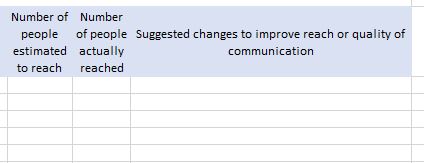
comms plan measures.JPG

The published date is important, not only to ensure that your intended actions were completed but also to measure the success of your communication activities after the activity has been completed. 

In this simple template, the only measure shown is based on the number of people reached. There are many more ways to measure the outcomes and success of your communication actions including:

  • How many people took a further action after reading or watching (if video) or listening to (if podcast) your message (i.e. liked it, clicked on the button for “more information etc),
  • How many people used it as a reference or highlighted it by linking to it, sharing it or tagging it,
  • How many people visited your website right after you have published or shared a new message?

Add additional columns to your plan (as needed) in order to capture any other important measures that you wish to track per message, date and communication channel.

General tips
  1. Plan to share the same message in many different ways to optimize the number of times and ways that your intended audiences receive the message during a relatively short timespan.
  2. Not every communication message can be forecasted and planned over a 12-month period but without at least a guideline of topics that you would like to share over a 12-month period, the chances of missing opportunities to impact your intended audiences are bigger. Remember, you can always update and make changes when unplanned events occur while you progress through your plan.
  3. Experiment with a mix of ways to communicate – create messages to be shared face-to-face with credible speakers and follow up with something online and perhaps also a film on your website.
  4. Do use metrics to track results against your goals. It is the best way to know what works and what needs to be improved. Having proven successes also adds credibility to your communication plan and activities.

When tasked with creating an Annual Communication Plan, you may never need to become an expert at creating this kind of plan, yet it is still in your best interests to capture your thoughts about planned communication activities, responsibilities, deadlines, and metrics in a concise way. This template is only one way to achieve this. Once you have created the plan in a structured way people can review it, comment on it and manage to it and it ensures alignment within the team as you make progress with your communication objectives.

Checklists for Stretch Assignments


Stretch assignments are useful for learning and personal growth and development, because they purposefully contain elements that are challenging in areas where the assignee needs to develop. Designed correctly, a stretch assignment confronts one with the necessity  to get out of your comfort zone in order to succeed.

The starting point for designing such an assignment can be multiple data sources:

  • the person’s own development needs compared to established leadership competencies,
  • key proven areas of mastery that a company requires from their leaders to advance to the next level,
  • a mindset or  mindset shift that is required to move the company and its leaders into a new way of operating; or
  • to build competency in specific important areas that are or will be important to the future of the company.

A stretch is not defined in a general way, but rather it is very specific to a person. While a stretch could mean that one requirement is for the person (plus family, if appropriate) to move to an international location, it inevitably would also include other job-related challenges. Examples include supervising more people, having financial performance targets (for someone who has only had functional roles in the past) or having more complexity such as multiple geographical areas to manage. The key balance to maintain when designing stretch assignments is to ensure that the assignee is put under a certain amount of pressure to learn and grow, but not so much pressure that he or she fails.

Mitigating failure risks

There are a few things you can implement to help monitor how things are going with each assignee and to provide a “safety net” for an assignee to get support from.

  1. Assign subject-matter experts as coaches – depending on the scope of the assignment.
  2. Assign a leadership development coach to help the assignee reflect on experiences, frame up challenges and cognitively choose best solutions and explore new ways of operating to be more successful in the assigned areas of responsibility.
  3. Set up internal-company networking events for the assignees to meet, have opportunities to mingle and share experiences and also include a pre-determined learning event tied to overall leadership development objectives within the company.
  4. Set up a structure of communication moments with the “home” organization supervisor and colleagues – this is especially important if you plan to return the assignee to the same organization at the end of the assignment. Maintaining ties would greatly improve a successful return and reintegration after an assignment. Communication moments like these can also greatly help colleagues NOT on assignment to learn from the experiences and best-in-class solutions their colleague on assignment is mastering.

New and challenging assignments often cause assignees to experience some stress. Supporting assignees to successfully navigate through the new challenges means you should pay attention to a change in behavior or performance which could indicate that he or she is stuck on the learning curve. Signs that things are going wrong are important to notice early-on to maximize chances of turning things around and avoiding an assignment disappointment and/or incurring an assignee retention risk. Pre-departure training should be provided to both assignees and their coaches to understand and recognize signs that things may not be going well and to understand ways to become unstuck in every situation.

Some warning signals:

stretch-assignments-signs-of-failure

Expectations for goal achievement by assignees must be specifically captured in a plan and communicated to an assignee along with available rewards for over-achievement of goals. The specific strategic importance of the assignment should also be highlighted as well as the developmental needs to be addressed during the assignment.

Tips for stretch-assignment coordinators:

  1. Ensure that there is a structure that enables assignees to succeed and always follow-through with the check-in points and feedback activities to ensure all is well.
  2. Ensure that all those involved in assignments are clear on the role of management, role and responsibilities of supporting coaches, the role and responsibilities of assignees and the role and responsibilities of assignment supervisors and “home office” supervisors.
  3. Adequately prepare assignees for their assignments: cultural awareness training (for international assignments), language skills (where needed) and if accompanied by family members – consider a session to discuss the practicalities of moving to a new location with those family members present.
  4. Ensure that the assignees get interim feedback on how their assignments are going -at least 3 times per year, but more often if this can be managed. This provides opportunities to refocus and apply new approaches as needed to ensure the assignment is successful.
  5. Provide assignees and stakeholders in assignments ample notification about the end date of an assignment. This assures minimum surprises and helps everyone to plan actions leading to a well-organized return upon assignment completion.

When assignments are successful in achieving or exceeding on all the objectives, assignees should return from their experiences with increased confidence, leadership skills, and maturity. The personal growth and development they experienced should enhance their ability to make better decisions and build stronger interpersonal relationships with those they lead and follow. Being mindful of how to setup and manage stretch assignments can make all of that a reality.

Structured Knowledge Sharing


people-final

Very few companies are planning ahead when it comes to knowledgeable people leaving the company and retiring. The knowledge that is lost to the company when Subject Matter Experts (SMEs) leave can have direct impacts to the top and bottom-line and yet, there appears to be room for improvement in this process.

The need for implementing a structured process for knowledge transfer or sharing can naturally come from any of the following process and review discussions involving HR representatives and Managers:

  • Succession Planning
  • Workforce planning
  • Recognition and Reward reviews
  • Training needs assessment
  • Organizational capability discussions (now and future)

The question is: how are you ensuring that those with recognized expertise in a specific area contribute to the learning of others?

In many cases such a recognized SME needs to be assigned to mentor a more junior employee delivering promising results early in his/her career with the company. However, the time commitment associated with mentoring one to three people individually plus ensuring that the interactions meet content coverage expectations can soon become a concern.  So how do you optimize the knowledge transfer or sharing process, while not taking up too much of the SMEs time doing so?

The solution is to structure the knowledge transfer or knowledge sharing process and to include multiple participants. Ideally participants with an SME should range between 3 and a maximum of 8 people. Structuring sessions where those present interact improves learning as it facilitates discussions leading to deeper understanding and the ability to get into more detail on some topics.

knowledge-transfer-graphic

Preparing the managers

It is helpful to ensure managers (of those attending knowledge-transfer sessions) are prepared and understand the process. When they know the topics that would be covered, they can plan post-session assignments for employees to benefit from the new knowledge and help them retain what they have learned. New knowledge is much easier remembered when it can be applied on-the-job soon after the learning session. This greatly improves the amount of newly acquired knowledge integrated in decision-making and execution of daily work activities at the company.

Measuring learning

  • Adding a pre- and post- survey with questions related to the topic can help you measure the increase in employee knowledge from sessions.
  • You can also use a 360 feedback survey and get feedback from those working with, for and managing the employees before they start attending sessions. It would give you a snapshot of their current strengths and improvement points. Structure the 360 feedback survey to include competencies in the areas that will be covered by the series of sessions to come.

Preparing the Subject Matter Expert

Structuring the discussions that will take place between an SME and assigned participants can be a daunting task for an SME. They often do not realize how much they know about various topics.

The first task would be to unpack the area of knowledge the person has – look at processes, clients, products, technology, developments outside your company, projects that the SMEs are particularly proud of. You can also survey the intended participants to find out what they would like to learn more about. That is the first task – focusing on the highest priority topics over a 6 months trajectory of sessions. As a starting point that would give you a good start and the opportunity to do a process check 6-months later to see what can be better.

Once you have the topics settled for each session, the SME would need some helpful structure to disseminate his or her knowledge in a helpful way as opposed to telling several war stories from the past which leaves session participants confused.

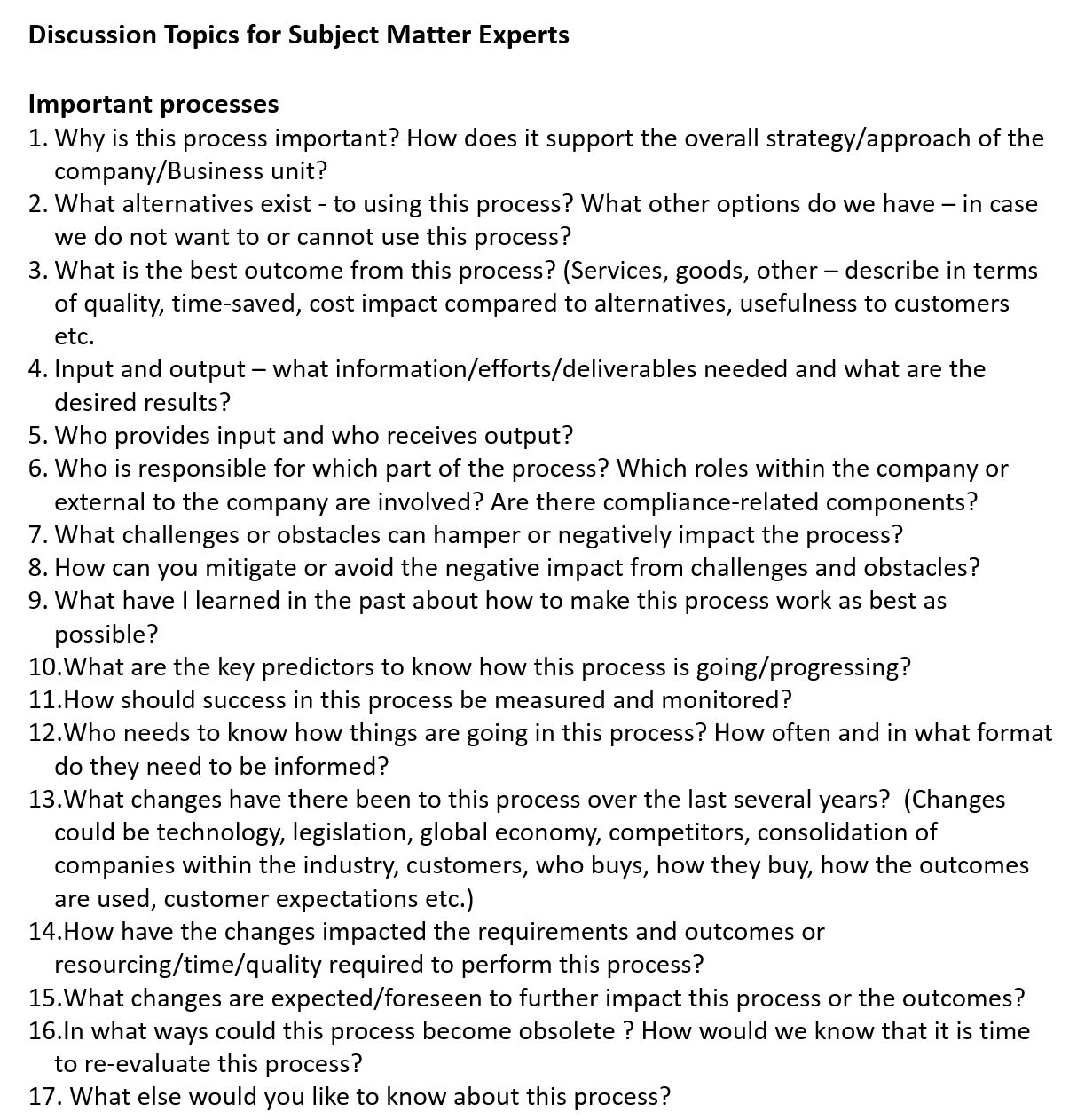
The questions below can be used by the SME to prepare for each session and it could be helpful for him or her to even present the information to the group in this structured way.

discussion-topics-for-smes

Capturing knowledge in a database would be one approach to knowledge sharing, but helping adults learn and know how to apply new knowledge requires that you build in room for questions and discussions in the process. This can be accomplished using face-to-face meetings, video conferencing, and webinars.

The best way to ensure that knowledge is retained and expanding within the company is to apply discipline and structure to knowledge sharing and transfer. This is especially important to do when you consider those who plan to retire in the next two to three years. Involving recognized experts (SMEs) within your company to share their knowledge with others is important for the sustainability of your competitive advantage in the market place. Its is about the things you know about your marketplace, the things you know how to do better and faster than your competition etc. Using the process and approach shared above will help you plan ahead and improve organizational capability over time.

Tips for new Facilitators


picture2

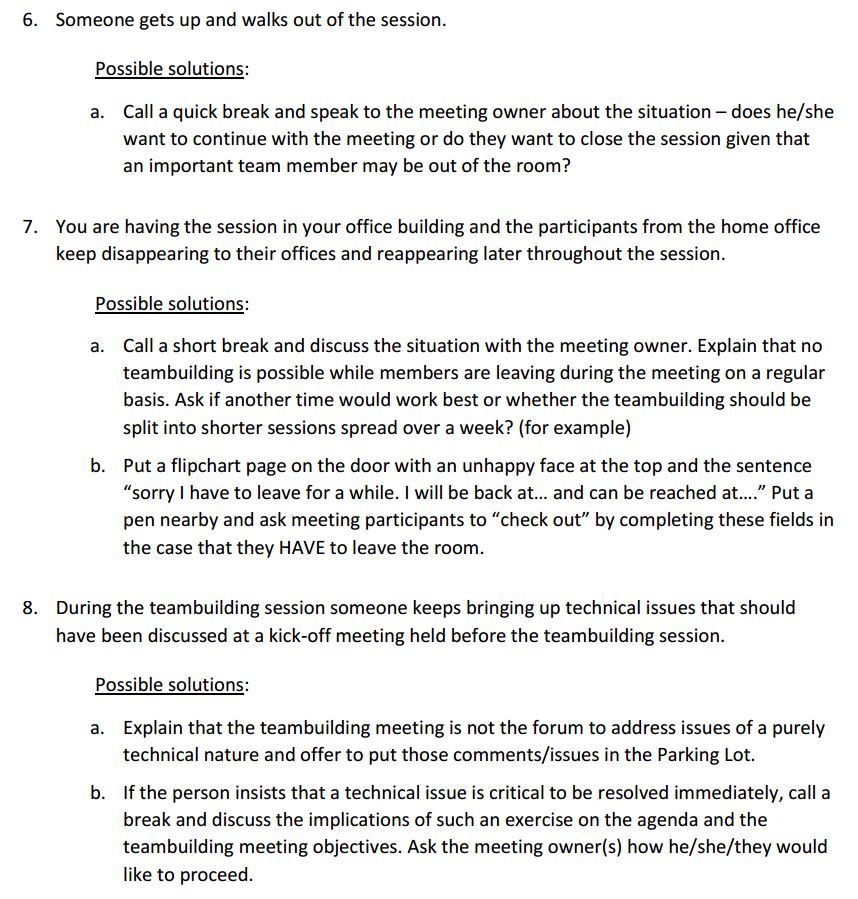
Being asked to facilitate a group of people to accomplish structured outcomes to a meeting or all-day session can be daunting if it is your first time.. This is especially true when there are strong opposing views within the group. I used to facilitate many sessions for a large global company and worked with a few colleagues who did similar work in other regions. The resource I am sharing contains tips received from my colleagues when I got started as a facilitator years ago. In turn, I have made it available to other new facilitators that I have encountered over the years. Now you can also benefit from this. (see inserts below)

Some assumptions made for these tips to be relevant:

  • As facilitator your workshop/session is part of a process. The session includes exercises designed to produce outcomes that would benefit the team. There is at least one (could be more) manager who have a vested interest in a successful outcome and who will also attend your session. These same managers are aware of the team and session process and have provided input to you in terms of their vision and needs from the process. Note: there may be more than one manager if you are facilitating a group process involving members of a client organization too and which may also be attended by the manager from the client organization.
  • Your role is to facilitate the agreed process and to re-agree next steps should the process somehow not be able to continue as planned or new information/changes trigger you to recognize that a change in timing/agenda should be considered.

TIPS for Facilitators:

tips-facilitator-1
tips-facilitator-2
tips-facilitator-3

How to stimulate participation by session participants?

  • Ask open-ended questions
  • Do a poll – where by raising hands people have to vote for one idea vs one or more other ideas
  • Count to 10 or more before you speak, let them bridge the silence with participation
  • When there is a question to you or a comment, defer it to the group – how does the group feel about this topic/question/statement?
  • Ask direct questions to specific participants whom you know (be sure) have experience in an area or on specific subject matters.
  • Summarize the points raised and ask the group to respond – agree or disagree? Correct or ..?
  • Divide them into pairs for a short discussion on a topic that pertains to what you just covered. (Gets them active after a period of perhaps monologue or exclusive dialogue.)
  • When the group seems lethargic consider an unscheduled short break
  • Do an impromptu energizing exercise (always have two or three of these in your back-pocket to employ when you see the need.
  • Expect some sluggishness in the period right after lunch for about an hour or so. Ensure your session design contains activities for this period – small groups etc.
  • Call it – sometimes a group is unresponsive, because everyone is thinking about an elephant in the room – some topic which should be discussed or settled which may not be on the agenda., but it is occupying the minds of everyone. If you know what it is, ask “Is ….. something we should discuss at this time?” if you do not know ask “Is there another issue that we should be covering at this time which may not be a scheduled topic?” [You would need to check in with the manager to ensure he wants to do it right away or later -schedule a specific date and time when he will deal with it. So call a short break if they tell you that something needs to be settled. To determine the”how” with the manager involved.)

These examples are not exhaustive, but they did help me out during those early years of facilitating sessions with groups and teams. I do trust they will do the same for you!

Cultural Differences Could Impact your Session

From a cultural perspective it is important to take note of cultural differences which may impact team and group dynamics during a facilitated session.

Some tips:

These examples could be tricky situations to navigate successfully, if you are not prepared to structure the process, the introduction and plan for the day in a way to ensure all participants see value in the time spent together. In some cases the answer may not be to have a facilitated session, but instead to have a series of meetings involving specific people from the participant groups. .

  • Some cultures expect the person in the front of the room to be an expert and if the facilitator asked questions of the group, his/her credibility may be at stake – in the mind of such a participant.
  • Valuing the goals that a sub-group brought to to the session, some cultures would expect that these goals may be more important than the goals set out for the session at the start.
  • Some cultures prefer to talk about practical examples during the session while others may prefer to talk about concepts. This could especially be apparent if a culture respects the resolution of disagreements privately instead of in a group context.
  • Physical activity or high-energy participant exercises may be seen as disrespectful or unsuitable behavior for senior level personnel in some cultures.
  • Asking questions or exploring concepts are not common across all cultures. Some participants from other cultures may find that approach alien and uncomfortable. They would expect the facilitator to simply give them the answers instead of asking the group to come up with the answer.

Use THIS LINK to read more about how to understand some cultural dimensions to consider as you plan to facilitate a meeting where there might be participants from multiple cultures.

Here is an example of how people from a Low Power Distance culture may differ from those coming from a High Power Distance culture in a facilitated or training sessions:

Renewal Exercise for an Existing Team – the journey


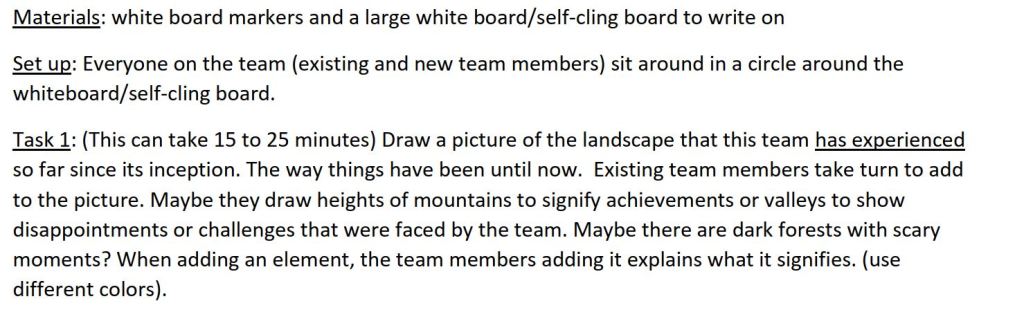
journey

Existing teams often go through phases of renewal, which requires that new team members and existing members come together to create a new or changed vision and way forward. This could happen when the project changes from design to implementation or from one conceptual to design. It could also happen if the leader is replaced. There are many reasons when an existing team can benefit from a renewal exercise to remind them of what they need to do, how they will do it and how they will measure success and collaborate.

Elements that can hold the new team back include existing members holding on to the past too strongly and new members not understanding why some things are done in a certain way within the team. Lacking the background and context of the past and a shared vision for the future the team could easily remain divided between the “new comers” and the “old timers” who know everything.

This exercise has two parts and helps to make the past easier to understand especially in terms of how it may have shaped the current belief system of existing team members – i.e. what they believe works and what does not work. The second part of the exercise helps new teams map out the new way forward together, which helps all team members be a part of what they plan to achieve and do going forward.

Tips/Comments:

  • This exercise does not replace any classic team chartering activities i.e. crafting a new or changed purpose statement, or reviewing/creating new roles and responsibilities going forward or agreeing on key team performance indicators. This exercise forms more of a bridge towards renewing the team and its activities and path forward. This exercise can best be followed by some more classic team chartering activities and exercises.
  • Monitor the communication process closely during the first part of the exercise: the sharing that happens has to remain constructive vs existing team members slipping into defensive behavior and/or new team members being overly critical of the lessons learned from the past.
  • This exercise has also sometimes been used as an ice-breaker to start off a one- or two-day team-building activity. It would be good to schedule this just before a natural break to allow team members to spend unstructured social time together as an aftermath of this exercise.

Starting right – new manager and team


new team leader

A new leader or manager has to quickly connect with the team and understand the objectives and issues around the team and their tasks if he or she wants to be effective in the shortest time possible. At times the team may know the person promoted to be the new leader or manager. The new leader or manager may also be hired from outside the company or someone who joined the team from a remote part of the organization where there had previously been very little to no interaction with team members. In all cases, the team members may have concerns and wonder how the new leader or manager will help the team and them as individuals succeed going forward.

The slides I am sharing can be used to facilitate a group session with the new leader/manager and the existing team. The focus of the session is to help them accelerate the connection and learning that needs to take place for the team to maintain momentum and reach their goals under new leadership. The session helps the team get to know the new leader/manager and voice their concerns. The new manager/leader also gets to know quickly what the team issues are and how the team feels about progress and possible team obstacles to success, which enables him/her to more accurately set the team’s priorities and focus areas for the next few months.

The resource includes some instructions for setting up the activities and also some timing estimates. The slides contain a basic ice breaker/check-in exercise at the start of the session. You could always change this activity for something that better fits with the group/team that you are working with, if needed.

For a simplified process of setting expectations with new leaders and/or new teams, you can download a file to help with that below.

Depending on how many issues the team has, the size of the team and how much they already know about the new leader/manager the entire session can take anything from 2 to 4 hours. If you are the facilitator you need to watch the time. Sometimes the first group discussion can take much longer than expected – when they share their answers. This means you need to plan up front : If they go over the planned timing for that portion of the agenda, will you let the discussion continue and defer the rest of the activities to a later date? Or what will you change to ensure you stay within the contracted time with the group while reaching the goals and objectives for the group session?

If time allows I strongly suggest that you include a team meal at the end of the session. This would allow for some informal social interaction between the new leader/manager and the team members, which further solidifies interpersonal relationships within the team and helps the new leader/manager have a good start with the team.