

We’ve all been there. It’s 11:00 PM. The day was a success – mostly – but your head is still spinning. You’re dictating reminders into your phone. You’re replaying meeting snippets in your mind, trying to unpack what was actually said. To top it off, you just found the dog destroyed your favorite sweatshirt, and the evidence is all over the floor.
You’re exhausted, but you’re too wired to sleep. Your mental RAM is at 100%, and your “processor” is overheating.
Mental clutter – tasks, worries, and that nagging sense you’ve forgotten something – slows your thinking and drains your motivation. High performance and a peaceful mind both require a clean slate.
In a world where leaders are currently facing high levels of burnout and cognitive load, a structured “Worry-to-Action Pipeline” is exactly the kind of pragmatic, tested tool you have come to expect from this blog!
Here is a no-nonsense, 4-step process to move your worries from your head onto paper, and turn that noise into a concrete to-do list.
Grab a pen. Let’s get to work.
Step 1: The Raw Dump
Dump every thought, fear, and reminder spinning in your head on paper. Write them down. Don’t filter, don’t judge, and definitely don’t try to solve them yet. Just write or type until the “RAM” is empty and no more thoughts come.
If your head is spinning too fast to type, use your phone to dictate a voice note. Once it’s out of your system, move those notes to a larger screen – like your laptop or tablet – where you can actually see the “mess” you’ve collected in your mind.
The outcome: moves you from “feeling” the chaos to “seeing” the data.
Step 2: Categorize to Conquer
Don’t just look at the mess -sort it. Grab three highlighters (or use the highlight tool on your screen) and assign every item to one of these three buckets:
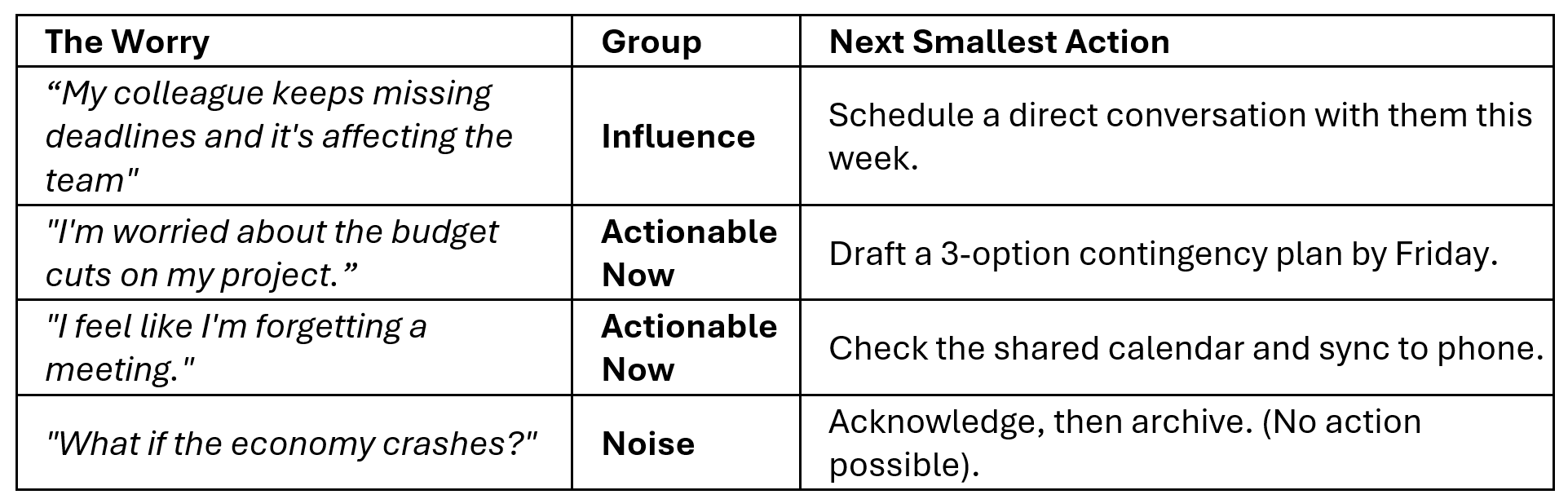
- Actionable Now (Green): Things you can act on in the next 24 hours. No excuses—just tasks you can do today or tomorrow (e.g., “Email the client”).
- Influence (Yellow): Things you can’t fix alone but can nudge. This requires a conversation with a colleague, a friend, or an expert. (e.g., Improving team morale when a manager is difficult to approach).
- The Noise (Red): Things you cannot change. This includes the past, yesterday’s mistakes, or other people’s opinions. (e.g., The dog eating your clothes while you were out).
Examples:
Step 3: Clear the Green (The 48-Hour Rule)
The “Actionable Now” items are the easiest to solve, yet they often cause the most background noise.
- The 48-Hour Rule: If it’s Green, give it a specific time slot in your calendar within the next two days. If you don’t schedule it, it stays in your head.
- The “Parking Lot”: If it truly isn’t urgent and can wait longer than two weeks, move it out of your daily view. Put a reminder in your calendar for a future date and delete it from your current list.
The outcome: reduces the number of active “tabs” open in your brain. If it’s scheduled or “parked,” your brain can stop processing it.
Step 4: Delegate and Release
For the items left on your list – the Yellow and the Red – you only need one simple decision each.
For your Yellow items (things you can influence but not fix alone): identify the one person you need to involve and write their name next to the item. That’s your action. You’re not solving it tonight – you’re simply deciding who carries it forward with you. One name. Done.
For your red items – choose a small ritual of release. Red items are RAM-drainers – things you cannot change, control, or solve tonight. But simply crossing them out rarely works. Your brain needs a small, deliberate act to believe it has actually let go.
Choose a ritual that suits you:
Tear it up. Transfer all your red items onto a separate page. Then tear that page – slowly and deliberately – into small pieces. The physical act of destruction signals to your brain that processing time on these is officially closed.
Box it. Not ready to destroy them? Fold the page and place it in a dedicated box – a shoebox, a tin, anything with a lid. This isn’t surrender; it’s containment. Tell yourself: if this still matters in two weeks, it will still be in the box. Most of the time, when you check, it won’t.
Either way, once the red items are off your main list and out of your hands – torn up or lidded away – your brain has its permission to stop processing them tonight.
Close the list. You’re done for tonight.
Tonight, you don’t need to solve everything. You just need to stop carrying it all at once. A pen, a page, and twenty minutes is enough to move from spinning to settled – and to wake up tomorrow with a clearer head and a shorter list. Your brain will thank you for it.

 The Rethink Shelf