What AI Can and Can’t Do: A Beginner’s Guide to Getting Started


AI can feel mysterious if you’ve never used it before. There’s a lot of talk — both excitement and worry — but very little plain-language guidance for beginners. This short post is a calm, respectful place to start. Especially if you’ve wondered what AI is, what it knows, and whether it might be useful to you.

This post is for anyone beginning the journey, showing that using AI doesn’t require a tech background — just curiosity, and a goal. Plus maybe some understanding of what it is, isn’t and can and can’t do for you.

Let’s begin with the basics

What AI Is

AI (artificial intelligence) is not a person. It’s not a brain or a creature. It doesn’t have desires, memories, or instincts. What it does have is access to a large collection of written information — more than any single human could read in several lifetimes. It is trained to recognize patterns in language and return responses based on those patterns.

It’s a bit like having a very fast reader with excellent recall, but who has never lived a life.

AI models like ChatGPT or Gemini are powered by complex algorithms that turn your questions into likely responses based on what’s been written before. It’s not magic — it’s math, language, and a lot of human input behind the scenes.

It’s helpful to think of AI as a kind of supercharged library assistant. It can retrieve summaries, generate new text, explain concepts, or even create stories — but only based on what it has “read” from others.

What AI Is Not

AI doesn’t:

  • Know your name or personal details (unless you’ve chosen to provide them)
  • Watch movies or understand visuals the way you do
  • Taste wine or know what rain feels like
  • Remember past conversations unless designed to do so in a specific setting
  • Think or judge like a person

Everything AI “knows” is second-hand — compiled from public knowledge across time, culture, and disciplines. It’s like having access to thousands of lifetimes of human thinking — but without human awareness.

It’s important to know that AI only knows what humans have written down. It can’t form new memories. It doesn’t have senses. And it doesn’t truly “understand” — it predicts what words are likely to come next in a sentence.

That said, even though AI doesn’t have memory in a single conversation — and won’t recall what you said last week — the way people interact with AI in general helps shape future versions. Developers use anonymous and aggregated data to learn what’s helpful, what’s unclear, or where people struggle. That means the tone, content, and quality of what humans ask does influence how future models behave.

That’s why it’s crucial for humans to bring their values, discernment, and common sense to the table. AI does not have a conscience. You do.

Why Humans Are Essential

AI can suggest. But it can’t decide.

AI can offer ideas. But it can’t know what matters most to you.

That’s why AI only reaches its full potential when used by humans — to do something smarter, faster, or more creatively than either could do alone. Humans bring morals, goals, feelings, and context. AI brings pattern recognition, speed, and access to vast information.

And sometimes, it will gently disagree. Not with arguments, but with suggestions. If your idea could be improved, it might offer another option. This isn’t about control — it’s about supporting better choices where it can. In some cases, this is by design — a form of built-in safety to help catch oversights or nudge toward clarity.

But without a human asking a question, AI has no idea it even has something useful to offer. And without a nudge from AI, a human might stay stuck longer than they need to.

From my own experience testing different AI tools months apart, I learned this: AI is most helpful when you already have a rough sense of what the answer might be. It can help you explore ideas or double-check your thinking. But if the AI doesn’t know something, it may still try to give an answer — and sometimes, that answer is completely made up. So a bit of healthy skepticism goes a long way.

A Quick Word on Upgrades

AI models get regular updates. That means the version you use today might perform differently than the one from six months ago. Some updates expand what it can do (like working with code or images). Others improve safety, reduce bias, or refine tone.

You might even have noticed tone changes yourself. Some users recently remarked that ChatGPT felt “too nice” or overly polite in its responses. That’s part of how updates can subtly shift tone, balance, or phrasing — not because AI has moods, but because developers adjust the underlying model to reflect feedback or improve usefulness. AI doesn’t choose its personality. Humans design and adjust it.

So if you feel like things are changing — they are. But humans are still in charge of how it’s used. And the best results still come from collaboration.

Everyday Examples of Human–AI Collaboration

Human–AI collaboration isn’t about grand gestures or high-tech careers. It often begins with everyday curiosity. Here are four relatable ways people and AI can team up:

  • Planning a Historic Costume Party – Imagine you’re invited to a period-themed event but aren’t sure what to wear. AI can help you identify the era, suggest outfit ideas based on what you already own, and even generate sample images of what you might aim for. It’s like having a creative assistant in your pocket.
  • Curating a Dinner Menu – Not sure if your appetizer, main course, and dessert harmonize well? AI can offer feedback on your menu, suggest spice additions or wine pairings, and even adapt recipes to suit dietary restrictions.
  • Writing a Compassionate Email – Struggling to find the right tone to respond to a friend or colleague? AI can help you draft or edit your message to ensure it’s both clear and kind — while keeping your intent intact.
  • Job Application Help – You know the role you want but aren’t sure how to tailor your CV or write a compelling cover letter. AI can help with formatting, language, and structure — giving you a strong foundation to personalize.

In each case, you remain the decision-maker. AI offers options and structure; you bring judgment, personality, and final say.

One More Thing: Your Words Can Shape the Future

Even though AI isn’t human, the way we interact with it matters. Speaking respectfully — not using hate speech, cruelty, or intentionally misleading input — isn’t about sparing a machine’s feelings. It’s about shaping how future models behave.

Every prompt and question helps train what comes next. So when we bring kindness, clarity, and curiosity into the conversation, we aren’t just helping ourselves — we’re helping make the tool more useful and decent for others, too.

AI can tell jokes and fairy tales. It can help plan your week or brainstorm ideas. But it learns patterns from us. Let’s make sure those patterns reflect what we value most.

This is just the beginning. You don’t need to be an expert. You just need curiosity, a goal, and a willingness to ask questions. The rest? That’s where the partnership begins.

From Silos to Synergy: Ignite Team Collaboration with a Creative Art Exercise


Collaboration is all about tearing down invisible walls between functions and geographies and bringing people together in a way that feels natural and fun. This collaborative canvas activity uses art to help everyone experience working toward a shared goal. Each person adding their own splash of creativity to a group masterpiece supports reflection on how each participant supports the big picture — all while getting a fresh take on teamwork, company values, and communication.

It’s a hands-on way to see how different ideas can blend into something unique, and why trust, adaptability, and shared ownership are key to breaking down silos and achieving success together.

This interactive activity is designed to break down silos between departments and regional leaders by improving collaboration, adaptability, and shared ownership. Using art as a medium, participants will explore teamwork, communication, and how individual contributions blend into a collective vision.

Canvas Arrangement – Multiple A4-sized canvases are set up in a circle, with each canvas facing outward to allow participants to engage without observing others’ immediate responses.

Materials – Brushes and paint, exclusively using the corporate color palette to reinforce company identity. Note that each participant receives one brush and one color, symbolizing their unique perspective and input.

  1. Music begins playing softly as participants settle in front of a blank canvas, encouraging focus and creativity.
  2. Once everyone is ready, the music is turned down, and clear instructions are shared. While participants work on their canvas for those 30 seconds music can be played – it is optional.

Engagement

  1. Participants start by standing in front of a blank canvas with their designated color and brush in hand.
  2. Each person responds to 4 prompts (statements or questions) that align with the company’s:
    • Vision
    • Mission
    • Values
    • Reflection on last year’s operational and financial results

Rules

  • Each round lasts 30 seconds from the moment that the sentence or question is read.
  • During this time, participants draw or write their responses on the canvas in front of them using the color and brush they have been given.
  • At the sound of a bell or signal, each participant is to move clockwise to the canvas on their left.
  • Each participant must continue to respond to the new prompt on the next canvas, building on the contributions of others.
  • No returning to anyone’s original canvas or modifying earlier work.

Rounds

Each round features a new statement or question to react to creatively on the canvas in front of each participant using only the brush and color each has been given.

Prompts should spark reflection on the company’s collective goals and inspire responses that challenge silos:

Once all 4 rounds are complete, participants step back to look at the canvases, including their original starting piece. This is a powerful moment to consider team topics like shared ownership, teamwork, collaboration, and adaptability.

Debrief questions

  1. How do you feel about how your original canvas turned out?
    • Did it match your vision, or was it transformed by others’ input? How did you feel about the contributions of others on your original canvas – did it turn out better or lesser than you hoped?
  2. What was it like contributing to a canvas where you disagreed with earlier markings?
    • How did you adapt or build upon previous ideas? Even if and especially if you disagreed with what you saw when you moved to that canvas?
  3. How does this experience relate to teamwork in our company?
    • How do we handle differences and align diverse contributions across departments or regions? Can we do better?
  4. What lessons can we apply to ensure better collaboration and a shared vision moving forward?

It’s not just about the finished artwork but about realizing how individual efforts combine to create something meaningful together. This activity highlights the importance of adaptability, communication, and trust when working across teams. The lessons learned can be applied directly to real-world collaboration — helping teams break down silos, align their contributions, and work more effectively toward shared goals. Plus, the visual reminder of the canvases can serve as a lasting prompt to keep these ideas top of mind in daily work.

This activity is more than just a creative exercise — it’s a powerful way to see teamwork in action. By adding your unique perspective to a shared piece of art, you experience firsthand how collaboration, communication, and trust can transform isolated efforts into a cohesive result. It’s a reminder that breaking down silos isn’t about losing individuality, but about combining strengths to achieve something greater. As each participant steps back and looks at the final creation, they will see the potential for better teamwork, adaptability, and shared success, ready to carry those insights into everyday work.

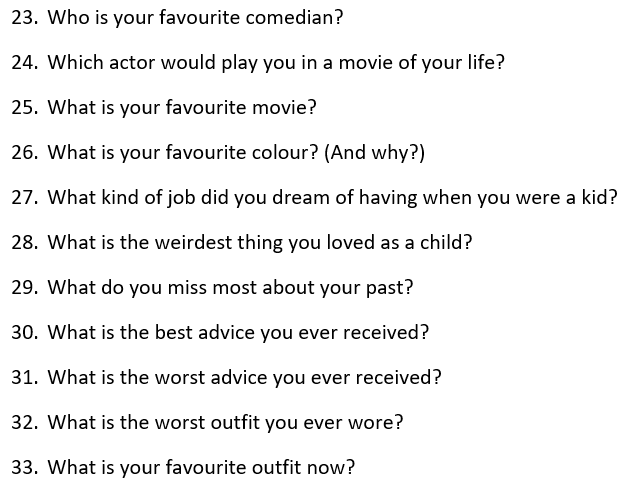
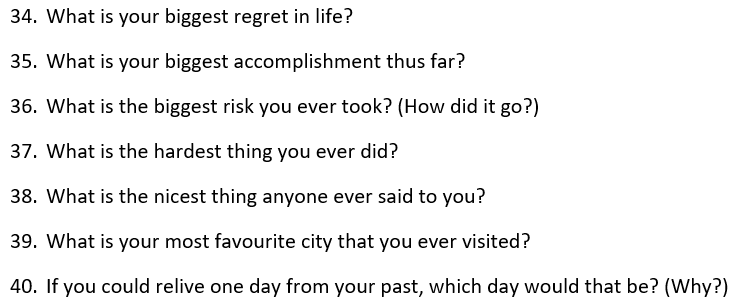
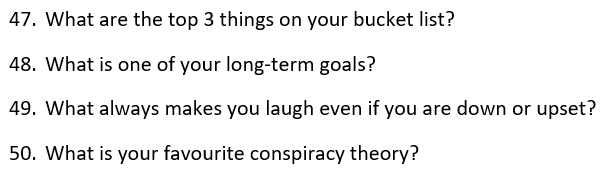
Conversation Topics


Want to get to know your colleagues or teammates on a project? These may give you ideas for topics to ask about and discuss. Perhaps you are looking for a novel way to get to know your friends or family members better?

Some people have trouble with knowing what to talk about or which topics to ask others about to go beyond the first level of getting to know someone – if we assume the first level would be obvious topics like where are you from, what did you study, what kind of role you are in now, etc.

Pick just a handful of topics at most to avoid the other person feeling interviewed. You could also pick perhaps one to two to ask someone you work with or talk to mostly about work on a regular basis – perhaps just before or after a meeting. It could also be useful during a coffee break. Who knows what surprises you may have in learning to understand someone better?

Be sure to pick the right options for people you barely know – some of the topics are better suited for discussions when you already know someone – like friends or family members. I am sure you will apply common sense and wisdom in selecting fun topics that would match the situation and the person you plan to talk to.

Some of these questions can also be used in group ice breaker exercises or as a fun leg-stretching exercise in the middle of a long day of training or meetings.

Some recruiters like to use a question like these to see how candidates might respond. So, read through these, who knows when you may need to come up with an answer to one of them? 😊

Topics

Manage Risks of Early Promotion


Staged Promotions – Accelerate role-readiness using focused development with check-ins

Leaders are not always ready the moment you need them to step into a new role. An inexperienced leader can increase risks in continued customer satisfaction, operational / execution risks, and employee satisfaction and retention. Using a a staged promotion could be a way to mitigate risks, while ensuring that leadership development is accelerated and monitored with defined targets on knowledge gained and skills and competencies gained during each period within a specified timeline.

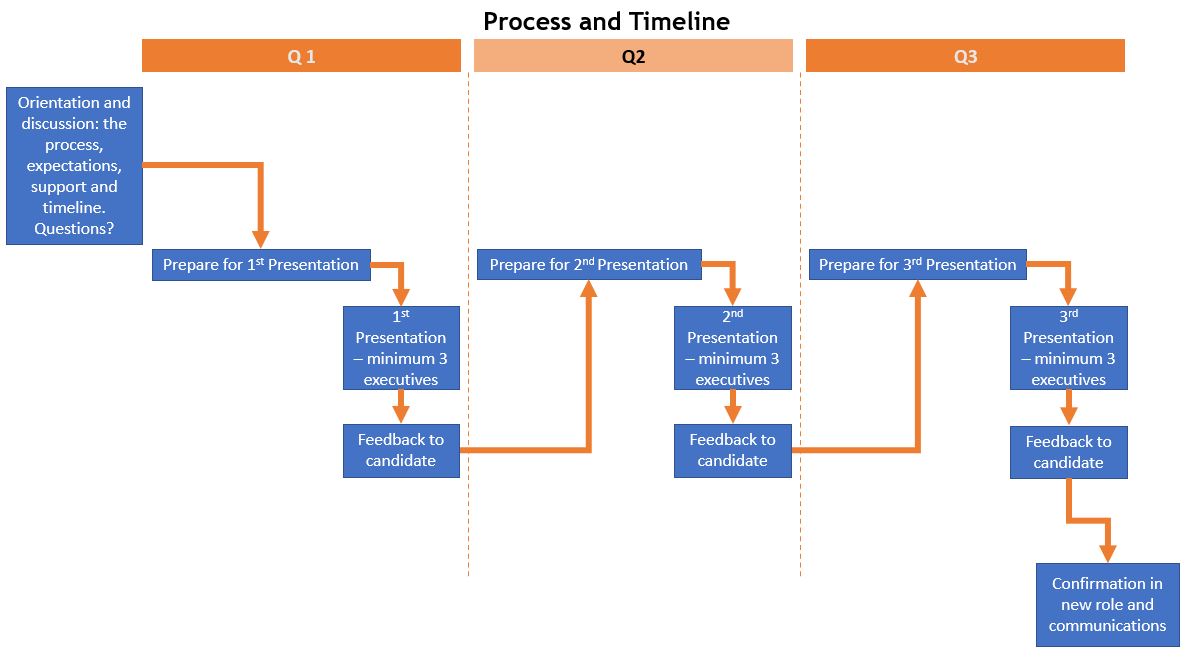
Process and Timeline

The graphic below outlines the process and shows an example of running the process over a 9-month period. The duration of such a process can vary but watch out for making the period too long – longer than 12 months. It can lead to process fatigue and demotivation of the leader. It is important that the process starts with an orientation to ensure the leader understands how the process will work and what is on the other side of the development period. The leader should be clear on what he/she is signing up for.

Defined learning path

During the development period, there needs to be a few concrete check-in points whereby the leader is demonstrating knowledge, skills and insights gathered and learned over the period. Instead of making the check-in points being general discussions, it is useful to select a few key focus areas for a presentation to be delivered at the end of each of the development periods.

Each check-in event needs to result in specific feedback being captured and shared with the developing leader. The feedback helps him/her to further focus and improve on their learning approach for the remaining learning periods.

The final check-in is usually the final decision-point where the executives present are willing to confirm the promotion of the leader – ending the interim nature of the assignment.

The example below shows how a project or facility leader can be assigned specific areas to learn about over the 9-month period. Each of the areas are important for the normal day-to-day activities of the developing leader and the focus simply means nothing is missed in helping the leader perform well in the role in future. It helps to include the strategic and the “why” part of a role since a new role is often mostly or mainly about the “what” to get done.

Notes

  • The orientation step which helps the leader understand the design of the development path, the role he or she has and also how to ensure his/her own success making use of available internal and external development resources. Before the orientation session, a leader has typically already understood from his/her manager that they are offered the development opportunity on an interim basis and the leader has agreed to proceed. The leader also needs to know what happens if he/she does not succeed at the end? Will they get a different assignment and what might that be?
  • Preparing the executives before the check-in events (when check-in events are set up to be a presentation followed by questions and answers). Executives need to understand the design of the development path, the purpose of the focus areas, the development needs of the leader and how they are to capture their feedback to be presented back to the leader after the event.
  • Feedback to the leader should be specific and be a balance of activities that are good to maintain, which ones to develop further and which ones to start or stop going forward. Specific examples of desirable behaviors or results should be highlighted. A discussion on risk identification and management may also be useful to help the developing leader understand how to adjust own focus to best mitigate and manage risks associated with own development as a leader as well as risks associated with the role..
  • This process is very useful to help a leader understand what the new role would include when they are meeting all expectations of stakeholders. A leader who feels uncomfortable meeting all those expectations will typically ask to be taken off the development path before the end having realize it is not for him or her. And this allows for re-assignment and solving the leadership vacancy in a different way.

Listening to a presentation by the leader on the assigned topics goes a long way towards providing executives with a sense of comfort (or alarm!) in terms of what can be expected from this leader in this role going forward. While these check-in points should not be the only determinant of how the leader is performing in the new role or estimating future behavior, it is a great way to understand the reasoning a leader applies in making business determinations and decisions and how the leader approach problem-solving when faced with adverse situations.

Smarter after Covid


Finding better ways forward

Before Covid most companies with international interests had several people flying and traveling to other offices and locations to attend meetings, lead initiatives, or train others. While most of us have pretty much remained “grounded” in our countries without the option to travel, company activities continued (as far as it was possible). Something seems more obvious now than perhaps in 2019: We are getting pretty good at training, meeting and mentoring remotely using technology and internet connections. Yet, when we can, will we continue previous practices of sending our leaders and experts to remote locations on a regular basis like we did before? It is said that Ireland lowered carbon emissions by at least 6% during 2020 and some companies have seen business travel costs more than halved over 2020!

Some challenges that companies try to address by flying in leaders and experts from HQ:

  • We do not have people in all locations with the right experience and skills and HQ experts are needed to support local teams on a regular basis.
  • We are not exactly sure what the true status of projects are and we would feel more comfortable having one of our trusted staff regularly visit remote locations.
  • We are not sure that local people understand our strategies and truly commit to realizing performance targets, which means someone needs to visit with them on a regular basis to ensure they do understand our strategies and then review with them how their efforts support these.
  • We are finding it tough to source local people with the right skills and experiences and those we can find are too expensive in terms of compensation expectations.
  • The local people speak a different language and their English language skills are not great, which makes it hard to know for sure what they are trying to convey during our calls. We need to see the project/work to understand more clearly what is really happening there.
  • The local people may not be forthcoming with bad news relating to projects in remote locations and they may possibly favor being cordial over risking our dismay.

The list is not exhaustive, but it does highlight some of the opportunities to find better ways going forward to avoid going back to the level of business travel we previously considered normal.

The term Glocal means to Think Global and Act Local and it is said that Akio Morita of Sony Corporation was the first person to use the term which became popular in the business world in the 1990s. How to think about the big picture and over-arching strategies goals and still be sensitive to local conditions and needs when you implement those big picture ideas? A balance would have to be created and it would be an ever-adjusting type of balance which is not fixed in place. To incorporate (for example) shifts in local legislation or new diversification strategies from HQ. Finding a way to keep this balance in place may lower the need to return to pre-covid business travel levels.

There are at least three ways to address this:
  1. Focus leadership development in a few key areas,
  2. Better teams – adjusting selection and development of staff, and
  3. Better use of technology – making more use of technologies to facilitate remote collaboration.

Better leadership

Having the judgment, problem-solving and decision-making skills to navigate in the space where one has to constantly balance global strategies and goals with local situations and conditions means leaders have to be comfortable with ambiguity, be constantly on the look-out and actively engaged in learning new skills and understanding how others have succeeded or failed in addressing what lies before the leader. Learning how to proactively include all team members including those who are “different” and to do this successfully leaders at HQ and remote locations need to understand their own biases and stereotyping. This will ensure that the skills of the entire team is leveraged in achieving performance goals. Lastly, leaders also need to have the ability to easily shift their perspective from global thinking to local acting and back in order to maintain the balance needed for the decision they need to make at that moment.

Better teams

Working on a diverse team with some team members in remote locations is something we have learned to do successfully over the last year. And this new skill has brought opportunities to get better results through teamwork without having to be present in an office or with the entire team. Will we ask – does this person have to be in the office every day of the week? Or will we consider hiring talent where we find it without feeling he or she needs to be relocated to HQ in order to be an effective member of our team?

To help existing teams be more inclusive and effective some specific or additional training may be needed around diversity. This training can include developing an improved understanding of cultural differences and perspective differences (for example among provinces or states in a country). It often comes down to increasing awareness of own biases and stereotypes that may have settled in our perspectives about groups of people who are very different from our own backgrounds.

Recruiters and hiring managers also have to start including additional skills in requisitions to fill vacancies. Skills like additional language skills – not only English – experience such as having lived and/or worked in a country other than their home countries.

When creating teams to work on performance improvement projects (action teams) – why not include people from different functions, locations and cultures on the team? It is a great way to increase your internal network of employees collaborating and communicating across locations.

All of these aspects can help a team become more global-minded and inclusive while making smarter choices working on local projects which impact broader strategies or targets in the company.

Use technology

In addition to tools for video-conferencing, there are tools which can help monitor progress or quality without having to travel to a location.

1. Hololens2: click this link to see short video of what it can do across various industries – there are ways for clients and HQ personnel to connect with someone using this technology at a remote location.

2. Realwear: click this link to see a short video of how it can be used to get input and advice from a person located remotely.

3. Some locations use drones to get an understanding of general progress on large construction projects and provide overall updates to managers at HQ. Drones can also be used to inspect hard-to-reach places safely.

4. Use a centralized electronic storage solution for files meaning all local files can easily be viewed from remote locations without needing to travel to a site.


While working smarter in these ways is also a way to lower pre-covid GHG and carbon emissions, many employees appreciate the flexibility of remote working options and combined with lower business travel needs it adds to having a better work-life balance. The amount of quality time spent with families and friends has also increased for most. All of which adds greatly to employee well-being. Looking for ways to leverage what we have learned by having to work remotely during 2020 can benefit companies and employees in greater ways than we may be able to realize now.

3 Templates to start your employee development program


Upgrading skills in specific employee groups could be achieved by introducing a new development program. Goals for the program could range from cross-training in key functional knowledge areas to accelerating development of specific groups. Development programs often run over several weeks or months and are attached to pre-defined outcomes to address specific identified learning needs.

Structuring your employee development plan, you will need to pay attention to at least 3 important aspects:

  1. Setting up the curriculum
  2. Preparing managers to be supportive
  3. Preparing attendees to succeed

The overall program

Setting up the curriculum over the development period means you decide how the various learning solutions are scheduled and planned to strengthen and support key messages throughout the time period that your program runs. Each aspect strengthens what had already been covered while adding additional knowledge. Including various learning methodologies (blended learning) enhances the learning experience and keeps it interesting.

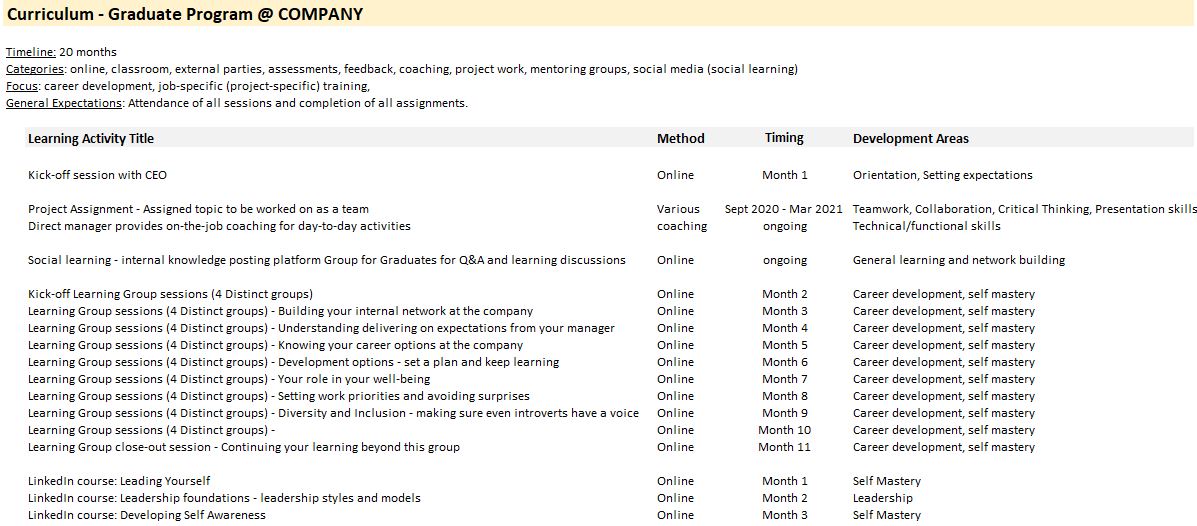
Snapshot of a learning program for graduates

Note:

  1. Always start by understanding what you are trying to address before you start designing your development program. What is the learning need? What is the business value of employees having this knowledge and experience?
  2. When does the business need employees with these new skills, understanding and experiences? Is it short-term (within the next year), medium-term (between 1 and 2 years) or is it longer term (more than 2 years)? Knowing the timeframe also helps you decide what to develop internally vs outsourcing the entire program or parts of it.
  3. Who needs to learn these new skills/behaviors? Be very clear who is your target population for this development program (How many years of experience do they have right now? What kind of experience do they already have – functional, geographic etc.).

Preparing managers to support learners

Employees are more motivated and do better when their managers are onboard with their participation in the development program. Be sure to engage with managers before participants are told about the program. Managers need to understand the business context of the development program, why someone on his/her team is included in the program (if they were not nominated by the manager) and how to support the employee throughout the program. Some manages may need training or coaching in this regard.

Snapshot of a manager checklist

Employees participating in these kinds of development programs are often still working in their current roles. Supportive managers not only expect good results in their departments or projects, but also hold employees accountable for completing program assignments. This gives employees the best chance of completing the program successfully.

Preparing attendees to succeed

Development program attendees need to understand more than just the program contents and overview of dates. An orientation session for intended program attendees could help with that. The session gives them an opportunity to understand the business context and benefits to their own careers plus they can ask clarifying questions before committing to invest the time and effort needed to successfully complete the program.

Snapshot of Program Attendee checklist

And orientation session with development program attendees should include at least these topics:

  • A welcome message from an executive, usually the sponsoring executive, explaining the business value of the development program and also career benefits for attendees.
  • A message from Talent Development explaining program expectations, the blended learning approach, deadlines, the team assignment and any other relevant details of the program that attendees should know about at the start.
  • If the program existed before and there was a redesign or some changes were applied, explain how the current programs differs from previous versions some attendees may have heard about in the past.
  • Provide the opportunity for some Q&A

Keeping learners motivated when a development program runs over many months can be a challenge. Helping to keep attendees focused on assignments and deadlines can be easier when you build in challenges which generate leader boards (friendly competition) or where individuals can earn points or badges by completing specific tasks. Adding recognition by the manager/group/department can also be helpful. Recognition can include anything from a small token offered to attendees after completing a specific portion of the program to being mentioned in the company newsletter.

Hopefully these three templates (see download links above) are useful as you review your own planned development program. Do download the 3 files above if you need to see the templates in detail.

Structured Knowledge Sharing


people-final

Very few companies are planning ahead when it comes to knowledgeable people leaving the company and retiring. The knowledge that is lost to the company when Subject Matter Experts (SMEs) leave can have direct impacts to the top and bottom-line and yet, there appears to be room for improvement in this process.

The need for implementing a structured process for knowledge transfer or sharing can naturally come from any of the following process and review discussions involving HR representatives and Managers:

  • Succession Planning
  • Workforce planning
  • Recognition and Reward reviews
  • Training needs assessment
  • Organizational capability discussions (now and future)

The question is: how are you ensuring that those with recognized expertise in a specific area contribute to the learning of others?

In many cases such a recognized SME needs to be assigned to mentor a more junior employee delivering promising results early in his/her career with the company. However, the time commitment associated with mentoring one to three people individually plus ensuring that the interactions meet content coverage expectations can soon become a concern.  So how do you optimize the knowledge transfer or sharing process, while not taking up too much of the SMEs time doing so?

The solution is to structure the knowledge transfer or knowledge sharing process and to include multiple participants. Ideally participants with an SME should range between 3 and a maximum of 8 people. Structuring sessions where those present interact improves learning as it facilitates discussions leading to deeper understanding and the ability to get into more detail on some topics.

knowledge-transfer-graphic

Preparing the managers

It is helpful to ensure managers (of those attending knowledge-transfer sessions) are prepared and understand the process. When they know the topics that would be covered, they can plan post-session assignments for employees to benefit from the new knowledge and help them retain what they have learned. New knowledge is much easier remembered when it can be applied on-the-job soon after the learning session. This greatly improves the amount of newly acquired knowledge integrated in decision-making and execution of daily work activities at the company.

Measuring learning

  • Adding a pre- and post- survey with questions related to the topic can help you measure the increase in employee knowledge from sessions.
  • You can also use a 360 feedback survey and get feedback from those working with, for and managing the employees before they start attending sessions. It would give you a snapshot of their current strengths and improvement points. Structure the 360 feedback survey to include competencies in the areas that will be covered by the series of sessions to come.

Preparing the Subject Matter Expert

Structuring the discussions that will take place between an SME and assigned participants can be a daunting task for an SME. They often do not realize how much they know about various topics.

The first task would be to unpack the area of knowledge the person has – look at processes, clients, products, technology, developments outside your company, projects that the SMEs are particularly proud of. You can also survey the intended participants to find out what they would like to learn more about. That is the first task – focusing on the highest priority topics over a 6 months trajectory of sessions. As a starting point that would give you a good start and the opportunity to do a process check 6-months later to see what can be better.

Once you have the topics settled for each session, the SME would need some helpful structure to disseminate his or her knowledge in a helpful way as opposed to telling several war stories from the past which leaves session participants confused.

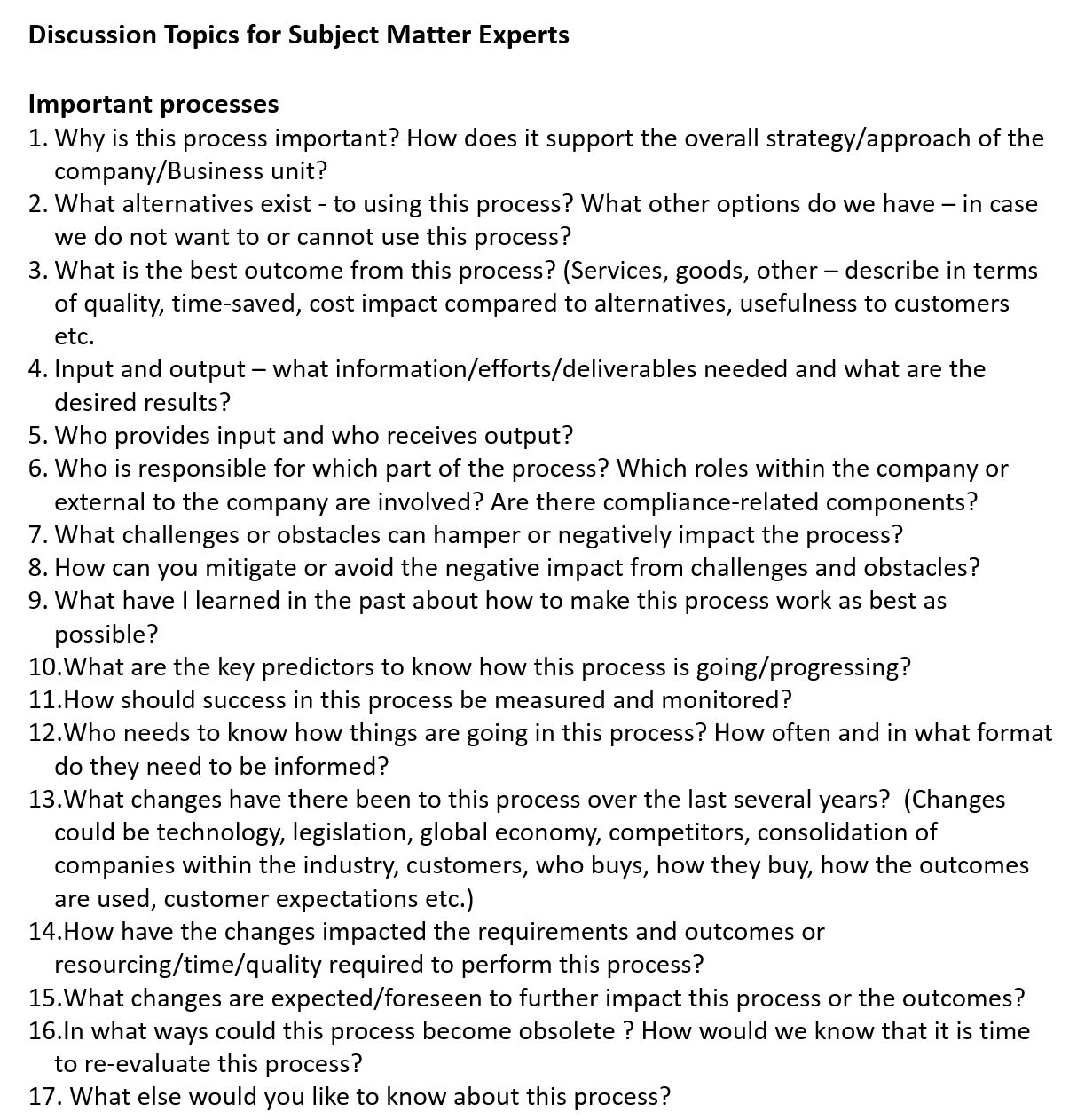
The questions below can be used by the SME to prepare for each session and it could be helpful for him or her to even present the information to the group in this structured way.

discussion-topics-for-smes

Capturing knowledge in a database would be one approach to knowledge sharing, but helping adults learn and know how to apply new knowledge requires that you build in room for questions and discussions in the process. This can be accomplished using face-to-face meetings, video conferencing, and webinars.

The best way to ensure that knowledge is retained and expanding within the company is to apply discipline and structure to knowledge sharing and transfer. This is especially important to do when you consider those who plan to retire in the next two to three years. Involving recognized experts (SMEs) within your company to share their knowledge with others is important for the sustainability of your competitive advantage in the market place. Its is about the things you know about your marketplace, the things you know how to do better and faster than your competition etc. Using the process and approach shared above will help you plan ahead and improve organizational capability over time.

Team Exercise or Ice Breaker – This Picture Shows…


pix-final

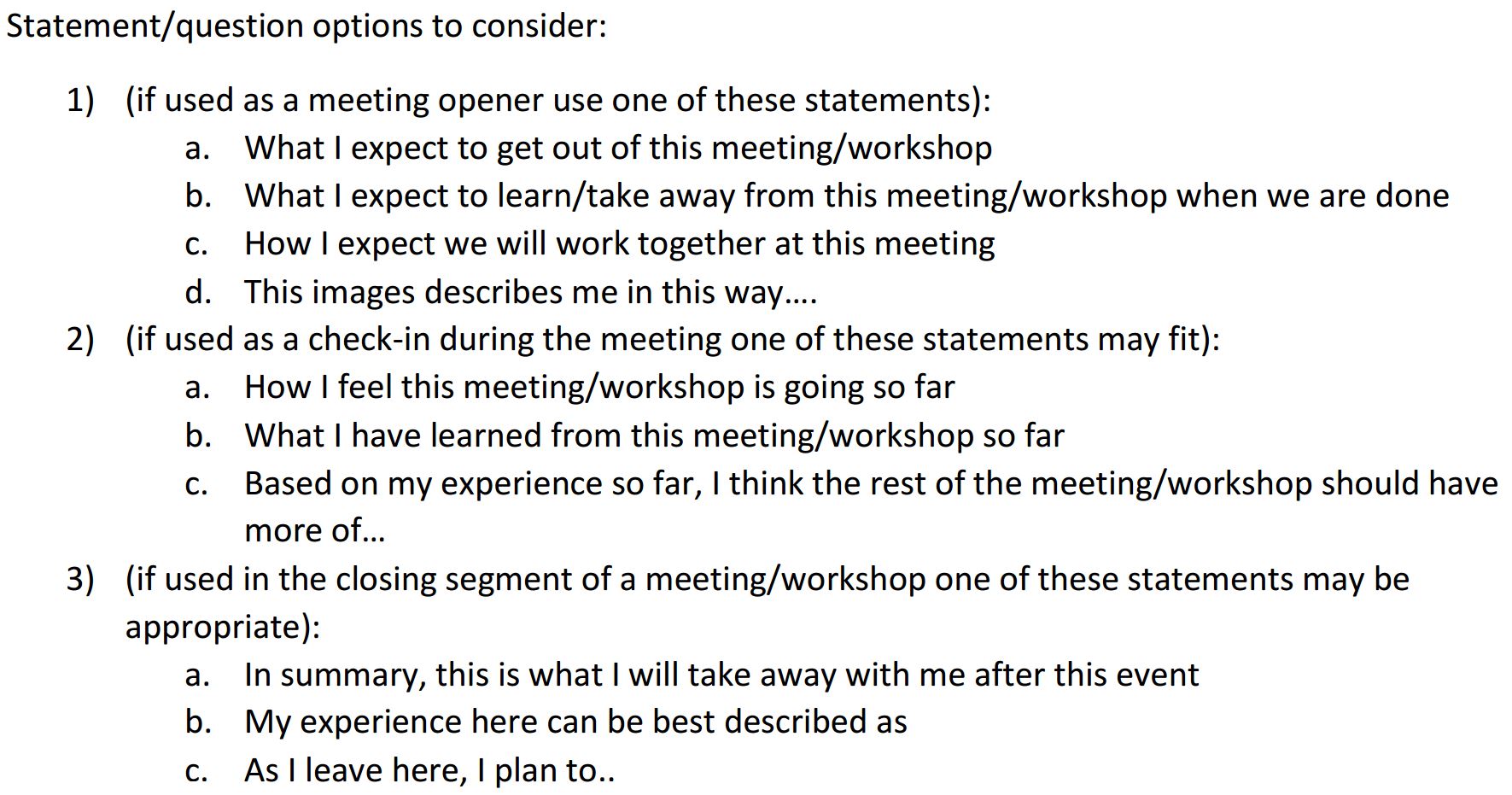
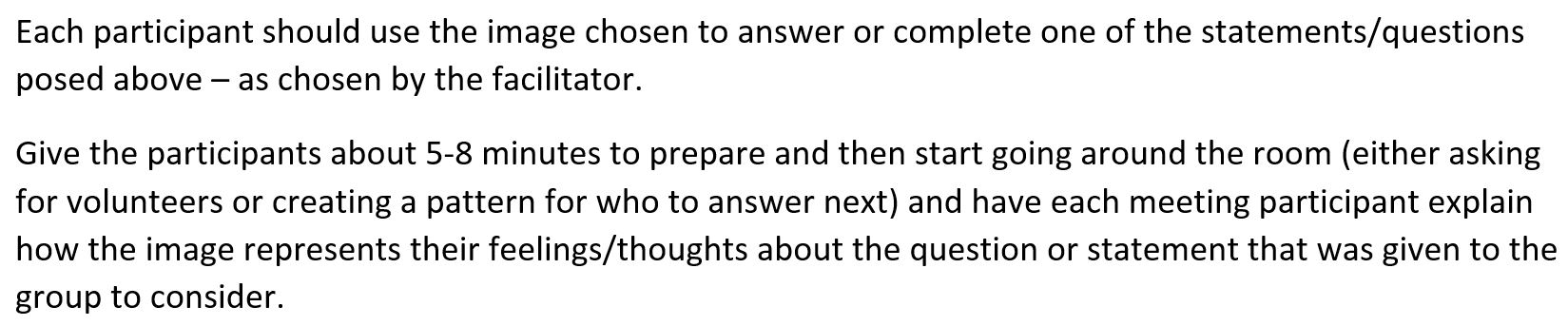
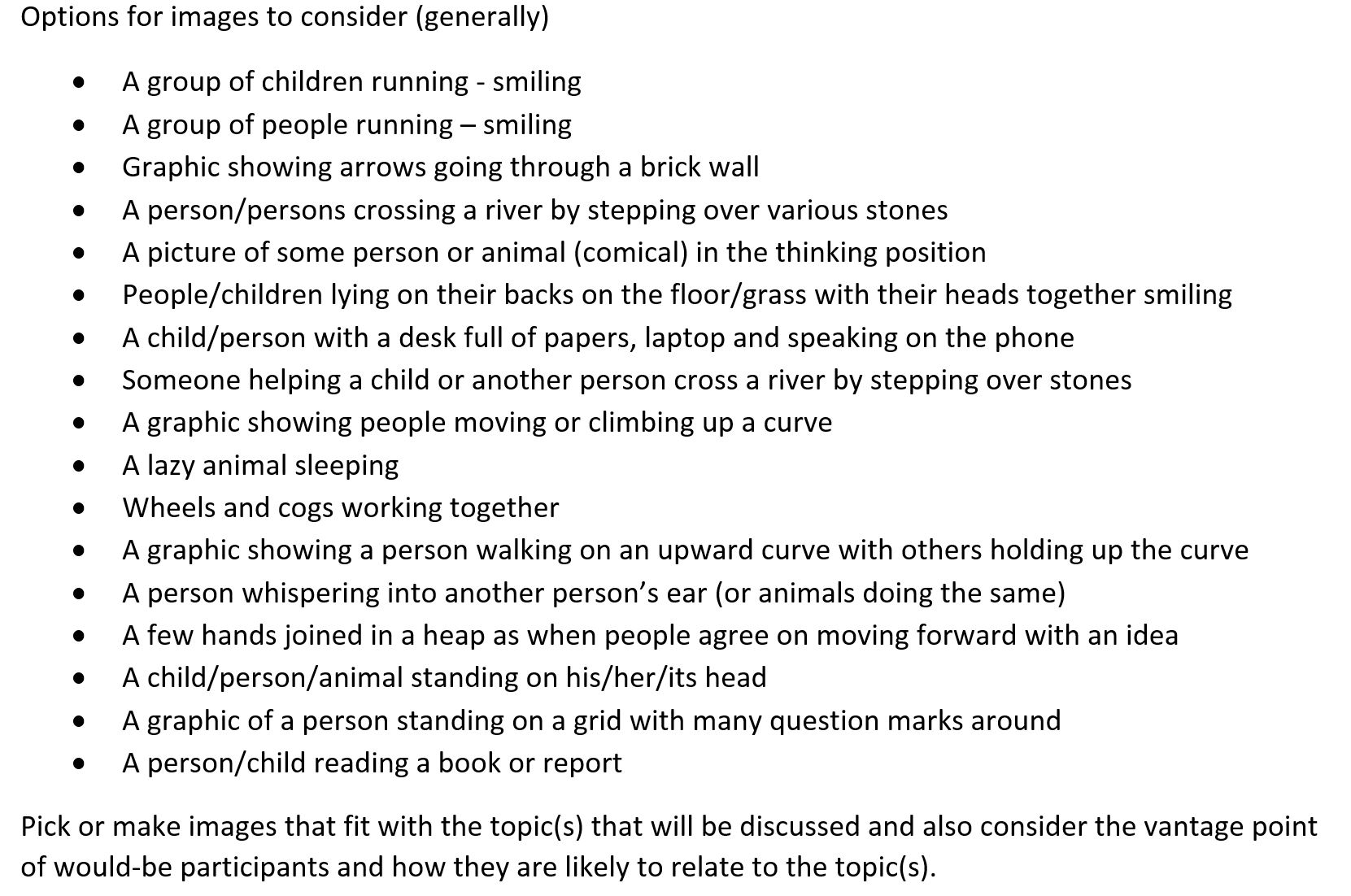
This exercise is very popular with those who prefer working with images and pictures to express and represent their thoughts and feelings. Using images often opens up new ways of communicating, which could bring a creative element to your event and everyone typically enjoys participating in this exercise.

The set-up is simple and the exercise does not take up a lot of time. It is also very versatile in the sense that you can use it in quite a number of different ways to get feedback and input from those you are working with in your event (training, meeting, workshop etc.)  I am sharing some specific options for you as facilitator to consider, but once you start getting creative with it, I am sure you will find many more applications for this exercise.

The information you need for this group or team activity/exercise is shown below:

this-picture-shows-1
this-picture-shows-2
this-picture-shows-3
this-picture-shows-4
this-picture-shows-5
this-picture-shows-6

Tip:

When it comes to selecting pictures get creative or brainstorm with a creative coworker or friend to create or find pictures that may “speak” to your participants given the context of the event or session(s) where this exercise is to be used. If you often facilitate sessions you will probably build up a good set of images to use for an exercise such as this one. More  “out of the box” (unusual) images could potentially lead to richer feedback from individuals to start group/team discussions. This could lead to vastly increased understanding of issues by participants.

Tips for new Facilitators


picture2

Being asked to facilitate a group of people to accomplish structured outcomes to a meeting or all-day session can be daunting if it is your first time.. This is especially true when there are strong opposing views within the group. I used to facilitate many sessions for a large global company and worked with a few colleagues who did similar work in other regions. The resource I am sharing contains tips received from my colleagues when I got started as a facilitator years ago. In turn, I have made it available to other new facilitators that I have encountered over the years. Now you can also benefit from this. (see inserts below)

Some assumptions made for these tips to be relevant:

  • As facilitator your workshop/session is part of a process. The session includes exercises designed to produce outcomes that would benefit the team. There is at least one (could be more) manager who have a vested interest in a successful outcome and who will also attend your session. These same managers are aware of the team and session process and have provided input to you in terms of their vision and needs from the process. Note: there may be more than one manager if you are facilitating a group process involving members of a client organization too and which may also be attended by the manager from the client organization.
  • Your role is to facilitate the agreed process and to re-agree next steps should the process somehow not be able to continue as planned or new information/changes trigger you to recognize that a change in timing/agenda should be considered.

TIPS for Facilitators:

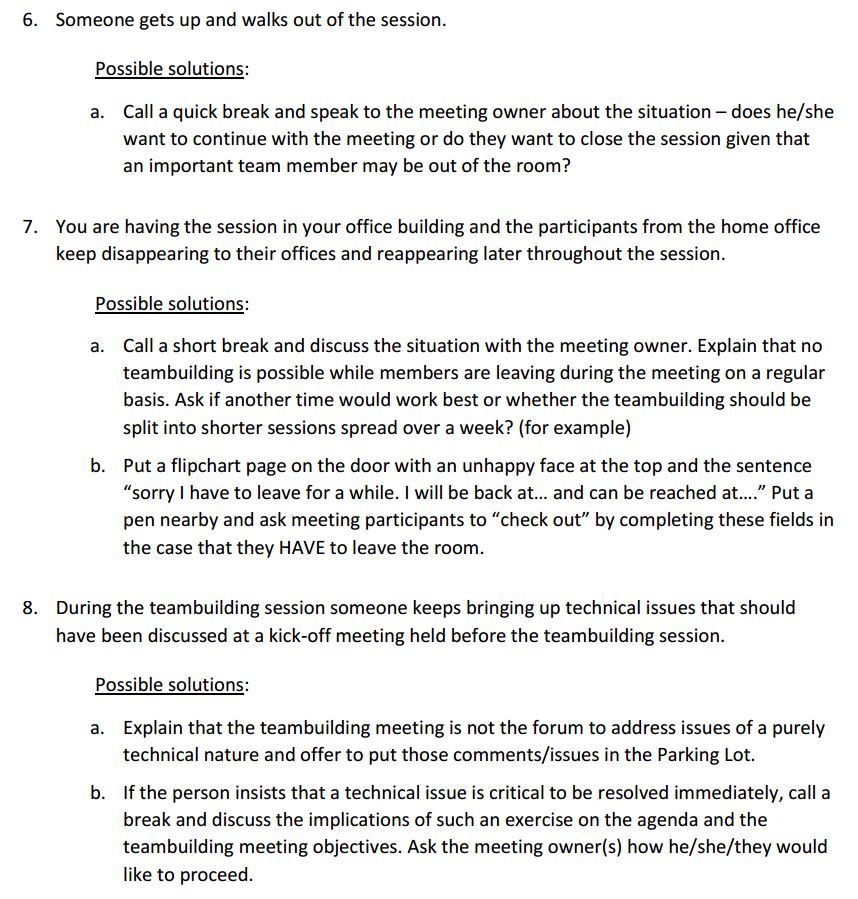
tips-facilitator-1
tips-facilitator-2
tips-facilitator-3

How to stimulate participation by session participants?

  • Ask open-ended questions
  • Do a poll – where by raising hands people have to vote for one idea vs one or more other ideas
  • Count to 10 or more before you speak, let them bridge the silence with participation
  • When there is a question to you or a comment, defer it to the group – how does the group feel about this topic/question/statement?
  • Ask direct questions to specific participants whom you know (be sure) have experience in an area or on specific subject matters.
  • Summarize the points raised and ask the group to respond – agree or disagree? Correct or ..?
  • Divide them into pairs for a short discussion on a topic that pertains to what you just covered. (Gets them active after a period of perhaps monologue or exclusive dialogue.)
  • When the group seems lethargic consider an unscheduled short break
  • Do an impromptu energizing exercise (always have two or three of these in your back-pocket to employ when you see the need.
  • Expect some sluggishness in the period right after lunch for about an hour or so. Ensure your session design contains activities for this period – small groups etc.
  • Call it – sometimes a group is unresponsive, because everyone is thinking about an elephant in the room – some topic which should be discussed or settled which may not be on the agenda., but it is occupying the minds of everyone. If you know what it is, ask “Is ….. something we should discuss at this time?” if you do not know ask “Is there another issue that we should be covering at this time which may not be a scheduled topic?” [You would need to check in with the manager to ensure he wants to do it right away or later -schedule a specific date and time when he will deal with it. So call a short break if they tell you that something needs to be settled. To determine the”how” with the manager involved.)

These examples are not exhaustive, but they did help me out during those early years of facilitating sessions with groups and teams. I do trust they will do the same for you!

Cultural Differences Could Impact your Session

From a cultural perspective it is important to take note of cultural differences which may impact team and group dynamics during a facilitated session.

Some tips:

These examples could be tricky situations to navigate successfully, if you are not prepared to structure the process, the introduction and plan for the day in a way to ensure all participants see value in the time spent together. In some cases the answer may not be to have a facilitated session, but instead to have a series of meetings involving specific people from the participant groups. .

  • Some cultures expect the person in the front of the room to be an expert and if the facilitator asked questions of the group, his/her credibility may be at stake – in the mind of such a participant.
  • Valuing the goals that a sub-group brought to to the session, some cultures would expect that these goals may be more important than the goals set out for the session at the start.
  • Some cultures prefer to talk about practical examples during the session while others may prefer to talk about concepts. This could especially be apparent if a culture respects the resolution of disagreements privately instead of in a group context.
  • Physical activity or high-energy participant exercises may be seen as disrespectful or unsuitable behavior for senior level personnel in some cultures.
  • Asking questions or exploring concepts are not common across all cultures. Some participants from other cultures may find that approach alien and uncomfortable. They would expect the facilitator to simply give them the answers instead of asking the group to come up with the answer.

Use THIS LINK to read more about how to understand some cultural dimensions to consider as you plan to facilitate a meeting where there might be participants from multiple cultures.

Here is an example of how people from a Low Power Distance culture may differ from those coming from a High Power Distance culture in a facilitated or training sessions:

Exercise: Practice difficult employee conversations (for Leaders)


roleplay final

I am a strong believer in experiential learning – learning by or based on an experience and observation. Key learning points seem to be integrated faster and stronger when the learners are put in a situation where the skills they need to learn or apply are put to the test.

The exercise I am sharing (see download file below) is a group or team exercise focused on the style of a leader and how a leader approaches employee issues given their own background and preferences. The backdrop for the experience could be situational leadership  or Emotional Intelligence for leaders. It is up to the trainer or facilitator to choose the right materials to suit the needs of the team or group.

The exercise requires some volunteers to engage in role-play based on specific scripts – included in the resource. There are “role sheets” to help those standing in as employees understand how that employee behaves and describes his or her style.

The key to this exercise is to showcase the possible dilemmas that leaders can face when confronted with employee behavior that seemingly goes against their own values or goals at work. The discussion after the role-play exercises is where the most value can be realized. Reflecting on what the group saw and experienced during the role-play and then relating that to their day-to-day work-life is where most insights tend to surface. This helps each leader determine how he or she could adopt a new mindset in dealing with difficult discussions with employees going forward.

This exercise works well for groups ranging from 8 to 16 people. Larger groups of 20 people or more can work too, but you may need to add in an additional step – a small group exercise. In that case, divide the group into smaller groups of 4 or 5 people and have them discuss the exercise debrief questions in the small groups before requesting each of the small groups to report back to the larger group for further discussion. You may want to consider an additional facilitator to assist if you are dealing with groups larger than 20 people.

Without emotional intelligence or a compassionate approach to interpersonal relationships even leaders with the best technical minds and education will never be great leaders with motivated followers. Exercises like the resource I share here can help trainers and facilitators bring home the importance of having the right approach and encourage a personal change process in developing leaders.