Manage Risks of Early Promotion


Staged Promotions – Accelerate role-readiness using focused development with check-ins

Leaders are not always ready the moment you need them to step into a new role. An inexperienced leader can increase risks in continued customer satisfaction, operational / execution risks, and employee satisfaction and retention. Using a a staged promotion could be a way to mitigate risks, while ensuring that leadership development is accelerated and monitored with defined targets on knowledge gained and skills and competencies gained during each period within a specified timeline.

Process and Timeline

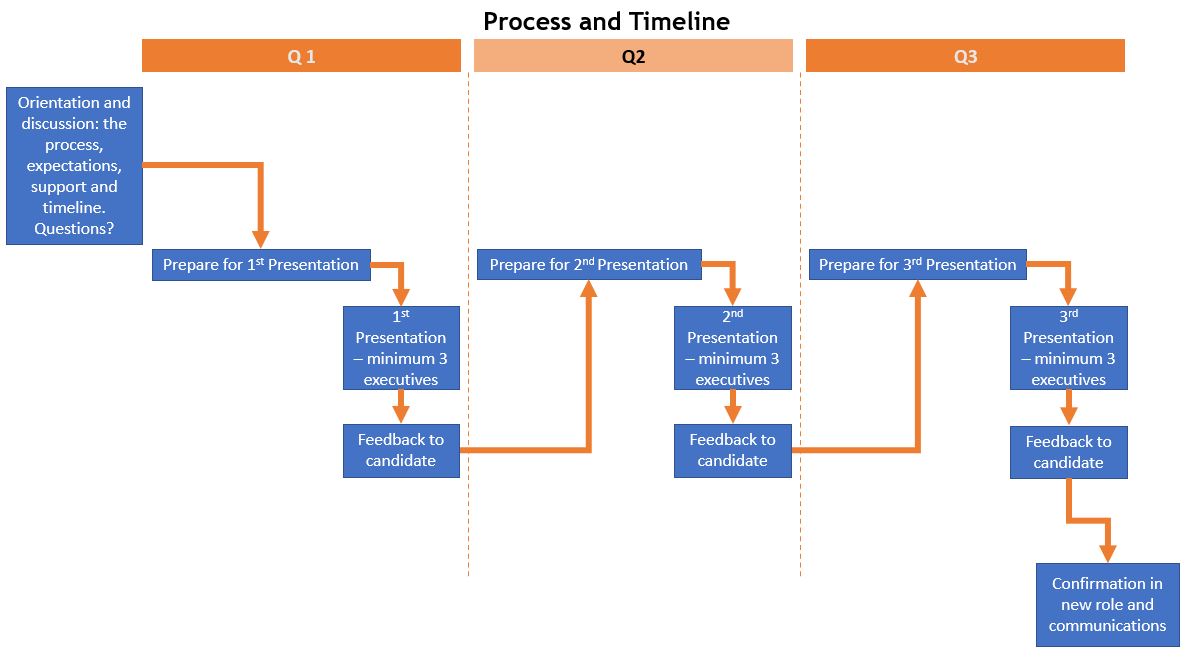
The graphic below outlines the process and shows an example of running the process over a 9-month period. The duration of such a process can vary but watch out for making the period too long – longer than 12 months. It can lead to process fatigue and demotivation of the leader. It is important that the process starts with an orientation to ensure the leader understands how the process will work and what is on the other side of the development period. The leader should be clear on what he/she is signing up for.
Defined learning path

During the development period, there needs to be a few concrete check-in points whereby the leader is demonstrating knowledge, skills and insights gathered and learned over the period. Instead of making the check-in points being general discussions, it is useful to select a few key focus areas for a presentation to be delivered at the end of each of the development periods.

Each check-in event needs to result in specific feedback being captured and shared with the developing leader. The feedback helps him/her to further focus and improve on their learning approach for the remaining learning periods.

The final check-in is usually the final decision-point where the executives present are willing to confirm the promotion of the leader – ending the interim nature of the assignment.

The example below shows how a project or facility leader can be assigned specific areas to learn about over the 9-month period. Each of the areas are important for the normal day-to-day activities of the developing leader and the focus simply means nothing is missed in helping the leader perform well in the role in future. It helps to include the strategic and the “why” part of a role since a new role is often mostly or mainly about the “what” to get done.

Notes

  • The orientation step which helps the leader understand the design of the development path, the role he or she has and also how to ensure his/her own success making use of available internal and external development resources. Before the orientation session, a leader has typically already understood from his/her manager that they are offered the development opportunity on an interim basis and the leader has agreed to proceed. The leader also needs to know what happens if he/she does not succeed at the end? Will they get a different assignment and what might that be?
  • Preparing the executives before the check-in events (when check-in events are set up to be a presentation followed by questions and answers). Executives need to understand the design of the development path, the purpose of the focus areas, the development needs of the leader and how they are to capture their feedback to be presented back to the leader after the event.
  • Feedback to the leader should be specific and be a balance of activities that are good to maintain, which ones to develop further and which ones to start or stop going forward. Specific examples of desirable behaviors or results should be highlighted. A discussion on risk identification and management may also be useful to help the developing leader understand how to adjust own focus to best mitigate and manage risks associated with own development as a leader as well as risks associated with the role..
  • This process is very useful to help a leader understand what the new role would include when they are meeting all expectations of stakeholders. A leader who feels uncomfortable meeting all those expectations will typically ask to be taken off the development path before the end having realize it is not for him or her. And this allows for re-assignment and solving the leadership vacancy in a different way.

Listening to a presentation by the leader on the assigned topics goes a long way towards providing executives with a sense of comfort (or alarm!) in terms of what can be expected from this leader in this role going forward. While these check-in points should not be the only determinant of how the leader is performing in the new role or estimating future behavior, it is a great way to understand the reasoning a leader applies in making business determinations and decisions and how the leader approach problem-solving when faced with adverse situations.

3 Templates to start your employee development program


Upgrading skills in specific employee groups could be achieved by introducing a new development program. Goals for the program could range from cross-training in key functional knowledge areas to accelerating development of specific groups. Development programs often run over several weeks or months and are attached to pre-defined outcomes to address specific identified learning needs.

Structuring your employee development plan, you will need to pay attention to at least 3 important aspects:

  1. Setting up the curriculum
  2. Preparing managers to be supportive
  3. Preparing attendees to succeed

The overall program

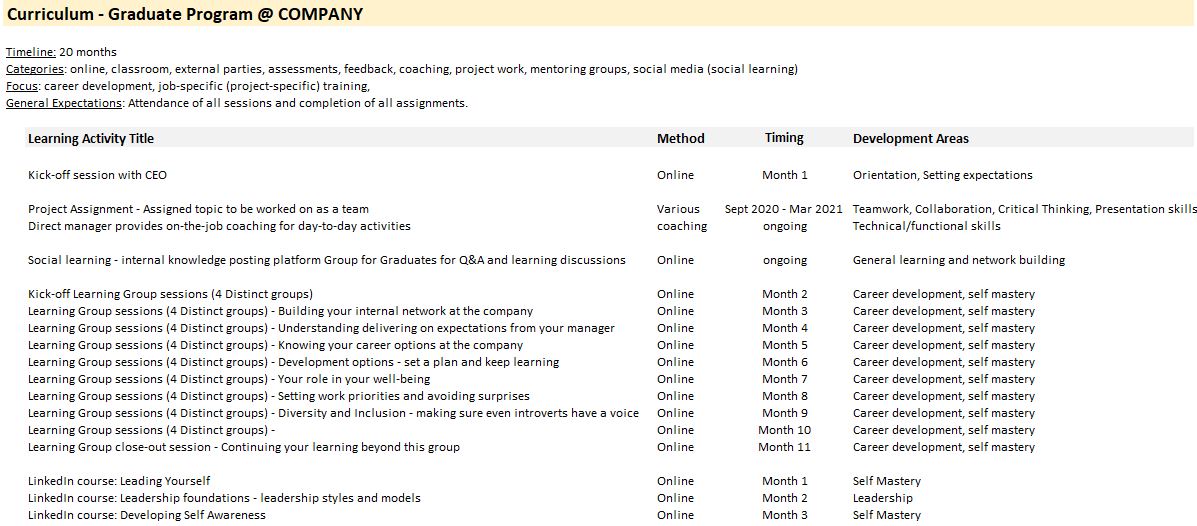
Setting up the curriculum over the development period means you decide how the various learning solutions are scheduled and planned to strengthen and support key messages throughout the time period that your program runs. Each aspect strengthens what had already been covered while adding additional knowledge. Including various learning methodologies (blended learning) enhances the learning experience and keeps it interesting.

Snapshot of a learning program for graduates

Note:

  1. Always start by understanding what you are trying to address before you start designing your development program. What is the learning need? What is the business value of employees having this knowledge and experience?
  2. When does the business need employees with these new skills, understanding and experiences? Is it short-term (within the next year), medium-term (between 1 and 2 years) or is it longer term (more than 2 years)? Knowing the timeframe also helps you decide what to develop internally vs outsourcing the entire program or parts of it.
  3. Who needs to learn these new skills/behaviors? Be very clear who is your target population for this development program (How many years of experience do they have right now? What kind of experience do they already have – functional, geographic etc.).

Preparing managers to support learners

Employees are more motivated and do better when their managers are onboard with their participation in the development program. Be sure to engage with managers before participants are told about the program. Managers need to understand the business context of the development program, why someone on his/her team is included in the program (if they were not nominated by the manager) and how to support the employee throughout the program. Some manages may need training or coaching in this regard.

Snapshot of a manager checklist

Employees participating in these kinds of development programs are often still working in their current roles. Supportive managers not only expect good results in their departments or projects, but also hold employees accountable for completing program assignments. This gives employees the best chance of completing the program successfully.

Preparing attendees to succeed

Development program attendees need to understand more than just the program contents and overview of dates. An orientation session for intended program attendees could help with that. The session gives them an opportunity to understand the business context and benefits to their own careers plus they can ask clarifying questions before committing to invest the time and effort needed to successfully complete the program.

Snapshot of Program Attendee checklist

And orientation session with development program attendees should include at least these topics:

  • A welcome message from an executive, usually the sponsoring executive, explaining the business value of the development program and also career benefits for attendees.
  • A message from Talent Development explaining program expectations, the blended learning approach, deadlines, the team assignment and any other relevant details of the program that attendees should know about at the start.
  • If the program existed before and there was a redesign or some changes were applied, explain how the current programs differs from previous versions some attendees may have heard about in the past.
  • Provide the opportunity for some Q&A

Keeping learners motivated when a development program runs over many months can be a challenge. Helping to keep attendees focused on assignments and deadlines can be easier when you build in challenges which generate leader boards (friendly competition) or where individuals can earn points or badges by completing specific tasks. Adding recognition by the manager/group/department can also be helpful. Recognition can include anything from a small token offered to attendees after completing a specific portion of the program to being mentioned in the company newsletter.

Hopefully these three templates (see download links above) are useful as you review your own planned development program. Do download the 3 files above if you need to see the templates in detail.

Coaching Program Orientation – Presentation


All coaching programs should contain an orientation as one of the starting elements. This session should cover the objectives of the program, what the expectations are for both coaches and those to be coached and any other general information that would be important for the participants of your coaching program. You can choose to combine the two groups for the session or you could choose to do separate sessions for coaches and those to be coached. If you choose the former you may want to add a training or reminder section of any specific coaching aspects that you wish to empathize.

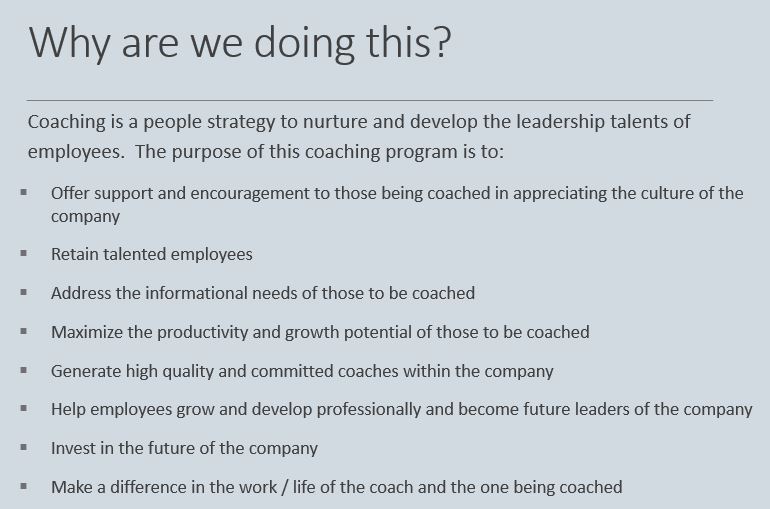
Slides for the orientation meeting

The download file above contains a series of slides to help you get started creating your own. It shows some of the typical questions that coaching program participants may have and answers that may be relevant, but of course subject to your edits to suit your specific needs.

Tips:

  • Be sure to have a Q and A portion to answer any specific questions that anyone may have.
  • The front part of the presentation which sets the scene in terms of “no entitlement to promotion etc.” would be relevant if you have experienced that as an issue in your workforce or talented employee pool. In some cultures that may be seen as “offensive” or even “threatening” that it would be mentioned. So be culturally sensitive when you consider keeping that comment.
  • In the roles section I mention HR as the function supporting the coaching program – depending on your organization that could be your Learning and Development department, your Organization Development (OD) group or any other department/group.
  • Be sure to provide the coaches and those to be coached with all the tools they will need. If not printed and handed out at your orientation session, then perhaps a soft copy on a USB stick or per email after the session. Coaching questions or Preparation for Coaching