9 Tips for Compelling Competition Entries in Sustainability


Entering the project you are most proud of into an excellence competition is an exciting opportunity to showcase your hard work and achievements. But let’s face it, the competition can be stiff—especially when sustainability is a key judging criterion. Don’t worry, though; this post will guide you through how to focus on the right elements and tell a compelling story that highlights your project’s success without making things up. The secret? It’s all about having the right data, understanding what it means, and explaining why it matters.

Here are nine ways to make your project stand out and be memorable and remarkable:

1. Start With the Basics: Read the Rules

Before drafting your entry, carefully review the competition guidelines, especially sections on sustainability or innovation. These often hint at what judges value most—energy efficiency, water conservation, carbon reduction, waste avoidance, community impact, or even all of these. Align your entry with these priorities. And don’t stress over word limits—stay within 10% of the specified count, as they’re there to keep entries focused, not to demand a full thesis.

2. Tell a Story, Not Just the Facts

Before you start writing your entry, read the competition guidelines carefully. Pay special attention to any sections about sustainability or innovation. Competitions often provide clues about what the judges are looking for—energy efficiency, water conservation, carbon reduction, waste avoidance, community impact, or maybe all of the above. Tailor your entry to match these expectations.

3 Focus on Measurable Outcomes

Judges love numbers, so don’t shy away from sharing your data. If your project saved energy, reduced emissions, or cut costs, include the specifics. Here are some examples:

  • Energy Efficiency: “We installed energy-efficient lighting and reduced electricity usage by 30%, saving EUR 10,000 annually.”
  • Waste Reduction: “By reusing materials on-site, we diverted 95% of construction waste from landfills.”
  • Sustainability Impact: “The project’s solar panels now produce 20,000 kWh annually, enough to power 10 homes.”

Don’t have all the data? That’s okay—start with what you do have. Just be sure to explain how you measured these outcomes and why they’re meaningful.

4. Highlight What Makes Your Project Unique

Competitions are about standing out. Did you try something new that hadn’t been done before? Did you find a way to make the project faster, cheaper, or more sustainable? Maybe you combined existing methods or approaches in creative ways. For example:

  • “We used prefabricated components to speed up construction, reducing on-site waste and emissions.”
  • “Our landscaping included native plants, which cut water usage by 40% and boosted local biodiversity.”

Be clear about how your approach sets your project apart.

5. Talk About What You Learned

No project is perfect, and judges appreciate honesty. Talk about what went well but also acknowledge what didn’t. Maybe a new method didn’t work as planned, or you realized late in the process that a different approach would have been better. What’s important is that you show you learned from the experience.

For example:
“We underestimated the time required to train staff on the new energy management system, which delayed implementation. In the future, we would schedule training earlier to avoid this issue.”

6. Sustainability: More Than Just Energy

When we think of sustainability, energy efficiency often comes to mind first. But there’s more to it. Judges might also look for:

  • Circular Economy: Did you reuse, upcycle or recycle materials?
  • Water Conservation: Did your project reduce water usage?
  • Community Impact: Did the project benefit local communities or create jobs?
  • Biodiversity: Did your landscaping include native plants to support local ecosystems, or did you create green spaces that attract pollinators like bees and butterflies?
  • Positive Local Community Impact: Did you partner with local schools for educational programs or support community groups through funding or volunteer initiatives during the project?

By broadening your perspective, you can show how your project goes beyond energy savings to create lasting, meaningful impacts. Be sure to cover these aspects if they apply to your project.

7. Be Honest—Don’t Fake It

It’s tempting to stretch the truth to make your project look better but resist the urge. Judges have likely seen it all, and they’ll spot exaggerations a mile away. Instead, focus on presenting your project’s real achievements as clearly and confidently as possible.

8. Make It Easy to Follow 

A clear, well-organized entry can make all the difference. Judges don’t have time to untangle cluttered submissions, so present your work in a way that flows logically and is easy to digest. Use clear headings, concise bullet points, and short paragraphs to guide the reader. 

Think about your structure: 

  • Timeline Approach: Are you walking judges through processes, events, or project phases step by step? 
    • Top-Down Method: Are you starting with a big-picture overview and then zooming in on specific achievements or highlights? 
    • Comparative Lens: Are you showcasing measurable improvements by comparing past performance to present outcomes and projecting future benefits? 

If you’re including technical data, don’t let it overwhelm the narrative. Break it down into simple, relatable terms that anyone—even those without technical expertise—can understand. For example, instead of saying “airtightness of 0.6 ACH at 50 pascals,” explain how that translates into better energy savings or indoor comfort. 

A polished, intuitive format not only keeps the competition judges engaged but also ensures they don’t miss the full scope of your project’s excellence.

9. Think About the Future

Judges often like to see how your project has inspired or informed future efforts. Did it set a standard for your company or industry? Has it led to new ideas or processes? For example:

  • “The success of this project has prompted us to roll out similar solar energy systems at three other sites.”
  • “We are now working to integrate lessons learned into our next project to achieve even greater sustainability.”

Entering a competition isn’t just about winning—it’s about showcasing what makes your work exceptional. By focusing on measurable outcomes, sustainability, and what you’ve learned, you can create a compelling entry that stands out.

Remember: the judges aren’t looking for perfection—they’re looking for impact, innovation, and integrity. Follow this approach, and you’ll not only improve your chances of winning but also demonstrate why your project truly matters.

Now go tell your story—sustainably, of course!

Timing is Everything: Save with Smarter Energy Use


Looking to lower your electricity bill? It starts with understanding when and how you use electricity. By reviewing your energy usage, you can spot the times when you use the most power and which appliances consume the most. This information is key to cutting costs.

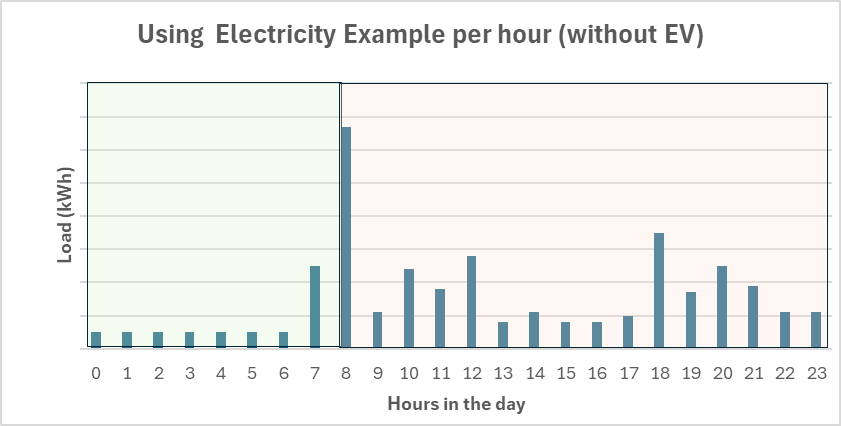
Below is an example that shows how much electricity a household uses each hour. The taller the bar, the more energy is used during that hour. You can see a spike around 8 AM, likely because people are getting ready for work or school. In contrast, early morning hours, when the household is asleep, show much lower energy use. This example might also reflect a home using efficient heating during winter, resulting in lower usage overnight.

Think of the electricity grid like a busy road. During rush hour, traffic slows down because everyone is on the road at the same time. The same thing happens with electricity—during peak hours (like afternoons and early evenings), lots of people are using power, which puts stress on the grid.

In the chart below, you’ll see the household’s energy use in two colors: green and orange. Green represents times when electricity is cheaper, while orange shows when it’s more expensive. As you can see, most of the electricity is being used during the orange (expensive) hours. If the household shifted some tasks, like running the washing machine, dryer, or dishwasher, to the green (cheaper) times, they could save money. Even small changes like this can make a big difference on their electricity bill.

Some utility companies offer plans that charge you based on when you use electricity. The rates vary depending on the time of day—electricity is cheaper during certain hours and more expensive during others. By understanding how these time-of-use tariffs work, you can adjust your habits and save money on your electric bill.

Variable electricity rates work like offering different prices to drive on the roads at different times of day. When more people use the roads at quieter times, traffic flows smoothly. Similarly, when more people use electricity during off-peak hours (when the grid is less busy), it helps utility companies avoid overloads and keep the system running smoothly.

By charging higher rates during peak hours, utility companies encourage people to shift their energy use to less busy times. This reduces strain on the grid and helps prevent blackouts or other issues during periods of high demand—like when everyone is cooking dinner or watching TV. During off-peak times, such as late at night when most people are asleep, electricity is cheaper because demand is lower.

This pricing system, known as Time-of-Use (TOU) tariffs, means that electricity costs vary throughout the day, giving you the opportunity to save money by using energy during cheaper, off-peak hours.

Let’s look at an example to show how time-of-use tariffs can impact your electricity bill. We’ll compare two scenarios: one where a household uses a variable rate plan, and another where they don’t. In both cases, the household uses 150 kWh of electricity in a month, so the only difference is the plan they’re on. This will help illustrate how using the same amount of energy can cost less when you take advantage of variable rates.

A Time-of-Use Electricity Tariff

For this example, let’s assume that electricity costs €0.18 per kilowatt-hour (kWh) during the day, from 8 AM to midnight. At night, from midnight to 8 AM, the cost drops to €0.10 per kWh.

Now, if your total electricity usage for the month is 150 kWh, and you use 100 kWh during the day and 50 kWh at night, your electricity bill would be calculated like this:

  • Daytime usage: 100 kWh x €0.18/kWh = €18
  • Nighttime usage: 50 kWh x €0.10/kWh = €5
  • Total bill: €18 + €5 = €23

Without a Variable Rate for Electricity

If there’s only one flat rate for electricity throughout the day, the cost is often higher. Let’s say the rate is €0.21 per kWh. In this case, the family’s monthly bill would be:

  • Total bill: 150 kWh x €0.21 = €31.50

As you can see, the household with a time-of-use plan pays less (€23) compared to the flat-rate plan (€31.50). This shows that variable rates can save you money, even though the peak-time rates are sometimes higher than a flat rate.

If your utility provider offers time-of-use or variable tariffs, where you pay less during certain times of the day, here are some steps you can take to maximize your savings:

  1. Install a Smart Meter: A smart meter tracks your electricity use hour by hour, so you can see exactly when and how much energy you’re using. Many utility companies offer free installations, giving you better control over your energy habits.
  2. Adjust Your Daily Habits: Shifting energy-heavy tasks like laundry or dishwashing to off-peak hours can significantly reduce your bill. Even small changes can add up over time.
  3. Monitor Your Usage: If your utility offers an app or online portal, check your electricity usage regularly. Look for patterns and try to match high energy use with specific activities (e.g., running the washing machine). This helps you identify when to shift energy use to cheaper times.
  4. Upgrade to Energy-Efficient Appliances: When it’s time to replace appliances, choose energy-efficient models. These not only use less electricity but can save even more if run during off-peak hours.
  5. Use Smart Appliances: Some appliances can be programmed to run during off-peak times automatically. Set them to start when rates are lower, and enjoy the savings without having to think about it.
  6. Install a Programmable Thermostat: Adjust your thermostat to lower the temperature during peak hours to reduce heating and cooling costs.
  7. Invest in Energy Monitoring Devices: These devices show real-time energy usage, helping you identify which appliances are using the most electricity. With this information, you can turn off unnecessary devices or shift their use to cheaper times.

Taking these simple steps can help you cut costs and make the most of your time-of-use tariff plan.

In conclusion, saving on your electricity bill is easier than you might think. By simply shifting your energy use to off-peak hours and being mindful of when and how much electricity you use, you can make a big difference in your monthly costs. Small adjustments, like running appliances at cheaper times or using energy-efficient devices, can lead to significant savings over time. With just a little effort and smarter energy habits, you’ll not only reduce your bill but also take control of your household’s energy use.

Smarter after Covid


Finding better ways forward

Before Covid most companies with international interests had several people flying and traveling to other offices and locations to attend meetings, lead initiatives, or train others. While most of us have pretty much remained “grounded” in our countries without the option to travel, company activities continued (as far as it was possible). Something seems more obvious now than perhaps in 2019: We are getting pretty good at training, meeting and mentoring remotely using technology and internet connections. Yet, when we can, will we continue previous practices of sending our leaders and experts to remote locations on a regular basis like we did before? It is said that Ireland lowered carbon emissions by at least 6% during 2020 and some companies have seen business travel costs more than halved over 2020!

Some challenges that companies try to address by flying in leaders and experts from HQ:

  • We do not have people in all locations with the right experience and skills and HQ experts are needed to support local teams on a regular basis.
  • We are not exactly sure what the true status of projects are and we would feel more comfortable having one of our trusted staff regularly visit remote locations.
  • We are not sure that local people understand our strategies and truly commit to realizing performance targets, which means someone needs to visit with them on a regular basis to ensure they do understand our strategies and then review with them how their efforts support these.
  • We are finding it tough to source local people with the right skills and experiences and those we can find are too expensive in terms of compensation expectations.
  • The local people speak a different language and their English language skills are not great, which makes it hard to know for sure what they are trying to convey during our calls. We need to see the project/work to understand more clearly what is really happening there.
  • The local people may not be forthcoming with bad news relating to projects in remote locations and they may possibly favor being cordial over risking our dismay.

The list is not exhaustive, but it does highlight some of the opportunities to find better ways going forward to avoid going back to the level of business travel we previously considered normal.

The term Glocal means to Think Global and Act Local and it is said that Akio Morita of Sony Corporation was the first person to use the term which became popular in the business world in the 1990s. How to think about the big picture and over-arching strategies goals and still be sensitive to local conditions and needs when you implement those big picture ideas? A balance would have to be created and it would be an ever-adjusting type of balance which is not fixed in place. To incorporate (for example) shifts in local legislation or new diversification strategies from HQ. Finding a way to keep this balance in place may lower the need to return to pre-covid business travel levels.

There are at least three ways to address this:
  1. Focus leadership development in a few key areas,
  2. Better teams – adjusting selection and development of staff, and
  3. Better use of technology – making more use of technologies to facilitate remote collaboration.

Better leadership

Having the judgment, problem-solving and decision-making skills to navigate in the space where one has to constantly balance global strategies and goals with local situations and conditions means leaders have to be comfortable with ambiguity, be constantly on the look-out and actively engaged in learning new skills and understanding how others have succeeded or failed in addressing what lies before the leader. Learning how to proactively include all team members including those who are “different” and to do this successfully leaders at HQ and remote locations need to understand their own biases and stereotyping. This will ensure that the skills of the entire team is leveraged in achieving performance goals. Lastly, leaders also need to have the ability to easily shift their perspective from global thinking to local acting and back in order to maintain the balance needed for the decision they need to make at that moment.

Better teams

Working on a diverse team with some team members in remote locations is something we have learned to do successfully over the last year. And this new skill has brought opportunities to get better results through teamwork without having to be present in an office or with the entire team. Will we ask – does this person have to be in the office every day of the week? Or will we consider hiring talent where we find it without feeling he or she needs to be relocated to HQ in order to be an effective member of our team?

To help existing teams be more inclusive and effective some specific or additional training may be needed around diversity. This training can include developing an improved understanding of cultural differences and perspective differences (for example among provinces or states in a country). It often comes down to increasing awareness of own biases and stereotypes that may have settled in our perspectives about groups of people who are very different from our own backgrounds.

Recruiters and hiring managers also have to start including additional skills in requisitions to fill vacancies. Skills like additional language skills – not only English – experience such as having lived and/or worked in a country other than their home countries.

When creating teams to work on performance improvement projects (action teams) – why not include people from different functions, locations and cultures on the team? It is a great way to increase your internal network of employees collaborating and communicating across locations.

All of these aspects can help a team become more global-minded and inclusive while making smarter choices working on local projects which impact broader strategies or targets in the company.

Use technology

In addition to tools for video-conferencing, there are tools which can help monitor progress or quality without having to travel to a location.

1. Hololens2: click this link to see short video of what it can do across various industries – there are ways for clients and HQ personnel to connect with someone using this technology at a remote location.

2. Realwear: click this link to see a short video of how it can be used to get input and advice from a person located remotely.

3. Some locations use drones to get an understanding of general progress on large construction projects and provide overall updates to managers at HQ. Drones can also be used to inspect hard-to-reach places safely.

4. Use a centralized electronic storage solution for files meaning all local files can easily be viewed from remote locations without needing to travel to a site.


While working smarter in these ways is also a way to lower pre-covid GHG and carbon emissions, many employees appreciate the flexibility of remote working options and combined with lower business travel needs it adds to having a better work-life balance. The amount of quality time spent with families and friends has also increased for most. All of which adds greatly to employee well-being. Looking for ways to leverage what we have learned by having to work remotely during 2020 can benefit companies and employees in greater ways than we may be able to realize now.