From Silos to Synergy: Ignite Team Collaboration with a Creative Art Exercise


Collaboration is all about tearing down invisible walls between functions and geographies and bringing people together in a way that feels natural and fun. This collaborative canvas activity uses art to help everyone experience working toward a shared goal. Each person adding their own splash of creativity to a group masterpiece supports reflection on how each participant supports the big picture — all while getting a fresh take on teamwork, company values, and communication.

It’s a hands-on way to see how different ideas can blend into something unique, and why trust, adaptability, and shared ownership are key to breaking down silos and achieving success together.

This interactive activity is designed to break down silos between departments and regional leaders by improving collaboration, adaptability, and shared ownership. Using art as a medium, participants will explore teamwork, communication, and how individual contributions blend into a collective vision.

Canvas Arrangement – Multiple A4-sized canvases are set up in a circle, with each canvas facing outward to allow participants to engage without observing others’ immediate responses.

Materials – Brushes and paint, exclusively using the corporate color palette to reinforce company identity. Note that each participant receives one brush and one color, symbolizing their unique perspective and input.

  1. Music begins playing softly as participants settle in front of a blank canvas, encouraging focus and creativity.
  2. Once everyone is ready, the music is turned down, and clear instructions are shared. While participants work on their canvas for those 30 seconds music can be played – it is optional.

Engagement

  1. Participants start by standing in front of a blank canvas with their designated color and brush in hand.
  2. Each person responds to 4 prompts (statements or questions) that align with the company’s:
    • Vision
    • Mission
    • Values
    • Reflection on last year’s operational and financial results

Rules

  • Each round lasts 30 seconds from the moment that the sentence or question is read.
  • During this time, participants draw or write their responses on the canvas in front of them using the color and brush they have been given.
  • At the sound of a bell or signal, each participant is to move clockwise to the canvas on their left.
  • Each participant must continue to respond to the new prompt on the next canvas, building on the contributions of others.
  • No returning to anyone’s original canvas or modifying earlier work.

Rounds

Each round features a new statement or question to react to creatively on the canvas in front of each participant using only the brush and color each has been given.

Prompts should spark reflection on the company’s collective goals and inspire responses that challenge silos:

Once all 4 rounds are complete, participants step back to look at the canvases, including their original starting piece. This is a powerful moment to consider team topics like shared ownership, teamwork, collaboration, and adaptability.

Debrief questions

  1. How do you feel about how your original canvas turned out?
    • Did it match your vision, or was it transformed by others’ input? How did you feel about the contributions of others on your original canvas – did it turn out better or lesser than you hoped?
  2. What was it like contributing to a canvas where you disagreed with earlier markings?
    • How did you adapt or build upon previous ideas? Even if and especially if you disagreed with what you saw when you moved to that canvas?
  3. How does this experience relate to teamwork in our company?
    • How do we handle differences and align diverse contributions across departments or regions? Can we do better?
  4. What lessons can we apply to ensure better collaboration and a shared vision moving forward?

It’s not just about the finished artwork but about realizing how individual efforts combine to create something meaningful together. This activity highlights the importance of adaptability, communication, and trust when working across teams. The lessons learned can be applied directly to real-world collaboration — helping teams break down silos, align their contributions, and work more effectively toward shared goals. Plus, the visual reminder of the canvases can serve as a lasting prompt to keep these ideas top of mind in daily work.

This activity is more than just a creative exercise — it’s a powerful way to see teamwork in action. By adding your unique perspective to a shared piece of art, you experience firsthand how collaboration, communication, and trust can transform isolated efforts into a cohesive result. It’s a reminder that breaking down silos isn’t about losing individuality, but about combining strengths to achieve something greater. As each participant steps back and looks at the final creation, they will see the potential for better teamwork, adaptability, and shared success, ready to carry those insights into everyday work.

Streamline Your Workflow: Start, Stop, Change Strategy


Feeling overwhelmed by your to-do list? It’s time for a fresh approach. Whether you’re figuring out what new tasks to start, which processes to stop, or where to make improvements—including sustainability initiatives—this simple method will help you cut waste and boost efficiency. Think of it as a game-changer for your workflow, empowering your team to work smarter, not harder, while making real progress. Change doesn’t have to be overwhelming; it’s about making strategic, impactful adjustments that lead to better results, smoother workflows, and more sustainable outcomes.

A Fresh Approach to Tackling Chaos

Ever feel like your to-do list is out of control? This simple method helps bring clarity, meaning, and direction to your tasks. Whether you’re deciding what new actions to take, which processes need tweaking, or which habits to drop, this approach will streamline your workflow, boost productivity, and make your routine more manageable.

Even the best processes lose their effectiveness over time or fail to take advantage of the improved availability of better tools and templates, signaling the need to reassess. While big changes can be costly, small adjustments often get things back on track. The method I’ll share is perfect for team brainstorming, making it easier to identify areas for improvement together.

Think of it like tidying up a familiar room. Some things need to go, while others just need a small fix. This tool helps you do the same with your work, identifying what needs to change, what new actions to start, and what habits to stop.

Importantly, it’s also about working smarter with sustainability in mind. Rethinking processes to reduce waste, conserve resources, and adopt eco-friendly practices not only improves efficiency but also builds a more sustainable work environment for the future.

Think of yourself as a gardener, planning to refresh and revive your garden. To improve a process or outcome at work or in a volunteer setting, you need to plant new “seeds”—ideas and actions that hold the potential to bring positive change. These are the things you want to start doing to make a meaningful impact.

Ask yourself: What new tools, strategies, or approaches could help streamline work, solve problems, or improve how people experience your organization or team? It might be a fresh approach to a recurring issue or an idea that could make things more efficient. Like planting new flowers in a garden, these initiatives will need your time and attention to grow and flourish.

By starting these key actions, you create opportunities for improvement and success and build an environment that thrives on new ideas and growth.

When we talk about what needs to stop in the workplace, we’re focusing on behaviors and habits that hold everyone back. Think of gossip—it’s like a poison that erodes trust and divides teams. Then there’s micromanagement, which stifles creativity and leaves people feeling frustrated and demotivated. And multitasking? While it might seem productive, it often leads to mistakes and burnout. By eliminating these negative behaviors, we can create a more positive, collaborative, and efficient work environment.

Stopping isn’t just about behaviors, though; it’s also about simplifying how we work. This means cutting out unnecessary steps, avoiding redundant processes, and leveraging technology to make tasks easier and faster. It’s about working smarter, not harder.

The key to success is getting everyone involved. When the team collaborates and shares insights, it becomes easier to identify which tasks or processes don’t add value—and figure out the best ways to eliminate them. This not only streamlines workflow but also helps the entire team feel more aligned, motivated, and connected.

When identifying what needs to be changed, it’s about finding those processes or tasks that work to some extent but aren’t quite hitting the mark. These are not things you want to stop completely, but they could benefit from refinement or improvement. The goal is to enhance their efficiency or effectiveness rather than overhaul them entirely.

This step is about finding out with your team where bottlenecks occur, where confusion arises, or where inefficiencies creep in. Perhaps you uncover small tweaks that make a big difference. For example, a task might be taking longer than necessary because of an outdated step, or perhaps communication between teams could be improved to streamline a handoff.

Other possible candidates for change may lie in opportunities to improve: Are there tasks that could be automated? Is there a process that could be shortened or simplified without sacrificing quality? Sometimes it’s as simple as adjusting timelines or reallocating resources to better fit the demands of a project.

The key is not to throw out processes that have potential but to fine-tune them. By making small, thoughtful adjustments, you can improve the overall flow and outcomes. Involving the entire team in identifying these areas for change ensures that the solutions are practical, realistic, and beneficial for everyone.

Setting up time with the team

To kick off improvements, start by gathering input from everyone involved in the workflow. Set up a dedicated meeting where each person can share their unique insights. By involving the whole team, you’ll gain a diverse range of perspectives, helping you identify opportunities for improvement far more effectively than if you were working alone.

To make the session productive, team up with coworkers and dedicate about an hour to look for ways to enhance how you work, the environment you work in, or how your organization delivers value—whether it’s to customers, clients, or those benefiting from your volunteer efforts.

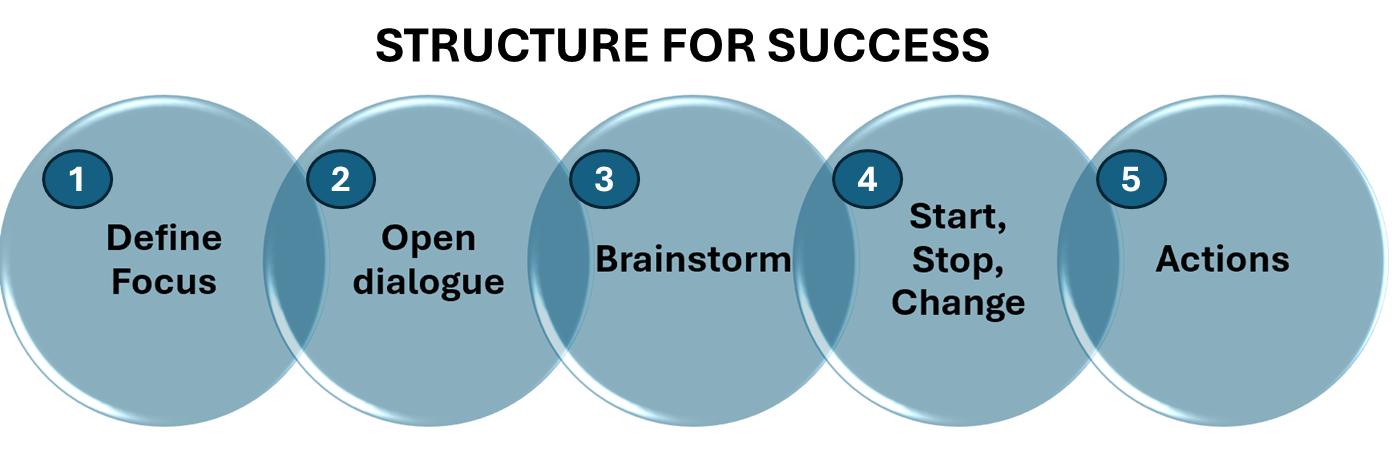
Here’s how to structure your session for success:

  1. Define the Focus: Clearly outline what the session is about. Are you looking to improve a specific process, boost safety, streamline workflows, or enhance customer/recipient satisfaction? Make sure everyone understands the goal before diving into discussions.
  2. Encourage Open Dialogue: Create a safe space for everyone to share their ideas, frustrations, and suggestions. Emphasize that all feedback is valuable and will contribute to positive change.
  3. Brainstorm Together: Work as a group to explore ways to make things better, smarter, and safer. This could involve improving the way tasks are done, optimizing the workspace, or enhancing the delivery of value to customers or the community.
  4. Capture Ideas: Use Stop, Start, and Change flipchart pages to organize ideas. After brainstorming, categorize the suggestions:
  • Stop: What isn’t working and needs to stop?
    • Start: What new actions, processes, or tools should be introduced?
      • Change: What existing processes could be improved with a few adjustments?

5. Assign Actions: Once ideas are gathered, assign ownership for each action. Ensure there’s follow-up so the insights gained from the session translate into real improvements. Also, set up a follow-up recurring meeting to review how things are going to discuss if you need to change or improve how you are implementing actions to be more successful and avoid obstacles to success.

By following this structure, you’ll ensure that your team collaborates effectively and walks away with actionable steps to make meaningful changes.

Keep Stakeholders in the Loop

After the meeting, it’s important to keep key stakeholders, such as your supervisor or others involved in the implementation, informed about the progress. Provide them with an update on the discussions, including the proposal for items to start, stop, or change. This transparency ensures they are aware of the team’s efforts and can offer support as needed. Additionally, ask for their feedback and suggestions. This will help ensure that no key opportunities for improvement are missed and that the plan is as comprehensive as possible. Engaging others in this way enhances collaboration and strengthens the overall success of the initiative.

Now It’s Your Turn to Change the Game

Taking a structured approach to what you start, stop, and change can really improve how your team works and help you reach your sustainability goals. I encourage you to take a fresh look at your team, your environment, and how you get things done. Find ways to not only make customers happier and save money, but also to reduce waste, save resources, and lessen your impact on the planet. Involving your team in this process will help everyone work smarter and feel more motivated as they see their ideas making a difference. Whether you’re working or volunteering, these changes can lead to a more rewarding and sustainable experience. Now is the time to act—start looking for where you can make a real difference for your team and the environment.

Sustainability Awareness Workshop


– Getting creative instead of trashing items –

Single-use packaging is intended to be used only once before being thrown away or recycled. Included in this kind of trash would be food packaging, bottles for laundry detergent and other household goods, straws and boxes for tea bags, etc  From a global perspective, over 90% of trash is estimated to come from single-use materials. The good news in some countries is that over 50% of packaging is recycled.

The upside-down pyramid for waste shows the more preferred ways to deal with it.

When it comes to waste, the best option is preventing the waste from coming into our homes or office buildings, the 2nd best option is to reuse items somehow, and then comes recycling. Increasing awareness in your team is important – of being more responsible with their purchasing choices and choices regarding trash that passes through their homes or at the office. This workshop can improve awareness of how to reuse items instead of discarding them.

Participating in this workshop will show participants how to look at packaging trash from the perspective of reusing it, and creating a new purpose for single-use packaging. You can open the workshop by reflecting on trash and recycling in your city/location and how they could all help to improve those statistics by being more mindful of the items they bring into their homes (avoiding single-use packaging as much as possible) and also to not be so fast to throw away items that had only been used once at the office.

If you are passionate about having a positive impact on the sustainability habits and thinking of others in your organization, in your family, or among friends, why not get 4-6 people to join you in being creative with packaging that would have otherwise been discarded.

Items you can use in the workshop:

Most households would be easily able to collect some items like small carton boxes and items, printed pages that are no longer needed like advertising leaflets thrown in through mailbox slots, and paper-based packaging used for supporting fruits purchased in supermarkets. In the office, there could be boxes that contained pens and pencils or paperclips.

Two ideas to consider for the activity:

Paper Mache (papier-mâché)

You can make the paste using flour and water (see https://kinderart.com/kitchen/papier-mache-recipes/) tear the collected sheets of paper into strips about 1 inch wide and dip them thoroughly into the paste mixture. Strip off the excess mixture from each strip before applying it. It works well if you pull the strip of paper through to the other side between two fingers. Build up the desired new object by applying only one layer at a time and waiting for that to dry before going to a new layer. Dried objects can be sanded to improve the smoothness of the finished project before you apply an environmentally friendly paint design on top. Ideas of items that might be useful include containers for jewelry, organizing loose containers into a neatly contained area, or creating a container for paperclips and other office items that could be cluttering up desk drawers.

Coffee Stirrers

Make sure the used stirring sticks are free of coffee remains that could interfere with the gluing process.  Design ideas could include coasters for cups, glasses, or mugs at the office or at home. You could also build containers for pens or other office supplies. Remember to wait until the glue had dried before putting items on your built items to avoid breakage! And again you might use environmentally friendly paints to finish your coffee stirrer design items.

To limit the space and supplies needed for your workshop team activity, it may be wise to pick one type of project to work on vs trying to cover several types of projects in one space.

Workshop Programme

Welcome, and introductions – if not all participants know each other, allow time for everyone to introduce themselves.

Overview – talk about the reason for the workshop and focus participant attention on sustainability and how sustainability principles relate to the way we think about and how we deal with the packaging associated with purchases. Give them some trash generation and recycling statistics for your local area to help them understand the scale of the issues faced environmentally with how things are going in your area. Introduce the workshop as a way to become more aware and get creative with packaging waste that comes from homes and offices. Creative activities in groups are also great ways to improve the mental health of individuals and feelings of belonging in a team or group.

Activity – introduce the chosen activity and explain the materials available to participants. Make sure people know how much time you have planned for the activity and if there will be follow-up opportunities to complete projects or whether they could take any half-finished projects home to finish them there. Walk around while participants work on their projects and support them with advice where needed. Always make sure that safety is a priority and be sure to explain any dangers such as using cutting devices or opening and closing drawers and cupboard doors in the workshop area.

Closing – when the workshop time is at the end. Thank everyone for participating and being willing to learn new ways of looking at single-use packaging as small steps to help improve the generation of trash in your area. Remind participants of how they could finish up their projects and encourage them to share pictures of completed items with the team/group.

Awareness

The first step to improving any situation is awareness. This kind of team or group activity is a great way to increase awareness of the issues at hand with local trash generation and how each person can make a difference in small ways. Using creative endeavors to address this issue is also enjoyable and can be a great way to improve feelings of mental well-being, which is something we all can use in today’s world.

Exercise: Practice difficult employee conversations (for Leaders)


roleplay final

I am a strong believer in experiential learning – learning by or based on an experience and observation. Key learning points seem to be integrated faster and stronger when the learners are put in a situation where the skills they need to learn or apply are put to the test.

The exercise I am sharing (see download file below) is a group or team exercise focused on the style of a leader and how a leader approaches employee issues given their own background and preferences. The backdrop for the experience could be situational leadership  or Emotional Intelligence for leaders. It is up to the trainer or facilitator to choose the right materials to suit the needs of the team or group.

The exercise requires some volunteers to engage in role-play based on specific scripts – included in the resource. There are “role sheets” to help those standing in as employees understand how that employee behaves and describes his or her style.

The key to this exercise is to showcase the possible dilemmas that leaders can face when confronted with employee behavior that seemingly goes against their own values or goals at work. The discussion after the role-play exercises is where the most value can be realized. Reflecting on what the group saw and experienced during the role-play and then relating that to their day-to-day work-life is where most insights tend to surface. This helps each leader determine how he or she could adopt a new mindset in dealing with difficult discussions with employees going forward.

This exercise works well for groups ranging from 8 to 16 people. Larger groups of 20 people or more can work too, but you may need to add in an additional step – a small group exercise. In that case, divide the group into smaller groups of 4 or 5 people and have them discuss the exercise debrief questions in the small groups before requesting each of the small groups to report back to the larger group for further discussion. You may want to consider an additional facilitator to assist if you are dealing with groups larger than 20 people.

Without emotional intelligence or a compassionate approach to interpersonal relationships even leaders with the best technical minds and education will never be great leaders with motivated followers. Exercises like the resource I share here can help trainers and facilitators bring home the importance of having the right approach and encourage a personal change process in developing leaders.

Team Activity – Defining Project Interfaces


Most projects are made up of several sub-groups of people. On a construction project you can imagine there is a group of people tasked with looking after the physical safety of people working on the site. You can also imagine another group that looks after checking that materials and installed units meet quality requirements. These sub-groups of people have interfaces with each other whereby they exchange and share information, documents and outcomes. They also provide and request support from other groups to start, complete and execute a process. Most of the time project inefficiencies occur across the interfaces with internal and external sub-groups or functions.

The best way to ensure efficiency and effectiveness across project interfaces is to increase transparency around assumptions that people have . Test whether they are accurate and understood by others on the project.

Note that project interfaces can also refer to processes that involve multiple functions in the home office environment or the company structure. These “external” groups to the project may be setting high-level processes and goals, which create the environment that the project team needs to operate in. Examples may include HR, Finance, the group that tracks compliance with corporate policies and procedures etc.

This team building activity that I am sharing helps various interfacing groups understand differences that may exist between how they think they should be interfacing with other groups and what the actual expectations from other groups are.

This activity can be used in many different ways:

  • Clearing up interface issues among geographically dispersed groups working on the same processes or projects;
  • Clarifying how different functions should interface with one another on a project;
  • Clarifying any differences in perspective among cultural groups or different shifts of people in the same function working on the same tasks interfacing with one another; and
  • Getting clarity on how multiple projects should interface with each other and/or the corporate groups they work with.

The reason that interfaces with other groups tend to be where delays and frustrations occur is because it is common for people to analyze and optimize processes only for the portion that they are responsible for. This perspective means they often overlook how their efforts impact others or how the efforts of others impact them and they fail to take the bigger picture into account. This activity will support efforts to improve the outcomes of inter-group processes as you work towards greater successes on your projects and initiatives.

Conflict Resolution between Teams – an Activity


Teams or groups mostly get upset with each other due to ill-defined or badly executed processes or unclear interface issues between them. There are of course other reasons too, but whatever the cause inter-team upsets can cause an overall failure to achieve planned outcomes and a project/location not achieving targets.

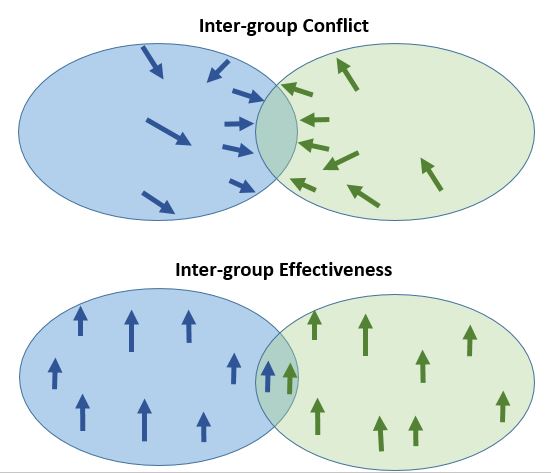
Intergroup conflict and effectiveness

This process that can be used to help two (or more) teams/groups work through their issues with each other and how they are impacting each other.

The process and activity is described in the document which you can download above. Estimated timing for each step of the process is also included. The timing is based on only two groups/teams working through the process. If you add teams/groups, do add additional presentation and discussion time to the combined portions of the process.

Each group or team have an assignment to work on independently and when the groups all gather together the results are presented and discussed in the larger group. The objective is to improve everyone’s understanding of exactly where things go wrong, what works and what does not work and how we will move forward with a new agreement of how we will work together.

The process requires at least one facilitator provided the combined groups comprise of no more than 18 people. If you combine more than two groups I would also consider having an additional facilitator to assist in the breakout sessions. The opening and closing sessions should be attended by one senior manager or executive that interfaces with all of the attending groups – to make opening comments to set the scene and establish the importance of the meeting and also to close off the event with encouraging and appreciative comments.

Note this:

  • The process is flexible and it would be up to you, as the facilitator, to make judgment calls along the way. Looking at how you are doing on timing and how well the process is going you may choose to avoid the second breakout session and instead have that discussion in the combined-group setting.
  • This process may not work well if the inter-group/team dysfunctions have been going on for quite some time and the frustration levels are high. In such cases I would recommend that you prepare for the session by first doing a pre-session interview with all or most of the intended participants. That way you can prepare for an intervention having a clear understanding of the issues at hand and the mindsets of those that will be attending. This may cause you to choose for a more comprehensive intervention.
  • If more than one facilitator is involved, do make sure every facilitator is completely aware of how the process will work. This is especially important when you choose to make some changes along the way – i.e. skipping the 2nd breakout session in favor of a large group discussion on the same topic.  It can be quite frustrating for groups/teams when they receive mismatched instructions from different facilitators for the activity they are to complete.