Risk Management TEMPLATE


Considering risks is a high priority for any project execution planning activity. It is important to also frequently re-assess during the project life-time. The project team should check the status of the risk plan against reality at various moments in time to ensure all risks are captured and accurately reflected along with mitigation or risk avoidance plans as required.

A risk plan is simply a plan that helps you identify where obstacles to successful outcomes could appear and what you could do about it. In some cases a potential risk can be avoided by taking some preventative actions in time. Some risks or obstacles could be things that can happen at any moment and some would only occur under specific circumstances. The project team should consider the key elements of the  project plan – where would the project plan have the highest risk of failing if key milestones or achievements are not met? That is the starting point of the template that I am sharing with you.

The risk mitigation template  shows you how to identify risks, identify the risk level of a possible obstacle to project success, determine what can be done to avoid or mitigate an issue/obstacle to success  and of course select who exactly should take the actions in the event that the risk is realized or upfront as a preventative measure.

Just download the attachment and complete the sections in yellow for each of the key elements of your project plan. Then answer the questions as outlined at the top of each column for each of the key parts of your plan.

When you review the plan look at the elements that were rated as “high risk” that it could occur and also a “high impact” if that risk did materialize. Focus your attention more on those items, but it is also true that sometimes a “low risk” obstacle could have a high impact on the project so be sure to review every element of the risk plan when you do your regular risk plan checks.

Every plan has risks and great returns on investments are often associated with a higher level of risks. The objective is not to avoid risks completely since the ability to manage risks well and willingness to accept and manage risks can be a competitive advantage in the marketplace. This template can help you increase your awareness of risks and learn how to manage them throughout your project. Becoming better at risk management will make you a valuable project member and business partner.
Conflict Resolution between Teams – an Activity


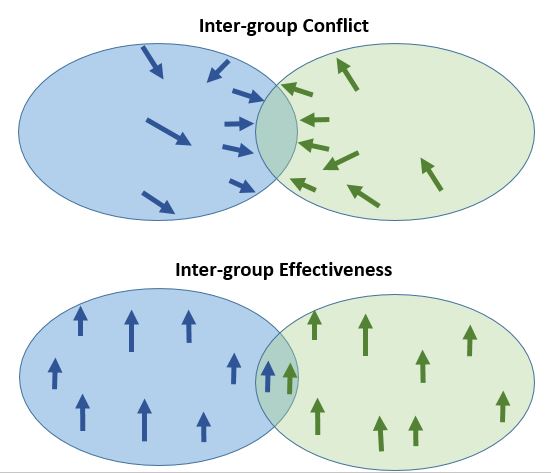
Teams or groups mostly get upset with each other due to ill-defined or badly executed processes or unclear interface issues between them. There are of course other reasons too, but whatever the cause inter-team upsets can cause an overall failure to achieve planned outcomes and a project/location not achieving targets.

Intergroup conflict and effectiveness

This process that can be used to help two (or more) teams/groups work through their issues with each other and how they are impacting each other.

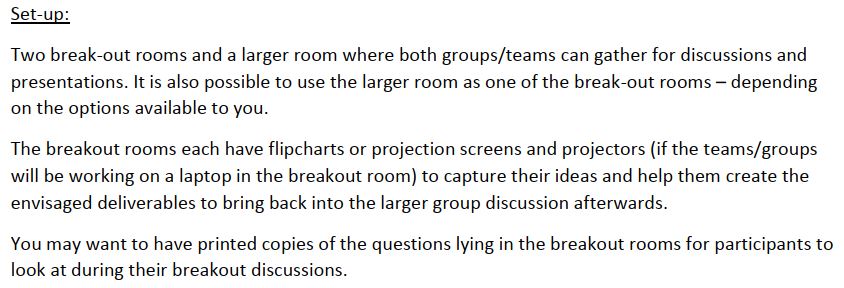
The process and activity is described in the document which you can download above. Estimated timing for each step of the process is also included. The timing is based on only two groups/teams working through the process. If you add teams/groups, do add additional presentation and discussion time to the combined portions of the process.

Each group or team have an assignment to work on independently and when the groups all gather together the results are presented and discussed in the larger group. The objective is to improve everyone’s understanding of exactly where things go wrong, what works and what does not work and how we will move forward with a new agreement of how we will work together.

The process requires at least one facilitator provided the combined groups comprise of no more than 18 people. If you combine more than two groups I would also consider having an additional facilitator to assist in the breakout sessions. The opening and closing sessions should be attended by one senior manager or executive that interfaces with all of the attending groups – to make opening comments to set the scene and establish the importance of the meeting and also to close off the event with encouraging and appreciative comments.

Note this:

  • The process is flexible and it would be up to you, as the facilitator, to make judgment calls along the way. Looking at how you are doing on timing and how well the process is going you may choose to avoid the second breakout session and instead have that discussion in the combined-group setting.
  • This process may not work well if the inter-group/team dysfunctions have been going on for quite some time and the frustration levels are high. In such cases I would recommend that you prepare for the session by first doing a pre-session interview with all or most of the intended participants. That way you can prepare for an intervention having a clear understanding of the issues at hand and the mindsets of those that will be attending. This may cause you to choose for a more comprehensive intervention.
  • If more than one facilitator is involved, do make sure every facilitator is completely aware of how the process will work. This is especially important when you choose to make some changes along the way – i.e. skipping the 2nd breakout session in favor of a large group discussion on the same topic.  It can be quite frustrating for groups/teams when they receive mismatched instructions from different facilitators for the activity they are to complete.

Problem Solving Template


puzzle (2)

It can be frustrating to try and figure out where things went wrong when the outcomes you had hoped for, did not work out. Sometimes it could be an object or piece of equipment that is not working well. It could also be a process that is at fault or perhaps it is human action or inaction that is causing the lack of performance.

This template helps one to work what you know and finding the facts in order to fix the issues that are stopping you from obtaining the right outcomes. This offers a better chance of discovering the root cause that is stopping you from achieving the planned good results.

After defining at the top what the problem is which you would like to solve, the worksheet takes you through a systematic process covering: The What, Where, When and How Big aspects are. Across the top moving from left to right on the columns, the worksheet has space to write down what you can see (what is observed) and it moves to any facts you are aware of which could relate to the observations, then writing down what the differences are between what you have observed and the facts until you finally arrive at the last column where you are able to narrow things down to the most likely causes that things are not working out with the problem you are trying to address.

It may seem tedious at first to complete the information indicated, but when the reasons or causes are less obvious this is a great way to summarize what you know about the situation in one place. We often know more than we realize and we simply need a way to put things together logically to spot the reasons behind a malfunctioning element in a failing piece of equipment or a process.

This tool can be used by an individual or in a group context. Sometimes it helps to have more than one person look at the same information and brainstorm through the elements shown in this template to get to the root cause(s). I also recommend that you retain a copy of this completed template to serve as a “lessons learned” to others.  I believe each one of us and every company/team should continuously strive to learn to remain competitive and innovative (creative). Others may be able to solve future issues by reviewing your completed sheet for the issue you solved.

How to set priorities in an action plan


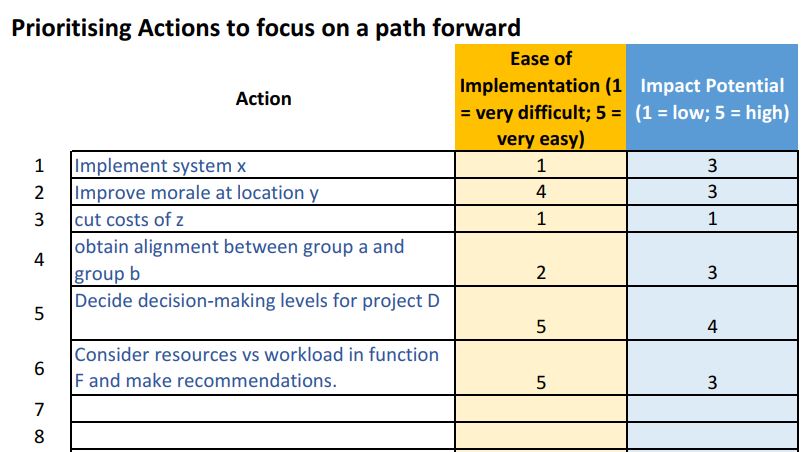
After a survey, a brainstorming session or a discussion it is often true that you end up with a long list of actions that should be put into an action plan. With many actions, maybe only a small number of people available to execute on those actions and possibly a small budget available for some of the actions, this could seem overwhelming.  The important question is: How can you prioritize the actions so you can make the most of the available resources (people to work on them) and funding (available budget)? And on top of that make sure that the most important actions are completed first?

Rate all the projects or activities on two questions:

  • what is the level of impact on your company, project, company if you completed that project/activity? (high means it would me a very big difference (positively))
  • how hard is it to implement this? (referring to available resources, skills and knowledge needed, tools needed, funding needed) (very difficult means you have very limited resources and budget and this project or activity would need more than you have available right now)

Use the scores obtained to plot your planned projects or activities onto this graphic: (the graphic shows an example based on the table and ratings above)

What to focus on?

Use the guide below to understand which of your projects or activities should be a high priority, low priority or medium priority with possible additional research needed.

One the one hand the question is: can you overcome what is difficult about that particular activity or project? Can you (for example) convince someone make more funding available if you present a very solid business case to highlight the value to the company or the project?

Or can you get more people to help? The other question to look into is whether the impact is really as low as you imagine? Speak to others to hear their views of how such a project or activity could possibly benefit more areas than you think. Perhaps the project is much more valuable than you think and it moves into the “green” quadrant meaning it should be a high priority for you to work on and complete.

If your dots appear in one of the yellow sections, you have some questions to ponder. If you can solve the question in each case you may be able to move that particular action into a different “zone” by changing the score. This means you are able to for example make it easier to implement by solving an issue which made it particularly difficult to implement. Or it could mean you realize the business impact is bigger than you previously realized because the company could gain a competitive edge if you implemented that particular action.  Your final action plan for immediate focus areas should contain those actions which finally end up in the green zone on the legend.

Be sure to communicate the reasoning behind your high priority actions to the key stakeholders in the outcomes of the action plan. They may have additional insights to share which could further cause you to change the scoring of actions.

You can use the Action Plan posted here to capture the actions that you will implement, monitor status of and report on regularly.

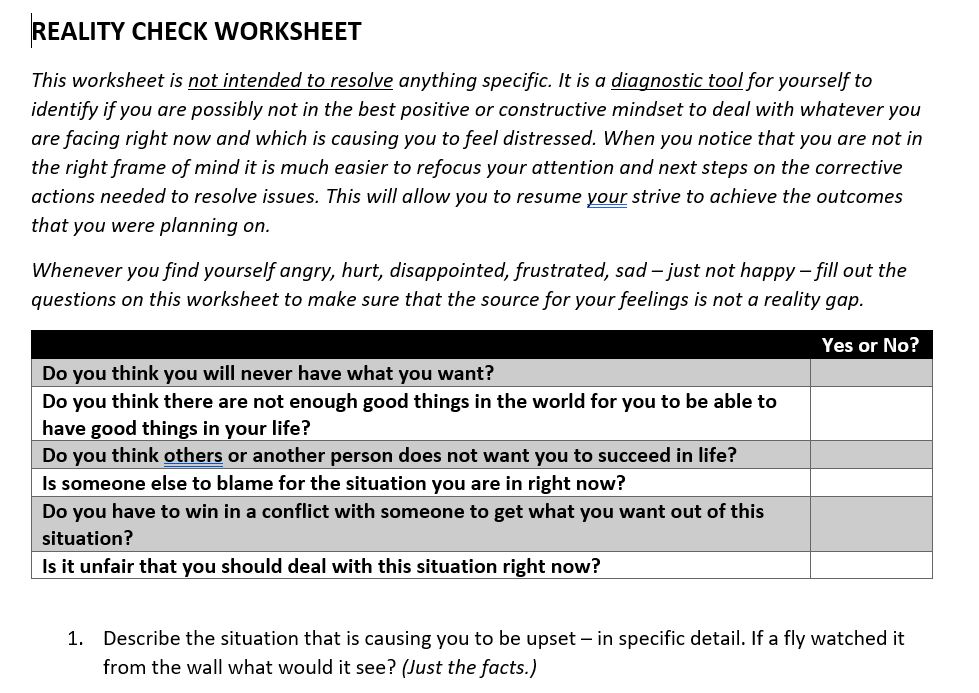
Use a reality-check worksheet for a Positive Mindset


The success of a leader, a manager or an ambitious employee depends largely on the mindset that he or she operates on. When we are in a positive state of mind we can focus on our goals and collaborate and communicate in positive ways which inspire and motivate others to help us succeed in our goals.

It is unfortunately also possible for us to get pulled away from the positive state of mind when we are in high stress situations for a long period of time and when we allow ourselves to go down a spiral of negative thinking. Successful leaders and managers have learned how to quickly realize when this happens and to start implementing corrective actions and adjustments to their way of thinking. This self-awareness and regulating their own emotions help them rapidly get back to a focused mind and closer to the outcomes that they are planning for.

Expectations and Reality Curves

This model shows the blue path which I call the Expectation Trap or summarized as the kind of thinking that believes “things should not be this way”. This kind of thinking very easily moves us out of a positive mindset and it is aligned with going against reality. We wish that reality was different and we build this on our expectations of how good things should be and how badly others are acting or behaving as if others are actually causing the negative outcomes which we do not want to see.  The green curve is the way out of the negative thinking. It is a different mindset which aligns with 1) doing a reality check and using that as the basis for moving towards a better way of thinking, 2) learning from the past, 3) changing or improving the plans we had before something happened to interrupt our progress and then 4) moving into the new direction with a positive focus and determination.

The first step, doing a reality check – is often the toughest and once a person is already in a negative state of mind it is really hard for him or her to realize that it is necessary to do this.

Use the outcomes from this worksheet for further discussions with your mentor/coach or adviser. It may be that you need some coaching or just someone to be a sounding board for you as you talk through the situation and how to resolve it in the best way.

Some tips:

  • Be sure to really connect with the negative feelings when you complete the worksheet. Some people are really good at being able to temporarily switch off their emotions to focus on business – but for this form, do make sure you are connecting with how it feels inside of you when you think about that situation or event that had caused you to feel pulled away from your positive mindset and down the Expectation Trap.
  • Do take the steps necessary to resolve any upsetting situation/event. There is nothing worse than unfinished business behind you. It slows you down and drains you of positive mental energy that you need to accomplish the goal(s) that you have set for yourself. Your coach/mentor or adviser can help you with that if you are not sure how to resolve the upset so you can leave it behind you.

Meeting Makeover: Improve Your Meetings with this Template


One of the most frustrating elements of many managers’ calendars are meetings. If you ask people they mostly believe there are too many participants, that meetings take too long, and that some individuals talk too much and venture off-topic. And most people are unable to remember what was decided or which actions came out of the meeting. The tool I am sharing helps a chairperson to prepare for a meeting and it helps him or her communicate the specific overall objectives for the meeting and also for every agenda item.

Some of the meeting maladies mentioned above can be cured simply by creating and distributing an agenda to participants before having the meeting. This tool goes further though – it also helps to create clarity around each agenda item’s purpose in informing participants or driving decision-making to move a project or initiatives forward.

The template you can download above contains an example to illustrate its use. Just replace the agenda items shown with your own meeting agenda items and then complete each column as demonstrated to clarify who is responsible for each agenda item, the purpose of each item, and the allocated time and desired outcome for each of the agenda items.  Do share the objectives, time available and expected outcomes with those who are assigned to each agenda item – it helps him or her be prepared to guide the conversation and discussion accordingly.

Suggestions

  • Even with an agenda and a well-planned meeting there may be times when things need to change as it becomes clear that a critical issue requires to be solved right-away.  Give yourself the leeway to abandon the agenda for a particular meeting to deal with such a highly critical and important issue or set another meeting right after the planned meeting to address the issue.
  • Some successful chairpersons make use of meeting “agreements” or “ground rules” to further improve the quality of the meeting. Some have items such as “each speaker gets a maximum of 1 minute to make his or her point” and “we debate issues and we respect the opinions of others.”
  • To know if your meetings are getting better – get feedback from your meeting participants. Take a few minutes at the end of the meeting to ask what went well and what could be better in future – exactly how. Reviewing the feedback when you plan the next meeting can help you to be mindful of further improvements that can be included going forward.

I hope this tool helps you plan your next meeting and move closer to having productive meetings which helps you progress your project or initiative as you had hoped.

Crafting a Communication Plan: Your Roadmap to Change Success


Whether it’s a new process, a revamped strategy, or a technological overhaul, effective communication is essential for a smooth transition. A well-crafted communication plan outlines the who, what, when, where, and how of sharing information, ensuring everyone is on the same page and aligned with the change journey. Let’s dive into the key components of creating a powerful communication plan.

Tailoring Your Message to Your Audience

Effective communication means understanding who you’re talking to. Different groups will need different information. Start by identifying everyone who’s affected by the change. This could include employees or different groups of employees, customers, partners, and even the wider community. By mapping out your audience, you can tailor your messages to their specific needs and interests. Think about different functions, think about geographic locations, think about management levels, and think about people outside your company who may be affected.

Communication messages could be intended to explain why things have to change, what is going to change, when and how it is going to change, how the change is going (progress update) and what (if anything) people need to start doing, stop doing or what should change in the way they have acted in the past.

Continue reading “Crafting a Communication Plan: Your Roadmap to Change Success”

Post-survey Action Plan


You’ve got the employee survey results. Great! But don’t just let them gather dust. Find the biggest pain points, make an action plan, and get moving. It’s about turning those numbers into real improvements. Remember, less is often more. Focus on a few key areas instead of trying to fix everything at once. Let your team know you’re listening and planning to make needed changes.

The first template helps you pinpoint exactly what worked and what didn’t. Don’t just list random stuff – get specific. Once you know what to improve, create clear action steps. Make sure you can measure your progress and know when an action is complete by defining what done looks like.

Continue reading “Post-survey Action Plan”