Tips for new Facilitators


picture2

Being asked to facilitate a group of people to accomplish structured outcomes to a meeting or all-day session can be daunting if it is your first time.. This is especially true when there are strong opposing views within the group. I used to facilitate many sessions for a large global company and worked with a few colleagues who did similar work in other regions. The resource I am sharing contains tips received from my colleagues when I got started as a facilitator years ago. In turn, I have made it available to other new facilitators that I have encountered over the years. Now you can also benefit from this. (see inserts below)

Some assumptions made for these tips to be relevant:

  • As facilitator your workshop/session is part of a process. The session includes exercises designed to produce outcomes that would benefit the team. There is at least one (could be more) manager who have a vested interest in a successful outcome and who will also attend your session. These same managers are aware of the team and session process and have provided input to you in terms of their vision and needs from the process. Note: there may be more than one manager if you are facilitating a group process involving members of a client organization too and which may also be attended by the manager from the client organization.
  • Your role is to facilitate the agreed process and to re-agree next steps should the process somehow not be able to continue as planned or new information/changes trigger you to recognize that a change in timing/agenda should be considered.

TIPS for Facilitators:

tips-facilitator-1
tips-facilitator-2
tips-facilitator-3

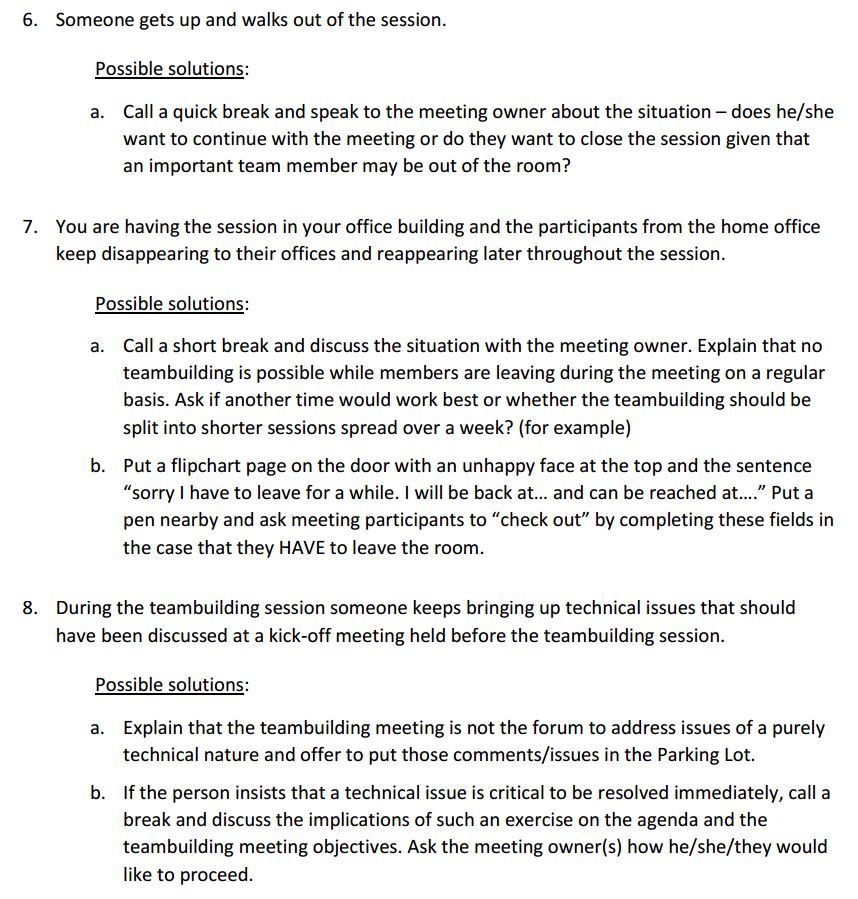
How to stimulate participation by session participants?

  • Ask open-ended questions
  • Do a poll – where by raising hands people have to vote for one idea vs one or more other ideas
  • Count to 10 or more before you speak, let them bridge the silence with participation
  • When there is a question to you or a comment, defer it to the group – how does the group feel about this topic/question/statement?
  • Ask direct questions to specific participants whom you know (be sure) have experience in an area or on specific subject matters.
  • Summarize the points raised and ask the group to respond – agree or disagree? Correct or ..?
  • Divide them into pairs for a short discussion on a topic that pertains to what you just covered. (Gets them active after a period of perhaps monologue or exclusive dialogue.)
  • When the group seems lethargic consider an unscheduled short break
  • Do an impromptu energizing exercise (always have two or three of these in your back-pocket to employ when you see the need.
  • Expect some sluggishness in the period right after lunch for about an hour or so. Ensure your session design contains activities for this period – small groups etc.
  • Call it – sometimes a group is unresponsive, because everyone is thinking about an elephant in the room – some topic which should be discussed or settled which may not be on the agenda., but it is occupying the minds of everyone. If you know what it is, ask “Is ….. something we should discuss at this time?” if you do not know ask “Is there another issue that we should be covering at this time which may not be a scheduled topic?” [You would need to check in with the manager to ensure he wants to do it right away or later -schedule a specific date and time when he will deal with it. So call a short break if they tell you that something needs to be settled. To determine the”how” with the manager involved.)

These examples are not exhaustive, but they did help me out during those early years of facilitating sessions with groups and teams. I do trust they will do the same for you!

Cultural Differences Could Impact your Session

From a cultural perspective it is important to take note of cultural differences which may impact team and group dynamics during a facilitated session.

Some tips:

These examples could be tricky situations to navigate successfully, if you are not prepared to structure the process, the introduction and plan for the day in a way to ensure all participants see value in the time spent together. In some cases the answer may not be to have a facilitated session, but instead to have a series of meetings involving specific people from the participant groups. .

  • Some cultures expect the person in the front of the room to be an expert and if the facilitator asked questions of the group, his/her credibility may be at stake – in the mind of such a participant.
  • Valuing the goals that a sub-group brought to to the session, some cultures would expect that these goals may be more important than the goals set out for the session at the start.
  • Some cultures prefer to talk about practical examples during the session while others may prefer to talk about concepts. This could especially be apparent if a culture respects the resolution of disagreements privately instead of in a group context.
  • Physical activity or high-energy participant exercises may be seen as disrespectful or unsuitable behavior for senior level personnel in some cultures.
  • Asking questions or exploring concepts are not common across all cultures. Some participants from other cultures may find that approach alien and uncomfortable. They would expect the facilitator to simply give them the answers instead of asking the group to come up with the answer.

Use THIS LINK to read more about how to understand some cultural dimensions to consider as you plan to facilitate a meeting where there might be participants from multiple cultures.

Here is an example of how people from a Low Power Distance culture may differ from those coming from a High Power Distance culture in a facilitated or training sessions:

Renewal Exercise for an Existing Team – the journey


journey

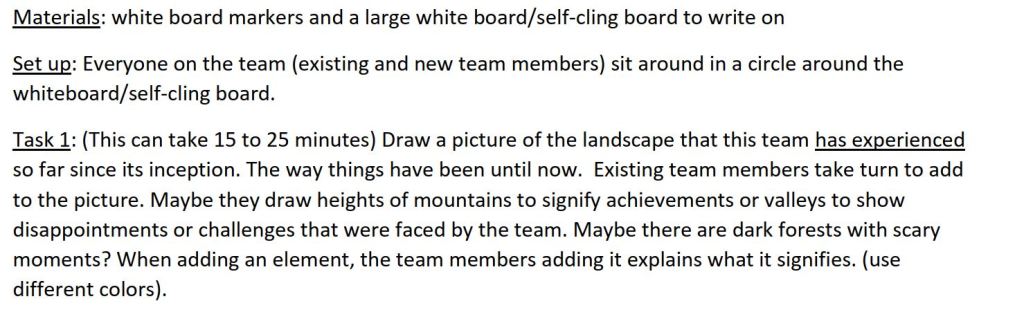
Existing teams often go through phases of renewal, which requires that new team members and existing members come together to create a new or changed vision and way forward. This could happen when the project changes from design to implementation or from one conceptual to design. It could also happen if the leader is replaced. There are many reasons when an existing team can benefit from a renewal exercise to remind them of what they need to do, how they will do it and how they will measure success and collaborate.

Elements that can hold the new team back include existing members holding on to the past too strongly and new members not understanding why some things are done in a certain way within the team. Lacking the background and context of the past and a shared vision for the future the team could easily remain divided between the “new comers” and the “old timers” who know everything.

This exercise has two parts and helps to make the past easier to understand especially in terms of how it may have shaped the current belief system of existing team members – i.e. what they believe works and what does not work. The second part of the exercise helps new teams map out the new way forward together, which helps all team members be a part of what they plan to achieve and do going forward.

Tips/Comments:

  • This exercise does not replace any classic team chartering activities i.e. crafting a new or changed purpose statement, or reviewing/creating new roles and responsibilities going forward or agreeing on key team performance indicators. This exercise forms more of a bridge towards renewing the team and its activities and path forward. This exercise can best be followed by some more classic team chartering activities and exercises.
  • Monitor the communication process closely during the first part of the exercise: the sharing that happens has to remain constructive vs existing team members slipping into defensive behavior and/or new team members being overly critical of the lessons learned from the past.
  • This exercise has also sometimes been used as an ice-breaker to start off a one- or two-day team-building activity. It would be good to schedule this just before a natural break to allow team members to spend unstructured social time together as an aftermath of this exercise.

Getting along better with others


thinking writing final

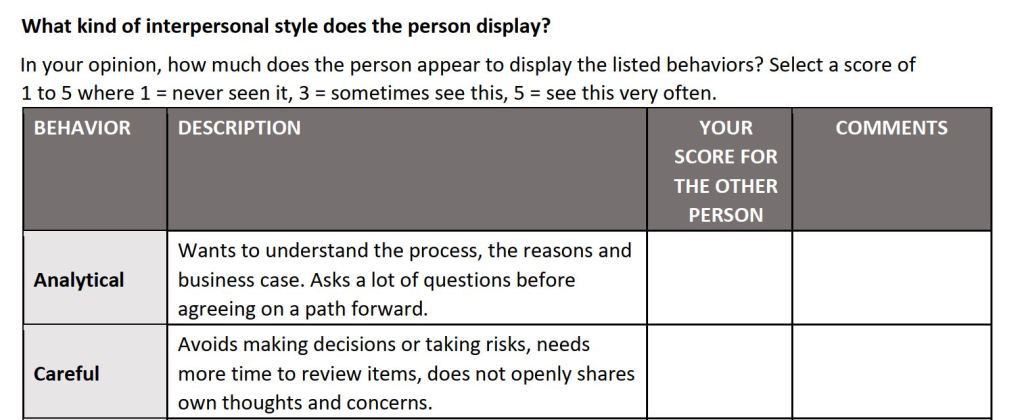
One area that often causes misunderstandings and frustrations in the workplace is when two employees have different interpersonal styles and ways of communicating and they do not get along. Being different from each other mostly means that they do not understand why the other party is doing and saying things in the manner that they do. Most of us do have the ability to make small changes to how we do or say things in order to improve collaboration and interfacing with others and this resource can help by creating awareness, which is the first step towards improvement.

The downloadable document I am sharing can be used for reviewing relationships with customers, other employees, work-related contacts, and even friends or loved ones. It helps you reflect on the interpersonal style that the other person displays in his or her behaviors. Building on this awareness this resource enables you to be more mindful of the best ways to interact with that specific person to have a better relationship with him or her.

Once you have awareness of how you can improve interpersonal relationships with specific people it may still be difficult to make changes to your own behavior for the betterment of the relationship. Should you get stuck once you have done the first part of the exercise, consider asking others for ideas on how you can best approach improvement in the key aspects you came up with. Depending on the current relationship you have with the person you focused on, you may be able to ask him or her directly. For example: “I noticed that you are very detail-oriented. Can you help me understand how I can better provide you with what you need in order for you to feel comfortable with my contribution on the projects that we are working on together?”

Uses for this resource include:

  • Own reflection and then taking action to improve on some of your interpersonal relationships.
  • Discussions with your coach on how to deal with some difficult individuals that you often work with.
  • Team-building – ask each team member to rate themselves on the items shown and then share with each other as a way to get to know each other better and improve interpersonal relationships on the team. (advocating).
  • Team feedback – Depending on the time you have available and the size of the team you may also ask each team member to map out each other team member using this resource. This means each person gets feedback from the entire team on how each team member sees them. The outcome could magnify self-awareness in the team and drive interpersonal relationship improvements across the entire team.

Misunderstandings can lead to a lot of misalignments between team members and can result in rework, which is a waste every project should avoid. Better interactions with others make the workday more fun and go a long way towards employees feeling more productive and effective at work.

Checklist for Team Leader with a remote team


table final

Leading and managing a group of people at a single location is not an easy task and managers often tell me it is the people-side that wears them down. When your team is very diverse and located at different remote locations instead of at one location, the challenges and risks of the team not reaching goals multiply. The resource I am sharing today is a checklist for team leaders or managers/supervisors of remote teams and it focuses primarily, but not exclusively, on the the people-side.

The downloadable checklist above lists a number of items to consider when you are leading a dispersed or remote team. This may be a useful check for team leads or project managers to ensure they are taking into account the additional challenges that remote teams bring and are taking the appropriate actions and precautions to manage the interpersonal and communications aspects on such a project.

The checklist items are grouped by the following main topics:

  1. Critical Skills for Supervising International Project teams
  2. Setting Goals and Expectations
  3. Giving Feedback and Coaching
  4. The team
  5. Communication
  6. Establishing a Good Start

Working with dispersed team members can be very interesting and it can be fun to learn about other cultures and other perspectives. However, those same interesting differences can make remote teamwork frustrating and difficult. The checklist shared here can go a long way towards helping you, as the team leader, take advantage of leading a diverse team while successfully managing the harder part of leading teams.

Organizational Strategy Framework


framework final

Setting a strategy for an organization requires a focus on aspects internally and external to your organization. Once you have set your strategic growth targets you would need to look at how you need things to change internally to support those growth targets. You may want to set your signs on improving profitability, increasing organizational effectiveness or moving leadership behaviors closer to your values and vision for the organization.

The resource I am sharing can help you align some of the most important internal aspects with your strategy to improve your chances of successfully executing on the strategy.

Most organizations are able to successfully navigate through the process of setting a strategy. Many organizational leaders find execution and implementation of the strategy the hardest part to achieve. I believe this is mostly because internal aspects that are needed to support the strategy are not always taken into account in the execution plan.

The framework (See download option above) and questions to address in each case help you by acting as a checklist. Reviewing the execution plan, this list will help you consider how to engage, involve, and inform stakeholders in the process. It helps ensure that every aspect of your execution plan reinforces your strategic objectives leading to a better implementation plan.

The areas to ensure alignment are:

  1. Company values and culture
  2. Leadership (behavior and mindset)
  3. Workforce capability
  4. Organization structure
  5. Organization processes
  6. Systems (Automation)
  7. Performance Management and Metrics

The sequence would always be to first select a strategy you would like to pursue with the organization and then use this resource to plan the implementation portion of the activity.

Setting strategies is often an iterative process as changes from inside or outside of companies require an adjustment in approach. Remember to check the impact of further changes on the same checklist (see above) to ensure you maintain the strategy alignment.

Team building activity – Defining roles and responsibilities


blocks final

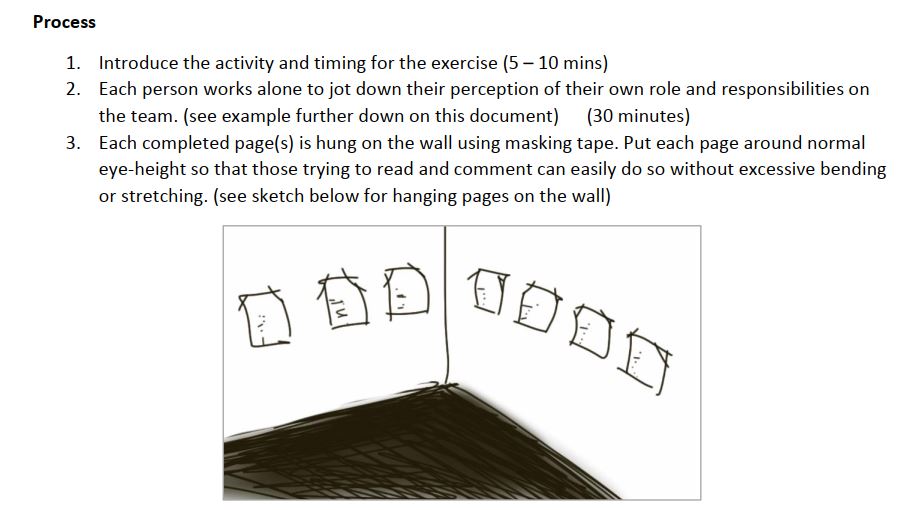
A new project is best started by getting the entire project leadership team on the same page. This relates to commercial terms, project scope, key milestones and other important contractual terms and conditions. It is also vital for the project leaders to understand how they will execute this project – who is going to do what exactly to make sure we execute this project scope to the best of our abilities?

The resource I am sharing here describes a process you can follow as part of an early team-building activity to clarify and agree team roles and responsibilities down to individual levels.

In this activity the project leaders are gathered together and a facilitator takes them through this process. (See downloadable process description below).

Additional thoughts:

  • You can use this activity after first running a sub-group responsibility definition activity which defines project interfaces or relative responsibilities for decisions and processes by functional or other sub-groups on the team. (see Defining team interfaces) Using this sequence means you drive home how the overall project outcomes are managed by sub-groups on the team and then right down to individual roles in those same processes.
  • This exercise can also be used when there is a change in phase or focus on the project or the composition of the team changes greatly. At those times it is important to keep the team’s momentum going by ensuring that roles and responsibilities remain clear throughout the changes.
  • Clarifying individual role and responsibilities also supports the performance management process. When individuals receive feedback regarding their performance it is important that they already understand what performance and role expectations are.
  • Having individual roles documented can also support bringing new team members up to speed fast. It helps explaining expected team functioning and who they should talk to while making their contributions to successful team outcomes.

Project teams simply function better when everyone understands how he or she is expected to contribute to the team’s goals. This activity does help greatly in clarifying expected individual contributions. I do suggest you distribute the final agreed pages with the team for reference purposes.

Preparing Managers for a Staff Reduction process


1453990358937

Staff reduction, mass employee lay-offs or a reduction in force, is a critical process. Consequences for not complying with labor laws or not acting and communicating correctly can be far-reaching.

Declining workloads or under-performing groups are some of the reasons that lead to the decision to reduce staff. Not executing staff reductions correctly can expose the company to many liabilities and potentially law suits.

There are several steps to take in this process and in most countries there are specific requirements which may include employee and/or union consultation and involvement and some steps could also be subject to approvals by governmental organizations. In many countries there are very specific justifications that a company has to be able to provide to show that the process of selecting who to lay off was fair and equitable and that no discrimination took place.

It is important that managers understand the correct process to follow for staff reductions and that they are able to for example conduct employee notification meetings in the right manner.

The resource you can download above contains a few slides which may be useful at a manager orientation meeting to ensure the principles and approach to follow with this staff reduction is well understood by the managers. There are also slides highlighting the human impact of staff reductions and the need to ensure that those who remain with the company are supported through the emotions when they see other trusted and well-liked colleagues leave.

Without proper preparation of the managers/supervisors before the notification meetings take place you risk them making incorrect statements or forgetting to make important statements. Sometimes unprepared managers act in ways that could be interpreted as discriminatory. The slides will help you minimize that risk as you first orient managers/supervisors in a group and then have each manager/supervisor work with his/her HR Representative to practice how to conduct the notification meeting correctly during the staff reduction process.

Remember:

  • It is not only the impacted employees who are going to have an emotional reaction to the staff reduction, employees intended to remain at the company may be losing valued friendly connections with peers – even friendships. Be sure to reassure those whom you intend to stay with the company to stop them from looking around for other jobs during the uncertainty that is created in the workforce when a reduction in staff is planned or in progress.
  • It is very important to plan the notification meetings to take place very fast. The shorter the time of uncertainty and people waiting to be called in for a meeting, the better your chances of restoring the morale of the remaining employees and avoid retention risks.
  • During times like these is when your company’s values should drive decision-making and how you talk to employees. Your branding messages can claim honorable conduct and make promises of fair treatment, but it is during staff reductions that you get to prove that you meant it. Employees will remember how you conducted the staff reduction more than they will remember what is written on your posters about company values.
  • (HR/Office Manager) Remember also to check in with the managers and supervisors who conducted the notification meetings. It is tough to tell a number of people that their jobs will go away and watch their emotional reactions to that.

The staff reduction process is tough on everyone and it is vital that you plan it and conduct it exactly according to the rules and laws of the country where the people are employed. Internally you also need to make sure your planning includes an orientation process for those managers and supervisors who have a role in the notification meetings. And most importantly, check in with those who will remain after the notification meetings are complete to ensure that your business activities can resume soon after.

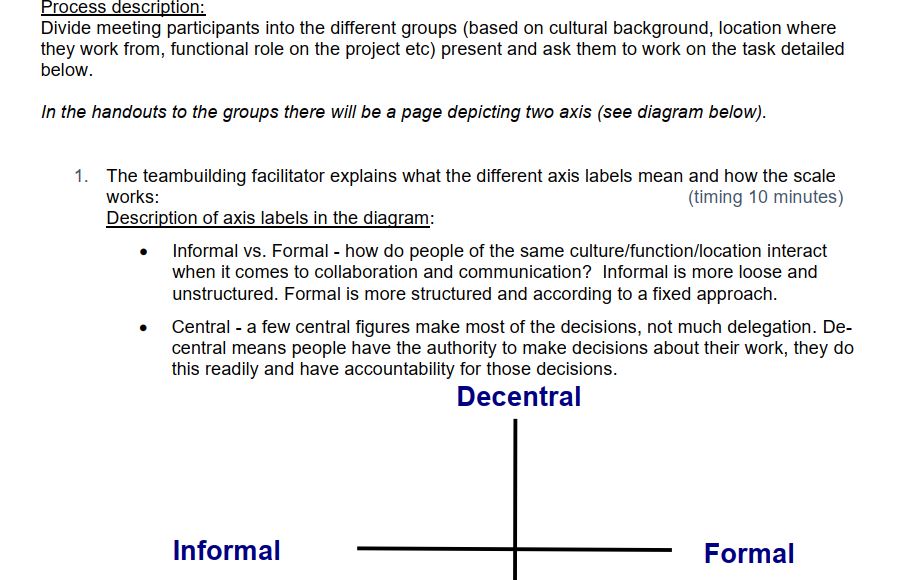
Activity for project teams – Diversity


colored circles

Your project team is very diverse and you are concerned that this may impact how your project will be executed – will you be able to achieve your overall project goals or will there be a lot of internal strife, misunderstandings and disagreements? Will they work against each other and have the wrong assumptions about each other and the project goals and metrics? If so, this team-building activity may help.

The downloadable resource I am sharing is a team activity you can use to help project team members understand that different groups of people can have different views on the various aspects of running a project and also the relative importance of key project processes. This activity makes those possible disconnects transparent which helps you lead clarification discussions with the team/group. While the activity itself is quite simple, the discussion that comes after the initial assignment is where the value lies and that will take up most of your time.

Further tips and ideas:

  • You can segregate meeting participants in various ways related to the most important diversity aspects you wish to highlight within the team. As a variation you may choose to run the first part of the exercise more than once and each time segregating the group of participants in a different way. Options include: cultures, locations where they are from or live, level of life experience, function etc.
  • There are several topics listed for discussion towards the end and it would be wise to prioritize them for your own convenience, as a facilitator. If you are running out of time towards the end you can then ensure you are covering the most important topics during the time you have available after the initial portion of the exercise.
  • Be sure to stress that diversity is a plus for team creativity and finding new solutions. The objective of this activity is to help work out some of the downsides of diversity without marginalizing any one or group or impose judgement.

Non-homogeneous teams may be tougher to manage than homogeneous teams, but the pay-off in creating new and innovative team solutions coupled with individuals learning new skills and perspectives from other team members can be very rewarding. As a team leader or facilitator you just need to make sure you have the right tools, such as this activity, available to help non-homogeneous teams succeed.

Ice Breaker for international teams


all hands2

In our globalized world it is very common for employees to have regular contact with people from other cultures and they may attend meetings at various international locations. When you are executing projects on a global scale it increases the importance of ensuring that communication and collaboration go as smoothly as possible in order to meet your project objectives.

Cultures and sub-cultures

You may be surprised to learn that even seemingly basic project concepts could have different interpretations across cultures and sub-cultures. This exercise that I am sharing with you focuses on intercultural aspects of international teams and can help by clarifying assumptions and expectations at an early stage of your project.

When I think of different cultures on a project team, I also include sub-cultures such as between different regions in the same country or different functional groups in the same company. (This link can provide context if you want to look at cultures more closely.)

In the exercise, participants answer questions from their own perspective being as true as possible to how things are done at the location or group that they represent in the exercise. Most people who have lived internationally for some years have already adapted to habits and ways that conform to expectations and habits for their new location and how people do things there. If your intention is to highlight the richness of different perspectives you have present at the event where you run this ice breaker – ask participants to think back to a time when they lived in location X or worked with group Y – how would they answer the question then?

The downloadable document above contains several project-related scenarios which can be used to explore differences in approaches and mindsets within your project team. You may also choose to use the topic of diversity and inclusion as an on-going exploration within your team where you could select one of the topics at each of your meetings instead of trying to cover all of them during a team-building event.

This ice-breaker can be a good item to include in a project kick-off meeting or when you are adding a few more people to the team from a different office/location. This exercise also works well when you have team members who are from the same country, but are from different offices. (It is not uncommon for offices/locations to have slightly different approaches).

Early exploration of different mindsets and assumptions among team members can be a valuable foundation to ensure smoother relationships and better collaboration on your project.  Feel free to suggest additional important scenarios to consider for discussion after you have reviewed the attachment I shared in this post.

Performance Management – setting up the annual process


final perf imp

The HR function manages a few processes which take place at various points over a 12-month period. Think of the annual salary reviews, annual training needs analysis, bonus calculations and performance management processes.

It is important to managers to have a clear understanding of each of these processes and when they take place throughout the year. If you set all of these processes on a regular annual schedule it helps managers to correctly anticipate next steps in processes and provide input required in a timely manner.

The process

This generic performance management process schedule I am sharing with you (see download option below) shows the various basic steps that would need to be followed over a 12 month period. There are references to the link with a salary/compensation review process and also the link with identifying and reviewing individual development needs and progress along achieving improvement goals.

Download a copy below

Implementing a process like this would need a change management plan if your organization has never done anything like this before. Even if you have had some form of a performance management process in place, but would now like to expand on it to include some of the elements shown in the attachment, a change management plan would be recommended. Before you start you would of course ensure that the manager/director, who is accountable for the performance management process at your organization, is aligned with your ideas and suggestions and strongly supports the direction you would like to take.

The benefits of having a documented process for Performance Management are:
  • It is easy for HR to ensure new employees, current employees, new supervisors and existing managers understand the process and their role in the process.
  • It is a way to help stakeholders understand and then prepare for the input and actions they need to complete in order to support the process.
  • Linked to a balanced score card, the process can make it clear to individuals/departments how they collectively and as individuals support the attainment of larger organizational performance goals.
  • Knowing that there are check-in moments for feedback and discussion moments around performance expectations, progress and development needs and activities can be a strong way to reinforce employee engagement. Many employees tend to consider other employment options when they feel that their development and career progression goals are not being met by their current employer.

This list is not exhaustive. For more information about benefits see links like Benefits of performance management or Importance of Performance Management