You sit down to use AI for a piece of work. The first prompt is vague, so the response is too. You refine it. Regenerate. Adjust the tone. Ask for more detail. Remove what doesn’t fit. After a few rounds, you have something you can use.
It feels efficient. But if you look closely, most of the time was spent correcting what could have been clarified before the first request was ever sent.
There is another layer to this that rarely gets mentioned. AI does not run in the abstract. Every prompt travels through servers in data centres, drawing power and requiring cooling. One request may seem insignificant. But how many requests are you making per day? The footprint of AI is real, and while a single exchange is small, scale is what turns small inefficiencies into meaningful impact.
The cost of skipping the thinking step is not just cognitive. It is operational and environmental.
Where we go wrong
If you stop using certain muscles, they weaken. Cognitive skill works the same way.
When AI starts doing thinking you should be doing yourself, the risk is not only weaker output. Over time, it affects your ability to analyse, question, and decide under pressure.
Here is where it usually goes wrong:
You let AI draft the email and do not review the tone carefully.
You accept a structured analysis without checking the assumptions behind it.
You copy a framework because it looks polished.
You mistake length for depth.
AI may invent details when it lacks context. It may reinforce the framing you give it. It may produce something that looks convincing but is slightly misaligned with your strategy, scope, or risk exposure.
And if you send that forward, the reputation attached to it is yours.
Fast does not mean flawless.
Think before you prompt
A better approach begins before you type.
AI performs best when it is clearly instructed. Missing context about audience, tone, constraints, or success criteria almost always leads to additional rounds of correction. You refine. You clarify. You ask again. What felt fast becomes repeated rework.
And there is another dimension to this that we rarely mention.
Thinking first is not just cognitively disciplined. It is operationally and environmentally responsible.
Before opening the ai tool, define:
– What must exist at the end? – Who is this for? – What tone and level of depth are required? – What constraints apply? – What would make the output unusable?
If regulatory exposure, strategic guardrails, or reputational sensitivities matter, state them explicitly.
The AI Briefing Sheet – available as a free download right below – is designed for exactly this step. It forces you to clarify intent before you outsource execution. It is editable, so you can adapt it to your specific project.
Only once the brief is clear should you move to the prompt window. If something is vague in your own mind, it will be vague in the response.
Pause before you prompt.
Staying Mentally Fit in an AI World
When AI always structures your first draft, it feels harmless at first and you slowly stop practicing structure yourself. When it consistently generates counterarguments, you stop anticipating objections. When it refines tone every time, your own calibration weakens.
Used properly, AI can be a sparring partner, a challenger, a speed amplifier, and a capable researcher. But it is not final authority. It should never be your only source, your only fact checker, or the voice that determines how your work will be perceived by specific stakeholders.
Some decisions remain entirely yours: defining what the task truly requires, editing for accuracy, checking tone, and ensuring the structure serves the intended purpose.
The final output must reflect your voice and your judgment.
Practical discipline helps. Draft your own thinking in bullets before prompting. Ask AI to challenge you. Request counterarguments. Pressure-test the output before accepting it.
When you prepare properly, AI works within your framework. Without one, you may find yourself adapting to its structure instead of the other way around.
AI will only get faster.
The real question is whether we remain deliberate.
It is a powerful assistant. Assistants extend capability. They do not set direction.
Use it well – but think first.
That is how you benefit from AI without slowly surrendering the one thing it cannot replicate: your judgment.
We’ve all been there. It’s 11:00 PM. The day was a success – mostly – but your head is still spinning. You’re dictating reminders into your phone. You’re replaying meeting snippets in your mind, trying to unpack what was actually said. To top it off, you just found the dog destroyed your favorite sweatshirt, and the evidence is all over the floor.
You’re exhausted, but you’re too wired to sleep. Your mental RAM is at 100%, and your “processor” is overheating.
Mental clutter – tasks, worries, and that nagging sense you’ve forgotten something – slows your thinking and drains your motivation. High performance and a peaceful mind both require a clean slate.
In a world where leaders are currently facing high levels of burnout and cognitive load, a structured “Worry-to-Action Pipeline” is exactly the kind of pragmatic, tested tool you have come to expect from this blog!
Here is a no-nonsense, 4-step process to move your worries from your head onto paper, and turn that noise into a concrete to-do list.
Grab a pen. Let’s get to work.
Step 1: The Raw Dump
Dump every thought, fear, and reminder spinning in your head on paper. Write them down. Don’t filter, don’t judge, and definitely don’t try to solve them yet. Just write or type until the “RAM” is empty and no more thoughts come.
If your head is spinning too fast to type, use your phone to dictate a voice note. Once it’s out of your system, move those notes to a larger screen – like your laptop or tablet – where you can actually see the “mess” you’ve collected in your mind.
The outcome: moves you from “feeling” the chaos to “seeing” the data.
Step 2: Categorize to Conquer
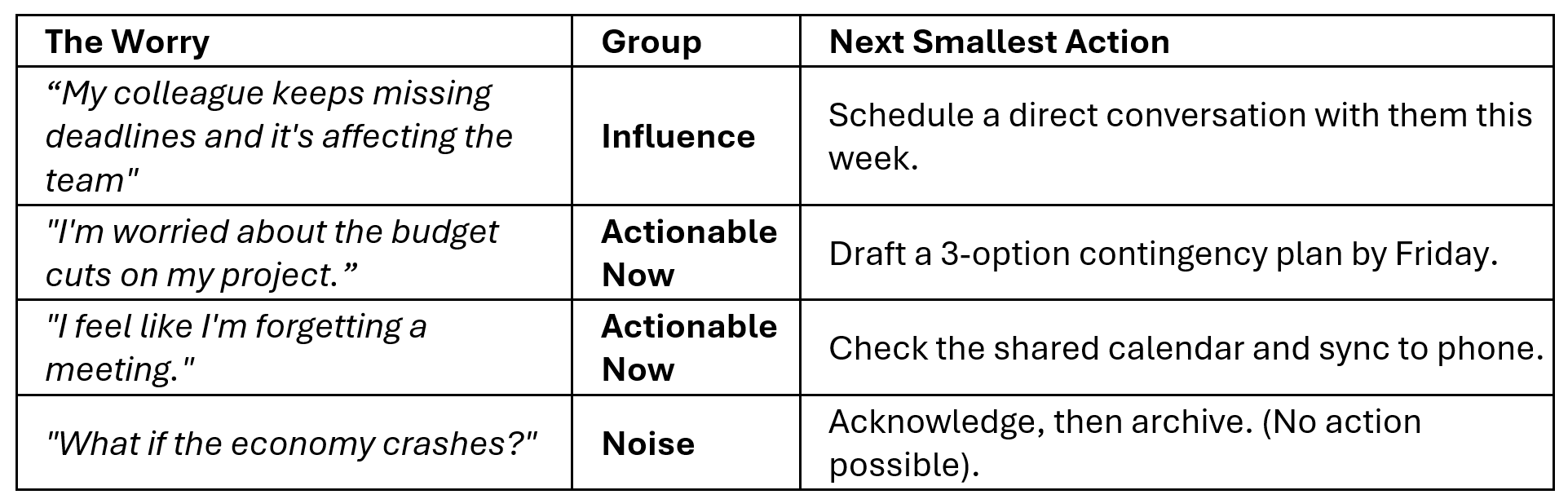
Don’t just look at the mess -sort it. Grab three highlighters (or use the highlight tool on your screen) and assign every item to one of these three buckets:
Actionable Now (Green): Things you can act on in the next 24 hours. No excuses—just tasks you can do today or tomorrow (e.g., “Email the client”).
Influence (Yellow): Things you can’t fix alone but can nudge. This requires a conversation with a colleague, a friend, or an expert. (e.g., Improving team morale when a manager is difficult to approach).
The Noise (Red): Things you cannot change. This includes the past, yesterday’s mistakes, or other people’s opinions. (e.g., The dog eating your clothes while you were out).
Examples:
Step 3: Clear the Green (The 48-Hour Rule)
The “Actionable Now” items are the easiest to solve, yet they often cause the most background noise.
The 48-Hour Rule: If it’s Green, give it a specific time slot in your calendar within the next two days. If you don’t schedule it, it stays in your head.
The “Parking Lot”: If it truly isn’t urgent and can wait longer than two weeks, move it out of your daily view. Put a reminder in your calendar for a future date and delete it from your current list.
The outcome: reduces the number of active “tabs” open in your brain. If it’s scheduled or “parked,” your brain can stop processing it.
Step 4: Delegate and Release
For the items left on your list – the Yellow and the Red – you only need one simple decision each.
For your Yellow items (things you can influence but not fix alone): identify the one person you need to involve and write their name next to the item. That’s your action. You’re not solving it tonight – you’re simply deciding who carries it forward with you. One name. Done.
For your red items – choose a small ritual of release. Red items are RAM-drainers – things you cannot change, control, or solve tonight. But simply crossing them out rarely works. Your brain needs a small, deliberate act to believe it has actually let go.
Choose a ritual that suits you:
Tear it up. Transfer all your red items onto a separate page. Then tear that page – slowly and deliberately – into small pieces. The physical act of destruction signals to your brain that processing time on these is officially closed.
Box it. Not ready to destroy them? Fold the page and place it in a dedicated box – a shoebox, a tin, anything with a lid. This isn’t surrender; it’s containment. Tell yourself: if this still matters in two weeks, it will still be in the box. Most of the time, when you check, it won’t.
Either way, once the red items are off your main list and out of your hands – torn up or lidded away – your brain has its permission to stop processing them tonight.
Close the list. You’re done for tonight.
Tonight, you don’t need to solve everything. You just need to stop carrying it all at once. A pen, a page, and twenty minutes is enough to move from spinning to settled – and to wake up tomorrow with a clearer head and a shorter list. Your brain will thank you for it.
Entering the project you are most proud of into an excellence competition is an exciting opportunity to showcase your hard work and achievements. But let’s face it, the competition can be stiff—especially when sustainability is a key judging criterion. Don’t worry, though; this post will guide you through how to focus on the right elements and tell a compelling story that highlights your project’s success without making things up. The secret? It’s all about having the right data, understanding what it means, and explaining why it matters.
Here are nine ways to make your project stand out and be memorable and remarkable:
1. Start With the Basics: Read the Rules
Before drafting your entry, carefully review the competition guidelines, especially sections on sustainability or innovation. These often hint at what judges value most—energy efficiency, water conservation, carbon reduction, waste avoidance, community impact, or even all of these. Align your entry with these priorities. And don’t stress over word limits—stay within 10% of the specified count, as they’re there to keep entries focused, not to demand a full thesis.
2. Tell a Story, Not Just the Facts
Before you start writing your entry, read the competition guidelines carefully. Pay special attention to any sections about sustainability or innovation. Competitions often provide clues about what the judges are looking for—energy efficiency, water conservation, carbon reduction, waste avoidance, community impact, or maybe all of the above. Tailor your entry to match these expectations.
3 Focus on Measurable Outcomes
Judges love numbers, so don’t shy away from sharing your data. If your project saved energy, reduced emissions, or cut costs, include the specifics. Here are some examples:
Energy Efficiency: “We installed energy-efficient lighting and reduced electricity usage by 30%, saving EUR 10,000 annually.”
Waste Reduction: “By reusing materials on-site, we diverted 95% of construction waste from landfills.”
Sustainability Impact: “The project’s solar panels now produce 20,000 kWh annually, enough to power 10 homes.”
Don’t have all the data? That’s okay—start with what you do have. Just be sure to explain how you measured these outcomes and why they’re meaningful.
4. Highlight What Makes Your Project Unique
Competitions are about standing out. Did you try something new that hadn’t been done before? Did you find a way to make the project faster, cheaper, or more sustainable? Maybe you combined existing methods or approaches in creative ways. For example:
“We used prefabricated components to speed up construction, reducing on-site waste and emissions.”
“Our landscaping included native plants, which cut water usage by 40% and boosted local biodiversity.”
Be clear about how your approach sets your project apart.
5. Talk About What You Learned
No project is perfect, and judges appreciate honesty. Talk about what went well but also acknowledge what didn’t. Maybe a new method didn’t work as planned, or you realized late in the process that a different approach would have been better. What’s important is that you show you learned from the experience.
For example: “We underestimated the time required to train staff on the new energy management system, which delayed implementation. In the future, we would schedule training earlier to avoid this issue.”
6. Sustainability: More Than Just Energy
When we think of sustainability, energy efficiency often comes to mind first. But there’s more to it. Judges might also look for:
Circular Economy: Did you reuse, upcycle or recycle materials?
Water Conservation: Did your project reduce water usage?
Community Impact: Did the project benefit local communities or create jobs?
Biodiversity: Did your landscaping include native plants to support local ecosystems, or did you create green spaces that attract pollinators like bees and butterflies?
Positive Local Community Impact: Did you partner with local schools for educational programs or support community groups through funding or volunteer initiatives during the project?
By broadening your perspective, you can show how your project goes beyond energy savings to create lasting, meaningful impacts. Be sure to cover these aspects if they apply to your project.
7. Be Honest—Don’t Fake It
It’s tempting to stretch the truth to make your project look better but resist the urge. Judges have likely seen it all, and they’ll spot exaggerations a mile away. Instead, focus on presenting your project’s real achievements as clearly and confidently as possible.
8. Make It Easy to Follow
A clear, well-organized entry can make all the difference. Judges don’t have time to untangle cluttered submissions, so present your work in a way that flows logically and is easy to digest. Use clear headings, concise bullet points, and short paragraphs to guide the reader.
Think about your structure:
Timeline Approach: Are you walking judges through processes, events, or project phases step by step?
Top-Down Method: Are you starting with a big-picture overview and then zooming in on specific achievements or highlights?
Comparative Lens: Are you showcasing measurable improvements by comparing past performance to present outcomes and projecting future benefits?
If you’re including technical data, don’t let it overwhelm the narrative. Break it down into simple, relatable terms that anyone—even those without technical expertise—can understand. For example, instead of saying “airtightness of 0.6 ACH at 50 pascals,” explain how that translates into better energy savings or indoor comfort.
A polished, intuitive format not only keeps the competition judges engaged but also ensures they don’t miss the full scope of your project’s excellence.
9. Think About the Future
Judges often like to see how your project has inspired or informed future efforts. Did it set a standard for your company or industry? Has it led to new ideas or processes? For example:
“The success of this project has prompted us to roll out similar solar energy systems at three other sites.”
“We are now working to integrate lessons learned into our next project to achieve even greater sustainability.”
Conclusion: Show the Big Picture
Entering a competition isn’t just about winning—it’s about showcasing what makes your work exceptional. By focusing on measurable outcomes, sustainability, and what you’ve learned, you can create a compelling entry that stands out.
Remember: the judges aren’t looking for perfection—they’re looking for impact, innovation, and integrity. Follow this approach, and you’ll not only improve your chances of winning but also demonstrate why your project truly matters.
Collaboration is all about tearing down invisible walls between functions and geographies and bringing people together in a way that feels natural and fun. This collaborative canvas activity uses art to help everyone experience working toward a shared goal. Each person adding their own splash of creativity to a group masterpiece supports reflection on how each participant supports the big picture — all while getting a fresh take on teamwork, company values, and communication.
It’s a hands-on way to see how different ideas can blend into something unique, and why trust, adaptability, and shared ownership are key to breaking down silos and achieving success together.
Purpose
This interactive activity is designed to break down silos between departments and regional leaders by improving collaboration, adaptability, and shared ownership. Using art as a medium, participants will explore teamwork, communication, and how individual contributions blend into a collective vision.
Setup
Canvas Arrangement – Multiple A4-sized canvases are set up in a circle, with each canvas facing outward to allow participants to engage without observing others’ immediate responses.
Materials – Brushes and paint, exclusively using the corporate color palette to reinforce company identity. Note that each participant receives one brush and one color, symbolizing their unique perspective and input.
Atmosphere
Music begins playing softly as participants settle in front of a blank canvas, encouraging focus and creativity.
Once everyone is ready, the music is turned down, and clear instructions are shared. While participants work on their canvas for those 30 seconds music can be played – it is optional.
Instructions for Participants
Engagement
Participants start by standing in front of a blank canvas with their designated color and brush in hand.
Each person responds to 4 prompts (statements or questions) that align with the company’s:
Vision
Mission
Values
Reflection on last year’s operational and financial results
Rules
Each round lasts 30 seconds from the moment that the sentence or question is read.
During this time, participants draw or write their responses on the canvas in front of them using the color and brush they have been given.
At the sound of a bell or signal, each participant is to move clockwise to the canvas on their left.
Each participant must continue to respond to the new prompt on the next canvas, building on the contributions of others.
No returning to anyone’s original canvas or modifying earlier work.
Rounds
Each round features a new statement or question to react to creatively on the canvas in front of each participant using only the brush and color each has been given.
Prompts should spark reflection on the company’s collective goals and inspire responses that challenge silos:
Round 1: Read the company’s vision then prompt: “What does our company’s vision mean to you? Reflect that on your canvas”
Round 2: Read the company’s mission statement, then prompt: “How do you contribute to our mission as part of a larger team? Write or draw something to indicate that.”
Round 3: Read the company’s values or value statements, then prompt: “Which company value resonates most with your role? Depict it in your own way”
Round 4:“Reflect on how collaboration led to achieving last year’s results. Think of a way to indicate that on the canvas in front of you.”
Debrief: Reflecting on the Experience
Once all 4 rounds are complete, participants step back to look at the canvases, including their original starting piece. This is a powerful moment to consider team topics like shared ownership, teamwork, collaboration, and adaptability.
Debrief questions
How do you feel about how your original canvas turned out?
Did it match your vision, or was it transformed by others’ input? How did you feel about the contributions of others on your original canvas – did it turn out better or lesser than you hoped?
What was it like contributing to a canvas where you disagreed with earlier markings?
How did you adapt or build upon previous ideas? Even if and especially if you disagreed with what you saw when you moved to that canvas?
How does this experience relate to teamwork in our company?
How do we handle differences and align diverse contributions across departments or regions? Can we do better?
What lessons can we apply to ensure better collaboration and a shared vision moving forward?
Outcome
It’s not just about the finished artwork but about realizing how individual efforts combine to create something meaningful together. This activity highlights the importance of adaptability, communication, and trust when working across teams. The lessons learned can be applied directly to real-world collaboration — helping teams break down silos, align their contributions, and work more effectively toward shared goals. Plus, the visual reminder of the canvases can serve as a lasting prompt to keep these ideas top of mind in daily work.
This activity is more than just a creative exercise — it’s a powerful way to see teamwork in action. By adding your unique perspective to a shared piece of art, you experience firsthand how collaboration, communication, and trust can transform isolated efforts into a cohesive result. It’s a reminder that breaking down silos isn’t about losing individuality, but about combining strengths to achieve something greater. As each participant steps back and looks at the final creation, they will see the potential for better teamwork, adaptability, and shared success, ready to carry those insights into everyday work.
Feeling overwhelmed by your to-do list? It’s time for a fresh approach. Whether you’re figuring out what new tasks to start, which processes to stop, or where to make improvements—including sustainability initiatives—this simple method will help you cut waste and boost efficiency. Think of it as a game-changer for your workflow, empowering your team to work smarter, not harder, while making real progress. Change doesn’t have to be overwhelming; it’s about making strategic, impactful adjustments that lead to better results, smoother workflows, and more sustainable outcomes.
A Fresh Approach to Tackling Chaos
Ever feel like your to-do list is out of control? This simple method helps bring clarity, meaning, and direction to your tasks. Whether you’re deciding what new actions to take, which processes need tweaking, or which habits to drop, this approach will streamline your workflow, boost productivity, and make your routine more manageable.
Even the best processes lose their effectiveness over time or fail to take advantage of the improved availability of better tools and templates, signaling the need to reassess. While big changes can be costly, small adjustments often get things back on track. The method I’ll share is perfect for team brainstorming, making it easier to identify areas for improvement together.
Think of it like tidying up a familiar room. Some things need to go, while others just need a small fix. This tool helps you do the same with your work, identifying what needs to change, what new actions to start, and what habits to stop.
Importantly, it’s also about working smarter with sustainability in mind. Rethinking processes to reduce waste, conserve resources, and adopt eco-friendly practices not only improves efficiency but also builds a more sustainable work environment for the future.
What to Start
Think of yourself as a gardener, planning to refresh and revive your garden. To improve a process or outcome at work or in a volunteer setting, you need to plant new “seeds”—ideas and actions that hold the potential to bring positive change. These are the things you want to start doing to make a meaningful impact.
Ask yourself: What new tools, strategies, or approaches could help streamline work, solve problems, or improve how people experience your organization or team? It might be a fresh approach to a recurring issue or an idea that could make things more efficient. Like planting new flowers in a garden, these initiatives will need your time and attention to grow and flourish.
By starting these key actions, you create opportunities for improvement and success and build an environment that thrives on new ideas and growth.
What to stop
When we talk about what needs to stop in the workplace, we’re focusing on behaviors and habits that hold everyone back. Think of gossip—it’s like a poison that erodes trust and divides teams. Then there’s micromanagement, which stifles creativity and leaves people feeling frustrated and demotivated. And multitasking? While it might seem productive, it often leads to mistakes and burnout. By eliminating these negative behaviors, we can create a more positive, collaborative, and efficient work environment.
Stopping isn’t just about behaviors, though; it’s also about simplifying how we work. This means cutting out unnecessary steps, avoiding redundant processes, and leveraging technology to make tasks easier and faster. It’s about working smarter, not harder.
The key to success is getting everyone involved. When the team collaborates and shares insights, it becomes easier to identify which tasks or processes don’t add value—and figure out the best ways to eliminate them. This not only streamlines workflow but also helps the entire team feel more aligned, motivated, and connected.
What to change
When identifying what needs to be changed, it’s about finding those processes or tasks that work to some extent but aren’t quite hitting the mark. These are not things you want to stop completely, but they could benefit from refinement or improvement. The goal is to enhance their efficiency or effectiveness rather than overhaul them entirely.
This step is about finding out with your team where bottlenecks occur, where confusion arises, or where inefficiencies creep in. Perhaps you uncover small tweaks that make a big difference. For example, a task might be taking longer than necessary because of an outdated step, or perhaps communication between teams could be improved to streamline a handoff.
Other possible candidates for change may lie in opportunities to improve: Are there tasks that could be automated? Is there a process that could be shortened or simplified without sacrificing quality? Sometimes it’s as simple as adjusting timelines or reallocating resources to better fit the demands of a project.
The key is not to throw out processes that have potential but to fine-tune them. By making small, thoughtful adjustments, you can improve the overall flow and outcomes. Involving the entire team in identifying these areas for change ensures that the solutions are practical, realistic, and beneficial for everyone.
Setting up time with the team
To kick off improvements, start by gathering input from everyone involved in the workflow. Set up a dedicated meeting where each person can share their unique insights. By involving the whole team, you’ll gain a diverse range of perspectives, helping you identify opportunities for improvement far more effectively than if you were working alone.
To make the session productive, team up with coworkers and dedicate about an hour to look for ways to enhance how you work, the environment you work in, or how your organization delivers value—whether it’s to customers, clients, or those benefiting from your volunteer efforts.
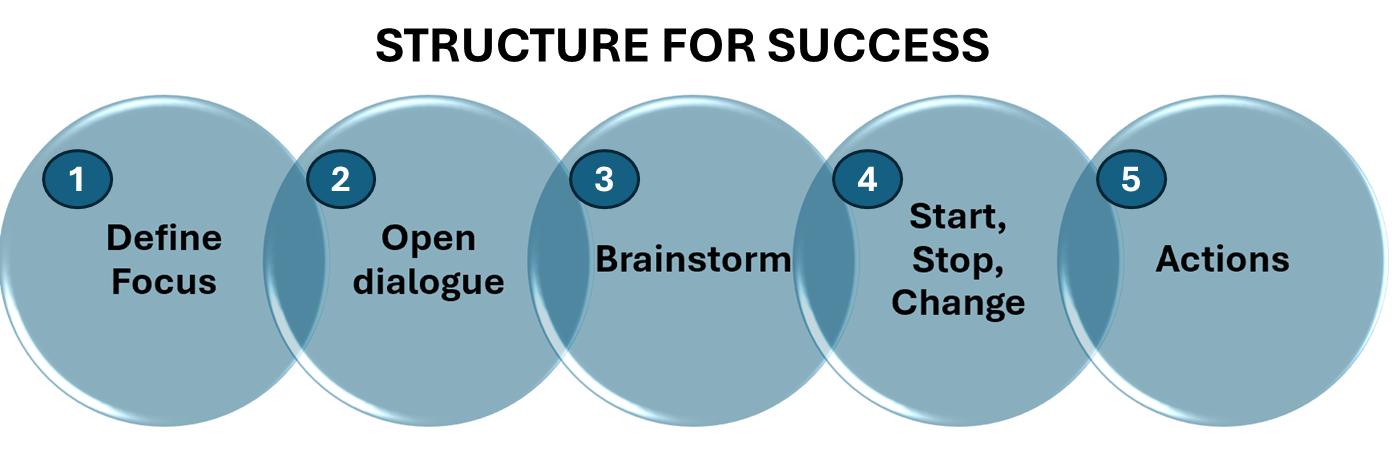
Here’s how to structure your session for success:
Define the Focus: Clearly outline what the session is about. Are you looking to improve a specific process, boost safety, streamline workflows, or enhance customer/recipient satisfaction? Make sure everyone understands the goal before diving into discussions.
Encourage Open Dialogue: Create a safe space for everyone to share their ideas, frustrations, and suggestions. Emphasize that all feedback is valuable and will contribute to positive change.
Brainstorm Together: Work as a group to explore ways to make things better, smarter, and safer. This could involve improving the way tasks are done, optimizing the workspace, or enhancing the delivery of value to customers or the community.
Capture Ideas: Use Stop, Start, and Change flipchart pages to organize ideas. After brainstorming, categorize the suggestions:
Stop: What isn’t working and needs to stop?
Start: What new actions, processes, or tools should be introduced?
Change: What existing processes could be improved with a few adjustments?
5. Assign Actions: Once ideas are gathered, assign ownership for each action. Ensure there’s follow-up so the insights gained from the session translate into real improvements. Also, set up a follow-up recurring meeting to review how things are going to discuss if you need to change or improve how you are implementing actions to be more successful and avoid obstacles to success.
By following this structure, you’ll ensure that your team collaborates effectively and walks away with actionable steps to make meaningful changes.
Keep Stakeholders in the Loop
After the meeting, it’s important to keep key stakeholders, such as your supervisor or others involved in the implementation, informed about the progress. Provide them with an update on the discussions, including the proposal for items to start, stop, or change. This transparency ensures they are aware of the team’s efforts and can offer support as needed. Additionally, ask for their feedback and suggestions. This will help ensure that no key opportunities for improvement are missed and that the plan is as comprehensive as possible. Engaging others in this way enhances collaboration and strengthens the overall success of the initiative.
Now It’s Your Turn to Change the Game
Taking a structured approach to what you start, stop, and change can really improve how your team works and help you reach your sustainability goals. I encourage you to take a fresh look at your team, your environment, and how you get things done. Find ways to not only make customers happier and save money, but also to reduce waste, save resources, and lessen your impact on the planet. Involving your team in this process will help everyone work smarter and feel more motivated as they see their ideas making a difference. Whether you’re working or volunteering, these changes can lead to a more rewarding and sustainable experience. Now is the time to act—start looking for where you can make a real difference for your team and the environment.
“”Is there a better way? Can you avoid printing that page?”
Photograph by Annie Sprat, Unsplash
Many project teams use tablets and television screens to project information during meetings for meeting participants to consider and discuss. And while we have cloud storage and the ability to access and edit or markup files from multiple devices, it appears that printing has not yet lost its appeal for some. If you are not yet ready to consider a working day without a printer, here are some ways to be more sustainable with the way you work on a day-to-day basis.
Removing Waste: Recycling
Have you considered what the end-of-life would be for that page you just printed and may be ready to throw into the trash bin soon? Why not set up a special bin for just collecting paper to be recycled? In some locations, secure bins are available which ensures that sensitive papers are securely stored until they are collected by the supplier and recycled.
Refills
Are you making use of a printer cartridge refill scheme? Instead of throwing used cartridges away, there may be suppliers in your area where you can get refills for your used cartridges.
And talking about printing cartridges – can you use only one colour – black? Having multiple colours may generate additional waste and perhaps you can save the colourful displays for virtual online documents?
Materials used
The paper you use for printing, is it made from environmentally-friendly recycled processes? Why not ask your local suppliers to advise you about recycled paper options available to you?
Habits
If you print on both sides of a page, you could be saving on paper usage and you could be lowering the weight of printed documents being shipped to recipients of your printed materials!
Fewer printers
Do you really need so many printers in your office? Or could you lower the ongoing electric power needs of printers and also encourage more physical movement of people during the day. Asking them to walk a little further in order to retrieve printed pages may be a great way to ensure they move out of a sedentary posture and increase blood circulation. Regular breaks and physical movement are great ways to improve physical and mental well–being at work.
Lower energy usage
Ensure that printers are turned off completely at the end of the working day and over weekends and periods of office closures. This ensures that no power is used in standby mode.
Consider digital solutions
Looking at the processes you use in your office – are you printing notifications or informational posters and is there a way to instead share it with colleagues, suppliers or customers digitally? For example – could suppliers download an electronic file from your website showing how you would like invoices prepared?
Understand your data and set improvement targets
Do you know who prints the most pages in the office? Is there an opportunity to engage with someone on printing more sustainably? Not everyone has been exposed to ways they could lower energy usage or how to avoid creating waste.. It could be great to have a discussion with someone about this.. Improving awareness is often the first step towards more sustainable practices at the office.
Getting together to set targets in your office like “We track our number of printed pages, and we strive to lower it by 10% this month compared to the previous month!” can be great ways to keep everyone focused on lowering your environmental footprint as an office..
In most cases, becoming more aware and conscious of ways that we can become less wasteful and generate less waste can be the first step toward being more innovative and finding new ways to positively impact the world and those around us. What will you do today to lower the waste you generate?
This post assumes a few starting points. For one, it assumes that you have a few leaders whom you would like to develop using a few specific developmental areas. When you review this example, you will notice that the areas shown here are typically associated with development of first-time or mid-level leaders. This example can help you take your own leadership development ideas a step further by defining specific steps, and processes which would make it easier to communicate your vision to stakeholders at your company – offering a well-considered program that includes all the elements that are important to developing leaders, their managers, executives considering succession planning, and also new recruits with dreams of building a great career at your company.
Defining outcomes
Which observable outcomes – behaviors – are important for successful leaders to display at your company? Can you define this per competency? Understanding what exact outcomes that your program strives to achieve makes it easier to select the right people for the program (those with development needs in these areas), evaluate the progress of developing leaders in your program (learning to lead with desirable behaviors), and also to understand where specific leaders may need more support with their own personal development plans.
Here is an example of defined outcomes and you will notice the columns to the right have spaces to insert names of possible program candidates. This would be a way to consider nominations when they are discussed by the program committee to decide on the next intake of leaders for the rotational assignment program.
Governance & Structure
Before you start to implement your ideas, take a moment to consider who are the key participants and stakeholders in this program? And have you thought of how you need to support each stakeholder’s needs and prepare them for their expected participation?
Basic processes would include:
Selection (nominations could be an additional process if you would not pre-select possible candidates using seniority or other criteria) – on what basis will multiple raters who know candidates propose and support nominated candidates?
Performance evaluation process – before the program starts and also at key stages during and at the end of each assignment.
Promotions and salary increase eview processes for program participants – checking thatyou are at least paying them at or above local market rates to ensure you are not endangering their retention.
Mentoring process for the benefit of participants – supporting developmental goals.
Performance feedback process to participants and the oversight committee in general.
Orientation process for managers whom program participants would report to during their rotational assignments.
Executive Sponsor for the program
It is important to understand who would be the sponsor at the executive level – involved in ensuring that the program meets strategic objectives and delivers on the agreed benefits. These would be the reasons why the program would be approved for funding and resource allocation like for example a program coordinator etc. Build a relationship with this stakeholder and ensure that he/she has all the information needed to feel comfortable with the progress you are making with the implementation or maintenance of the program on an ongoing basis.
Oversight committee
This may be a group of operational leaders, some group support (functional) leaders, and perhaps a mentor or two. The oversight committee may also be involved in the nomination and/or selection of participants and may also be a part of the audience when program participants are asked to conduct presentations about their projects as part of the program, The oversight committee might also at least annually evaluate possible risks to success and may suggest mitigating actions or improvements to avoid or manage risks to successful outcomes of the program.
Mentors
If you have dedicated internal and/or external mentors meeting with program participants on a regular basis it would be important to involve them by giving them an understanding of the strategic and operational expectations of the program. They would also need to be familiar with the measures of success and how they are defined and evaluated. The success of developing leaders would be very reliant on this group of people offering key support to them. For this reason, mentors should also be asked for (at least) annual feedback on their experiences as mentors and be able to share improvement suggestions and possible risks that need further consideration and action. Mentors should also be able to informally meet with the program manager to monitor program outcomes – understanding how the program is progressing in terms of outcomes achieved, number of development goals closed, number of participants being mentored, number of successful placements in higher roles for those coming out of the program, etc.
Managers of participants
There are aspects of a rotational program that differ from someone having a new team member to support departmental or divisional performance objectives. While the expectation is that these managers would invest their time and resources to accelerate the learning of participating leaders, these program participants will be expected to leave the managers’ groups at the end of the assignment. This concept may be challenged on a regular basis and common arguments include program particianpts being instrumental to maintaining successful client relationships (the client asked for him/her to be on the next project) and how their departures may pose risks to current projects (without his/her key knowledge on this project we cannot guarantee successful outcomes). Such issues would need to be resolved and escalated as needed to avoid participants getting stuck on one rotation.
Program participants
Not everyone considered to have the ability to function at higher leadership levels aspires to those outcomes. It is important to understand the drivers, ambition, and engagement of each participant being considered for participation in the rotational development assignment program. This, on top of his/her performance and development needs being identified and documented in a development plan. . Once a program participant has been confirmed the communication process starts including the next steps, the program contents and objectives, the processes, and what would be required from him/her while on the rotational assignment program. Being introduced to those who are involved in the process would also be important – the new manager for the duration of an assignment and the assigned mentor would be two important links to make. Ensure a feedback loop to understand the success and risks of the program seen from the eyes and experience of program participants.
Annual process(es)
In this example, the annual processes are relatively simple and include an annual intake of new participants, formal communications, obtaining feedback from key stakeholders, presentation by participants about projects they worked on, and talent review discussions on the development of each leader in relation to succession planning objectives and strategies.
Developmental Roles
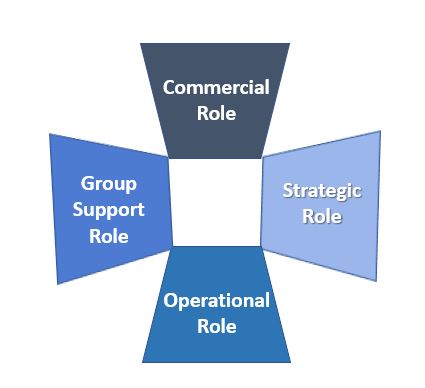
In general, rotational roles fall into these four categories (see graphic below).
Commercial roles could include sales support, marketing, external communications and sometimes includes roles that have direct interfacing with key customers – account roles. A key objective of commercial roles would be to ensure participants understand how money is made, reported, and the levers which could improve profitability, and the processes that are involved in converting operational success to money in the bank. This rotational assignment also provides an understanding of the level of customer satisfaction and where clients would like to see improvements or innovations. For more senior roles in a commercial function, the development objective could include understanding risks and opportunities and establishing a high-level plan to address both with internal initiatives and even external solutions like a merger or acquisition to address challenges and risks to customer satisfaction and the ability to deliver on customer expectations – given observed and expected changes in the marketplace, competitor offerings, etc.
Operational roles usually offer the ability to understand the daily activities and decisions which could lead to meeting or missing operational outcomes. This usually relates to impacts to the Profit and Loss Statements of a company. In these kinds of rotational assignment roles, participants learn to understand the challenges that project teams experience in delivering products or services that are attractive in the marketplace. They also learn how operational delivery can lead to optimal profitability. Concepts like LEAN, Circular economy, and agile are often concepts that are learned during assignments in operational roles.
Strategic roles are often assigned at one of the larger offices or to shadow a senior or executive leader involved in strategic projects and initiatives. During this assignment participants usually learn more about risk management, organizational strategies, and projects. Sometimes they could be involved in supporting due diligence activities for a possible merger or acquisition and may be exposed to considerations regarding organizational structure changes or changes to the legal structure of a company. During these assignments, participants understand how the company evaluates its internal and external strengths and opportunities along with possible organizational weaknesses and risks. In that landscape, the company will set strategies in motion to improve its competitiveness, its financial outcomes (P&L, Cashflow and/or balance sheet), and its ability to outmaneuver the competition in key areas. This could be as a result of acquiring and/or launching new innovative solutions or getting closer to the customers and how customers’ wishes are being met.
GroupSupport roles are often either in Human Resources or possibly in Procurement or any other group support (functional leadership) role where that specific participant can learn to more fully understand the challenges of balancing the needs of its shareholders, customers, employees, and supply chain partners.
How to start
Putting together a Rotational Assignment Program can take some time during the early stages and it would be very important to understand the strategic needs and objectives of the company when it comes to succession planning and key skills needed by the leaders of tomorrow. Talk to as many possible stakeholders as you can to build a successful business case and change plan addressing all concerns and needs of key stakeholders in the success of the rotational assignment plan. Talk to experts who have developed a program like this to garner any tips regarding pitfalls that they needed to navigate. Finally, commit to continue learning as you go. Get feedback and act on it and use the data gathered to drive continuous improvement activities. Use the feedback to ensure the program continues to deliver outstanding benefits in a fast-changing world which impacts your ability to attract and retain key talent on a continuous basis.
Useful posts to help with the preparation and communication of stretch/developmental assignments:
Staged Promotions – Accelerate role-readiness using focused development with check-ins
Leaders are not always ready the moment you need them to step into a new role. An inexperienced leader can increase risks in continued customer satisfaction, operational / execution risks, and employee satisfaction and retention. Using a a staged promotion could be a way to mitigate risks, while ensuring that leadership development is accelerated and monitored with defined targets on knowledge gained and skills and competencies gained during each period within a specified timeline.
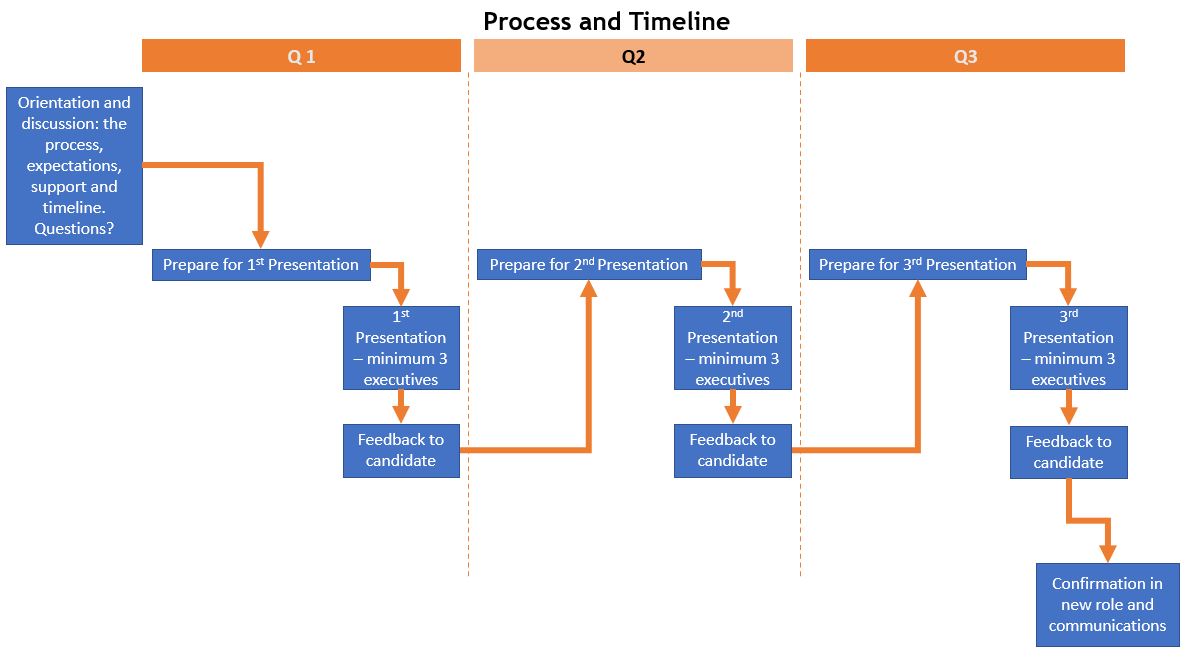
Process and Timeline
The graphic below outlines the process and shows an example of running the process over a 9-month period. The duration of such a process can vary but watch out for making the period too long – longer than 12 months. It can lead to process fatigue and demotivation of the leader. It is important that the process starts with an orientation to ensure the leader understands how the process will work and what is on the other side of the development period. The leader should be clear on what he/she is signing up for.
Defined learning path
During the development period, there needs to be a few concrete check-in points whereby the leader is demonstrating knowledge, skills and insights gathered and learned over the period. Instead of making the check-in points being general discussions, it is useful to select a few key focus areas for a presentation to be delivered at the end of each of the development periods.
Each check-in event needs to result in specific feedback being captured and shared with the developing leader. The feedback helps him/her to further focus and improve on their learning approach for the remaining learning periods.
The final check-in is usually the final decision-point where the executives present are willing to confirm the promotion of the leader – ending the interim nature of the assignment.
The example below shows how a project or facility leader can be assigned specific areas to learn about over the 9-month period. Each of the areas are important for the normal day-to-day activities of the developing leader and the focus simply means nothing is missed in helping the leader perform well in the role in future. It helps to include the strategic and the “why” part of a role since a new role is often mostly or mainly about the “what” to get done.
Notes
The orientation step which helps the leader understand the design of the development path, the role he or she has and also how to ensure his/her own success making use of available internal and external development resources. Before the orientation session, a leader has typically already understood from his/her manager that they are offered the development opportunity on an interim basis and the leader has agreed to proceed. The leader also needs to know what happens if he/she does not succeed at the end? Will they get a different assignment and what might that be?
Preparing the executives before the check-in events (when check-in events are set up to be a presentation followed by questions and answers). Executives need to understand the design of the development path, the purpose of the focus areas, the development needs of the leader and how they are to capture their feedback to be presented back to the leader after the event.
Feedback to the leader should be specific and be a balance of activities that are good to maintain, which ones to develop further and which ones to start or stop going forward. Specific examples of desirable behaviors or results should be highlighted. A discussion on risk identification and management may also be useful to help the developing leader understand how to adjust own focus to best mitigate and manage risks associated with own development as a leader as well as risks associated with the role..
This process is very useful to help a leader understand what the new role would include when they are meeting all expectations of stakeholders. A leader who feels uncomfortable meeting all those expectations will typically ask to be taken off the development path before the end having realize it is not for him or her. And this allows for re-assignment and solving the leadership vacancy in a different way.
Listening to a presentation by the leader on the assigned topics goes a long way towards providing executives with a sense of comfort (or alarm!) in terms of what can be expected from this leader in this role going forward. While these check-in points should not be the only determinant of how the leader is performing in the new role or estimating future behavior, it is a great way to understand the reasoning a leader applies in making business determinations and decisions and how the leader approach problem-solving when faced with adverse situations.
Working on multicultural teams you may have had moments of wondering what he or she just meant by that comment? Or why will he or she not make a key decision so an activity can move forward? Cultural perspectives and ways of life may be one of the reasons that could explain those incidents.
It is fun to meet people from other cultures and learn about their lives and experiences. And at first it may be interesting to learn how their cultures vary from your own, but once you work on a project together and it is remote working, including long hours and tight deadlines those differences can start to cause friction on the team. This can slow down progress and impact team morale. Being aware of the most common inter-cultural disconnects can prevent team members from blaming it on a person and instead enter into a discussion to unpack the root cause of a lack of action, lack of decision-making or the exact opposite – too many fast actions without thinking or making decisions without considering consequences.
4 Areas of misunderstanding that can impact inter-cultural teams
Some things are smart to do in order to ensure the team understands required project outcomes and approaches to use. Aspects would include clarifying the definition of done, outlining project phases and deadlines, assigning roles and responsibilities and having regular meetings to monitor and understand progress and resolve issues that are hindering progress or pose a risk.
Some aspects may need additional attention if your team consists of a few members from very different cultures.
1. Managing to deadlines
This relates to how important team members believe deadlines are. Some may see them as a guideline while others will suffer anxiety and will work longer hours to make sure the are met. In some cultures, there is a strong emphasis on being for example exactly on time for an appointment while in other cultures it may be okay to be a few minutes late for business meetings and perhaps even a few hours late for a social engagement.
Cross-cultural impact:
Make sure all team members understand the consequences, knock-on effects and penalties which may be triggered if the team missed deadlines. Monitor progress and have follow-up conversations if team members are falling behind to ensure they understand the importance of their activities being completed on-time.
Ensure team members understand the priorities they should place on various aspects of the work that needs to be done by the deadline. Ensure it is also clear exactly what “done” means. Do you expect quality checks to be done too or just a first draft of the outcome to be available? Should it be print-ready or just ready for an internal review or further discussions?
2. Clear Role Expectations
There are differences in cultures around the meaning of “in charge” or the Subject Matter Expert (SME). In some cultures, it is customary to take the word of such a person as a mandate to perform a specific task or action exactly according to what he/she said. In other cultures, SMEs and leaders are considered more “accessible”, and dialogue is welcomed when one does not agree with a requirement or task assigned by the one “in charge.” This difference can cause confusion on teams including many different cultures. To what degree can and should instructions be discussed and challenged vs accepted? Are those in expert roles or roles with authority prepared to deal with challenging discussions and comments – if the project team will operate in a culture of open discussions?
Cross-cultural impact:
Have a role discussion at the start of the project and include what would be great questions to ask each role and how interaction is expected to take place on the project to maximize positive team outcomes.
Be sure to have further discussions highlighting best-practices during the project and as new team members join, who may have missed the original discussions around the different project roles and how to best interact with them.
3. Conflict resolution
Conflict shows up differently in each person – some people speak up and go to the “max ” to be heard and understood while others take their thoughts, feelings and especially resentment underground and do not speak out. This means that conflict can be hard to resolve and to feel comfortable that all thoughts and concerns are on the table and discussed before decisions are made. Some cultures are more likely to speak up and make sure their opinions are voiced while others might patiently and politely wait to be asked for an opinion and speaking out of turn (from their perspective) may be seen as impolite or disrespectful. In some cultures open disagreements are best avoided to maintain a cordial/good relationship with others on the project.
Cross-cultural impact:
Use more than one channel to check in with team members and get feedback – ask in meetings, but also check in with individual team members between meetings to understand if there is any part of the path forward chosen which concerns them.
If any team members are especially aggressive in voicing opinions, perhaps a quiet word might help that person to still voice opinions, but possibly in a less forceful way to avoid antagonizing anyone from a culture where a forceful (overly enthusiastic ) communication style might cause discomfort.
Provide training in non-violent communication and voicing messages with a healthy balance between listening and advocating. Help team members to constantly improve in understanding each other’s styles to help communication and collaboration efforts on the project.
When a conflict does occur, address it in a culturally-sensitive way if the disconnect could be related to a cultural difference in perspective. The objective should be to solve and address project issues in a helpful way without causing negative impacts to collaboration on the project.
4. Navigating with many languages
We all know of situations where people from the same country with the same language find it hard to communicate successfully with understanding and openness. When a team consists of many different cultures, this can be so much more confusing and frustrating.
Cross-cultural impact:
Agree from the start of the project to follow a few guidelines such as: For the chosen project language, native speakers are to slow down and use simple ways to bring their points across. And native speakers of the main project language will be patient with non-native speakers trying to get their thoughts across. If there is a large language ability gap between the native-speakers and other team members consider some language classes to bridge the gap.
Consider asking presenters/speakers at planned meetings to send out specific agenda items and a summary paragraph of the issues to be raised and discussed at least a day before the meeting. That would help non-native speakers to prepare ensuring they understand the issues and are able to fully participate in the conversation at the meeting.
When there are significant differences in levels of language abilities on the team, meetings may take longer, and collaboration may also be a little harder especially in a virtual/remote environment. Be sure to take this into account when planning project timelines and deadlines.
Plan ahead to succeed
Knowing you may be starting up a project with a multi-cultural team, schedule team-building activities for team members early on. This will help them get to know each other as humans/people. Establishing trust early on, can avoid frustration turning into conflict and delays in reaching project team deadlines.
Create team opportunities to get to know more about each other’s cultures. This could bridge the gap in understanding each other’s perspectives and avoid labeling, misunderstandings, and internal team misalignments..
Set continuous learning as one of the core values of the team and live it, encourage it and keep bringing the team back to what can be learned from successes and failure as the project progresses. Having a curious and learning mindset is a great way to avoid major disconnects between team members as they will engage in inquiry and advocacy vs judgment and labelling as a default behavior.
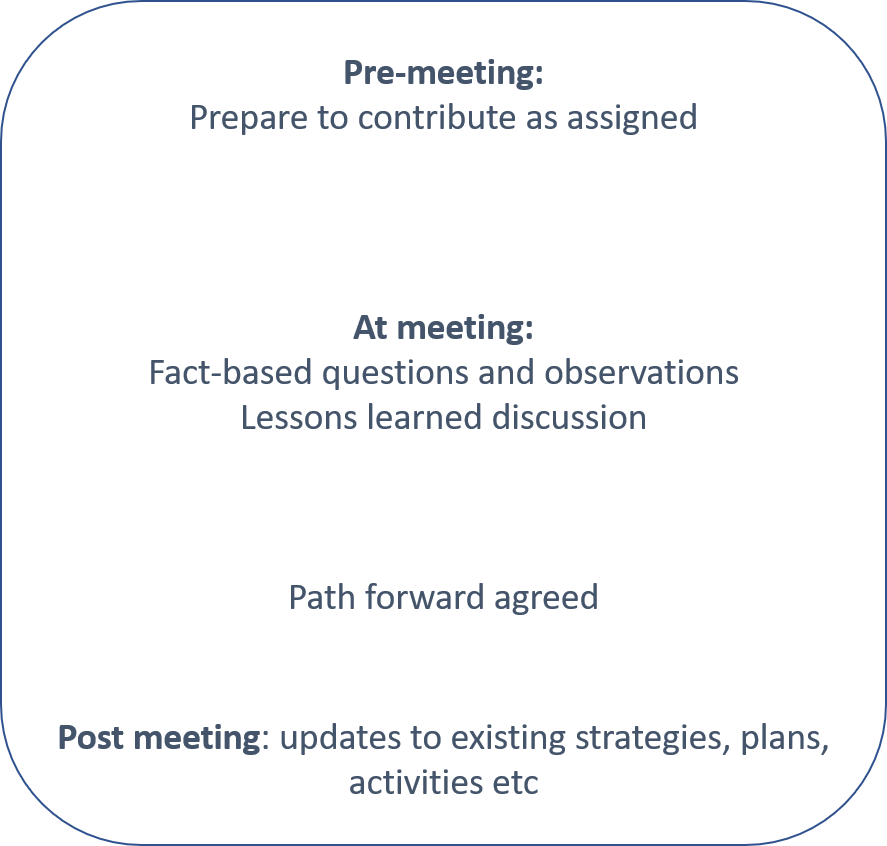
Have your review meetings for a process or a policy document turned into a low-value event where tons of slides are being shown and no real discussion takes place? Do you feel confident about the outcomes from your review meetings? What if you had a way to make the review meetings more structured and action-oriented, making sure everyone is engaged?
This activity will help you do that!
When your review meetings succeed they…
Result in improvements and updates that ensure your plan/policy is fit-for-purpose and comply with most recent business and legal requirements,
Make sure your plan/policy, in addition to fully complying with most recent legal and government requirements, also align with your company’s strategies,
Engage all stakeholders making sure every one of them has an opportunity to suggest ways to improve the policy/plan to better meet business needs and concerns, and
Enable you to get through internal and external audits with confidence.
The process
Divide your meeting participants into two groups and give each group a preparation assignment – Team Blue and Team Red. They are to arrive at the meeting, prepared to either defend or criticize the existing plan or policy and underpin their points with solid arguments based on research (doing homework before the meeting).
The blue team has the assignment to identify fact-based reasons why the existing plan or policy is fit-for-purpose, compliant, and good enough as it is today. While the red team has the assignment to research and come prepared to point out specific areas or aspects where the current plan or policy fails to address specific issues or factors.
Preparation
Each of the teams prepare before attending the meeting. The blue team will prepare in this way:
And preparation by the red time includes:
Members from each team bring their notes to the review meeting – prepared to substantiate their claims based on their pre-meeting homework assignments.
Meeting Agenda
After the meeting has been opened, objectives shared and the process discussed, the review process follows these steps:
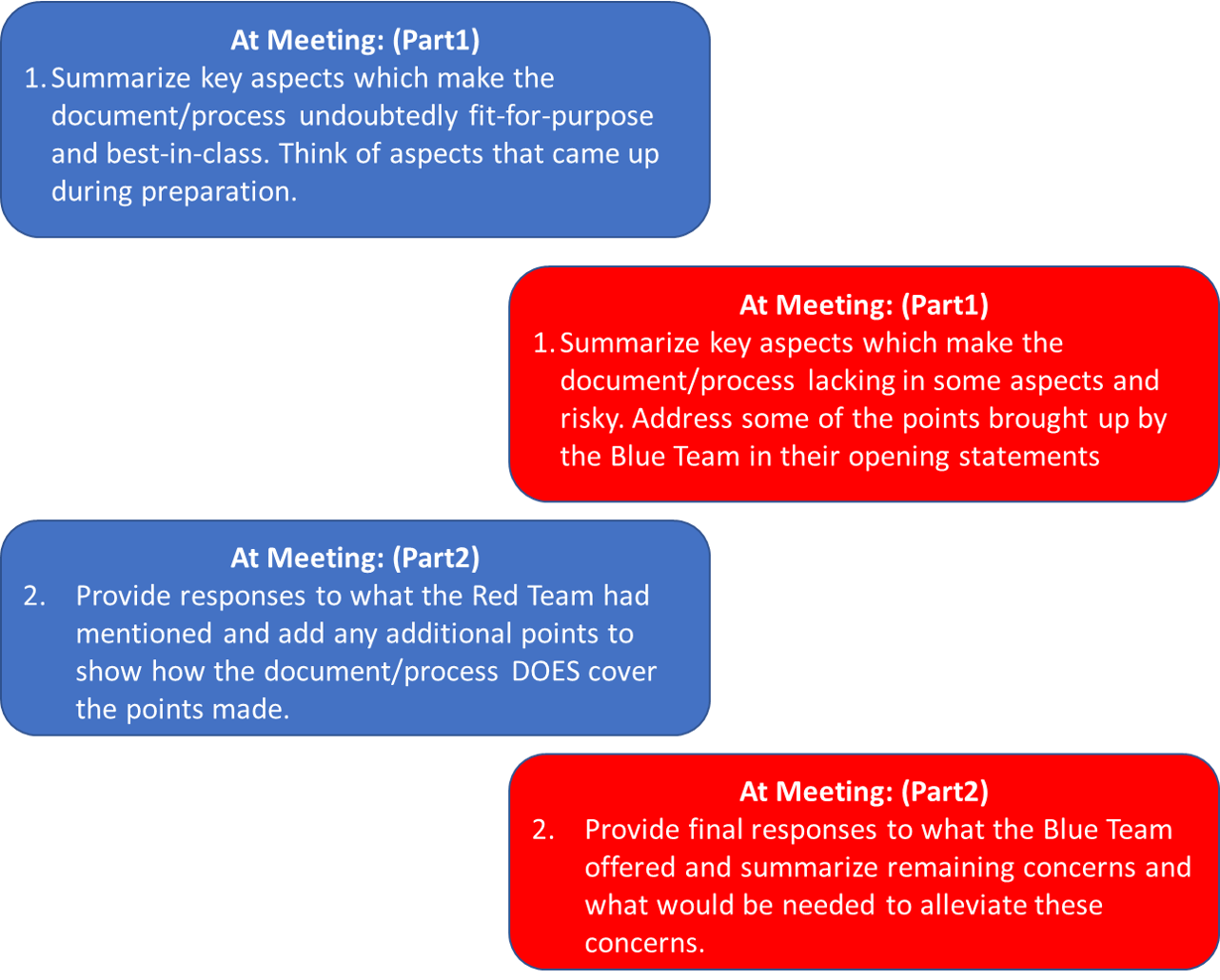
The Blue team summarizes the high-level benefits and explains how the current version of the document/policy is fit-for-purpose vs over-the-top in terms of mitigating, avoiding or managing risks associated with why the document/policy was originally created. (10 mins)
The Red team then gets 10 minutes to summarize risks or changes to laws, which means that the current policy or document is not currently fit-for-purpose. They may comment on some aspects raised by the Blue Team too.
The Blue team gets 10 – 15 mins to make their final statements: responding to anything specific that was mentioned by the Red team and also adding to any additional points related to key items they had mentioned during their opening summary. They would make specific mention of aspects that are strongly beneficial and need to remain in the policy/document.
The Red team then makes their final statements in 10 – 15 mins. They would especially summarize key gaps between the current policy/document and aspects that would need to be addressed in the next version.
Path forward
The final part of the meeting consists of all meeting participants discussing and summarizing improvements that would be needed to the next version of the policy/document. In the process, they may assign various meeting participants to do additional research, align with stakeholders not present at the meeting, and/or write the updates or additional segments to add to the current policy/document.
An additional meeting may be needed to check-in on progress and finalize the updates that have been agreed upon.
Tips:
Do not run this with groups larger than 15 people. It would lead to a longer meeting and some people feeling less involved and engaged.
Be sure to state that the meeting is to take no more than 1 hour. If the process is followed for too long a period, it waters down the intent – focus – and gets more into minute details which are often best dealt with in post-meeting assignments.
Be sure to assign someone to be the time-keeper to keep an eye on the process – ensuring the meeting stays focused on the agreed approach and time-commitment. And be sure to note the path forward actions to help the designated coordinator with follow-up actions and close-out activities.
In general, this interactive approach to review meetings leaves participants much more energized and positive about meeting outcomes.













 The Rethink Shelf