Before any organizational change is launched there has to be meetings with executives and senior leaders to ensure alignment around the reason(s) and main principles of the change initiative. Meeting objectives would also typically include getting their support for executing change activities and to help them understand expectations of them as executives and senior leaders during the change period and beyond.
The downloadable slide deck (above) can be used as a basis for creating your messages to senior leaders and executives. The slides helps to explain how change will likely impact the organization and the people plus explaining how leaders can help by being role models and also by actively addressing resistance and other signs of low engagement in those around them.
Use this resource as optional examples to help communicate the specific messages that makes sense for the change management initiative that you may be leading and the meeting participants/audience that you will be facing.
Here are the steps I would suggest you follow:
Be clear on the reasons that your change initiative need to be implemented and how the changes will improve on status quo. (Business case or burning platform)
Did you get executive buy-in from one or more sponsors before your presentation? (Highly recommended – in fact, do not proceed until you have it!)
Consider the presentation you will be doing – who will be there? What do they know and what do you need them to know, understand and do once they leave the presentation?
What impact will the planned changes likely have on the employees at your company and how do you think your targeted audience can help and should act/behave given the change process and desired outcomes?
Review the slides in the resource I am sharing and determine if any of them could help you and support the messages that you would like to communicate to the audience that you will be facing.
Of course these slides are not going to substitute the preparation work you need to do before starting a change initiative, but they may be helpful to use as background or to explain some of the specific change management aspects that may be of particular importance to your audience.
Every employee has different reasons for showing up at work and there are different ways to motivate each of the people working with you. Since one size does not fit all, it is best to stop guessing and to find out for sure what it is that makes those reporting to you love their jobs.
Knowing what motivates your direct reports is a great way to ensure you retain your direct reports. Of course having a good professional relationship with each of your direct reports goes a long way to ensuring that issues which may demotivate them are brought up early and resolved in open dialogue and discussion.
The exercise below can be used by you to first establish what you believe would be motivational before you ask your direct reports to complete the exercise below. Understanding that, as their supervisor, you are most likely not going to get it right without their input may further instill the practice in you to always check your assumptions before you engage when it comes to understanding what would motivate others.
The list below contain outcomes that could be motivational to your direct reports in their jobs. This means that these outcomes would keep them interested in continuing to work in this role, for you and in this company.
Instructions:
Rank the list below in terms of 1 to 14 where 1 means “motivates me the most” to 14 which means “this does not motivate me much.” The ranking is not to say that this is how it is RIGHT NOW, but in the perfect environment, what would be the most vs least motivational to the person doing the ranking.
A. Rank these from 1 to 14 – what motivates me most at the top
Receiving market-aligned compensation for the job I am doing
Recognition for my efforts by my supervisor
My work is interesting and challenges me in a positive way
The company/job comes with excellent benefits (separate from my annual salary)
Pleasant working environment (ambiance, set-up)
My supervisor is fair in making decisions and communicating them i.e. promotion, recognition, expectations.
The knowledge of my colleagues which is shared with me
I have all the information I need to have in order to understand what my priorities are and why I am performing the tasks that I am assigned
I understand exactly what my supervisor expects from me
I have a great feeling of accomplishment in this role/job
This role/job provides me with a lot of learning options, which can lead to promotions in the future
I have a chance to contribute to discussions and decisions that impact me
The people I work with are great people who make me feel included and valued
My opinion is often asked for and is valued by my supervisor
B. Level of current motivation
The next step would be to ask the same employees to rate how much they are currentlymotivated by the same items from above. Comparing these answers with the answers in A. can help you identify possible ways in which you can improve the motivation of each employee reporting to you. For example, if someone had a high ranking motivator in A. and that same item gets a low score in B. that means you should look for ways to impact that area to motivate and retain that particular employee.
Results – what to do next?
Once you have captured the feedback from those who report to you, have individual discussions with each one of them to determine how you can better impact the areas that they scored as the highest importance in terms of motivation and where potentially their scores for current experience were the lowest.
How can I, as your supervisor, help you to have a better experience of this item (high ranking items from A. the list above – especially if that same item has a low score in B.)? _____________________________________________________
Are there ways in which you feel that I can remove obstacles or improve your experience in this regard? (see highest ranking items with low scores in exercise B.) ______________________
Is there anything that you and I need to discuss or resolve to remove any bad feelings or negativity from the past to move forward on a positive note? _________________________
Is there anything that I, as your supervisor, can do better to improve your enjoyment of your job/role at the company?
Be sure to mention (as appropriate – be truthful and honest):
I want you to know that I value your contribution and you are an important team member to this project/department.
I believe we can achieve great accomplishments in this department/team if we work together and communicate openly about what needs to be done and how to support each other in order to have a better overall outcome for the team/department.
I hope you will take the time to let me know of any obstacle that you see which may hinder us in achieving our goals. And I hope you will see any feedback from me in the same light – I want you as an individual to enjoy what you are doing (realizing that not all of our jobs are highly enjoyable – some parts are typically repetitive and maybe mainly administrative) and I want your contribution to the team/department to be clear to you in terms of expectations and how things are going.
Is there anything else you would like to bring my attention or which you think we should discuss before we end our meeting?
After the meeting you may want to consider reviewing your notes. Some items may be easy to action, simply by you emailing or calling someone in order to set something up. Other items may not be so straight-forward. For example, someone with a performance that does not meet expectations may ask for an increase. Set up a meeting with your HR Business Partner or representative to talk through the items and set priorities. Always make sure you are able to provide direct individual feedback to each employee on the items you discussed in your individual meetings with them.
Employees are motivated by different aspects of their roles/jobs at the company and there are many ways in which you are able to influence these aspects. The professional relationship you have with your direct employees also greatly impacts whether someone chooses to stay or leave the company/their role.
In the end some employees will leave and you will need to fill those roles by promoting existing employees or hiring new employees. Ultimately, the sign of a good leader is the number of great leaders he or she creates. When they feel the need to leave to move up, applaud them, keep contact with them and congratulate yourself when you see them succeed regardless of where they end up as a result of your great coaching and support.
A new leader or manager has to quickly connect with the team and understand the objectives and issues around the team and their tasks if he or she wants to be effective in the shortest time possible. At times the team may know the person promoted to be the new leader or manager. The new leader or manager may also be hired from outside the company or someone who joined the team from a remote part of the organization where there had previously been very little to no interaction with team members. In all cases, the team members may have concerns and wonder how the new leader or manager will help the team and them as individuals succeed going forward.
The slides I am sharing can be used to facilitate a group session with the new leader/manager and the existing team. The focus of the session is to help them accelerate the connection and learning that needs to take place for the team to maintain momentum and reach their goals under new leadership. The session helps the team get to know the new leader/manager and voice their concerns. The new manager/leader also gets to know quickly what the team issues are and how the team feels about progress and possible team obstacles to success, which enables him/her to more accurately set the team’s priorities and focus areas for the next few months.
The resource includes some instructions for setting up the activities and also some timing estimates. The slides contain a basic ice breaker/check-in exercise at the start of the session. You could always change this activity for something that better fits with the group/team that you are working with, if needed.
For a simplified process of setting expectations with new leaders and/or new teams, you can download a file to help with that below.
Depending on how many issues the team has, the size of the team and how much they already know about the new leader/manager the entire session can take anything from 2 to 4 hours. If you are the facilitator you need to watch the time. Sometimes the first group discussion can take much longer than expected – when they share their answers. This means you need to plan up front : If they go over the planned timing for that portion of the agenda, will you let the discussion continue and defer the rest of the activities to a later date? Or what will you change to ensure you stay within the contracted time with the group while reaching the goals and objectives for the group session?
If time allows I strongly suggest that you include a team meal at the end of the session. This would allow for some informal social interaction between the new leader/manager and the team members, which further solidifies interpersonal relationships within the team and helps the new leader/manager have a good start with the team.
How many leaders are we developing for future leadership roles? Where should you be spending your employee development efforts? What is the best way to spend your training budget to contribute to the company’s ability to produce desired results? Being able to answer these questions, is the reason you would want to be able to do a talent audit.
You may benefit from doing a talent audit – review your team and your leaders to get to a thorough understanding of the needs of each individual and the capabilities of your entire team/organization.
The vertical axis on this graphic is where you rate the performance of the employee and the horizontal scale is where you rate his or her potential to reach higher levels of leadership in the company if you develop him or her.
The green star example would be a leader who is performing exceptionally high and who also still has the potential to move up more levels within the company – maybe 2 or 3 levels more in the next few years.
The red star would represent a leader or employee who is not performing according to expectations at all and who has not shown any signs of being capable of or motivated to move up any levels in the company.
When you are used to looking at your leaders and teams in this way, you may not need to use a formal checklist, but you should be able to do this on the back of a napkin. Until you can do that the resource I am sharing below and which you can download, may be useful.
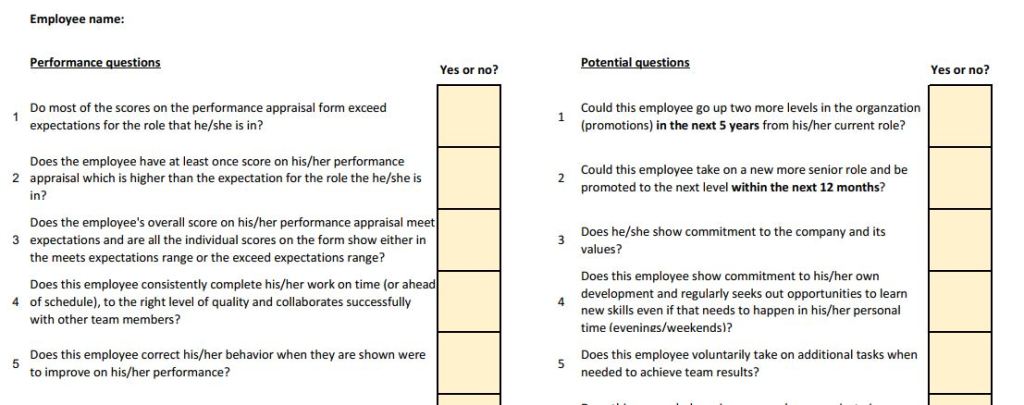
An easy checklist for employees and leaders is shown below – note how well they are performing in their current roles and then compare that to how much potential do they still have to move up a level or two in the company in the short to medium term.
Once you have the number of YES answers to the questions in the downloadable link above, you can plot where each leader or employee would be on chart like the one shown below. The maximum value would be 12 on the potential axis and 11 on the performance axis. Your scores will likely be somewhere between zero and those maximum numbers. The scale for both axis is 0 in the bottom left corner and the the top of Performance would be the maximum and the right side of the Potential axis is the maximum.
Using the checklist helps you determine where your current employees and leaders would fit on the model shown above. All you need to do is answer yes or no to the questions shown. When you get to the bottom count the number of times you answered yes and calculate the % yes score (total yes answers divided by number of questions).
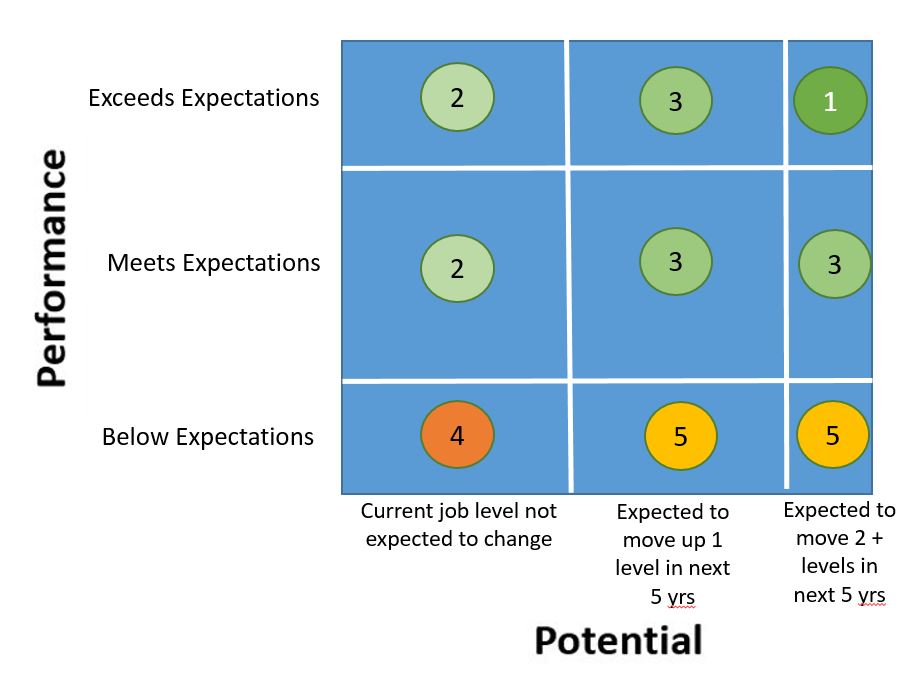
Alternatively you can use the next figure (see below) to plot the employees. Review their latest performance review outcomes against the vertical scale: Exceeds Expectations, Meets Expectations and Below Expectations. Looking at the employee’s motivation, mindset and capabilities – does he or she have the potential to move up some levels in the company? Plot that against the horizontal axis.
To ensure a good perspective of the employee pool that you are reviewing, ask various executives/senior managers who have regular contact with the employees to complete the list of questions in the resource. Combine all the answers to arrive at the final plot on the graphic for the employees/ leaders. Always perform a sanity check before you complete the final plot – employees must have the motivation and interest to advance in their own careers and have great interpersonal relationship skills before you can plot them towards the middle and right side of the horizontal scale.
Once you have the employees plotted as stars or markers on the diagram you can move towards planning next steps.
Interpreting the numbers in the chart shown above:
These employees are able to grow to the top of the organization. Accelerate their development and make sure they have stretch-goal assignments.
These employees are good performers who need to be recognized and you should keep them engaged. Retention is the word, especially if they possess key skills that are hard to find in the market.
These employees need training, coaching and a structured approach to improve on their skills and competencies. Since they have the motivation, ambition and ability to move to higher roles in the company, the gap between future role requirements and current performance assessments should be driving the development actions needed.
This group needs to be addressed fast. Or you can coach/motivate this employee to improve performance or you need to let them go. They are taking management energy away from growth and are not contributing to the company’s success. (If their below expectations performance is related to health issues – manage according to the local laws and agreements with unions etc.)
The performance of these employees has to improve. There are several reasons why someone could be plotted in this group. a) some executives/managers see potential here, but the employees’ own motivation or ambition may not align with that – move the employee into the correct group – towards the left; b) personal or interpersonal issues may be at work here – try to resolve; c) employee does not understand what is required from a performance perspective – ensure clear goals and expectations are set and train/coach and review regularly to ensure that performance does improve.
This process is not static and you should review your plots at least once a year. It is possible for employees to move into other areas of the graphic after they get the promotion they worked towards or their motivation and ambition at work may change.
This annual review is an exercise that should include the executive team or management team for that location, because it is important that the senior team understands the talent and leadership potential that is available at that location. It is also important that multiple views are incorporated and discussed during the review sessions. It all starts with doing the first talent audit though and this tool will hopefully help you do that.
Leading and managing a group of people at a single location is not an easy task and managers often tell me it is the people-side that wears them down. When your team is very diverse and located at different remote locations instead of at one location, the challenges and risks of the team not reaching goals multiply. The resource I am sharing today is a checklist for team leaders or managers/supervisors of remote teams and it focuses primarily, but not exclusively, on the the people-side.
The downloadable checklist above lists a number of items to consider when you are leading a dispersed or remote team. This may be a useful check for team leads or project managers to ensure they are taking into account the additional challenges that remote teams bring and are taking the appropriate actions and precautions to manage the interpersonal and communications aspects on such a project.
The checklist items are grouped by the following main topics:
Critical Skills for Supervising International Project teams
Setting Goals and Expectations
Giving Feedback and Coaching
The team
Communication
Establishing a Good Start
Working with dispersed team members can be very interesting and it can be fun to learn about other cultures and other perspectives. However, those same interesting differences can make remote teamwork frustrating and difficult. The checklist shared here can go a long way towards helping you, as the team leader, take advantage of leading a diverse team while successfully managing the harder part of leading teams.
Setting a strategy for an organization requires a focus on aspects internally and external to your organization. Once you have set your strategic growth targets you would need to look at how you need things to change internally to support those growth targets. You may want to set your signs on improving profitability, increasing organizational effectiveness or moving leadership behaviors closer to your values and vision for the organization.
The resource I am sharing can help you align some of the most important internal aspects with your strategy to improve your chances of successfully executing on the strategy.
Most organizations are able to successfully navigate through the process of setting a strategy. Many organizational leaders find execution and implementation of the strategy the hardest part to achieve. I believe this is mostly because internal aspects that are needed to support the strategy are not always taken into account in the execution plan.
The framework (See download option above) and questions to address in each case help you by acting as a checklist. Reviewing the execution plan, this list will help you consider how to engage, involve, and inform stakeholders in the process. It helps ensure that every aspect of your execution plan reinforces your strategic objectives leading to a better implementation plan.
The areas to ensure alignment are:
Company values and culture
Leadership (behavior and mindset)
Workforce capability
Organization structure
Organization processes
Systems (Automation)
Performance Management and Metrics
The sequence would always be to first select a strategy you would like to pursue with the organization and then use this resource to plan the implementation portion of the activity.
Setting strategies is often an iterative process as changes from inside or outside of companies require an adjustment in approach. Remember to check the impact of further changes on the same checklist (see above) to ensure you maintain the strategy alignment.
A new project is best started by getting the entire project leadership team on the same page. This relates to commercial terms, project scope, key milestones and other important contractual terms and conditions. It is also vital for the project leaders to understand how they will execute this project – who is going to do what exactly to make sure we execute this project scope to the best of our abilities?
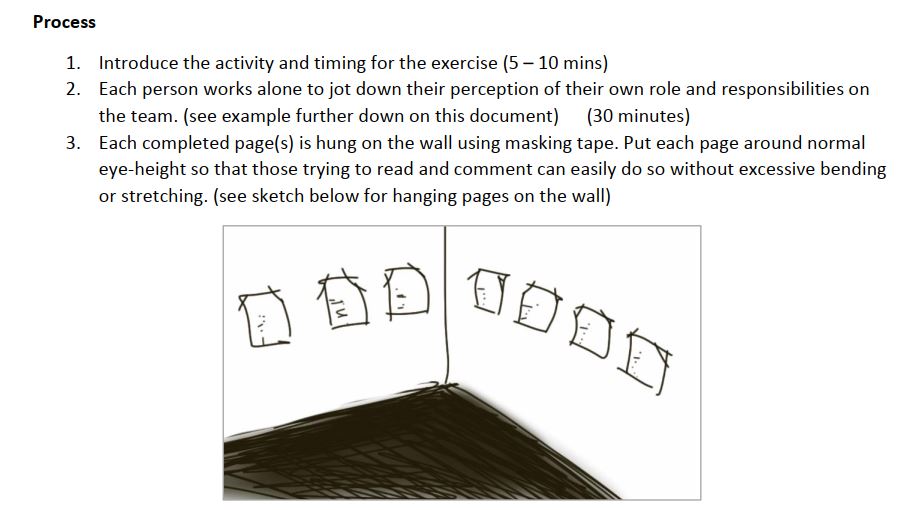
The resource I am sharing here describes a process you can follow as part of an early team-building activity to clarify and agree team roles and responsibilities down to individual levels.
In this activity the project leaders are gathered together and a facilitator takes them through this process. (See downloadable process description below).
You can use this activity after first running a sub-group responsibility definition activity which defines project interfaces or relative responsibilities for decisions and processes by functional or other sub-groups on the team. (see Defining team interfaces) Using this sequence means you drive home how the overall project outcomes are managed by sub-groups on the team and then right down to individual roles in those same processes.
This exercise can also be used when there is a change in phase or focus on the project or the composition of the team changes greatly. At those times it is important to keep the team’s momentum going by ensuring that roles and responsibilities remain clear throughout the changes.
Clarifying individual role and responsibilities also supports the performance management process. When individuals receive feedback regarding their performance it is important that they already understand what performance and role expectations are.
Having individual roles documented can also support bringing new team members up to speed fast. It helps explaining expected team functioning and who they should talk to while making their contributions to successful team outcomes.
Project teams simply function better when everyone understands how he or she is expected to contribute to the team’s goals. This activity does help greatly in clarifying expected individual contributions. I do suggest you distribute the final agreed pages with the team for reference purposes.
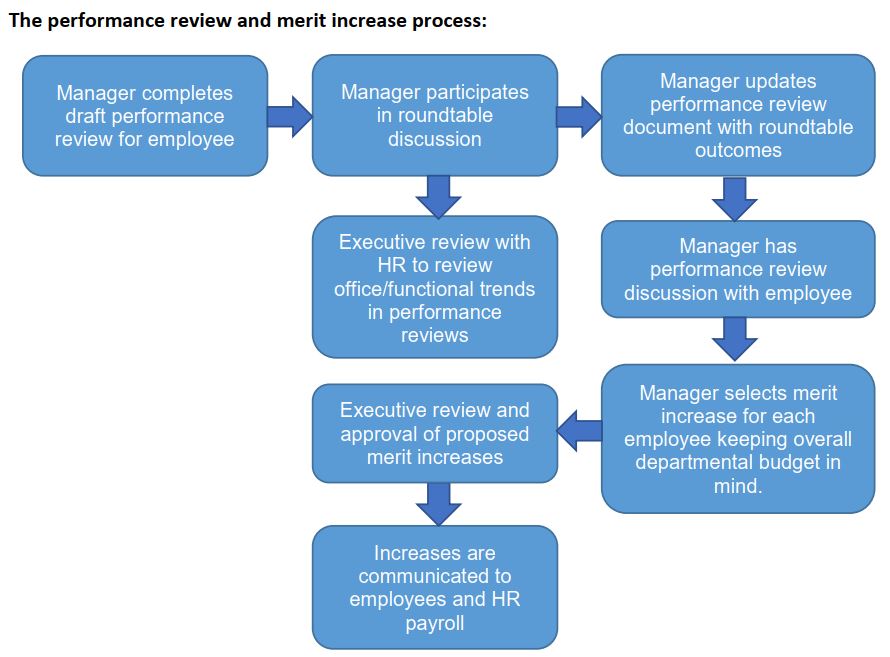
Employee performance outcomes is one important aspect to be reviewed when it comes to considering merit increases. It is not the only consideration though. Overall merit increase budgets, inflation, changes in external benchmarks for specific roles, current compensation ratios etc. are all additional elements which would impact actual merit increases per department and employee.
The resource I have here ties a specific overall individual performance review score to a specific range of possible merit increases. Some managers require a highly structured and fixed process for determining % changes and this is one way to create one. One should however also be sure to consider the other aspects mentioned above: budget for increases that year, company performance in the last year (overall), the market value of specific roles (roles that are in high demand). Compensation has a powerful influence on employee engagement and retention, but it is not the only one. Employees also care about career growth, flexible benefits and being helped to develop further.
I would caution anyone to consider unintended outcomes when attempting to standardize and establish rigid structures for considering individual performance and linking that in a fixed way to merit increase percentages. While intentions may be good: to reward your best performers for their contributions and to ensure those with lesser performance improve or leave the company, a process that is overly structured could fail to accomplish that intention.
The approach shared above – see download link – indicates one way in which a group has established a direct link tying the performance review process directly to the merit increase process. This example does not take into account some of the considerations highlighted above when it comes to selecting the actual increase percentage and I chose to share this resource anyway, because it does happen that HR is asked for a process like the attached on a regular basis and I want to make an example available to you if you find yourself in that situation.
I do suggest you consider ways to incorporate the other aspects as outlined above when you finalize your proposal to implement a more structured approach to tie performance management to compensation review.
My main advice is to think it through carefully to ensure your good intentions have the best chance of being reinforced by your performance management process and pay-for-performance approach . And I would also add that you should remain flexible in working with your documented process. Be ready and willing to adjust and update it as you gather input about how successful your process is in driving desired outcomes – results and behavior that you and the executives would like to see in your pool of employees.
Most projects are made up of several sub-groups of people. On a construction project you can imagine there is a group of people tasked with looking after the physical safety of people working on the site. You can also imagine another group that looks after checking that materials and installed units meet quality requirements. These sub-groups of people have interfaces with each other whereby they exchange and share information, documents and outcomes. They also provide and request support from other groups to start, complete and execute a process. Most of the time project inefficiencies occur across the interfaces with internal and external sub-groups or functions.
The best way to ensure efficiency and effectiveness across project interfaces is to increase transparency around assumptions that people have . Test whether they are accurate and understood by others on the project.
Note that project interfaces can also refer to processes that involve multiple functions in the home office environment or the company structure. These “external” groups to the project may be setting high-level processes and goals, which create the environment that the project team needs to operate in. Examples may include HR, Finance, the group that tracks compliance with corporate policies and procedures etc.
This team building activity that I am sharing helps various interfacing groups understand differences that may exist between how they think they should be interfacing with other groups and what the actual expectations from other groups are.
Clearing up interface issues among geographically dispersed groups working on the same processes or projects;
Clarifying how different functions should interface with one another on a project;
Clarifying any differences in perspective among cultural groups or different shifts of people in the same function working on the same tasks interfacing with one another; and
Getting clarity on how multiple projects should interface with each other and/or the corporate groups they work with.
The reason that interfaces with other groups tend to be where delays and frustrations occur is because it is common for people to analyze and optimize processes only for the portion that they are responsible for. This perspective means they often overlook how their efforts impact others or how the efforts of others impact them and they fail to take the bigger picture into account. This activity will support efforts to improve the outcomes of inter-group processes as you work towards greater successes on your projects and initiatives.
Your project team is very diverse and you are concerned that this may impact how your project will be executed – will you be able to achieve your overall project goals or will there be a lot of internal strife, misunderstandings and disagreements? Will they work against each other and have the wrong assumptions about each other and the project goals and metrics? If so, this team-building activity may help.
The downloadable resource I am sharing is a team activity you can use to help project team members understand that different groups of people can have different views on the various aspects of running a project and also the relative importance of key project processes. This activity makes those possible disconnects transparent which helps you lead clarification discussions with the team/group. While the activity itself is quite simple, the discussion that comes after the initial assignment is where the value lies and that will take up most of your time.
You can segregate meeting participants in various ways related to the most important diversity aspects you wish to highlight within the team. As a variation you may choose to run the first part of the exercise more than once and each time segregating the group of participants in a different way. Options include: cultures, locations where they are from or live, level of life experience, function etc.
There are several topics listed for discussion towards the end and it would be wise to prioritize them for your own convenience, as a facilitator. If you are running out of time towards the end you can then ensure you are covering the most important topics during the time you have available after the initial portion of the exercise.
Be sure to stress that diversity is a plus for team creativity and finding new solutions. The objective of this activity is to help work out some of the downsides of diversity without marginalizing any one or group or impose judgement.
Non-homogeneous teams may be tougher to manage than homogeneous teams, but the pay-off in creating new and innovative team solutions coupled with individuals learning new skills and perspectives from other team members can be very rewarding. As a team leader or facilitator you just need to make sure you have the right tools, such as this activity, available to help non-homogeneous teams succeed.