Boost Your Onboarding Game: Survey Your New Hires


Uncovering the Onboarding Experience: The Power of Feedback

Your onboarding process sets the tone for an employee’s entire tenure. To ensure you’re creating a positive and productive experience, gather insights directly from the source: your new hires. By surveying employees during their initial months, you can identify areas of strength and opportunities for improvement, ultimately enhancing employee satisfaction and retention.

Measuring Onboarding Success Over Time

To gauge the effectiveness of your onboarding process, ongoing feedback is essential. By tracking survey results over time, you can identify trends, measure improvement, and pinpoint areas for further enhancement. Comparing responses across different locations can also highlight regional variations and inform targeted interventions.

Leveraging Technology for Effective Feedback

Gathering feedback from new hires is essential for refining your onboarding process. Fortunately, numerous online survey platforms, many offering free plans, can streamline this process. From Google Forms and Microsoft Forms to dedicated HR software, you can easily create and distribute surveys to collect valuable insights. If technology isn’t readily available, a traditional paper survey can also be effective. The key is to capture data that will inform improvements to your onboarding journey.

Tips:

  • Don’t make the survey very long or you will risk lower response rates, questions skipped, or repeated answers.
  • Watch out for questions that seem similar which frustrates survey respondents.
  • Make sure you are asking questions that would generate actionable answers. For example, I advise against asking “Did you feel good on your 1st day at the office?” If the survey respondent answered “no” you would have limited ability to avoid getting that response from future new employees.
  • Do take the time at least once per quarter (or shorter time periods if you are hiring several people) to review, analyze, and summarize the results obtained from the New Employee Surveys. That way you will be able to spot trends and identify specific focus areas for you and your HR/Learning and Development teams to address and improve upon going forward.

Crafting a Communication Plan: Your Roadmap to Change Success


Whether it’s a new process, a revamped strategy, or a technological overhaul, effective communication is essential for a smooth transition. A well-crafted communication plan outlines the who, what, when, where, and how of sharing information, ensuring everyone is on the same page and aligned with the change journey. Let’s dive into the key components of creating a powerful communication plan.

Tailoring Your Message to Your Audience

Effective communication means understanding who you’re talking to. Different groups will need different information. Start by identifying everyone who’s affected by the change. This could include employees or different groups of employees, customers, partners, and even the wider community. By mapping out your audience, you can tailor your messages to their specific needs and interests. Think about different functions, think about geographic locations, think about management levels, and think about people outside your company who may be affected.

Communication messages could be intended to explain why things have to change, what is going to change, when and how it is going to change, how the change is going (progress update) and what (if anything) people need to start doing, stop doing or what should change in the way they have acted in the past.

Continue reading “Crafting a Communication Plan: Your Roadmap to Change Success”

Post-survey Action Plan


You’ve got the employee survey results. Great! But don’t just let them gather dust. Find the biggest pain points, make an action plan, and get moving. It’s about turning those numbers into real improvements. Remember, less is often more. Focus on a few key areas instead of trying to fix everything at once. Let your team know you’re listening and planning to make needed changes.

The first template helps you pinpoint exactly what worked and what didn’t. Don’t just list random stuff – get specific. Once you know what to improve, create clear action steps. Make sure you can measure your progress and know when an action is complete by defining what done looks like.

Continue reading “Post-survey Action Plan”

Training Evaluation Forms


Beyond the Basics: The Importance of Effective Training Evaluation

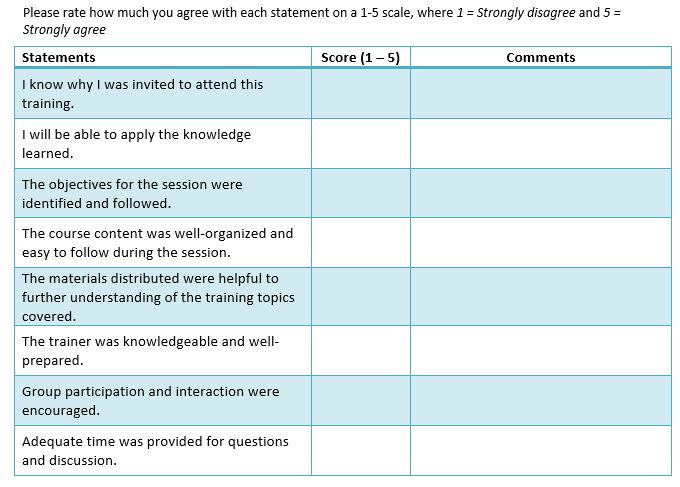
It’s easy to get caught up in the logistics of training – did people show up, did they enjoy the food, was the room comfortable? While these factors are important, they don’t tell us if the training actually worked. To truly measure the effectiveness of a training program, we need to dig deeper.

Focusing solely on surface-level feedback, like how attendees felt about the event or the trainer, is like judging a book by its cover. It might look good on the outside, but what really matters is what’s inside – the knowledge gained, the skills developed, and the behavior changes that occur.

To delve deeper you may want to consider questions like:

Continue reading “Training Evaluation Forms”

Employee Satisfaction Score


Smiley Charts

Sometimes you don’t want to run a full employee engagement survey, but you just want to do a quick check to see how things are going. Call it a “mood meter” or a high level check to see if you can catch some underlying issues that may require further investigation.

Of course it is understood that a quick check is not meant for applications where the correlation between questions and outcomes require a statistically defensible position. HR folks and OD folks sometimes just need a quick tool that would help you see if there may be a trend that is worth looking into further at your location. Sometimes the trend you see can be as simple as a low level of responses to your quick check.

Continue reading “Employee Satisfaction Score”