Checklists for Stretch Assignments


Stretch assignments are useful for learning and personal growth and development, because they purposefully contain elements that are challenging in areas where the assignee needs to develop. Designed correctly, a stretch assignment confronts one with the necessity  to get out of your comfort zone in order to succeed.

The starting point for designing such an assignment can be multiple data sources:

  • the person’s own development needs compared to established leadership competencies,
  • key proven areas of mastery that a company requires from their leaders to advance to the next level,
  • a mindset or  mindset shift that is required to move the company and its leaders into a new way of operating; or
  • to build competency in specific important areas that are or will be important to the future of the company.

A stretch is not defined in a general way, but rather it is very specific to a person. While a stretch could mean that one requirement is for the person (plus family, if appropriate) to move to an international location, it inevitably would also include other job-related challenges. Examples include supervising more people, having financial performance targets (for someone who has only had functional roles in the past) or having more complexity such as multiple geographical areas to manage. The key balance to maintain when designing stretch assignments is to ensure that the assignee is put under a certain amount of pressure to learn and grow, but not so much pressure that he or she fails.

Mitigating failure risks

There are a few things you can implement to help monitor how things are going with each assignee and to provide a “safety net” for an assignee to get support from.

  1. Assign subject-matter experts as coaches – depending on the scope of the assignment.
  2. Assign a leadership development coach to help the assignee reflect on experiences, frame up challenges and cognitively choose best solutions and explore new ways of operating to be more successful in the assigned areas of responsibility.
  3. Set up internal-company networking events for the assignees to meet, have opportunities to mingle and share experiences and also include a pre-determined learning event tied to overall leadership development objectives within the company.
  4. Set up a structure of communication moments with the “home” organization supervisor and colleagues – this is especially important if you plan to return the assignee to the same organization at the end of the assignment. Maintaining ties would greatly improve a successful return and reintegration after an assignment. Communication moments like these can also greatly help colleagues NOT on assignment to learn from the experiences and best-in-class solutions their colleague on assignment is mastering.

New and challenging assignments often cause assignees to experience some stress. Supporting assignees to successfully navigate through the new challenges means you should pay attention to a change in behavior or performance which could indicate that he or she is stuck on the learning curve. Signs that things are going wrong are important to notice early-on to maximize chances of turning things around and avoiding an assignment disappointment and/or incurring an assignee retention risk. Pre-departure training should be provided to both assignees and their coaches to understand and recognize signs that things may not be going well and to understand ways to become unstuck in every situation.

Some warning signals:

stretch-assignments-signs-of-failure

Expectations for goal achievement by assignees must be specifically captured in a plan and communicated to an assignee along with available rewards for over-achievement of goals. The specific strategic importance of the assignment should also be highlighted as well as the developmental needs to be addressed during the assignment.

Tips for stretch-assignment coordinators:

  1. Ensure that there is a structure that enables assignees to succeed and always follow-through with the check-in points and feedback activities to ensure all is well.
  2. Ensure that all those involved in assignments are clear on the role of management, role and responsibilities of supporting coaches, the role and responsibilities of assignees and the role and responsibilities of assignment supervisors and “home office” supervisors.
  3. Adequately prepare assignees for their assignments: cultural awareness training (for international assignments), language skills (where needed) and if accompanied by family members – consider a session to discuss the practicalities of moving to a new location with those family members present.
  4. Ensure that the assignees get interim feedback on how their assignments are going -at least 3 times per year, but more often if this can be managed. This provides opportunities to refocus and apply new approaches as needed to ensure the assignment is successful.
  5. Provide assignees and stakeholders in assignments ample notification about the end date of an assignment. This assures minimum surprises and helps everyone to plan actions leading to a well-organized return upon assignment completion.

When assignments are successful in achieving or exceeding on all the objectives, assignees should return from their experiences with increased confidence, leadership skills, and maturity. The personal growth and development they experienced should enhance their ability to make better decisions and build stronger interpersonal relationships with those they lead and follow. Being mindful of how to setup and manage stretch assignments can make all of that a reality.

Exercise: Practice difficult employee conversations (for Leaders)


roleplay final

I am a strong believer in experiential learning – learning by or based on an experience and observation. Key learning points seem to be integrated faster and stronger when the learners are put in a situation where the skills they need to learn or apply are put to the test.

The exercise I am sharing (see download file below) is a group or team exercise focused on the style of a leader and how a leader approaches employee issues given their own background and preferences. The backdrop for the experience could be situational leadership  or Emotional Intelligence for leaders. It is up to the trainer or facilitator to choose the right materials to suit the needs of the team or group.

The exercise requires some volunteers to engage in role-play based on specific scripts – included in the resource. There are “role sheets” to help those standing in as employees understand how that employee behaves and describes his or her style.

The key to this exercise is to showcase the possible dilemmas that leaders can face when confronted with employee behavior that seemingly goes against their own values or goals at work. The discussion after the role-play exercises is where the most value can be realized. Reflecting on what the group saw and experienced during the role-play and then relating that to their day-to-day work-life is where most insights tend to surface. This helps each leader determine how he or she could adopt a new mindset in dealing with difficult discussions with employees going forward.

This exercise works well for groups ranging from 8 to 16 people. Larger groups of 20 people or more can work too, but you may need to add in an additional step – a small group exercise. In that case, divide the group into smaller groups of 4 or 5 people and have them discuss the exercise debrief questions in the small groups before requesting each of the small groups to report back to the larger group for further discussion. You may want to consider an additional facilitator to assist if you are dealing with groups larger than 20 people.

Without emotional intelligence or a compassionate approach to interpersonal relationships even leaders with the best technical minds and education will never be great leaders with motivated followers. Exercises like the resource I share here can help trainers and facilitators bring home the importance of having the right approach and encourage a personal change process in developing leaders.

Getting along better with others


thinking writing final

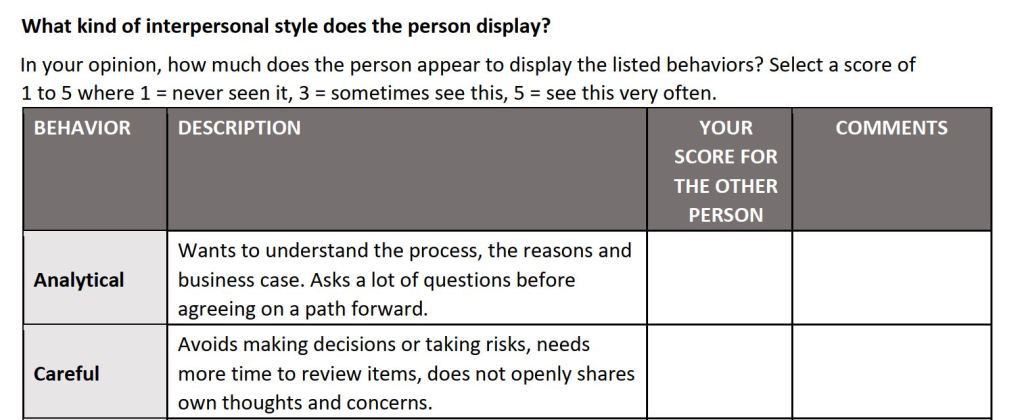
One area that often causes misunderstandings and frustrations in the workplace is when two employees have different interpersonal styles and ways of communicating and they do not get along. Being different from each other mostly means that they do not understand why the other party is doing and saying things in the manner that they do. Most of us do have the ability to make small changes to how we do or say things in order to improve collaboration and interfacing with others and this resource can help by creating awareness, which is the first step towards improvement.

The downloadable document I am sharing can be used for reviewing relationships with customers, other employees, work-related contacts, and even friends or loved ones. It helps you reflect on the interpersonal style that the other person displays in his or her behaviors. Building on this awareness this resource enables you to be more mindful of the best ways to interact with that specific person to have a better relationship with him or her.

Once you have awareness of how you can improve interpersonal relationships with specific people it may still be difficult to make changes to your own behavior for the betterment of the relationship. Should you get stuck once you have done the first part of the exercise, consider asking others for ideas on how you can best approach improvement in the key aspects you came up with. Depending on the current relationship you have with the person you focused on, you may be able to ask him or her directly. For example: “I noticed that you are very detail-oriented. Can you help me understand how I can better provide you with what you need in order for you to feel comfortable with my contribution on the projects that we are working on together?”

Uses for this resource include:

  • Own reflection and then taking action to improve on some of your interpersonal relationships.
  • Discussions with your coach on how to deal with some difficult individuals that you often work with.
  • Team-building – ask each team member to rate themselves on the items shown and then share with each other as a way to get to know each other better and improve interpersonal relationships on the team. (advocating).
  • Team feedback – Depending on the time you have available and the size of the team you may also ask each team member to map out each other team member using this resource. This means each person gets feedback from the entire team on how each team member sees them. The outcome could magnify self-awareness in the team and drive interpersonal relationship improvements across the entire team.

Misunderstandings can lead to a lot of misalignments between team members and can result in rework, which is a waste every project should avoid. Better interactions with others make the workday more fun and go a long way towards employees feeling more productive and effective at work.

Evaluating Leaders – a template


pen writing final

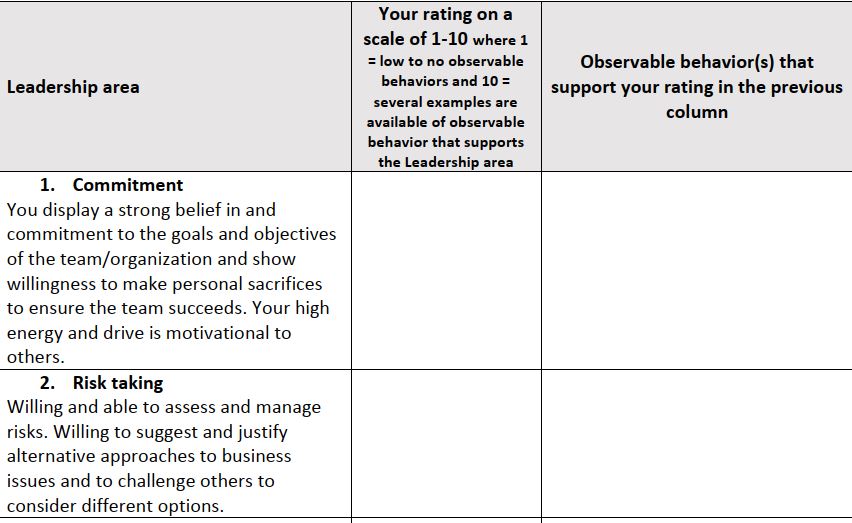
The ability to reflect and learn from experiences and observations is one I most commonly associate with and admire in the best leaders that I have met over the years. This resource can be used to help leaders reflect on their own behaviors to identify development and improvement needs.

The leadership rating worksheet shared contains a sheet for self rating and also a sheet which can be shared with others for feedback purposes.

The resource (see downloadable file above) is not only helpful for leaders in rating themselves and uncovering possible developmental needs, but can also be used as a 360-type feedback tool. In that case the leader rates himself or herself and then requests feedback from others – in more senior roles, same level peers or in lower hierarchical roles – interacting with the leader on a regular basis. The 360 view can help eliminate any blind-spots that a leader may have concerning his or her own leadership behaviors as the perspectives are from others who often interface with the leader.  

The leadership aspects covered in this resource are:

  • Commitment
  • Risk taking
  • Motivational style
  • Open-mindedness
  • Diversity conscious
  • Trustworthiness
  • Continuous learning
  • Self-adjustment
  • Steadiness

Each of the aspects come with a brief description to ensure ratings are comparable after you have obtained feedback from others.

Uses for this resource include:

  1. Updating your own development plan and setting new goals and priorities for your own development activities
  2. Discussing the results with a coach or mentor to get guidance on what to focus on and how to plan next steps to improve on key leadership aspects.
  3. If a manager rates all of the leaders working in his or her department using this tool you can compare the leaders to each other in terms of strengths and development needs. This would be useful information to help select the best development programs for the team over the next year (for example).

Developing leadership skills is a lifelong journey. We can all learn to do better in some aspects over time and tools like this one can be a very useful check-in for reflection even for those who have been leaders for a long time. It is also true that we expect more from leaders in a globalized business world and concepts like “diversity conscious” and “cross cultural” skills are becoming very important for leaders to be effective on a global scale.

Planning Developmental Assignments – Process and Preparing Assignee


global travel5

A decade ago it seemed to be more common for employees to be on developmental assignments for longer periods of time. These days the duration of assignments seems to have become shorter. The required steps are not much different though.

It is vital for the organization to have a clear process around the mobilization, preparation, sustaining, return, development of assignees and there are multiple organizations (internally and possibly externally if outsourced) which need to contribute to the process in order to make the assignment a successful one for the company and the employee

Some of the biggest unintended outcomes of assignments are:

  • The employee (and/or family) did not fully understand what they were getting into and found it too overwhelming at the assignment location – wished to return earlier or resigned.
  • Employee did not understand how the assignment was adding to his or her skill sets or competencies and he or she ended up frustrated and demotivated.
  • Employee on assignment no longer felt connected to the home office and were anxious about what happens after the assignment – wished to return earlier or resigned.
  • Employees (and families) experienced a high level of anxiety associated with the assignments due to inadequate preparation and support before, during and after return to home location.

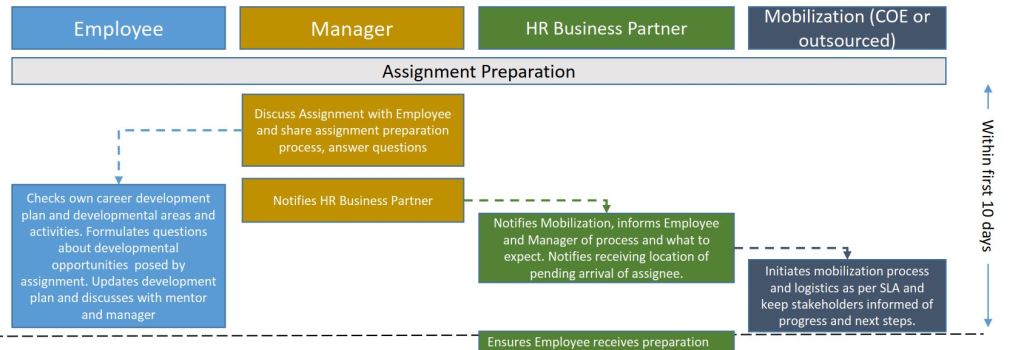
The process flow shared here shows a simplified version of how a developmental assignment should be planned and executed before mobilization, during and after an assignment has ended. It takes into account the logistics part, which may be an internal organization (Center of Excellence) or an outsourced party, the role of the manager, the role of the employee and how the Business Partner can contribute to ensure the entire process yields the desired outcomes. There are also some suggestions for surveys to capture any feedback to identify useful improvements to the process.

Some additional tips:

  • Make sure that managers are clear on the process, the various steps and the specific roles and responsibilities. Most employees will ask their managers for advice and information first. The role of the manager is very important to ensure future retention of the employee by staying in touch and ensuring the employee continues to feel valued by the organization during and after the assignment.
  • Create or outsource a solid assignment preparation program for employees (and families as applicable). This includes cultural awareness training, language training (if applicable) and developing the right mindset and approach to living in a new country for a period of time.
  • Apply attention and diligence when outsourcing logistics and defining the SLAs associated with mobilization. Lost goods, delays in finding accommodation, faulty or missing paperwork can cause a lot of unnecessary distraction and anxiety on the part of an employee on assignment. Conduct regular audits and have discussions with an outsourcing partner/COE using the surveys as a basis to provide input aimed at improving the experience of assignees.
  • Ensure either the Business Partner or the Manager has discussions with the employees to be sent on the assignment to ensure they understand how to leverage the opportunity to improve on their own skill sets/competencies and how they should contribute to the learning of those at the assignment location and again to the learning of those at the home office upon their return.

Preparation and Training

Training and support in these areas (see below) will help each assignee and his/her family – should they accompany the assignee – the best opportunity to understand the assignment requirements and the local culture better. And having an improved awareness will enable the assignee (and family) to have a solid plan of how they would set-up their start-up activities at the new location for a successful assignment experience and conclusion.

Being sent on an assignment is both an opportunity and a responsibility for the assignee. It can bring out the best and worst in a person as he/she (and the family) face huge life changes compared to life at the home office. The experience can lead to increased maturity, improved leadership skills and understanding and increased knowledge and skills if managed properly. As the manager, business partner or any other stakeholder in the process, it is important you ensure there is a clear process mapped out which details the various steps by process contributor and that each stakeholder is acutely aware of the bigger picture while performing own parts.

Icebreaker – Advertising boards


posters

This icebreaker works well with new teams or when you have had quite a few new members who recently joined a team.  The time, materials and space requirements are very economical so this is easy to combine with team meetings. Running this exercise can help you lead a new team into the right discussions to break down barriers to trust among (new) team members.

This ice breaker is a simple exercise which requires very limited instructions to get started and completed.

The most valuable part of this exercise is most likely the debriefing questions you (as the facilitator) choose to use: (some options)

  • Did anyone see something on an advertising board that was surprising about team members?
  • What are the strengths you think this team has?
  • Where do you think this team could get into trouble (given these team members and what you now know about them?)

This exercise is fun to do and the creativity of your teams may surprise you!

I would recommend that you use this exercise as part of a series of exercises to help new teams succeed in the long run. The Team Effectiveness Snapshot can be a great follow-up tool to introduce to the new team to help them on their journey of trust building and achieving a high level of performance.

Brand-new teams typically work well since most of the team members are “playing nice” at first, but as the team moves through the various stages of team formation  things can change. A lot of teams never make it out of the Storming phase so early introduction of team orientation, induction and assessment tools to help teams understand naturally occurring team dysfunctions can help them deal with these situations successfully. The advertising board icebreaker is a great way for teams in forming mode to break through the “niceness” and go a little deeper into the “who are you really” and “what do you bring to this team” discussion.

Life Balance Blueprint – a Template


Understanding Your Starting Point: A Blueprint for Balanced Living

Before embarking on a journey of self-improvement, it’s essential to assess your current position. This template will guide you through a self-evaluation, helping you identify strengths, weaknesses, and life areas that require greater attention. By understanding your starting point, you can set realistic goals and create a personalized plan for achieving a more balanced and fulfilling life.

A Holistic Approach to Self-Assessment

Many coaches utilize tools like this template to help clients gain a broader perspective on their lives. By examining various aspects of life, such as career, relationships, health, and finances, coaching clients can identify areas of strength and areas that need improvement. This holistic approach provides a clearer picture of overall well-being and facilitates more effective goal-setting.

Consider using this template as a yearly check-in to track progress and ensure a balanced lifestyle.

Addressing Burnout Through Self-Assessment

If you’re experiencing signs of burnout, this tool can be a valuable aid. By examining your life from a holistic perspective, you can identify areas where your actions and schedule choices may not align with your values. This self-awareness can help you make necessary lifestyle adjustments to restore balance and turn things around.

Imagine your life looked like a pizza

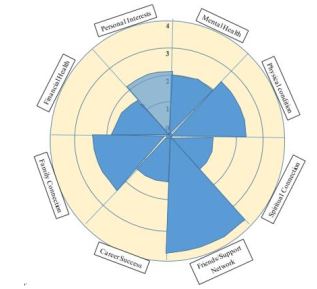
The starting point is to imagine your life has segments or aspects that matter to you. Imagine there is a segment called Financial Health which is important to you because you like to have nice new clothes and a nice car. So you would have to make sure you pay attention to being able to earn money so that you are able to buy those things that matter to you. Another segment may be friends – and it would be important to spend time with your friends or you may find they are less engaged with you. This is how one starts to identify what each of those “pizza slices” of your life may be.

Visualizing Your Life Balance

After completing the self-assessment below, color-code each segment to visualize your life balance. A high score in one area might contrast sharply with a low score in another. This visual representation provides a clear picture of where your focus lies and where you might need to make adjustments.

This template can be the basis for evaluating your “life set-up” and then you can work with your coach to discuss how balanced this is for you given your priorities in life. If you want to increase the outcomes in a specific area, simply start setting some goals in that area and then plan to follow through with actions to help achieve them.

Partnering with a Coach for Personalized Guidance

While self-assessment is valuable, working with a coach can provide deeper insights and personalized guidance. A coach can help you interpret your results, set meaningful goals, and create a tailored action plan. Additionally, having a coach to hold you accountable can increase your motivation and ensure you stay on track.

Achieving a Balanced Life: The Power of Prioritization

By regularly assessing your life balance and identifying areas that require attention, you can take proactive steps to enhance your overall well-being. Remember, life balance is not about perfection; it’s about consciously prioritizing the areas that matter most to you. By aligning your actions with your values, you can create a more fulfilling and harmonious life.

How to start Coaching your direct reports


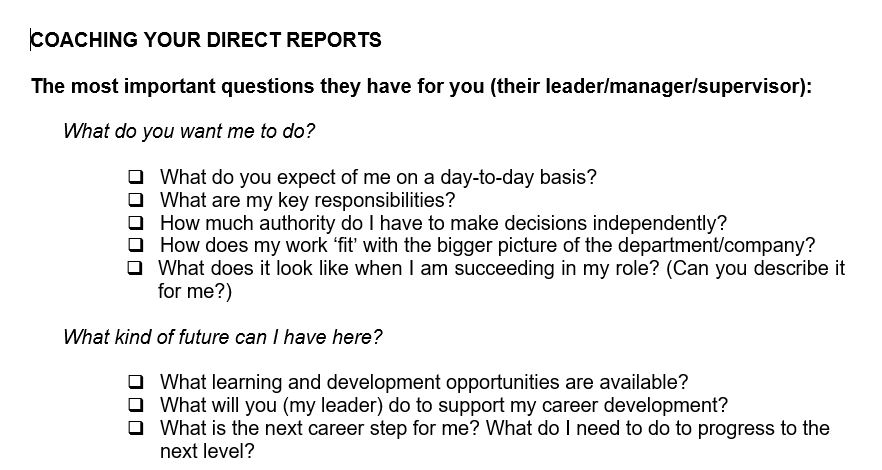
I often hear from managers that they don’t know how to approach coaching their direct reports. It appears the word coaching implies to them that they must have some special insights and skills which would qualify them to coach someone else. Most managers do not realize that they actually know a lot about the company, how things work, how things should be working and how it is going generally. Perhaps all they need is a way to get the conversation going?

Sometimes employees have questions, which are easy to address and other times you need time to get back to them with answers.

Coaching may seem a little less daunting if you had this checklist ( see download button above) of topics to discuss with employees as a group or as individuals. There is a lot to be said for group coaching sessions! They can also be very effective in developing a group of people who may roughly all have the similar development needs and questions for you.

As their manager, you can open a conversation covering one of the questions on the sheet and just state “I can imagine you may have some questions or would like to know more about….” (use one of the questions shown on the sheet). Once the conversation is kicked-off it often happens that the employee will start to bring up more specific questions that he or she may have.

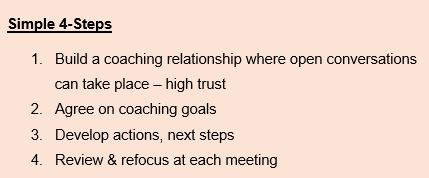
coaching process 4 steps

This graphic shows the basic 4 steps that can be used to start and keep a good coaching relationship going. Trust is a key component and building trust is important – honesty, integrity and showing employees that you care about their work, their careers and their well-being all help to build trust.

Coaching can be a highly structured program requiring a lot of specialized communication and coaching skills and training. It can also be simply helping employees understand the basics around their roles, the company and how things work in their environment. It is your role as their manager to coach them and develop their knowledge, skills and competencies on an on-going basis. If you need more training and support with regards to coaching, do talk to your HR or L&D representative. In the interim, this conversation-starting summary sheet may be helpful to you!

Making Difficult Decisions


Making decisions is a key part of any leader or manager’s day. Most new leaders find this somewhat intimidating. There is the fear of making the wrong decision, the fear of not having enough time to make the decision, the fear of not having enough information to make the decision and the list goes on.

“Every decision has at least a 50% chance of being the wrong one.”

The decisions that leaders make add up to the value that he or she adds to a team or an organization. And yet there are those who say most of our decisions have a 50% chance of being the right choice between two options. They say this to make the point that you can better make a choice and be active in the process than to avoid making a choice or a decision and being reactive.

Competing Benefit decisions
Classic example of trade-off choices

Trade-offs

When it comes to commercial and operational decisions most of the time the difficulty in decision-making lies in the correct trade-off within the benefits triangle (shown to the left).  If you can get the article/outcome within the time-frame that you would like and with the right quality that you would like to have, there may be a high cost trade-off. Similarly you can find yourself having a low cost at the right quality, but you may have to wait longer to receive the outcome or article. Understanding the trade-off as shown in the graphic above may make it easier to decide which of the three are non-negotiable and where a compromise may be appropriate.

Competing values

Another challenging area for decision-making can be competing values. Imagine you value employee development (as a leader or manager) and you also value productivity. Choosing to develop your employees typically means you have to take them away from their daily activities to attend a development or learning event. This implies they are not able to produce the results you need during that time. This kind of choice often comes at the last minute. Imagine you had planned for Employee A to attend a training course, but at the last moment he or she is sick or otherwise unable to attend and HR asks you to nominate a substitute and thereby presents you with a decision-making dilemma.

Competing Values Decisions

The graphic shown the the left illustrates some competing value trade-off decisions that you may be called upon to consider as a leader or manager.  If you have already completed a review of your own values as a leader you may have the advantage of using that as a framework for decision-making.  You would also need to look at the values that the company represent to make sure your trade-off options also include that perspective.

Finally when you do make a decision, be sure to explain your reasoning and make the values you are honoring clear to the impacted employee(s) or colleagues.

Decision-making styles

Decision Making Styles

Leaders and managers also often fall into the trap of trying to use only one decision-making style and they neglect to consider the other options open to them. There is a time and a place for every type of decision-making style.

Sometimes it may be appropriate to make autocratic decisions – this can be useful when the impact is limited, the need is immediate and the risk low of encountering resistance during implementation. At other times a more collaborative and inclusive decision-making process may be appropriate – such as when there are many stakeholders, people need to change their behaviors or work methods, time is on your side etc. Selecting only one decision-making style as a leader can make decisions difficult since you may find you experience a lot of resistance from others to implement your decisions especially if you favor autocratic decision-making most of the time.

The main job of a leader and a manager is to make decisions and choices in order to move projects and initiatives forward. Decisions also impact dealing with risks, unplanned barriers to success, and how to achieve the goals set for organizations and teams. All this, while respecting approval matrices, client satisfaction and the profitability of a project.

Decision-making is a skill that many leaders need help with and being more mindful about their own process for making decisions and understanding options open to decision-makers, is a good start. Work with a coach or trusted advisor if you want to talk through tough choices you need to make – it is a best practice that most successful executives engage in.

What are your Values -TEMPLATE


Before you can select goals and development objectives for your life and your career, you need to know what you value above all else in your life. Deciding how to spend your time, how to use your energy and where to focus your efforts – all of that starts with knowing what matters to you. Only when you know what you value the most, are you ready to make deliberate choices that reflect what matters to you the most.

Values drive how you spend your time and how you make choices and decisions for activities and events that are important to you. Your values are especially helpful with choosing among options – which events to attend, what to do first, which actions to take next etc. When it comes to decision-making: select options that align best with your values and avoid options that are not aligned with your values or may even be opposites to your values.

This tool (see download option above) an help you define your own values; it contains a list of statements to guide you on your quest. Instructions on how to use the template can be found at the top of the worksheet. First you read through the statements and then put a Y for yes in the first column to indicate those statements which most appeal to you from a gut-feel perspective. (It seems or feels right to you; knowing yourself and what you find important in life). The next step is to look at only the ones you have selected with a Y – put a score between 1 and 10 next to the selected items using the column to the right of each statements to indicate how important that selected statement (representing a value) is to you. The highest scores indicate your highest values. Rephrase or clarify any of the value statements if they do not fit 100% with how you see it.

Tips:

  • Feel free to add more statements or words at the bottom of the list if you think of values that are not shown. I find that these lists are good at helping one start-up the process and then your own ideas and words start to pop into your mind. This then enables you to complete the process without needing to use the listed statements.
  • Once you have your list of top 5 values, check that against how you spend your time and ask yourself if your choices reflect your values or not. If they do, great. If they do not, what will you change to ensure you spend your time in a way that reflects your values better?
  • Look at people you spend time with. Are you surrounded by people who share your values or do they have different values? If their values are aligned with yours, great. If their values are not aligned with yours, what will you do to ensure that you are able to live up to your own values?
  • Your job and the company you work for/the office environment – do you feel that your values are compatible with the environment and how leaders are behaving? Are people (employees and customers) being treated in a way that you feel is aligned with your values? I am not suggesting that you resign tomorrow if there is a disconnect between your values and status quo. Instead I would like to pose a question… what can you do to positively impact how things are being done right now? And what do you think are the best steps to take if you do not see any improvement over time or a better alignment with your values?

It is not easy to hold yourself accountable in this way; knowing what your values are and being honest with yourself about how well your life choices align with your values.  It is possible that some people will get upset with you when you consciously start making different choices with the way you spend your time and the things you are interested in or willing to do. The benefit of making decisions with your values in mind is that you will be able to take a more direct line to accomplishing your goals.  This will impact time management, prioritizing preferences and cutting out those items that distract you from achieving the goals and objectives that you have set for yourself.