Spotting Employee Flight Risks: A Retention Checklist


20200524 risk ass

It has been said that your most valuable asset walks out of the doors every single day and you can but hope they come back the next day – your employees!

Keeping employees from leaving a company could be as simple as engaging with them, including them, helping them develop new skills and listening to their ideas. While that sounds deceptively simple, not every leader finds it easy to act when they hear that advice.

Get the facts

Understanding Your Team’s Pulse

Before diving into solutions, it’s essential to pinpoint the problem areas. Are employees considering leaving? If so, who’s most likely to exit and why? By asking the right questions and gathering data, you can identify potential risks and take proactive steps to boost employee retention.

The self-audit list below may be a good place to start assessing how much anyone on your team may be tempted to leave your team or the company.

Self Audit template

Completing the checklist requires you to answer yes or no to a series of statements as they would apply to each employee on your team. Once you have completed the assessment, add up the number of “no” answers you have for each employee and use the Score guide at the top of the page to determine whether each employee would be in the low, medium, or high risk from an employee retention perspective.

The next risk to assess is the impact it would have on your project or team if that particular employee decided to leave. Look at each employee (each column) and consider the unique skills and talents that he or she brings to the project and rate the impact that his/her (unplanned) voluntary departure could have – low, medium, or high.

Map it

Where to start? Map the answers from the self-audit sheet onto the graphic below. The risk that each employee could decide to leave on the horizontal access and the impact on the project, in case that employee did leave, on the vertical axis.

Then write down the names of employees that would be in the “green zone” vs the “yellow zone” vs the “orange zone”.

The orange area requires immediate and high focus, and the yellow zone does require focus, but less so. The green zone requires maintenance. Do not assume that because a retention risk is low today it would stay that way for years. Many talented employees get calls and offers from other companies and recruiters all the time! This means you should never stop reminding them why you are happy that they are on your team! And don’t only tell them, show them! Celebrate milestones and successes, recognize them in meaningful ways, and show them how working with your team or company is the right long-term strategy for them. Make sure you offer them advantages towards their overall life goals, their career goals, their work-life balance goals, etc.

Take action

Once you know where to focus, use the last worksheet as a checklist for areas where you can lower the risk that someone may consider leaving the team.

Use one checklist per employee and make sure that you have conversations with each employee about the areas where you either did not know the answers (looking at the self-audit worksheet) or you have not said anything to an employee about a particular area.

When it doesn’t work

Unexpected departures can disrupt teams and projects. That’s why it’s crucial to have a strong bench of talent ready to step up. By investing in employee development and creating clear career paths, you can mitigate the impact of turnover and ensure business continuity.

Taking proactive steps to assess employee retention risk is essential for organizational success. While it doesn’t guarantee zero turnover, it empowers you to identify potential departures early and take steps to improve employee satisfaction and engagement. By investing in your team’s growth and well-being, you’ll create a more stable and productive work environment.

4 Questions to ask about HR metrics


Understand first, then act

empto6

Without the right level of scrutiny, it can be easy to misinterpret a metric (key measurement, KPI) and waste valuable time and resources debating and taking actions to “fix” things that may not be “broken.”

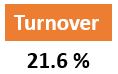
Let’s take an example to illustrate: Employee turnover. Let’s say I show you this number and tell you that this represents Employee turnover at a company:

empto1

I would imagine you would have some questions for me? Let’s go through some questions I expect you to ask me as we clarify what that number means. (Answers in blue from an HR representative at a fictitious company)

  1. How do you define turnover and how did you calculate that?

Answer: The company defined employee turnover as the number of employees who left the company. And they calculate that number this way:

empto2
empto3

If you think this number is high or low, hold your horses, we have a few more questions to ask before we can come to a conclusion.

  1. Over what time period was this number calculated?

Answer: It represents the employee turnover over one quarter. 

An unusually high or low number can be an anomaly if it represents, for example, one day or one week out of a year. And that could be for many reasons including possible entry errors or calculation errors. If it is an average over an entire year, an unusually high number may indicate an alarming trend.

  1. What is this metric about?  

Here you would like to understand the reason why they are tracking the metric and how they are using this metric for decision-making.

Answer: “We want to make sure that we retain employees and do not have too many people leaving thereby causing us to have to retrain people on a regular basis. We also want to avoid constantly having to hire and onboard people to replace those who left. We think it is disruptive to the business. We have set a limit of 7% as a reasonable employee turnover maximum.”

Knowing that this is about retention helps to understand the metric more. For example, you could now start to form an idea in your head about the employees that a company would like to retain. To ensure you lose no more than 7% of your employees through resignations, you would want to ensure that internal communication is going well, that employees feel appreciated and that there are development opportunities for them etc. (These would be all the efforts you could make to increase employee engagement and satisfaction).  But it is also immediately obvious that 21.6% is much higher than 7%! So we need to ask more questions.

  1. What is the context of this metric? 

With this question, you are trying to understand if there were any events or special circumstances that may have contributed to this metric being unusually high or low.  It may also highlight how this metric compares to other periods – is it higher or lower than in the past?

Answer: “The metric is much higher than in previous quarters. During this quarter, we had to lay off some people due to losing a large customer. We also let some temporary workers go. And some people have chosen to take early retirement with the incentives that we offered around the reduction in workforce.”

Going back to how they calculated the 21.6% you may now wonder if they did the calculation correctly. If the metric is about making sure that they retain employees then it would be logical to ensure they do not include those who leave involuntarily – due to a lay-off for example. And there was also mention of temporary workers. Workforce planning often includes having a pool of temporary/agency workers who can more easily be let go of in the event of an organizational downturn. From that perspective, it would also not be useful to include those workers in an employee retention metric. It is time to question the number of people who left the company – the 108.  Having obtained more information about the 108 employees, we see that this number represents various groups including retirees, agency workers, redundancies, and resignations.

empto4

In this case, the only unplanned people that the company “lost” = 32

In that case, the metric calculation would result in 6.4% which is below the 7% limit that was set as a goal.  It is important that the definition of the metric is clear about which groups of people who left should be included or excluded in the calculation.

In summary, we can make some suggestions for this  HR team:
  • Clear name and definition. Perhaps the metric should be redefined and possibly renamed if their intention is to capture how many employees (not temporary workers) resign from the company and to keep that % below 7%.
  • Share definition with stakeholders. Just looking at 21.6% employee turnover can be alarming so it would also be very important that the metric is well understood by the team and its key stakeholders outside of the team.
  • Accuracy. To avoid any possible calculation errors, it could help if somebody audits the metrics before the dashboard is finalized and distributed. The credibility of the HR team can be impacted if an executive team regularly sees errors or inconsistencies on the HR dashboard.

Keeping track of key metrics to monitor the success of specific processes or initiatives is important. That way you would be able to easily identify if a project or an objective is in danger of failing to achieve desired outcomes at the end of a year. Early identification also enables you to take the appropriate actions to correct an alarming trend. The key is to ensure that metrics on a dashboard are accurate and easy to interpret by those who view it. Be intentional and critical when you choose the metrics to track and when you define them to stakeholders.

When reviewing metrics, ensure that you truly understand what they represent before drawing premature conclusions. Planning actions to rectify premature conclusions could be a waste of your valuable time and resources when they are based on erroneous assumptions.

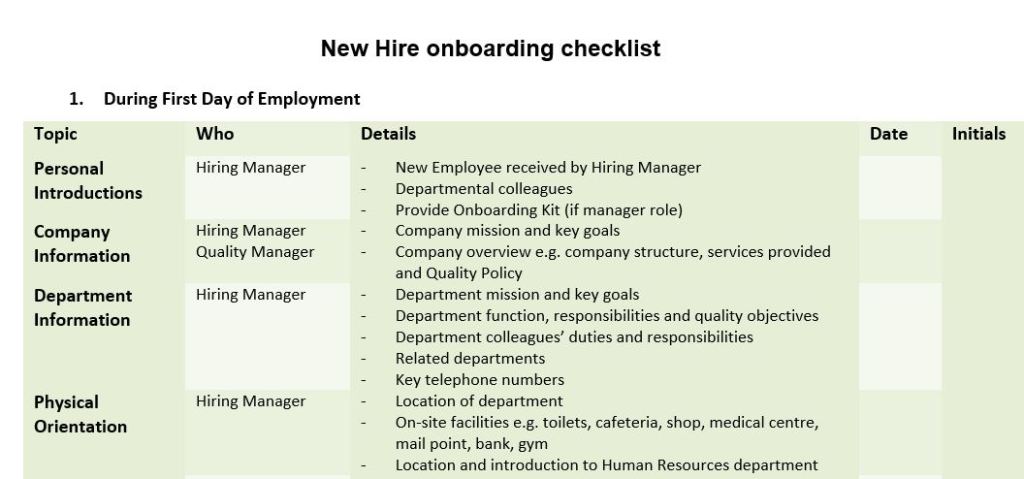
Onboarding Checklist: Set New Hires Up for Success


First impressions matter, especially when it comes to new hires. A well-structured onboarding process is crucial for setting employees up for success. By providing clarity, support, and a warm welcome, you can accelerate their productivity and boost job satisfaction. This process can be more successful when you create a plan and share it with the hiring manager and the new hire..

Onboarding: Your New Hire’s First Impression

A strong onboarding process is essential for employee satisfaction and retention. It’s not just about paperwork and introductions; it’s about setting new hires up for success from day one. By providing clear expectations, necessary tools, and a supportive environment, you can accelerate their productivity and foster a sense of belonging. Let’s explore how a well-structured onboarding checklist can make a difference.

People centered HR Processes MODEL

Laying the Groundwork for New Hire Success

A successful onboarding experience starts before a new employee even walks through the door. By planning and coordinating tasks in advance, you can create a seamless transition. This involves everything from communicating expectations to the new hire to aligning key stakeholders. The key players in setting up the plan and ensuring that everyone is ready to support the necessary meetings and onboarding discussions are usually the HR business partner and the Hiring manager. Effective onboarding isn’t just about paperwork; it’s about setting the stage for long-term employee satisfaction and productivity.

This template is a basic version and you should add your own additional items to help new employees understand your industry and company plus know how to navigate the office building, and business better. If the new employee will be in a customer-facing role you may need to include introductions to customers too.

A well-structured onboarding process is your secret weapon for talent retention and productivity. By providing a clear roadmap for new hires, you not only accelerate their ramp-up time but also create a positive and lasting first impression. Remember, a smooth onboarding experience sets the tone for an employee’s entire tenure.

Salary Review Simplified: A Practical Template


Fair compensation is essential for attracting, retaining, and motivating top talent. By conducting regular salary reviews, organizations can maintain internal equity and external competitiveness. This template helps to have a practical approach to evaluating employee compensation and making data-driven adjustments.

While large corporations often rely on sophisticated HR software for compensation management, smaller businesses can achieve similar results with a well-structured spreadsheet. This editable template allows for flexibility and customization, making it a practical choice for many organizations managing a smaller pool of employees.

The basic principles for using this tool:

  •  You need to make sure to retain employees and avoid employee turnover by reviewing his or her salary on a regular basis. Typically once per year.
  • Employees need feedback regarding job performance expectations and also their own performance delivered against the expectations. The compensation they receive should reflect not only the market value of the work they do for you but also their own level of delivery against expectations for that role. Performance that exceeded your expectations deserves to be rewarded. You could do it as a discretionary bonus or you could review the person’s annual salary and consider an increase.
  • Some employees bring increase requests to their bosses on a regular basis while others may just be waiting for their bosses to realize how much effort they put in and how many good results they are achieving. Without a solid salary review process which is run uniformly on an annual basis (at least), you could run the risk of not treating all of your employees in the same fair manner when it comes to salary reviews. It could happen that only those employees requesting regular increases are receiving them while those who do not ask, do not.
Continue reading “Salary Review Simplified: A Practical Template”

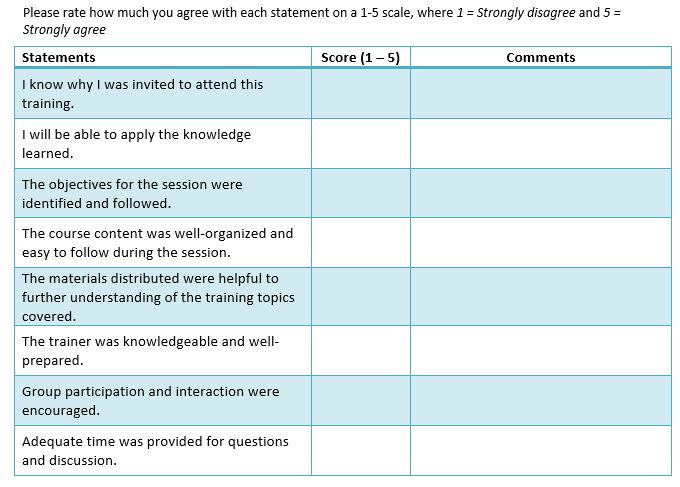
Training Evaluation Forms


Beyond the Basics: The Importance of Effective Training Evaluation

It’s easy to get caught up in the logistics of training – did people show up, did they enjoy the food, was the room comfortable? While these factors are important, they don’t tell us if the training actually worked. To truly measure the effectiveness of a training program, we need to dig deeper.

Focusing solely on surface-level feedback, like how attendees felt about the event or the trainer, is like judging a book by its cover. It might look good on the outside, but what really matters is what’s inside – the knowledge gained, the skills developed, and the behavior changes that occur.

To delve deeper you may want to consider questions like:

Continue reading “Training Evaluation Forms”