Emergency Preparedness Is Not Optional Anymore


I started writing this in September 2025. I should have published it then. The growing frequency of extreme weather has only made the message more urgent.

Last year’s storm season left many homes without power, water, or communication for days at a time. Roads were blocked, services were stretched thin, and some communities found themselves scrambling to cope.

The reality is that most of us weren’t prepared for how long recovery efforts would take. And with weather patterns becoming more unpredictable, this season is shaping up to be no different. A little preparation now can mean the difference between anxiety and confidence when the winds pick up or the rain won’t stop.

Why This Matters Right Now

While forecasting systems are valuable, the impact, timing, and severity of storms can outpace warnings. Even the best warning systems miss sudden changes. We’ve seen flooding in areas that weren’t historically flood-prone, power outages lasting longer than anyone expected, and communities cut off because access roads were too dangerous to travel.

And sometimes, there’s no warning at all. Heavy rainfall on already saturated ground can trigger flooding overnight. Strong winds can knock out power lines or damage infrastructure in minutes. These realities make storm readiness a skill every household should take seriously.

Why Storms Feel Harder to Predict

  1. Climate Change: More intense storms and unpredictable weather patterns mean traditional “storm seasons” are harder to define. Some events may not be predicted, and we have seen that warnings do not always go out on time. You need to be watchful. Check a reliable weather app and be aware of the state that soil in your area may be in – dry (very dry)? Perhaps that creates a harder surface for water to soak into and could lead to fast surface water movement.
  2. Infrastructure Limitations: Utility teams work hard, but restoration takes time, especially in rural areas or after widespread damage. Recovery may take longer than expected, delaying your return to normal life.
  3. Geography: Know your environment – tree cover, low-lying areas, and road access all play a role. Consider that you may need to get your household to higher ground depending on the weather event you are preparing for.
  4. Hidden Hazards: Recent rainfall or ground saturation means flooding risk isn’t always obvious.

The Cost of Being Unprepared

When a storm hits, it’s not just about losing power for a few hours. It’s about making sure your family has safe drinking water, warmth, food, and a way to communicate. Being unprepared adds stress in an already difficult time, while being ready brings peace of mind and even positions you to help neighbours.

Editable 72-Hour Checklist (Downloadable & Editable)

I’ve created a practical checklist based on lessons learned from last year’s storms — and from my own experience of seeing how quickly things can spiral. Once downloaded, this tool is:

  • Editable: Add or remove items specific to your family, pets, or home.
  • Comprehensive: Goes beyond food and water to include communication, travel readiness, and planning with housemates or renters.
  • Free: Download it, print it, and make it your own.

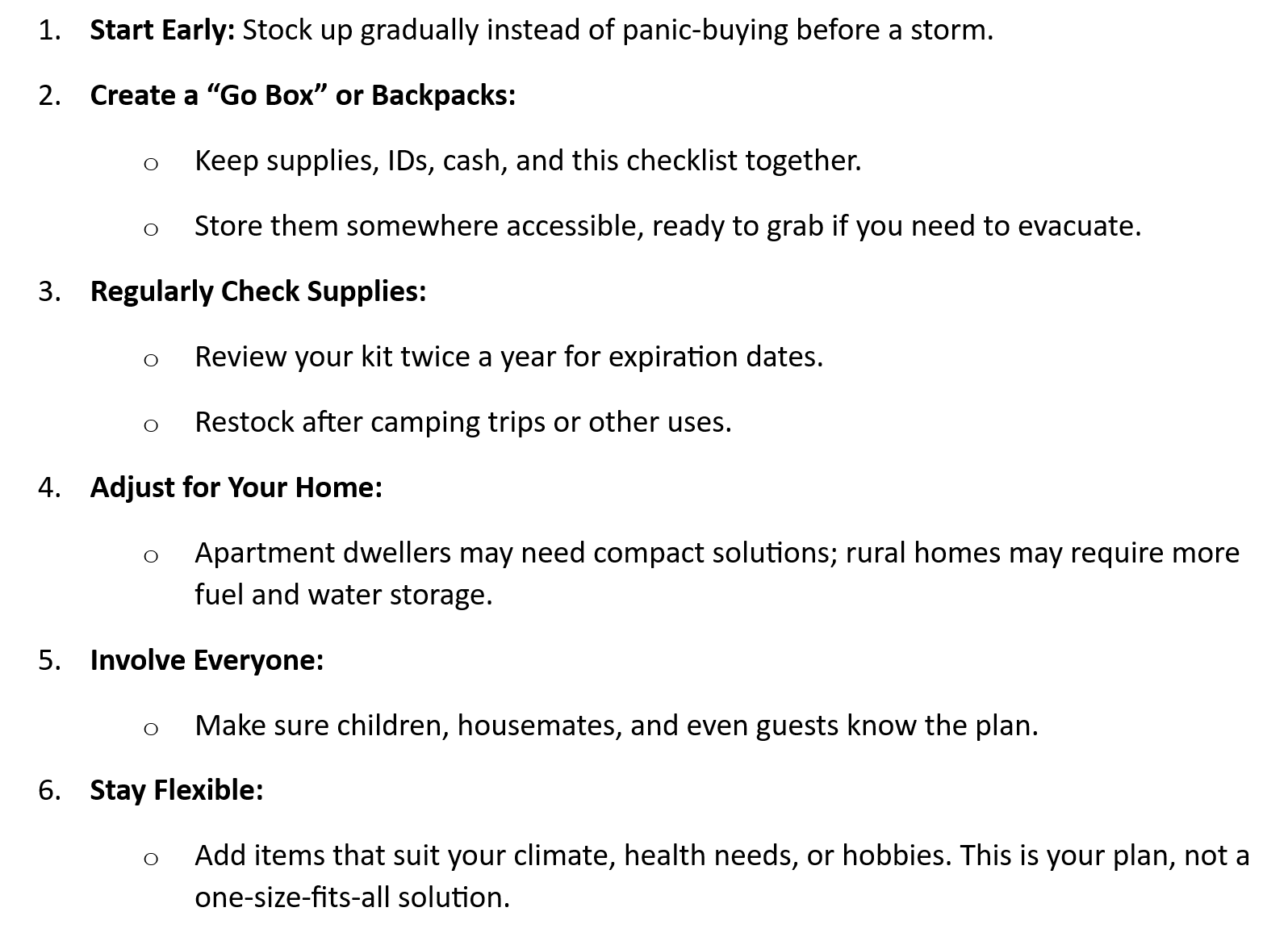
How to Build a Kit That Works for You
Be Ready for the Unexpected

Preparedness isn’t just about “storm season.” Sudden heavy rainfalls, extended winds, or flash floods can happen with little or no warning. Watch the weather, stay aware of ground conditions, and take action early.

Small steps today mean you’ll face whatever storms come next with confidence. Instead of scrambling, you’ll know exactly where your supplies are, how to reach loved ones, and how to ride out a few days off the grid safely.

Will you love it?


Your dream job – will it be all that you are hoping for?

When you consider a job change or a pivot, you may need to go and talk to people who are doing that job or role right now to answer some of your questions. Before you make a change you probably would need to understand the qualifications or certifications that are important and maybe understand what a typical day is like in that role? If you don’t have the certifications that would be a great way to make sure you prioritize getting the most essential certifications first. If you don’t like the way the typical day goes in that other role you are thinking about, perhaps it is not for you? Perhaps it is good to know more before you jump?

Desktop research first

A lot of this information is available online if you, for example, search for those job vacancies online – you can find out which qualifications or certifications are most required for the role you are considering changing towards. The job vacancies can also show what kinds of competencies and skills recruiters are looking for. Just bear in mind, sometimes they just ask for the moon and the stars in job vacancies to try and ensure they get a really good person who can satisfy a long wishlist (hard to do in most cases!) So, desktop research only goes so far…

Who can you talk to?

Knowing how the typical day goes in a role like the one you want, is not usually so easy to find out by doing online internet searches. This is where you would need to look to your own network of contacts – family members, friends, colleagues or ex-colleagues, and others in sports teams or clubs with you. When you have gone through all the people you know, and perhaps you did not find any or enough people who can help you, you may have to start looking online. Use social media platforms to find people who are in the role you would like to have. If you use LinkedIn, you might be able to see if you know someone or through your network may be able to contact someone who does what you would like to do in the future. If you have no direct links to a person you can often still reach out to them via a message. Your objective would be: Find someone who now has or someone who did have your dream role in the past so you can ask him/her some questions about it. That way you can have more clarity regarding how much might you love this role you are dreaming about?

Plan your next steps

Before you approach anyone for a meeting or a discussion around the questions you have, what targets and specific objectives do you want to set for yourself?

How many people you should approach with your questions? (Is 3 enough, or is a minimum of 5 your target? How many experts in this role do you need to talk to?) In some cases, it may be hard to answer the question because you don’t know if the first two people will give you quality answers or not? Set yourself a guideline target if you are not sure. (Tip: 15 may be too many! If you have not identified the right people to talk to, you may end up with too many discussions. If you find the right 3 and they are willing to spend 20 minutes with you on your key questions, it may be enough!)

Make a list of the people you know who may be able to answer the questions- we will talk about them in a moment. And think specifically about how they may be able to help. If you just ask just anyone you know or post it on your social media page, you may not get quality answers so think carefully about how each of the names you write down can help you. Is he/she currently in the role you are thinking of changing to? Is he/she a mentor or guide who can help me work out the steps to take? Is he/she working for a company or department that hires people for the role I am interested in? Was he/she in such a role in the past?

Start listing the specific questions which you would like to have answered. Here are some question options to consider:

The questions are about:

  • Find out what knowledge you might need. Once you know that, you can look for courses or certificates or volunteer options to help you gain the knowledge you need.
  • Which experiences would be important to have demonstrated in the past to get a role/job like this one? If you do not yet have that, how can you get those experiences? (ask for special assignments in your current role or consider a volunteer role)
  • Which key competencies or skills does it take to succeed in this role? How do your competencies and skills compare to that? If you have to fill in some learning gaps, how can you do that?
  • Are you possibly idealizing this role? Are there downsides you have not considered like a lot of travel and being away from your family and friends? Maybe there are some standby or nightshift requirements? Are you aware of that and does that fit in with your decision-making criteria?
  • In the greater scheme of things – how does this role or job contribute to success in a company? Is there something great about this role that you have not yet realized or understood? Does that motivate you to make time to fill in the knowledge and skills gaps that you discovered?

Keep your momentum

Set yourself small tasks to achieve every week to move forward in understanding more about the role/job you are interested to have in the future:.

  1. What will you do and complete this week?
  2. What will you do the week after?
  3. Which day and at what time of the day each week will you check to see how you are doing against your planning (Did you complete the tasks you set yourself to achieve in the last week?)

To succeed at moving forward you need forward planning, checking back at least once per week to see how far you have come on your plan once you have started. And you need to set yourself targets to achieve in the next few days (be specific) to keep your momentum. That is how you keep your plan alive for moving towards your career move or change!

Tips for that interview


It is about knowing what you want to say when you answer the questions, but it is also about how you say it. Your credibility and success will depend on both – contents and delivery. While you can get feedback from others on your written answers (contents) and feel confident about that, until you have practiced the delivery, you are only halfway ready for the interview to get the job or role you so desperately want!

Steps

Collect maybe a handful of typical questions asked at interviews (there are several sites that would offer you suggestions for questions to prepare for). Also, look for some specific questions that are logically tied to the role description for the job.

Examples of typical questions include:

  • Give me a summary of your career history and why this role is right for you.
  • Tell me more about yourself.
  • Where do you see yourself in 5 yrs – career-wise?
  • Why are you interested in this role?
  • What is the achievement that you are most proud of in your life?
  • Tell me about the last time you got angry with a colleague?

2. Use the STAR methodology to construct answers on paper/screen to the typical questions you picked. If the question is not in the format “tell me about a time when” – you can still use the STAR method by answering “The situation was… X, I had to do Y, Here is what I did… Z, and the outcome was AA and this is why I believe/want/have this approach… (explain your answer)”. In some cases, STAR may not the be right way to go about giving an answer. (Link to explanation of how STAR methodology works)

3. Use structured messages (especially if STAR may not be the right approach for your answers) See post about how to structure messages. In principle – look for 3 key points you want to bring across to answer the question or explain something. The power of using 3 points is that humans remember 3 points and it satisfies something primal in us to hear answers in 3’s. Tell us first “There are 3 reasons why” and then tell us that one by one.

4. Practice your prepared answers a few times until you feel that you have reached a satisfactory level of delivering the right message in the right way – answering the questions you have selected.

5. Time to record yourself. Get out your video recorder/tablet/phone and record yourself answering the questions one by one.

How to use the recording(s) of yourself answering the questions:

How to review your recording

Turn off the sound! – Watch your body language and look for moments when you find your body language possibly distracting from your message. It could be that you keep sweeping your hair behind your ear, or you fiddle with a pen or your glasses or you do not make eye contact. Make notes about that to yourself.

Don’t watchlisten! – Watch it again without looking at the screen, just listen to your answers… does your voice sound steady? Is it clear? Do your answers come across crisply and credibly? Make notes for yourself.

Watch and listen! For the 3rd time, watch the recording with the sound on. How does your body language compliment your answers? Where do you wish you didn’t play with that object in front of you because it made your answer sound tentative? Or did you look away from the camera while saying something important? Make more notes.

6. Use your notes and adjust your answers as needed to improve on the contents. And practice answering them in a new way.

7. Find someone who has interviewed others in the past to listen to you. Ask him/her to ask the questions one by one and deliver your answers (updated words and delivery as per your adjustments). Ask for specific feedback on areas where your answers or delivery could be better.

Having made the adjustments and delivered your answers to the best of your ability on the day of the interview does not always mean the job is yours. There are many reasons why good candidates do not go to the next level of interviews. Do make sure you learn from your experience if you are not successful. Ask for specific feedback after the interview – regarding areas where they felt you did not meet expectations. Then use that as a checklist for the next time you prepare for an interview.

Prepare to Negotiate – Tips and a Worksheet


arm wrestle
(The Devil’s Advocate, 1997)

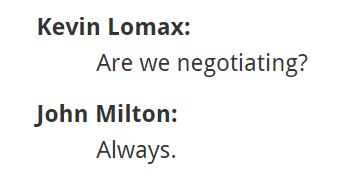
The quote from the movie, The Devil’s Advocate, sums it up perfectly. Whether we like it or not, in life we are negotiating more often than we think we are.

Negotiation skills is something that most people can improve upon. There are several training options available if you want to make this a developmental priority. And there are also a few training games which offer you the opportunity to test your negotiating skills in role-plays.

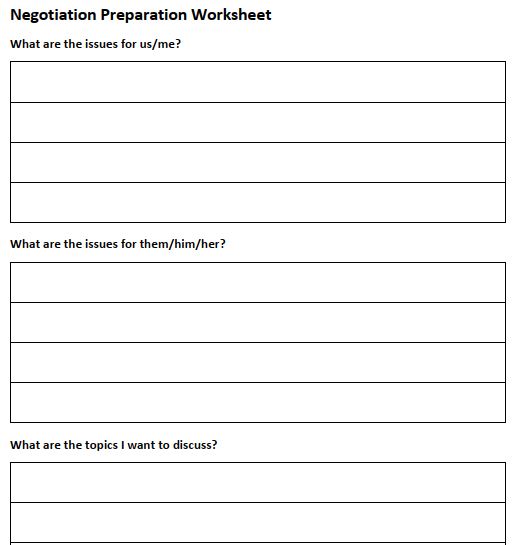
The resource that I am sharing is more generic and it helps you jot down some important notes before enter a negotiating process.

The worksheet, which you can download above, can help both experienced and new negotiators to organize their thoughts and prepare for a negotiation. Having your notes available during the negotiation discussions can help you maintain your focus and avoid distractions or knee-jerk reactions during crucial moments and stages of the discussion.

Uses:

  • Preparing for actual negotiations.
  • In training sessions to train participants on how to prepare and demonstrate the importance of this planning during a role-play later.
  • Prepare for discussion with supervisor/manager on salary increase.
  • Document your thinking going into a negotiation to support a post-negotiation lessons-learned reflection later which can help you and your team to continuously improve upon your past performances.

Cross-cultural Negotiations

When negotiating with someone who is from another cultural background than your own, remember that you will need to watch out for communicational disconnects based on having some of the following misaligment:

  • If the negotiating parties do not have the same first language and at least one party is negotiating in a non-native language there could be misunderstandings around the use of words of phrases. Use simple language and engage with translators if you want to avoid misunderstandings. .
  • Having different cultural views and perspectives, the relative importance of not only items negotiated but interaction with each other (from a relationship perspective) during the breaks or meals during days of negotiation could lead to unintended misunderstandings. Some actions or comments could even negatively impact the trust in the interpersonal relationship.
  • Depending on one’s view of the world, one tends to project your own views onto others as if everyone thinks and reasons like your would. That can lead to using methods of persuasion that would work in your own culture and it may be ineffective with others cultures. . Learn about the culture of key negotiators on the other side and learn what might persuade them vs only looking at your own experience and perspectives.
  • Establishing and maintaining trust can vary from one culture to another. Be slow to distrust the other party from another culture based on limited evidence of low-trust actions. Always engage with a cultural coach to help you correctly interpret the actions and communications from those from other cultures that you may be negotiating with.
  • Remember that negotiations are often not a one-time activity, but a business relationship that may span months or even years depending on how often roles changes at either party’s company. Take time to understand and get to know the other person or party that you often need to negotiate with. The more you know about the person and his or her preferences and views, the more successful your negotiations are likely to be.

Prepare by knowing a few key aspects about the other party

Checklist

Not all negotiations result in a definite outcome. In many cases discussions can take place over a long period of time. The better you are at understanding the other party and what her or she wants and values compared to your own needs and values, the better your chances would be to reach a win-win outcome for both yourself and the other party. And you will be able to leave the door open for successful future negotiations if you pay the right attention to the interpersonal relationship with the other party and not only to getting your own needs met in a win-lose way.