Protect Your Organization: Your Risk Assessment Step-by-Step Guide


In today’s world, unexpected things happen. That’s why it’s important to be prepared. This free template download below will help you identify potential problems and figure out how to fix them. You can keep your organization safe and strong by staying ahead of risks.

Remember, this isn’t a one-time thing. You need to keep reviewing and updating this checklist to make sure it’s always relevant. With a little effort, you can create a stronger organization that is able to withstand life’s little surprises.

Here are two examples of big problems that can hurt an organization:

  1. Hackers stealing information: Bad guys can steal important stuff like customer data or company secrets. This can ruin your reputation and cost you a lot of money.
  2. Mother Nature strikes back: Hurricanes, floods, or earthquakes can damage your business and disrupt operations.

A Risk Assessment: Your Roadmap to a Safer Future

In today’s uncertain world, risks are everywhere. From financial losses to reputational damage, the potential consequences can be severe. That’s where a risk assessment comes in. By identifying potential threats and understanding their impact, you can take proactive steps to protect your organization.

So, what exactly is a risk assessment? It’s like a crystal ball, helping you see potential problems before they happen. Think of it as a map that guides you through the dangers ahead. By understanding the risks you face, you can develop strategies to avoid or reduce them.

But how do you do it? It’s actually simpler than you might think. Let’s break it down into two key steps:

  1. Identify the risks: Think about all the things that could go wrong. Financial losses? Safety issues? Reputation damage? Write them down.
  2. Assess the impact and probability: For each risk, figure out how bad it would be if it happened (the impact) and how likely it is to happen (the probability).

By combining these two factors, you can rank the risks that pose the biggest threat to your organization. Then, you can create a plan to tackle them.

Have a strategy for risk management

A strong risk management plan is like a safety net for your business. By spotting potential problems and having a plan to deal with them, you can protect your money, keep your good name, and build a stronger, more stable company.

  • Find potential threats: By understanding the risks you face, you can take proactive steps to prevent or mitigate them.
  • Protect your assets: Effective risk management helps safeguard your organization’s financial resources, reputation, and operations.
  • Make informed decisions: Risk strategies give valuable insights that can inform smart decisions and resource allocation.
  • Guarantee long-term sustainability: You can build a more resilient and sustainable organization by managing risks effectively.

What is risk?

A risk is simply a potential problem or danger. It’s something that might happen in the future that could cause harm or loss to your organization. Think of it as a threat that you need to be prepared for.

A risk assessment is a proactive tool that helps you discover potential threats to your organization and develop strategies to mitigate their impact. By understanding the risks you face, you can take steps to avoid or manage them effectively, protecting your assets and ensuring long-term success.

Unpacking the two ratings

What is the meaning of risk impact?

Impact refers to the potential consequences or severity of a risk event. It measures the harm or damage that could result if the risk occurs. For example, a high-impact risk might involve significant financial loss, reputational damage, or operational disruption.

How to look at probability or likelihood

Probability refers to the probability of a risk event occurring. It measures the chances that the risk will materialize. For example, a high-probability risk is more likely to happen than a low-probability risk.

By considering both the impact and probability of a risk, you can focus your efforts on mitigating the most significant threats to your organization.
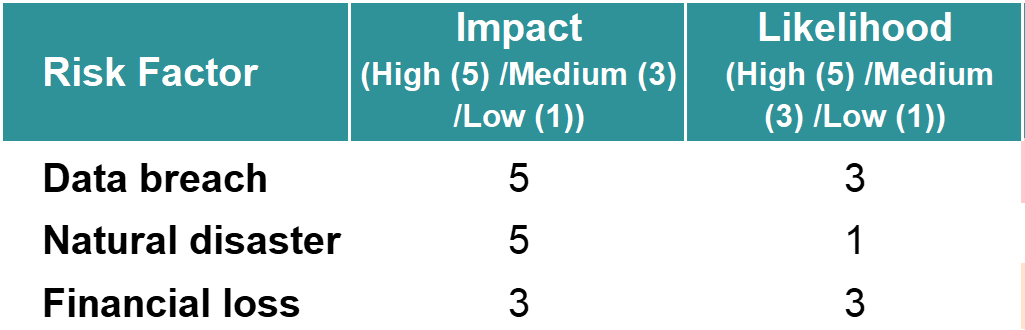
Assessing Risks: A Step-by-Step Guide

Identify Potential Risks:

  • Brainstorm a list of potential risks that could affect your organization. Consider risks that could impact your financial situation, the way you are able to run your organizational processes, your reputational, and risks that relate to legal issues – think about compliance and adhering to legal requirements and regulations.

2. Evaluate Impact:

Assess the potential impact of each risk on a scale of 1-5 where you use either a 1 a 3 or a 5 to rate the impact of every risk you noted in case they happened:

  • 1: Low impact (minor financial loss or inconvenience)
  • 3: Medium impact (noticeable financial loss or disruption)
  • 5: High impact (significant financial loss, reputational damage, or operational disruption)

3. Assess Probability:

  • Estimate the probability of each risk occurring on a scale of 1-5. Use a number 1, 3, or 5 to rate the probability or likelihood that the risks you have would happen:
    • 1: Very low probability
    • 3: Medium Probability
    • 5: High Probability

4. Calculate Overall Risk:

  • The download template below will multiply the impact rating by the probability rating to determine the overall risk level.
  • Rank risks based on the calculated overall risk score. The higher the score, the more important it is to have a plan to avoid it, lower its impact (mitigation), or manage it if there is no way you can avoid it.

5. Develop Risk Strategies

This is where you spot potential problems and make a plan to deal with them. It could be to protect your money, keep your good name, and build a stronger, more stable organization.

Here are some types of strategies that might be needed:

  • Risk Avoidance: Remove or avoid the risk completely by putting some form of protection in place to ensure it can’t easily happen.
  • Risk Reduction: Instead of just letting problems happen, take steps to make them less likely or less harmful. Or you could say it is about implementing measures to reduce the likelihood or impact of the risk.
  • Risk Transfer: Instead of taking on the risk yourself, pass it on to someone else, like an insurance company.
  • Risk Acceptance:  Sometimes, risks are unavoidable. Instead of trying to stop them completely, be prepared for them. Have a backup plan in case things go wrong.

Taking Action: Protecting Your Organization

Once you’ve identified and assessed your risks, it’s time to act. Focus on the risks with the highest scores and implement your mitigation strategies. Remember, a risk assessment isn’t a one-time thing. Review it regularly to make sure it’s still relevant and up to date.

Share your risk assessment with key leaders in your organization. Their insights can help you refine your strategies and check to be sure they align with your overall business goals. By actively managing risks, you’re taking a proactive step toward protecting your organization and securing its long-term success.

From Strategy to Performance Goals


Employees and Company Boards want the same thing – they want clarity around what you expect from employees, want feedback on how it is going from an outcomes perspective and want to know the steps you will take to fix it, in case outcomes are less than expected.

Most companies use a Balanced Scorecard approach whereby specific performance metrics in key performance or result areas from company strategies are used to set and monitor performance expectations into the company from the most senior roles to the most junior roles.

The benefits of this approach are numerous… for one you can get a good understanding of how well things are going with implementing your strategies in the company, you can make sure that all the initiatives being worked on relate to the strategy, identify organizational units or individual where things are going well or not so well – which mean you can provide support in the form of training for example. A balanced scorecard also helps to ensure you have organizational alignment where it is clear to every employee how he/she impacts the overall results of the company. And when an employee sees his or her own goals, it is easy for him/her to understand what exactly the company strategy and desired outcomes are about in a practical way.

Strategic Performance Areas

Having a cheat-sheet to get started may be useful…Performance Indicators can be set in many different areas. This list shows a few examples which may be handy as you read your own strategy and select the top performance areas that need to be impacted in your upcoming performance period.

In most cases 5 key performance areas would be chosen to balance current operations, growth goals, keeping current stakeholders satisfied and continuing to improve and innovate. e.g: 1) Financial outcome(s), 2) Quality outcome(s), 3) Customer satisfaction outcome(s), 4) Improving upon performance and efficiencies of previous years, and 5) Employee (leaders/specialists?) development and or retention outcomes.

Example

Let’s look at some specific KPIs and how they may translate into performance expectations into the organization. From high organizational levels deeper into the organization the goals become more specific to an individuals’ tasks and activities. In contrast, the goals of managers are typically focused on their ability to influence and lead the outcomes of teams or groups reporting into him or her. Managers ensure that things happen while in most cases the deeper you go into the organization, the more you see performance goals are based on the individual’s efforts to achieve an outcome.

Performance goals typically come in various types of outcomes based on how your KPI would require the right response to meet the company strategy.

Setting Expectations

.

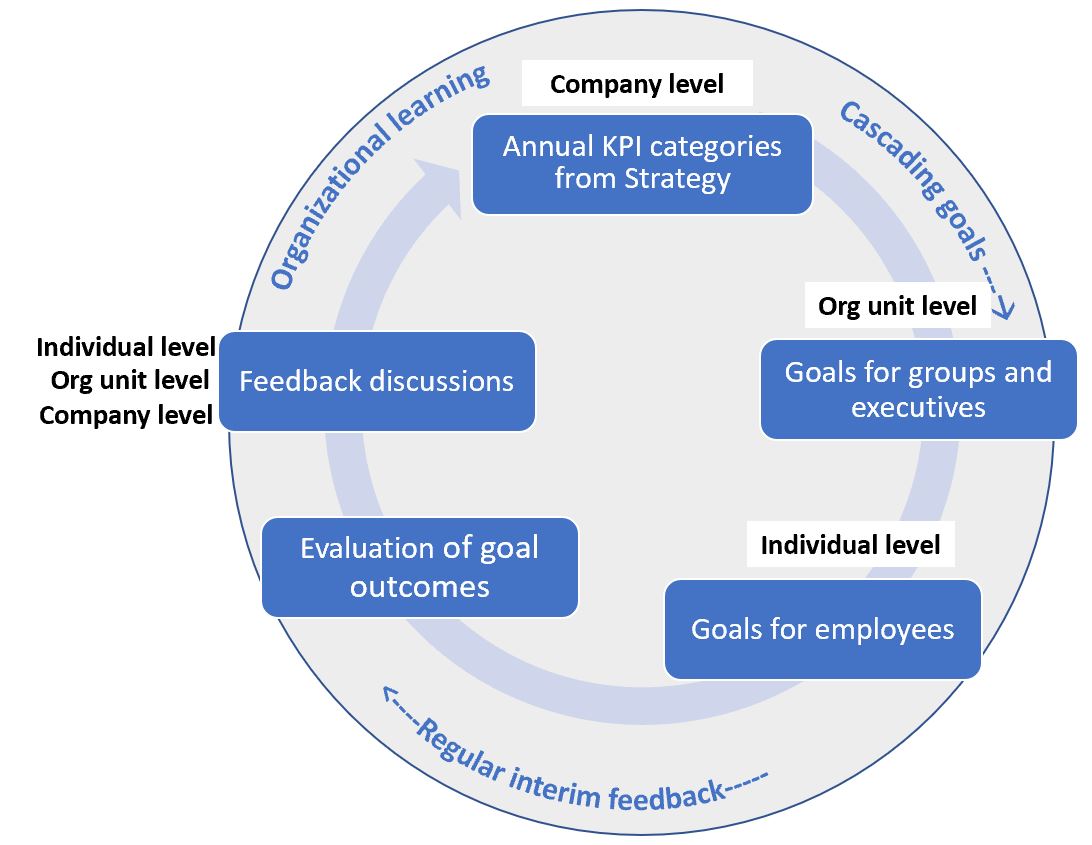
Cascading goals

Starting with the company’s strategy (at the highest level) the CEO or executive team can easily identify the top 4 to 7 Performance Areas where focus is needed to drive outcomes needed in the coming year. From there the heads of functions or organizational units can identify what that means for each of their organizations. Then performance goals for each organizational unit manager can be determined . And the same process cascades down until performance goals have been set for everyone at the company. All of the goals finally relate to a big-picture framework of KPIs at the top level of the organization.

Most performance expectations are set as SMART goals and each employee would typically end up with between 3 and 7 (max) performance goals for the year.

The graphic below shows how at individual level the goal may be a specific part of the overall KPI but when it is all “rolled-up” organizationally the full organizational KPI can be achieved in full by all employees contributing to the desired outcome. Not every organization group or unit might support every high-level KPI. Think for example of an organizational unit responsible for the upkeep of facilities, there may not be direct goals that relate to revenue growth for that group.

Note Goal E: It does not relegate to a KPI at the broader organizational level. This happens often – for example that a functional organization has a specific focus which may not directly relate to the KPIs that were set on a company-wide basis. That could be something like finalize implementation of a digital tool which enables better efficiency the following year. If there are no high-level KPIs related to improving on existing performance/efficiency, Goal E would not have a direct link to the overall high-level KPIs set. For this reason, it is important to set the high-level KPIs in a broad and balanced way to ensure that most goals that would be important at a level deeper into the organization to maintain or improve a specific level of efficiency or service delivery can be matched with the high-level need for renewal or continuous improvement. Some companies do not think broader than revenue or growth goals.

Interim feedback

It is important for managers to monitor outcomes along the way – do not wait until the end of the year to discover that outcomes were not trending in the right direction. Spotting issues or delays early means you can rectify or influence rectification of the situation. Give employees feedback throughout the year – make them aware of outcomes that deviate from desired outcomes, train and coach them to improve outcomes that they are responsible for and give them on-the-job coaching and support when they are inexperienced in specific areas. Every outcome matters and contributes to the overall outcome.

Learning

Evaluating outcomes and discussing those with employees is the next step. This step also includes looking at relative performance outcomes among various organizational units and overall outcomes. This can lead to an improved understanding of where further improvements may be needed. Improvements can range from awareness training, making more information available, helping to upskill or cross-skill employees in various areas. It may also lead to understand misalignment with what suppliers can or are delivering or misalignment between customer expectations and what operations is able to deliver right now.

Use what you learn from discussing performance outcomes to influence future performance outcomes and support that might be needed for the next year.

In the final outcome of the performance period you will have individual scores that relate to individual performance. When you look one level higher you see the contributions of various employees in the same organizational unit and how each of them did on their own performance goals. If the goals were created to be an exact match – between goals set for the manager and those set for those reporting to the manager – the aggregate outcome of the team would determine the manager’s score.

Looking at the organization, it is easy to pinpoint where contributions by individuals, teams, managers may not have reached expected results in the outcomes.
Understanding why this occurred would help learning from the past and improving going forward. Answering questions like:
  • Knowing what we know now, were these realistic expectations or do we need to first solve some key issues before we can make more progress in this area?
  • Do people need more training to make sure they are able to perform in new areas or with new outcomes (such as new markets or types of customers)?
  • Is this area so specialized that we need to hire some people with the specialized knowledge or experience that this team needs?

Most companies are on a learning path when it comes to their own performance management process and approach. If you are just starting, do expect it to be a journey and make sure you allow space for reviewing, reflecting and learning as you go. It may lead you to make adjustments to your strategy or the way the organization is structured, to name but a few ways that on-going organizational learning can benefit the greater organization.

Ultimately the goal of your performance management approach is to measure how much the efforts of those in the organization are helping you achieve your goals as a company, where are hidden barriers to succeeding with your organizational strategies and where are opportunities to accelerate results if you leverage great ideas and tools developed in any part of the organization. This makes your company sustainable into the future. Viable today and into the future by continuously evolving, learning and innovating without losing focus of the basic outcomes needed to drive profitability on an on-going basis.

Organizational Strategy Framework


framework final

Setting a strategy for an organization requires a focus on aspects internally and external to your organization. Once you have set your strategic growth targets you would need to look at how you need things to change internally to support those growth targets. You may want to set your signs on improving profitability, increasing organizational effectiveness or moving leadership behaviors closer to your values and vision for the organization.

The resource I am sharing can help you align some of the most important internal aspects with your strategy to improve your chances of successfully executing on the strategy.

Most organizations are able to successfully navigate through the process of setting a strategy. Many organizational leaders find execution and implementation of the strategy the hardest part to achieve. I believe this is mostly because internal aspects that are needed to support the strategy are not always taken into account in the execution plan.

The framework (See download option above) and questions to address in each case help you by acting as a checklist. Reviewing the execution plan, this list will help you consider how to engage, involve, and inform stakeholders in the process. It helps ensure that every aspect of your execution plan reinforces your strategic objectives leading to a better implementation plan.

The areas to ensure alignment are:

  1. Company values and culture
  2. Leadership (behavior and mindset)
  3. Workforce capability
  4. Organization structure
  5. Organization processes
  6. Systems (Automation)
  7. Performance Management and Metrics

The sequence would always be to first select a strategy you would like to pursue with the organization and then use this resource to plan the implementation portion of the activity.

Setting strategies is often an iterative process as changes from inside or outside of companies require an adjustment in approach. Remember to check the impact of further changes on the same checklist (see above) to ensure you maintain the strategy alignment.

How to set priorities in an action plan


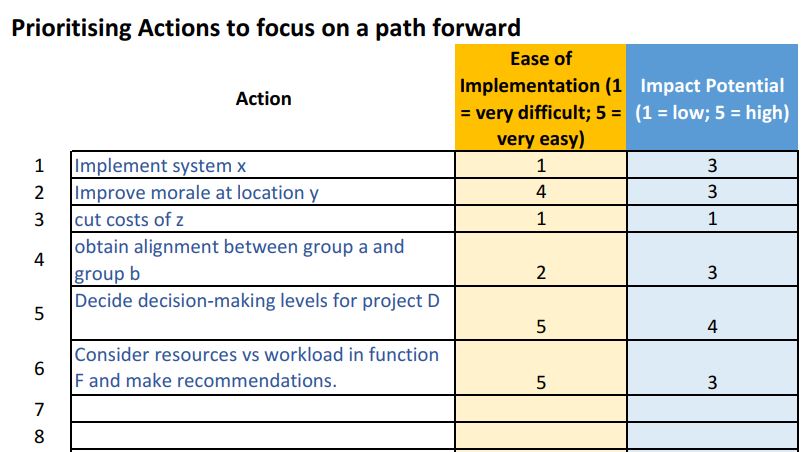
After a survey, a brainstorming session or a discussion it is often true that you end up with a long list of actions that should be put into an action plan. With many actions, maybe only a small number of people available to execute on those actions and possibly a small budget available for some of the actions, this could seem overwhelming.  The important question is: How can you prioritize the actions so you can make the most of the available resources (people to work on them) and funding (available budget)? And on top of that make sure that the most important actions are completed first?

Rate all the projects or activities on two questions:

  • what is the level of impact on your company, project, company if you completed that project/activity? (high means it would me a very big difference (positively))
  • how hard is it to implement this? (referring to available resources, skills and knowledge needed, tools needed, funding needed) (very difficult means you have very limited resources and budget and this project or activity would need more than you have available right now)

Use the scores obtained to plot your planned projects or activities onto this graphic: (the graphic shows an example based on the table and ratings above)

What to focus on?

Use the guide below to understand which of your projects or activities should be a high priority, low priority or medium priority with possible additional research needed.

One the one hand the question is: can you overcome what is difficult about that particular activity or project? Can you (for example) convince someone make more funding available if you present a very solid business case to highlight the value to the company or the project?

Or can you get more people to help? The other question to look into is whether the impact is really as low as you imagine? Speak to others to hear their views of how such a project or activity could possibly benefit more areas than you think. Perhaps the project is much more valuable than you think and it moves into the “green” quadrant meaning it should be a high priority for you to work on and complete.

If your dots appear in one of the yellow sections, you have some questions to ponder. If you can solve the question in each case you may be able to move that particular action into a different “zone” by changing the score. This means you are able to for example make it easier to implement by solving an issue which made it particularly difficult to implement. Or it could mean you realize the business impact is bigger than you previously realized because the company could gain a competitive edge if you implemented that particular action.  Your final action plan for immediate focus areas should contain those actions which finally end up in the green zone on the legend.

Be sure to communicate the reasoning behind your high priority actions to the key stakeholders in the outcomes of the action plan. They may have additional insights to share which could further cause you to change the scoring of actions.

You can use the Action Plan posted here to capture the actions that you will implement, monitor status of and report on regularly.