You sit down to use AI for a piece of work. The first prompt is vague, so the response is too. You refine it. Regenerate. Adjust the tone. Ask for more detail. Remove what doesn’t fit. After a few rounds, you have something you can use.
It feels efficient. But if you look closely, most of the time was spent correcting what could have been clarified before the first request was ever sent.
There is another layer to this that rarely gets mentioned. AI does not run in the abstract. Every prompt travels through servers in data centres, drawing power and requiring cooling. One request may seem insignificant. But how many requests are you making per day? The footprint of AI is real, and while a single exchange is small, scale is what turns small inefficiencies into meaningful impact.
The cost of skipping the thinking step is not just cognitive. It is operational and environmental.
Where we go wrong
If you stop using certain muscles, they weaken. Cognitive skill works the same way.
When AI starts doing thinking you should be doing yourself, the risk is not only weaker output. Over time, it affects your ability to analyse, question, and decide under pressure.
Here is where it usually goes wrong:
You let AI draft the email and do not review the tone carefully.
You accept a structured analysis without checking the assumptions behind it.
You copy a framework because it looks polished.
You mistake length for depth.
AI may invent details when it lacks context. It may reinforce the framing you give it. It may produce something that looks convincing but is slightly misaligned with your strategy, scope, or risk exposure.
And if you send that forward, the reputation attached to it is yours.
Fast does not mean flawless.
Think before you prompt
A better approach begins before you type.
AI performs best when it is clearly instructed. Missing context about audience, tone, constraints, or success criteria almost always leads to additional rounds of correction. You refine. You clarify. You ask again. What felt fast becomes repeated rework.
And there is another dimension to this that we rarely mention.
Thinking first is not just cognitively disciplined. It is operationally and environmentally responsible.
Before opening the ai tool, define:
– What must exist at the end? – Who is this for? – What tone and level of depth are required? – What constraints apply? – What would make the output unusable?
If regulatory exposure, strategic guardrails, or reputational sensitivities matter, state them explicitly.
The AI Briefing Sheet – available as a free download right below – is designed for exactly this step. It forces you to clarify intent before you outsource execution. It is editable, so you can adapt it to your specific project.
Only once the brief is clear should you move to the prompt window. If something is vague in your own mind, it will be vague in the response.
Pause before you prompt.
Staying Mentally Fit in an AI World
When AI always structures your first draft, it feels harmless at first and you slowly stop practicing structure yourself. When it consistently generates counterarguments, you stop anticipating objections. When it refines tone every time, your own calibration weakens.
Used properly, AI can be a sparring partner, a challenger, a speed amplifier, and a capable researcher. But it is not final authority. It should never be your only source, your only fact checker, or the voice that determines how your work will be perceived by specific stakeholders.
Some decisions remain entirely yours: defining what the task truly requires, editing for accuracy, checking tone, and ensuring the structure serves the intended purpose.
The final output must reflect your voice and your judgment.
Practical discipline helps. Draft your own thinking in bullets before prompting. Ask AI to challenge you. Request counterarguments. Pressure-test the output before accepting it.
When you prepare properly, AI works within your framework. Without one, you may find yourself adapting to its structure instead of the other way around.
AI will only get faster.
The real question is whether we remain deliberate.
It is a powerful assistant. Assistants extend capability. They do not set direction.
Use it well – but think first.
That is how you benefit from AI without slowly surrendering the one thing it cannot replicate: your judgment.
Collaboration is all about tearing down invisible walls between functions and geographies and bringing people together in a way that feels natural and fun. This collaborative canvas activity uses art to help everyone experience working toward a shared goal. Each person adding their own splash of creativity to a group masterpiece supports reflection on how each participant supports the big picture — all while getting a fresh take on teamwork, company values, and communication.
It’s a hands-on way to see how different ideas can blend into something unique, and why trust, adaptability, and shared ownership are key to breaking down silos and achieving success together.
Purpose
This interactive activity is designed to break down silos between departments and regional leaders by improving collaboration, adaptability, and shared ownership. Using art as a medium, participants will explore teamwork, communication, and how individual contributions blend into a collective vision.
Setup
Canvas Arrangement – Multiple A4-sized canvases are set up in a circle, with each canvas facing outward to allow participants to engage without observing others’ immediate responses.
Materials – Brushes and paint, exclusively using the corporate color palette to reinforce company identity. Note that each participant receives one brush and one color, symbolizing their unique perspective and input.
Atmosphere
Music begins playing softly as participants settle in front of a blank canvas, encouraging focus and creativity.
Once everyone is ready, the music is turned down, and clear instructions are shared. While participants work on their canvas for those 30 seconds music can be played – it is optional.
Instructions for Participants
Engagement
Participants start by standing in front of a blank canvas with their designated color and brush in hand.
Each person responds to 4 prompts (statements or questions) that align with the company’s:
Vision
Mission
Values
Reflection on last year’s operational and financial results
Rules
Each round lasts 30 seconds from the moment that the sentence or question is read.
During this time, participants draw or write their responses on the canvas in front of them using the color and brush they have been given.
At the sound of a bell or signal, each participant is to move clockwise to the canvas on their left.
Each participant must continue to respond to the new prompt on the next canvas, building on the contributions of others.
No returning to anyone’s original canvas or modifying earlier work.
Rounds
Each round features a new statement or question to react to creatively on the canvas in front of each participant using only the brush and color each has been given.
Prompts should spark reflection on the company’s collective goals and inspire responses that challenge silos:
Round 1: Read the company’s vision then prompt: “What does our company’s vision mean to you? Reflect that on your canvas”
Round 2: Read the company’s mission statement, then prompt: “How do you contribute to our mission as part of a larger team? Write or draw something to indicate that.”
Round 3: Read the company’s values or value statements, then prompt: “Which company value resonates most with your role? Depict it in your own way”
Round 4:“Reflect on how collaboration led to achieving last year’s results. Think of a way to indicate that on the canvas in front of you.”
Debrief: Reflecting on the Experience
Once all 4 rounds are complete, participants step back to look at the canvases, including their original starting piece. This is a powerful moment to consider team topics like shared ownership, teamwork, collaboration, and adaptability.
Debrief questions
How do you feel about how your original canvas turned out?
Did it match your vision, or was it transformed by others’ input? How did you feel about the contributions of others on your original canvas – did it turn out better or lesser than you hoped?
What was it like contributing to a canvas where you disagreed with earlier markings?
How did you adapt or build upon previous ideas? Even if and especially if you disagreed with what you saw when you moved to that canvas?
How does this experience relate to teamwork in our company?
How do we handle differences and align diverse contributions across departments or regions? Can we do better?
What lessons can we apply to ensure better collaboration and a shared vision moving forward?
Outcome
It’s not just about the finished artwork but about realizing how individual efforts combine to create something meaningful together. This activity highlights the importance of adaptability, communication, and trust when working across teams. The lessons learned can be applied directly to real-world collaboration — helping teams break down silos, align their contributions, and work more effectively toward shared goals. Plus, the visual reminder of the canvases can serve as a lasting prompt to keep these ideas top of mind in daily work.
This activity is more than just a creative exercise — it’s a powerful way to see teamwork in action. By adding your unique perspective to a shared piece of art, you experience firsthand how collaboration, communication, and trust can transform isolated efforts into a cohesive result. It’s a reminder that breaking down silos isn’t about losing individuality, but about combining strengths to achieve something greater. As each participant steps back and looks at the final creation, they will see the potential for better teamwork, adaptability, and shared success, ready to carry those insights into everyday work.
Feeling overwhelmed by your to-do list? It’s time for a fresh approach. Whether you’re figuring out what new tasks to start, which processes to stop, or where to make improvements—including sustainability initiatives—this simple method will help you cut waste and boost efficiency. Think of it as a game-changer for your workflow, empowering your team to work smarter, not harder, while making real progress. Change doesn’t have to be overwhelming; it’s about making strategic, impactful adjustments that lead to better results, smoother workflows, and more sustainable outcomes.
A Fresh Approach to Tackling Chaos
Ever feel like your to-do list is out of control? This simple method helps bring clarity, meaning, and direction to your tasks. Whether you’re deciding what new actions to take, which processes need tweaking, or which habits to drop, this approach will streamline your workflow, boost productivity, and make your routine more manageable.
Even the best processes lose their effectiveness over time or fail to take advantage of the improved availability of better tools and templates, signaling the need to reassess. While big changes can be costly, small adjustments often get things back on track. The method I’ll share is perfect for team brainstorming, making it easier to identify areas for improvement together.
Think of it like tidying up a familiar room. Some things need to go, while others just need a small fix. This tool helps you do the same with your work, identifying what needs to change, what new actions to start, and what habits to stop.
Importantly, it’s also about working smarter with sustainability in mind. Rethinking processes to reduce waste, conserve resources, and adopt eco-friendly practices not only improves efficiency but also builds a more sustainable work environment for the future.
What to Start
Think of yourself as a gardener, planning to refresh and revive your garden. To improve a process or outcome at work or in a volunteer setting, you need to plant new “seeds”—ideas and actions that hold the potential to bring positive change. These are the things you want to start doing to make a meaningful impact.
Ask yourself: What new tools, strategies, or approaches could help streamline work, solve problems, or improve how people experience your organization or team? It might be a fresh approach to a recurring issue or an idea that could make things more efficient. Like planting new flowers in a garden, these initiatives will need your time and attention to grow and flourish.
By starting these key actions, you create opportunities for improvement and success and build an environment that thrives on new ideas and growth.
What to stop
When we talk about what needs to stop in the workplace, we’re focusing on behaviors and habits that hold everyone back. Think of gossip—it’s like a poison that erodes trust and divides teams. Then there’s micromanagement, which stifles creativity and leaves people feeling frustrated and demotivated. And multitasking? While it might seem productive, it often leads to mistakes and burnout. By eliminating these negative behaviors, we can create a more positive, collaborative, and efficient work environment.
Stopping isn’t just about behaviors, though; it’s also about simplifying how we work. This means cutting out unnecessary steps, avoiding redundant processes, and leveraging technology to make tasks easier and faster. It’s about working smarter, not harder.
The key to success is getting everyone involved. When the team collaborates and shares insights, it becomes easier to identify which tasks or processes don’t add value—and figure out the best ways to eliminate them. This not only streamlines workflow but also helps the entire team feel more aligned, motivated, and connected.
What to change
When identifying what needs to be changed, it’s about finding those processes or tasks that work to some extent but aren’t quite hitting the mark. These are not things you want to stop completely, but they could benefit from refinement or improvement. The goal is to enhance their efficiency or effectiveness rather than overhaul them entirely.
This step is about finding out with your team where bottlenecks occur, where confusion arises, or where inefficiencies creep in. Perhaps you uncover small tweaks that make a big difference. For example, a task might be taking longer than necessary because of an outdated step, or perhaps communication between teams could be improved to streamline a handoff.
Other possible candidates for change may lie in opportunities to improve: Are there tasks that could be automated? Is there a process that could be shortened or simplified without sacrificing quality? Sometimes it’s as simple as adjusting timelines or reallocating resources to better fit the demands of a project.
The key is not to throw out processes that have potential but to fine-tune them. By making small, thoughtful adjustments, you can improve the overall flow and outcomes. Involving the entire team in identifying these areas for change ensures that the solutions are practical, realistic, and beneficial for everyone.
Setting up time with the team
To kick off improvements, start by gathering input from everyone involved in the workflow. Set up a dedicated meeting where each person can share their unique insights. By involving the whole team, you’ll gain a diverse range of perspectives, helping you identify opportunities for improvement far more effectively than if you were working alone.
To make the session productive, team up with coworkers and dedicate about an hour to look for ways to enhance how you work, the environment you work in, or how your organization delivers value—whether it’s to customers, clients, or those benefiting from your volunteer efforts.
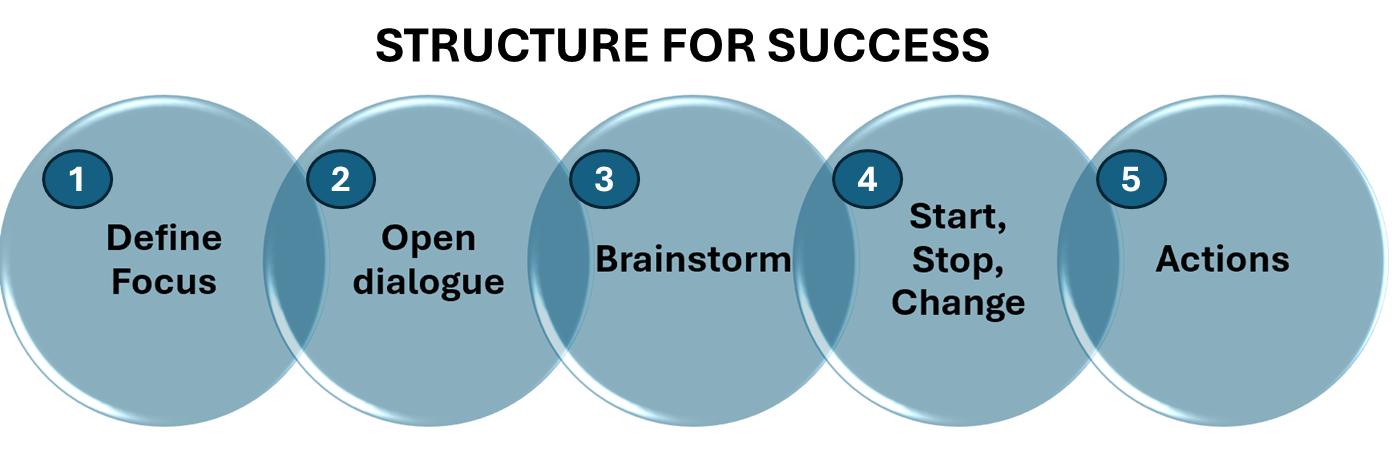
Here’s how to structure your session for success:
Define the Focus: Clearly outline what the session is about. Are you looking to improve a specific process, boost safety, streamline workflows, or enhance customer/recipient satisfaction? Make sure everyone understands the goal before diving into discussions.
Encourage Open Dialogue: Create a safe space for everyone to share their ideas, frustrations, and suggestions. Emphasize that all feedback is valuable and will contribute to positive change.
Brainstorm Together: Work as a group to explore ways to make things better, smarter, and safer. This could involve improving the way tasks are done, optimizing the workspace, or enhancing the delivery of value to customers or the community.
Capture Ideas: Use Stop, Start, and Change flipchart pages to organize ideas. After brainstorming, categorize the suggestions:
Stop: What isn’t working and needs to stop?
Start: What new actions, processes, or tools should be introduced?
Change: What existing processes could be improved with a few adjustments?
5. Assign Actions: Once ideas are gathered, assign ownership for each action. Ensure there’s follow-up so the insights gained from the session translate into real improvements. Also, set up a follow-up recurring meeting to review how things are going to discuss if you need to change or improve how you are implementing actions to be more successful and avoid obstacles to success.
By following this structure, you’ll ensure that your team collaborates effectively and walks away with actionable steps to make meaningful changes.
Keep Stakeholders in the Loop
After the meeting, it’s important to keep key stakeholders, such as your supervisor or others involved in the implementation, informed about the progress. Provide them with an update on the discussions, including the proposal for items to start, stop, or change. This transparency ensures they are aware of the team’s efforts and can offer support as needed. Additionally, ask for their feedback and suggestions. This will help ensure that no key opportunities for improvement are missed and that the plan is as comprehensive as possible. Engaging others in this way enhances collaboration and strengthens the overall success of the initiative.
Now It’s Your Turn to Change the Game
Taking a structured approach to what you start, stop, and change can really improve how your team works and help you reach your sustainability goals. I encourage you to take a fresh look at your team, your environment, and how you get things done. Find ways to not only make customers happier and save money, but also to reduce waste, save resources, and lessen your impact on the planet. Involving your team in this process will help everyone work smarter and feel more motivated as they see their ideas making a difference. Whether you’re working or volunteering, these changes can lead to a more rewarding and sustainable experience. Now is the time to act—start looking for where you can make a real difference for your team and the environment.
In today’s world, unexpected things happen. That’s why it’s important to be prepared. This free template download below will help you identify potential problems and figure out how to fix them. You can keep your organization safe and strong by staying ahead of risks.
Remember, this isn’t a one-time thing. You need to keep reviewing and updating this checklist to make sure it’s always relevant. With a little effort, you can create a stronger organization that is able to withstand life’s little surprises.
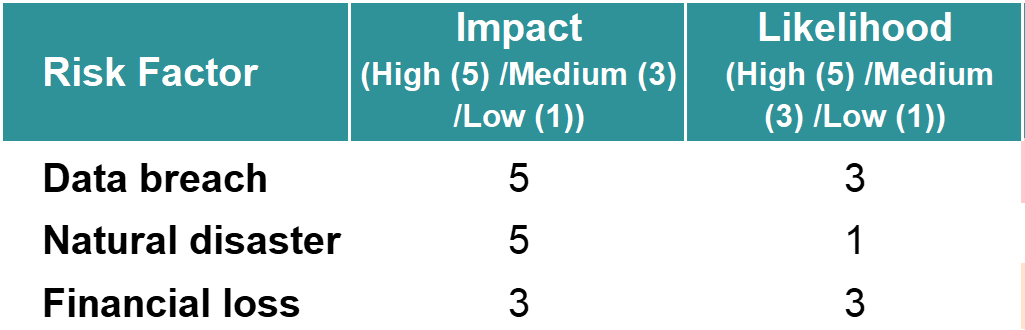
Here are two examples of big problems that can hurt an organization:
Hackers stealing information: Bad guys can steal important stuff like customer data or company secrets. This can ruin your reputation and cost you a lot of money.
Mother Nature strikes back: Hurricanes, floods, or earthquakes can damage your business and disrupt operations.
You will notice that the template comes prepopulated with some headings for your identified risks – feel free to add more if your organization has important categories that are not listed there and feel free to remove the ones that do not apply to your organization. Every organization could have categories of risks that are unique to the industry or the services or goods provided.
In today’s uncertain world, risks are everywhere. From financial losses to reputational damage, the potential consequences can be severe. That’s where a risk assessment comes in. By identifying potential threats and understanding their impact, you can take proactive steps to protect your organization.
So, what exactly is a risk assessment? It’s like a crystal ball, helping you see potential problems before they happen. Think of it as a map that guides you through the dangers ahead. By understanding the risks you face, you can develop strategies to avoid or reduce them.
But how do you do it? It’s actually simpler than you might think. Let’s break it down into two key steps:
Identify the risks: Think about all the things that could go wrong. Financial losses? Safety issues? Reputation damage? Write them down.
Assess the impact and probability: For each risk, figure out how bad it would be if it happened (the impact) and how likely it is to happen (the probability).
By combining these two factors, you can rank the risks that pose the biggest threat to your organization. Then, you can create a plan to tackle them.
Have a strategy for risk management
A strong risk management plan is like a safety net for your business. By spotting potential problems and having a plan to deal with them, you can protect your money, keep your good name, and build a stronger, more stable company.
Find potential threats: By understanding the risks you face, you can take proactive steps to prevent or mitigate them.
Protect your assets: Effective risk management helps safeguard your organization’s financial resources, reputation, and operations.
Make informed decisions: Risk strategies give valuable insights that can inform smart decisions and resource allocation.
Guarantee long-term sustainability: You can build a more resilient and sustainable organization by managing risks effectively.
What is risk?
A risk is simply a potential problem or danger. It’s something that might happen in the future that could cause harm or loss to your organization. Think of it as a threat that you need to be prepared for.
A risk assessment is a proactive tool that helps you discover potential threats to your organization and develop strategies to mitigate their impact. By understanding the risks you face, you can take steps to avoid or manage them effectively, protecting your assets and ensuring long-term success.
Unpacking the two ratings
What is the meaning of risk impact?
Impact refers to the potential consequences or severity of a risk event. It measures the harm or damage that could result if the risk occurs. For example, a high-impact risk might involve significant financial loss, reputational damage, or operational disruption.
How to look at probability or likelihood
Probability refers to the probability of a risk event occurring. It measures the chances that the risk will materialize. For example, a high-probability risk is more likely to happen than a low-probability risk.
By considering both the impact and probability of a risk, you can focus your efforts on mitigating the most significant threats to your organization.
Assessing Risks: A Step-by-Step Guide
Identify Potential Risks:
Brainstorm a list of potential risks that could affect your organization. Consider risks that could impact your financial situation, the way you are able to run your organizational processes, your reputational, and risks that relate to legal issues – think about compliance and adhering to legal requirements and regulations.
2. Evaluate Impact:
Assess the potential impact of each risk on a scale of 1-5 where you use either a 1 a 3 or a 5 to rate the impact of every risk you noted in case they happened:
1: Low impact (minor financial loss or inconvenience)
3: Medium impact (noticeable financial loss or disruption)
5: High impact (significant financial loss, reputational damage, or operational disruption)
3. Assess Probability:
Estimate the probability of each risk occurring on a scale of 1-5. Use a number 1, 3, or 5 to rate the probability or likelihood that the risks you have would happen:
1: Very low probability
3: Medium Probability
5: High Probability
4. Calculate Overall Risk:
The download template below will multiply the impact rating by the probability rating to determine the overall risk level.
Rank risks based on the calculated overall risk score. The higher the score, the more important it is to have a plan to avoid it, lower its impact (mitigation), or manage it if there is no way you can avoid it.
This is where you spot potential problems and make a plan to deal with them. It could be to protect your money, keep your good name, and build a stronger, more stable organization.
Here are some types of strategies that might be needed:
Risk Avoidance: Remove or avoid the risk completely by putting some form of protection in place to ensure it can’t easily happen.
Risk Reduction: Instead of just letting problems happen, take steps to make them less likely or less harmful. Or you could say it is about implementing measures to reduce the likelihood or impact of the risk.
Risk Transfer: Instead of taking on the risk yourself, pass it on to someone else, like an insurance company.
Risk Acceptance: Sometimes, risks are unavoidable. Instead of trying to stop them completely, be prepared for them. Have a backup plan in case things go wrong.
Taking Action: Protecting Your Organization
Once you’ve identified and assessed your risks, it’s time to act. Focus on the risks with the highest scores and implement your mitigation strategies. Remember, a risk assessment isn’t a one-time thing. Review it regularly to make sure it’s still relevant and up to date.
Share your risk assessment with key leaders in your organization. Their insights can help you refine your strategies and check to be sure they align with your overall business goals. By actively managing risks, you’re taking a proactive step toward protecting your organization and securing its long-term success.
Remember that idyllic family vacation – sandcastles, stunning sunsets, and endless movie nights? Every memory captured, every photo snapped, contributes to a hidden cost: a growing mountain of data. We’ve ditched bulky photo albums for high-resolution cameras, amassing gigabytes in the blink of an eye.
Sure, modern technology is fantastic. We access work documents from anywhere, stream music on a whim, and capture travel moments with ease. But have you considered the environmental impact of this constant connectivity and data storage?
The Unspoken Footprint of Our Memory Mountains
Our digital lives require a physical home – data centers. They house several bustling servers to store our information 24/7, and while they’re not inherently bad, their energy consumption creates a significant environmental footprint.
Why? Because we crave constant access. We want to view vacation photos from anywhere, edit documents on the go, and stream movies on airplanes. Data centers make this possible, but accessibility comes at a price. Cooling massive server rooms and powering them around the clock requires a lot of energy, especially if sourced from fossil fuels.
The more data we generate, the bigger the data center footprint becomes. Every photo, movie, and document we store contributes to this ever-growing mountain. The more data, the more energy is needed to keep it accessible.
From Vacation Snaps to Server Saps
The good news is you have the power to make a difference! Here’s how to lower your data footprint:
Family Fun with a Digital Detox Twist
Organize Family Photo Cleanup Sessions: Turn deleting photos into a fun family activity! Let your children participate in selecting the best shots and discuss what makes a good picture.
Discuss the Impact of Data: Talk openly about the environmental impact of cloud storage and how responsible data habits can make a difference. Encourage them to think critically about their downloads and storage.
These small changes, multiplied by millions of families, can create a substantial positive impact. By being mindful of your data habits, you’re not just decluttering your digital life, you’re setting an example and making a positive contribution to the environment.
The good news continues! Data center operators are constantly seeking ways to be more energy-efficient. From better cooling technologies that don’t rely on freshwater to renewable energy sources and sustainable data center designs, these efforts not only reduce operating costs but also lighten the environmental footprint of these facilities.
So, let’s embrace the convenience of modern technology while taking responsibility for our digital footprint. Together, we can create a greener future for our planet, one byte at a time.
One of the key reasons that companies lose new hires with some experience is that they fail to support these new hires adequately during their first few months. In some companies, it can be quite hard to understand how things work there, how to fit in and be successful, feel valued and included. Having a written onboarding plan from the start is a great way to bring more clarity to the person and also help them understand expectations during the crucial early months in their new roles in the new company.
The onboarding plan can be written as early as during the recruitment process. In one best-case scenario, it was shared with a senior executive right after his interview with the CEO. It was such an unexpected and appreciated action that the executive commented how refreshing he found the transparency and it made him see the hiring company as head-and-shoulders above the competition which led to him accepting the offer and joining the company a few months later.
The Process
While the plan can help clarify the set-up and structure for a new hire, it is important to set up review meetings with the newly hired managers or key hires. In some cases, reviews with an HRBP could be useful to understand for example how performance management is organized and how the process works. Such review moments could also clarify talent development programs and processes, which is useful to know for the new hire regarding his/her own career but also for helping the new hire manage the development actions for those who report to him/her.
Review meetings with the manager that the new hire reports to could help identify priorities and understand where to connect with more people or build additional internal or external relationships. The manager can also answer questions about activities planned to ensure desired outcomes are achieved after 30-days, 60-days, and 90-days as captured in the onboarding plan.
The people side of success
The template captures not only the tasks and activities needed to succeed in a new role but also identifies people with whom to build relationships. These are important relationships and contacts that the new hire would need to establish and maintain to ensure his/her success in the long run. They could be key client contact personnel or contacts from key suppliers or subcontractors. They could also be internal – people who know how things work and who can advise on the best course of action to get something done at that company.
And it is also important to identify people who can be trusted to keep things to themselves and who could advise on who to talk to before moving in specific directions for changes the new hire would like to implement. Either the HR Director/HRBP or the new hire’s manager may be helpful to identify who those contacts may be.
Note that confidants or advisors may also be external people such as professional coaches or consultants.
Accountability
While it is important from a company’s perspective to ensure key new hires are provided with onboarding plans, completing the details and setting priorities to accomplish the outcomes defined in the plan lie with the new hire. The success of the new hire is only partially dependent on helping him/her get up to speed faster by having review meetings and an onboarding plan and giving him or her access to professional helpers and advisors. The new hire remains accountable for his or her own performance and following through on the items recorded in the onboarding plan.
When both the process of onboarding works well and the new hire holds himself/herself accountable for the outcomes produced, the risks of failure due to onboarding gaps are lowered and retention success is more likely in the medium to long term!
Useful posts for new employee/ new manager onboarding and orientations :
Staged Promotions – Accelerate role-readiness using focused development with check-ins
Leaders are not always ready the moment you need them to step into a new role. An inexperienced leader can increase risks in continued customer satisfaction, operational / execution risks, and employee satisfaction and retention. Using a a staged promotion could be a way to mitigate risks, while ensuring that leadership development is accelerated and monitored with defined targets on knowledge gained and skills and competencies gained during each period within a specified timeline.
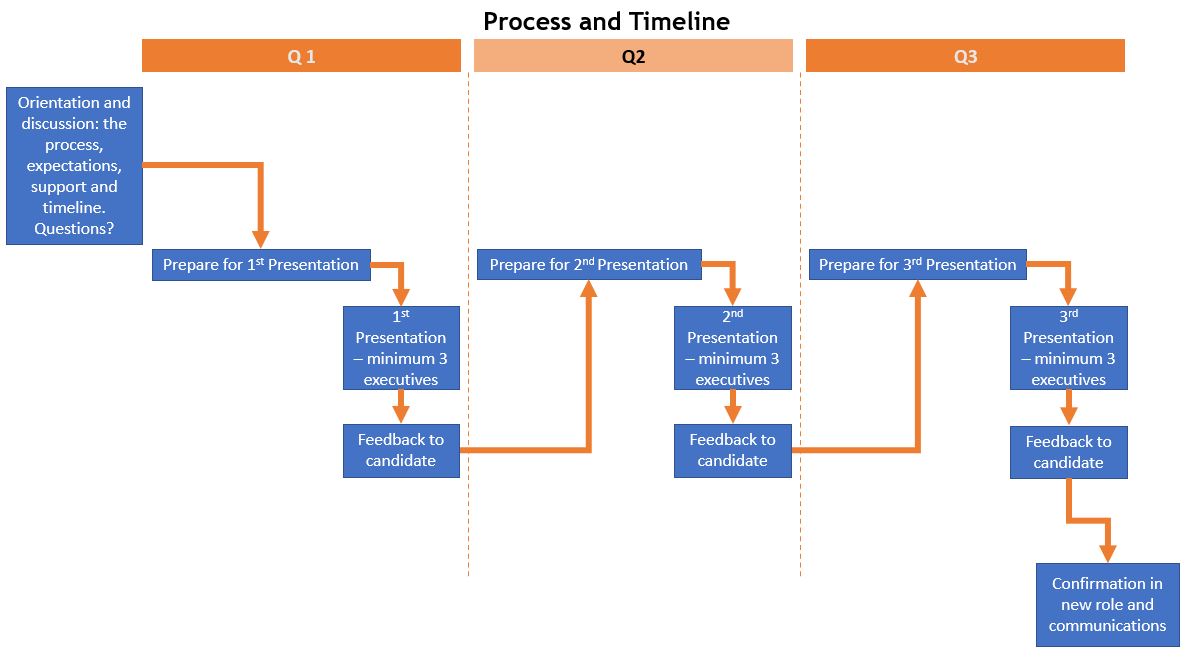
Process and Timeline
The graphic below outlines the process and shows an example of running the process over a 9-month period. The duration of such a process can vary but watch out for making the period too long – longer than 12 months. It can lead to process fatigue and demotivation of the leader. It is important that the process starts with an orientation to ensure the leader understands how the process will work and what is on the other side of the development period. The leader should be clear on what he/she is signing up for.
Defined learning path
During the development period, there needs to be a few concrete check-in points whereby the leader is demonstrating knowledge, skills and insights gathered and learned over the period. Instead of making the check-in points being general discussions, it is useful to select a few key focus areas for a presentation to be delivered at the end of each of the development periods.
Each check-in event needs to result in specific feedback being captured and shared with the developing leader. The feedback helps him/her to further focus and improve on their learning approach for the remaining learning periods.
The final check-in is usually the final decision-point where the executives present are willing to confirm the promotion of the leader – ending the interim nature of the assignment.
The example below shows how a project or facility leader can be assigned specific areas to learn about over the 9-month period. Each of the areas are important for the normal day-to-day activities of the developing leader and the focus simply means nothing is missed in helping the leader perform well in the role in future. It helps to include the strategic and the “why” part of a role since a new role is often mostly or mainly about the “what” to get done.
Notes
The orientation step which helps the leader understand the design of the development path, the role he or she has and also how to ensure his/her own success making use of available internal and external development resources. Before the orientation session, a leader has typically already understood from his/her manager that they are offered the development opportunity on an interim basis and the leader has agreed to proceed. The leader also needs to know what happens if he/she does not succeed at the end? Will they get a different assignment and what might that be?
Preparing the executives before the check-in events (when check-in events are set up to be a presentation followed by questions and answers). Executives need to understand the design of the development path, the purpose of the focus areas, the development needs of the leader and how they are to capture their feedback to be presented back to the leader after the event.
Feedback to the leader should be specific and be a balance of activities that are good to maintain, which ones to develop further and which ones to start or stop going forward. Specific examples of desirable behaviors or results should be highlighted. A discussion on risk identification and management may also be useful to help the developing leader understand how to adjust own focus to best mitigate and manage risks associated with own development as a leader as well as risks associated with the role..
This process is very useful to help a leader understand what the new role would include when they are meeting all expectations of stakeholders. A leader who feels uncomfortable meeting all those expectations will typically ask to be taken off the development path before the end having realize it is not for him or her. And this allows for re-assignment and solving the leadership vacancy in a different way.
Listening to a presentation by the leader on the assigned topics goes a long way towards providing executives with a sense of comfort (or alarm!) in terms of what can be expected from this leader in this role going forward. While these check-in points should not be the only determinant of how the leader is performing in the new role or estimating future behavior, it is a great way to understand the reasoning a leader applies in making business determinations and decisions and how the leader approach problem-solving when faced with adverse situations.
Working on multicultural teams you may have had moments of wondering what he or she just meant by that comment? Or why will he or she not make a key decision so an activity can move forward? Cultural perspectives and ways of life may be one of the reasons that could explain those incidents.
It is fun to meet people from other cultures and learn about their lives and experiences. And at first it may be interesting to learn how their cultures vary from your own, but once you work on a project together and it is remote working, including long hours and tight deadlines those differences can start to cause friction on the team. This can slow down progress and impact team morale. Being aware of the most common inter-cultural disconnects can prevent team members from blaming it on a person and instead enter into a discussion to unpack the root cause of a lack of action, lack of decision-making or the exact opposite – too many fast actions without thinking or making decisions without considering consequences.
4 Areas of misunderstanding that can impact inter-cultural teams
Some things are smart to do in order to ensure the team understands required project outcomes and approaches to use. Aspects would include clarifying the definition of done, outlining project phases and deadlines, assigning roles and responsibilities and having regular meetings to monitor and understand progress and resolve issues that are hindering progress or pose a risk.
Some aspects may need additional attention if your team consists of a few members from very different cultures.
1. Managing to deadlines
This relates to how important team members believe deadlines are. Some may see them as a guideline while others will suffer anxiety and will work longer hours to make sure the are met. In some cultures, there is a strong emphasis on being for example exactly on time for an appointment while in other cultures it may be okay to be a few minutes late for business meetings and perhaps even a few hours late for a social engagement.
Cross-cultural impact:
Make sure all team members understand the consequences, knock-on effects and penalties which may be triggered if the team missed deadlines. Monitor progress and have follow-up conversations if team members are falling behind to ensure they understand the importance of their activities being completed on-time.
Ensure team members understand the priorities they should place on various aspects of the work that needs to be done by the deadline. Ensure it is also clear exactly what “done” means. Do you expect quality checks to be done too or just a first draft of the outcome to be available? Should it be print-ready or just ready for an internal review or further discussions?
2. Clear Role Expectations
There are differences in cultures around the meaning of “in charge” or the Subject Matter Expert (SME). In some cultures, it is customary to take the word of such a person as a mandate to perform a specific task or action exactly according to what he/she said. In other cultures, SMEs and leaders are considered more “accessible”, and dialogue is welcomed when one does not agree with a requirement or task assigned by the one “in charge.” This difference can cause confusion on teams including many different cultures. To what degree can and should instructions be discussed and challenged vs accepted? Are those in expert roles or roles with authority prepared to deal with challenging discussions and comments – if the project team will operate in a culture of open discussions?
Cross-cultural impact:
Have a role discussion at the start of the project and include what would be great questions to ask each role and how interaction is expected to take place on the project to maximize positive team outcomes.
Be sure to have further discussions highlighting best-practices during the project and as new team members join, who may have missed the original discussions around the different project roles and how to best interact with them.
3. Conflict resolution
Conflict shows up differently in each person – some people speak up and go to the “max ” to be heard and understood while others take their thoughts, feelings and especially resentment underground and do not speak out. This means that conflict can be hard to resolve and to feel comfortable that all thoughts and concerns are on the table and discussed before decisions are made. Some cultures are more likely to speak up and make sure their opinions are voiced while others might patiently and politely wait to be asked for an opinion and speaking out of turn (from their perspective) may be seen as impolite or disrespectful. In some cultures open disagreements are best avoided to maintain a cordial/good relationship with others on the project.
Cross-cultural impact:
Use more than one channel to check in with team members and get feedback – ask in meetings, but also check in with individual team members between meetings to understand if there is any part of the path forward chosen which concerns them.
If any team members are especially aggressive in voicing opinions, perhaps a quiet word might help that person to still voice opinions, but possibly in a less forceful way to avoid antagonizing anyone from a culture where a forceful (overly enthusiastic ) communication style might cause discomfort.
Provide training in non-violent communication and voicing messages with a healthy balance between listening and advocating. Help team members to constantly improve in understanding each other’s styles to help communication and collaboration efforts on the project.
When a conflict does occur, address it in a culturally-sensitive way if the disconnect could be related to a cultural difference in perspective. The objective should be to solve and address project issues in a helpful way without causing negative impacts to collaboration on the project.
4. Navigating with many languages
We all know of situations where people from the same country with the same language find it hard to communicate successfully with understanding and openness. When a team consists of many different cultures, this can be so much more confusing and frustrating.
Cross-cultural impact:
Agree from the start of the project to follow a few guidelines such as: For the chosen project language, native speakers are to slow down and use simple ways to bring their points across. And native speakers of the main project language will be patient with non-native speakers trying to get their thoughts across. If there is a large language ability gap between the native-speakers and other team members consider some language classes to bridge the gap.
Consider asking presenters/speakers at planned meetings to send out specific agenda items and a summary paragraph of the issues to be raised and discussed at least a day before the meeting. That would help non-native speakers to prepare ensuring they understand the issues and are able to fully participate in the conversation at the meeting.
When there are significant differences in levels of language abilities on the team, meetings may take longer, and collaboration may also be a little harder especially in a virtual/remote environment. Be sure to take this into account when planning project timelines and deadlines.
Plan ahead to succeed
Knowing you may be starting up a project with a multi-cultural team, schedule team-building activities for team members early on. This will help them get to know each other as humans/people. Establishing trust early on, can avoid frustration turning into conflict and delays in reaching project team deadlines.
Create team opportunities to get to know more about each other’s cultures. This could bridge the gap in understanding each other’s perspectives and avoid labeling, misunderstandings, and internal team misalignments..
Set continuous learning as one of the core values of the team and live it, encourage it and keep bringing the team back to what can be learned from successes and failure as the project progresses. Having a curious and learning mindset is a great way to avoid major disconnects between team members as they will engage in inquiry and advocacy vs judgment and labelling as a default behavior.
Knowing what kind of opportunity you would like to pursue next, you can wait for the perfect role to show up online or… you could actively work through your network to get further!
Think about this:
The high level of competition for the role if you apply for a role online! Your experience and education and the design of your CV/Resume would have to be better than all other applicants to get through to the end of the recruitment process!
They estimate that 70% of roles are not advertised, but instead are sourced through networks! This means you could be invited for a discussion or interview just based on the fact that someone recommended you or introduced you to a decision-maker!
Every person you know from past roles, from school or college days, people you met and talked to at conferences, family, friends – could possibly know someone who is connected to a role that would be great for you!
Getting more contacts and making a positive impression on those you meet is important. It is not about pretending or lying, it is more about showing respect and genuine interest in those you meet. When people like the encounters they have with you, they want good things to happen for you and they might be keen to ask people they know to meet you or have a discussion with you. And this is all you need in many cases to get to the next step – a consulting project or a new job!
What does your network look like?
If you take a blank sheet of paper and you try to draw out this graphic below, perhaps you will be able to jot down people’s names for each of the circles and be able to create your starter list. This means the list of people whom you will start with – making contact with them.
The groups of people you know the best are most likely:
Friends, Family members, Classmates (now or from years before), ex-colleagues or trusted current colleagues, neighbors (now or from an earlier address where you lived at one point).
The next level of people you may want to contact include:
People you have met or interacted with on a sports team, or a social organization you joined, or a hobby class you took at some point, people you met and spoke to at a conference.
Priorities:
Looking through the names of people you listed in the worksheet (download available below), who might know people at the companies you are hoping to work for? Who knows about the kind of work you are good at and want to do? Who has the knowledge or experience to help you in your search? Who am I most comfortable talking to? (start there!)
How can your network help you?
What do you tell them ?
When you talk to someone who already knows you, you do not need to introduce yourself. When talking to a contact of someone you know, introduce yourself.
Make sure your message is complete: why are you talking to him/her? What exactly do you hope to get out of the conversation?
Be specific about what you are looking for – i.e. role in sales, working on electric installation projects, etc.
What are your training, certifications, experience, and skills to explain how you plan to successfully deliver in the role mentioned above? (the short version – only mention the most important ones!)
Have your questions ready and be ready to rephrase any questions that are not easily understood by the person you are talking to.
Give the other person time to think about their answers by being quiet after you asked.
Show genuine interest in their advice or suggestions.
Questions to ask
The questions below can be used as a guide as you create your own list of questions to ask your contacts. Do consider how strong your history and relationship is with each person you talk to before you ask any of the questions. Rephrase any questions to allow for cultural differences and preferences and also to match the formality required for your conversation.
Depending on the role of the person or his or her expertise/experience, you may choose different questions for each conversation. Note the specific questions you want to ask each person before you contact him/her. Limit yourself to a reasonable number of questions – something you can fit into a 30-minute call would be best when you talk to someone whom you have not met yet and who is giving you some of his/her precious time for this conversation.
Are you aware of any job vacancies which would fit my skills/experience?
Would you help me by looking out for opportunities you might become aware of and which might be useful to me?
Do you know anyone who might be planning to change jobs where I might be a possible role replacement candidate?
Do you know any companies where my skills and experience may be sought-after?
Are you aware of any new companies moving into the area and/or whom I might be able to contact about a role there?
Would you be willing to help me get an appointment for a discussion with a recruiter at your company?
May I ask for your help in preparing for an interview (given your contacts/knowledge etc)?
Would you be able to help me with more information about a company I would like to target for an unsolicited application?
How would you advise me to proceed with my interest in THIS role or getting a role at Company X?
Would you be willing to be a reference for me?
Would you be willing to review my resume/CV and give me any tips or improvement suggestions?
How do you plan your approach?
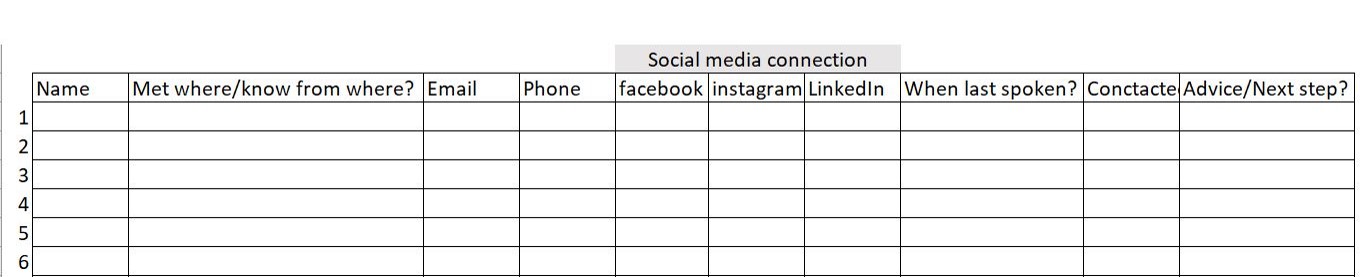
Using the attached workbook below, start filling in the names on a sheet
Note contact details you might have or if you are connected with any of them through social media
Start with the people you know the best and explain what kind of opportunity you are looking for and listen to their advice or ideas of who they might know and would connect you with.
After the discussion, capture their suggestions in the worksheet in the “Advice/Next step?” column.
Follow-up on these, contact the person they suggested or introduced you to and ask for a meeting to discuss your interest in the company, work they do, etc.
Each of the tabs in this worksheet (see file above) contains a table for you to capture the names of people you thought of while looking at the groups of people you are connected to. Complete the table for each of the groups you have considered as far as you can. (see example below for someone who identified 3 friends, but has not yet contacted them).
Follow-up
To keep your momentum, monitor your follow-up actions which could range from contacting a suggested person or calling someone another time as agreed during the previous conversation you had with him or her. Set targets for yourself per day and per week to avoid procrastination or letting a contact “go cold”. This could happen if you call too long after the initial call and the person you are contacting may have forgotten that your mutual contact had introduced you to each other.!
Tips:
Networks of contacts and human connections can be a fragile environment and it is important that though your need for them to act on your behalf is high, you need to also maintain a good relationship throughout and continue to be someone whom they would like to help. Very few people HAVE to help you, they will because they want to. Your attitude and way of talking to them will determine how much they will be willing to help you.
Be firm and confident, but not pushy. Sometimes there is a very thin line between those two. And the difference is often the strength of the history of your relationship with that person. If you know him or her for a long time and you have spent a lot of time together, you may be able to be a little pushier to get him or her to introduce you to someone else. When you have had only one or two conversations with someone at a conference, you would not likely have a strong enough relationship to be overly familiar or strong in your approach.
Always be thankful. Even if you have known someone for a long time, if they introduce you to someone or give you a handy tip that leads to a conversation, do let them know how thankful you are for their help.. Also thank people for taking the time to talk to you regardless of the outcome.
Only contact people from a conference or a class you took in the past if you actually spoke to them. It would be quite unusual to simply use a conference or class attendance list and email or contact each person on it regardless of whether you actually spoke to them at the time. Most people might disregard requests for calls or discussions in such cases.
Do not expect your contacts to call you back when they have more information for you. Ask if it would be alright for you to call back within a week or two.
When you had a great conversation with someone, why not add him or her to your list of future contacts? You never know when you may be able to introduce them to a new client or opportunity that fits into their business model!
Before Covid most companies with international interests had several people flying and traveling to other offices and locations to attend meetings, lead initiatives, or train others. While most of us have pretty much remained “grounded” in our countries without the option to travel, company activities continued (as far as it was possible). Something seems more obvious now than perhaps in 2019: We are getting pretty good at training, meeting and mentoring remotely using technology and internet connections. Yet, when we can, will we continue previous practices of sending our leaders and experts to remote locations on a regular basis like we did before? It is said that Ireland lowered carbon emissions by at least 6% during 2020 and some companies have seen business travel costs more than halved over 2020!
Some challenges that companies try to address by flying in leaders and experts from HQ:
We do not have people in all locations with the right experience and skills and HQ experts are needed to support local teams on a regular basis.
We are not exactly sure what the true status of projects are and we would feel more comfortable having one of our trusted staff regularly visit remote locations.
We are not sure that local people understand our strategies and truly commit to realizing performance targets, which means someone needs to visit with them on a regular basis to ensure they do understand our strategies and then review with them how their efforts support these.
We are finding it tough to source local people with the right skills and experiences and those we can find are too expensive in terms of compensation expectations.
The local people speak a different language and their English language skills are not great, which makes it hard to know for sure what they are trying to convey during our calls. We need to see the project/work to understand more clearly what is really happening there.
The local people may not be forthcoming with bad news relating to projects in remote locations and they may possibly favor being cordial over risking our dismay.
The list is not exhaustive, but it does highlight some of the opportunities to find better ways going forward to avoid going back to the level of business travel we previously considered normal.
The term Glocal means to Think Global and Act Local and it is said that Akio Morita of Sony Corporation was the first person to use the term which became popular in the business world in the 1990s. How to think about the big picture and over-arching strategies goals and still be sensitive to local conditions and needs when you implement those big picture ideas? A balance would have to be created and it would be an ever-adjusting type of balance which is not fixed in place. To incorporate (for example) shifts in local legislation or new diversification strategies from HQ. Finding a way to keep this balance in place may lower the need to return to pre-covid business travel levels.
There are at least three ways to address this:
Focus leadership development in a few key areas,
Better teams – adjusting selection and development of staff, and
Better use of technology – making more use of technologies to facilitate remote collaboration.
Better leadership
Having the judgment, problem-solving and decision-making skills to navigate in the space where one has to constantly balance global strategies and goals with local situations and conditions means leaders have to be comfortable with ambiguity, be constantly on the look-out and actively engaged in learning new skills and understanding how others have succeeded or failed in addressing what lies before the leader. Learning how to proactively include all team members including those who are “different” and to do this successfully leaders at HQ and remote locations need to understand their own biases and stereotyping. This will ensure that the skills of the entire team is leveraged in achieving performance goals. Lastly, leaders also need to have the ability to easily shift their perspective from global thinking to local acting and back in order to maintain the balance needed for the decision they need to make at that moment.
Better teams
Working on a diverse team with some team members in remote locations is something we have learned to do successfully over the last year. And this new skill has brought opportunities to get better results through teamwork without having to be present in an office or with the entire team. Will we ask – does this person have to be in the office every day of the week? Or will we consider hiring talent where we find it without feeling he or she needs to be relocated to HQ in order to be an effective member of our team?
To help existing teams be more inclusive and effective some specific or additional training may be needed around diversity. This training can include developing an improved understanding of cultural differences and perspective differences (for example among provinces or states in a country). It often comes down to increasing awareness of own biases and stereotypes that may have settled in our perspectives about groups of people who are very different from our own backgrounds.
Recruiters and hiring managers also have to start including additional skills in requisitions to fill vacancies. Skills like additional language skills – not only English – experience such as having lived and/or worked in a country other than their home countries.
When creating teams to work on performance improvement projects (action teams) – why not include people from different functions, locations and cultures on the team? It is a great way to increase your internal network of employees collaborating and communicating across locations.
All of these aspects can help a team become more global-minded and inclusive while making smarter choices working on local projects which impact broader strategies or targets in the company.
Use technology
In addition to tools for video-conferencing, there are tools which can help monitor progress or quality without having to travel to a location.
1. Hololens2: click this link to see short video of what it can do across various industries – there are ways for clients and HQ personnel to connect with someone using this technology at a remote location.
2. Realwear: click this link to see a short video of how it can be used to get input and advice from a person located remotely.
3. Some locations use drones to get an understanding of general progress on large construction projects and provide overall updates to managers at HQ. Drones can also be used to inspect hard-to-reach places safely.
4. Use a centralized electronic storage solution for files meaning all local files can easily be viewed from remote locations without needing to travel to a site.
While working smarter in these ways is also a way to lower pre-covid GHG and carbon emissions, many employees appreciate the flexibility of remote working options and combined with lower business travel needs it adds to having a better work-life balance. The amount of quality time spent with families and friends has also increased for most. All of which adds greatly to employee well-being. Looking for ways to leverage what we have learned by having to work remotely during 2020 can benefit companies and employees in greater ways than we may be able to realize now.
















 The Rethink Shelf