One of the key reasons that companies lose new hires with some experience is that they fail to support these new hires adequately during their first few months. In some companies, it can be quite hard to understand how things work there, how to fit in and be successful, feel valued and included. Having a written onboarding plan from the start is a great way to bring more clarity to the person and also help them understand expectations during the crucial early months in their new roles in the new company.
The onboarding plan can be written as early as during the recruitment process. In one best-case scenario, it was shared with a senior executive right after his interview with the CEO. It was such an unexpected and appreciated action that the executive commented how refreshing he found the transparency and it made him see the hiring company as head-and-shoulders above the competition which led to him accepting the offer and joining the company a few months later.
The Process
While the plan can help clarify the set-up and structure for a new hire, it is important to set up review meetings with the newly hired managers or key hires. In some cases, reviews with an HRBP could be useful to understand for example how performance management is organized and how the process works. Such review moments could also clarify talent development programs and processes, which is useful to know for the new hire regarding his/her own career but also for helping the new hire manage the development actions for those who report to him/her.
Review meetings with the manager that the new hire reports to could help identify priorities and understand where to connect with more people or build additional internal or external relationships. The manager can also answer questions about activities planned to ensure desired outcomes are achieved after 30-days, 60-days, and 90-days as captured in the onboarding plan.
The people side of success
The template captures not only the tasks and activities needed to succeed in a new role but also identifies people with whom to build relationships. These are important relationships and contacts that the new hire would need to establish and maintain to ensure his/her success in the long run. They could be key client contact personnel or contacts from key suppliers or subcontractors. They could also be internal – people who know how things work and who can advise on the best course of action to get something done at that company.
And it is also important to identify people who can be trusted to keep things to themselves and who could advise on who to talk to before moving in specific directions for changes the new hire would like to implement. Either the HR Director/HRBP or the new hire’s manager may be helpful to identify who those contacts may be.
Note that confidants or advisors may also be external people such as professional coaches or consultants.
Accountability
While it is important from a company’s perspective to ensure key new hires are provided with onboarding plans, completing the details and setting priorities to accomplish the outcomes defined in the plan lie with the new hire. The success of the new hire is only partially dependent on helping him/her get up to speed faster by having review meetings and an onboarding plan and giving him or her access to professional helpers and advisors. The new hire remains accountable for his or her own performance and following through on the items recorded in the onboarding plan.
When both the process of onboarding works well and the new hire holds himself/herself accountable for the outcomes produced, the risks of failure due to onboarding gaps are lowered and retention success is more likely in the medium to long term!
Useful posts for new employee/ new manager onboarding and orientations :
Working on multicultural teams you may have had moments of wondering what he or she just meant by that comment? Or why will he or she not make a key decision so an activity can move forward? Cultural perspectives and ways of life may be one of the reasons that could explain those incidents.
It is fun to meet people from other cultures and learn about their lives and experiences. And at first it may be interesting to learn how their cultures vary from your own, but once you work on a project together and it is remote working, including long hours and tight deadlines those differences can start to cause friction on the team. This can slow down progress and impact team morale. Being aware of the most common inter-cultural disconnects can prevent team members from blaming it on a person and instead enter into a discussion to unpack the root cause of a lack of action, lack of decision-making or the exact opposite – too many fast actions without thinking or making decisions without considering consequences.
4 Areas of misunderstanding that can impact inter-cultural teams
Some things are smart to do in order to ensure the team understands required project outcomes and approaches to use. Aspects would include clarifying the definition of done, outlining project phases and deadlines, assigning roles and responsibilities and having regular meetings to monitor and understand progress and resolve issues that are hindering progress or pose a risk.
Some aspects may need additional attention if your team consists of a few members from very different cultures.
1. Managing to deadlines
This relates to how important team members believe deadlines are. Some may see them as a guideline while others will suffer anxiety and will work longer hours to make sure the are met. In some cultures, there is a strong emphasis on being for example exactly on time for an appointment while in other cultures it may be okay to be a few minutes late for business meetings and perhaps even a few hours late for a social engagement.
Cross-cultural impact:
Make sure all team members understand the consequences, knock-on effects and penalties which may be triggered if the team missed deadlines. Monitor progress and have follow-up conversations if team members are falling behind to ensure they understand the importance of their activities being completed on-time.
Ensure team members understand the priorities they should place on various aspects of the work that needs to be done by the deadline. Ensure it is also clear exactly what “done” means. Do you expect quality checks to be done too or just a first draft of the outcome to be available? Should it be print-ready or just ready for an internal review or further discussions?
2. Clear Role Expectations
There are differences in cultures around the meaning of “in charge” or the Subject Matter Expert (SME). In some cultures, it is customary to take the word of such a person as a mandate to perform a specific task or action exactly according to what he/she said. In other cultures, SMEs and leaders are considered more “accessible”, and dialogue is welcomed when one does not agree with a requirement or task assigned by the one “in charge.” This difference can cause confusion on teams including many different cultures. To what degree can and should instructions be discussed and challenged vs accepted? Are those in expert roles or roles with authority prepared to deal with challenging discussions and comments – if the project team will operate in a culture of open discussions?
Cross-cultural impact:
Have a role discussion at the start of the project and include what would be great questions to ask each role and how interaction is expected to take place on the project to maximize positive team outcomes.
Be sure to have further discussions highlighting best-practices during the project and as new team members join, who may have missed the original discussions around the different project roles and how to best interact with them.
3. Conflict resolution
Conflict shows up differently in each person – some people speak up and go to the “max ” to be heard and understood while others take their thoughts, feelings and especially resentment underground and do not speak out. This means that conflict can be hard to resolve and to feel comfortable that all thoughts and concerns are on the table and discussed before decisions are made. Some cultures are more likely to speak up and make sure their opinions are voiced while others might patiently and politely wait to be asked for an opinion and speaking out of turn (from their perspective) may be seen as impolite or disrespectful. In some cultures open disagreements are best avoided to maintain a cordial/good relationship with others on the project.
Cross-cultural impact:
Use more than one channel to check in with team members and get feedback – ask in meetings, but also check in with individual team members between meetings to understand if there is any part of the path forward chosen which concerns them.
If any team members are especially aggressive in voicing opinions, perhaps a quiet word might help that person to still voice opinions, but possibly in a less forceful way to avoid antagonizing anyone from a culture where a forceful (overly enthusiastic ) communication style might cause discomfort.
Provide training in non-violent communication and voicing messages with a healthy balance between listening and advocating. Help team members to constantly improve in understanding each other’s styles to help communication and collaboration efforts on the project.
When a conflict does occur, address it in a culturally-sensitive way if the disconnect could be related to a cultural difference in perspective. The objective should be to solve and address project issues in a helpful way without causing negative impacts to collaboration on the project.
4. Navigating with many languages
We all know of situations where people from the same country with the same language find it hard to communicate successfully with understanding and openness. When a team consists of many different cultures, this can be so much more confusing and frustrating.
Cross-cultural impact:
Agree from the start of the project to follow a few guidelines such as: For the chosen project language, native speakers are to slow down and use simple ways to bring their points across. And native speakers of the main project language will be patient with non-native speakers trying to get their thoughts across. If there is a large language ability gap between the native-speakers and other team members consider some language classes to bridge the gap.
Consider asking presenters/speakers at planned meetings to send out specific agenda items and a summary paragraph of the issues to be raised and discussed at least a day before the meeting. That would help non-native speakers to prepare ensuring they understand the issues and are able to fully participate in the conversation at the meeting.
When there are significant differences in levels of language abilities on the team, meetings may take longer, and collaboration may also be a little harder especially in a virtual/remote environment. Be sure to take this into account when planning project timelines and deadlines.
Plan ahead to succeed
Knowing you may be starting up a project with a multi-cultural team, schedule team-building activities for team members early on. This will help them get to know each other as humans/people. Establishing trust early on, can avoid frustration turning into conflict and delays in reaching project team deadlines.
Create team opportunities to get to know more about each other’s cultures. This could bridge the gap in understanding each other’s perspectives and avoid labeling, misunderstandings, and internal team misalignments..
Set continuous learning as one of the core values of the team and live it, encourage it and keep bringing the team back to what can be learned from successes and failure as the project progresses. Having a curious and learning mindset is a great way to avoid major disconnects between team members as they will engage in inquiry and advocacy vs judgment and labelling as a default behavior.
Knowing what kind of opportunity you would like to pursue next, you can wait for the perfect role to show up online or… you could actively work through your network to get further!
Think about this:
The high level of competition for the role if you apply for a role online! Your experience and education and the design of your CV/Resume would have to be better than all other applicants to get through to the end of the recruitment process!
They estimate that 70% of roles are not advertised, but instead are sourced through networks! This means you could be invited for a discussion or interview just based on the fact that someone recommended you or introduced you to a decision-maker!
Every person you know from past roles, from school or college days, people you met and talked to at conferences, family, friends – could possibly know someone who is connected to a role that would be great for you!
Getting more contacts and making a positive impression on those you meet is important. It is not about pretending or lying, it is more about showing respect and genuine interest in those you meet. When people like the encounters they have with you, they want good things to happen for you and they might be keen to ask people they know to meet you or have a discussion with you. And this is all you need in many cases to get to the next step – a consulting project or a new job!
What does your network look like?
If you take a blank sheet of paper and you try to draw out this graphic below, perhaps you will be able to jot down people’s names for each of the circles and be able to create your starter list. This means the list of people whom you will start with – making contact with them.
The groups of people you know the best are most likely:
Friends, Family members, Classmates (now or from years before), ex-colleagues or trusted current colleagues, neighbors (now or from an earlier address where you lived at one point).
The next level of people you may want to contact include:
People you have met or interacted with on a sports team, or a social organization you joined, or a hobby class you took at some point, people you met and spoke to at a conference.
Priorities:
Looking through the names of people you listed in the worksheet (download available below), who might know people at the companies you are hoping to work for? Who knows about the kind of work you are good at and want to do? Who has the knowledge or experience to help you in your search? Who am I most comfortable talking to? (start there!)
How can your network help you?
What do you tell them ?
When you talk to someone who already knows you, you do not need to introduce yourself. When talking to a contact of someone you know, introduce yourself.
Make sure your message is complete: why are you talking to him/her? What exactly do you hope to get out of the conversation?
Be specific about what you are looking for – i.e. role in sales, working on electric installation projects, etc.
What are your training, certifications, experience, and skills to explain how you plan to successfully deliver in the role mentioned above? (the short version – only mention the most important ones!)
Have your questions ready and be ready to rephrase any questions that are not easily understood by the person you are talking to.
Give the other person time to think about their answers by being quiet after you asked.
Show genuine interest in their advice or suggestions.
Questions to ask
The questions below can be used as a guide as you create your own list of questions to ask your contacts. Do consider how strong your history and relationship is with each person you talk to before you ask any of the questions. Rephrase any questions to allow for cultural differences and preferences and also to match the formality required for your conversation.
Depending on the role of the person or his or her expertise/experience, you may choose different questions for each conversation. Note the specific questions you want to ask each person before you contact him/her. Limit yourself to a reasonable number of questions – something you can fit into a 30-minute call would be best when you talk to someone whom you have not met yet and who is giving you some of his/her precious time for this conversation.
Are you aware of any job vacancies which would fit my skills/experience?
Would you help me by looking out for opportunities you might become aware of and which might be useful to me?
Do you know anyone who might be planning to change jobs where I might be a possible role replacement candidate?
Do you know any companies where my skills and experience may be sought-after?
Are you aware of any new companies moving into the area and/or whom I might be able to contact about a role there?
Would you be willing to help me get an appointment for a discussion with a recruiter at your company?
May I ask for your help in preparing for an interview (given your contacts/knowledge etc)?
Would you be able to help me with more information about a company I would like to target for an unsolicited application?
How would you advise me to proceed with my interest in THIS role or getting a role at Company X?
Would you be willing to be a reference for me?
Would you be willing to review my resume/CV and give me any tips or improvement suggestions?
How do you plan your approach?
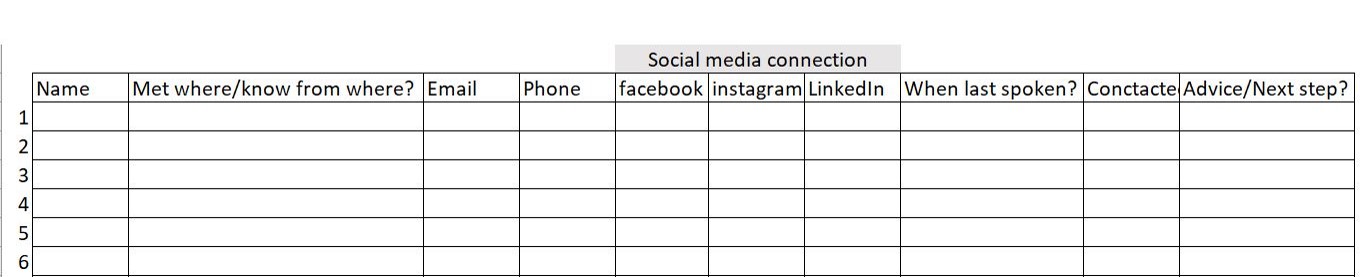
Using the attached workbook below, start filling in the names on a sheet
Note contact details you might have or if you are connected with any of them through social media
Start with the people you know the best and explain what kind of opportunity you are looking for and listen to their advice or ideas of who they might know and would connect you with.
After the discussion, capture their suggestions in the worksheet in the “Advice/Next step?” column.
Follow-up on these, contact the person they suggested or introduced you to and ask for a meeting to discuss your interest in the company, work they do, etc.
Each of the tabs in this worksheet (see file above) contains a table for you to capture the names of people you thought of while looking at the groups of people you are connected to. Complete the table for each of the groups you have considered as far as you can. (see example below for someone who identified 3 friends, but has not yet contacted them).
Follow-up
To keep your momentum, monitor your follow-up actions which could range from contacting a suggested person or calling someone another time as agreed during the previous conversation you had with him or her. Set targets for yourself per day and per week to avoid procrastination or letting a contact “go cold”. This could happen if you call too long after the initial call and the person you are contacting may have forgotten that your mutual contact had introduced you to each other.!
Tips:
Networks of contacts and human connections can be a fragile environment and it is important that though your need for them to act on your behalf is high, you need to also maintain a good relationship throughout and continue to be someone whom they would like to help. Very few people HAVE to help you, they will because they want to. Your attitude and way of talking to them will determine how much they will be willing to help you.
Be firm and confident, but not pushy. Sometimes there is a very thin line between those two. And the difference is often the strength of the history of your relationship with that person. If you know him or her for a long time and you have spent a lot of time together, you may be able to be a little pushier to get him or her to introduce you to someone else. When you have had only one or two conversations with someone at a conference, you would not likely have a strong enough relationship to be overly familiar or strong in your approach.
Always be thankful. Even if you have known someone for a long time, if they introduce you to someone or give you a handy tip that leads to a conversation, do let them know how thankful you are for their help.. Also thank people for taking the time to talk to you regardless of the outcome.
Only contact people from a conference or a class you took in the past if you actually spoke to them. It would be quite unusual to simply use a conference or class attendance list and email or contact each person on it regardless of whether you actually spoke to them at the time. Most people might disregard requests for calls or discussions in such cases.
Do not expect your contacts to call you back when they have more information for you. Ask if it would be alright for you to call back within a week or two.
When you had a great conversation with someone, why not add him or her to your list of future contacts? You never know when you may be able to introduce them to a new client or opportunity that fits into their business model!
Have your review meetings for a process or a policy document turned into a low-value event where tons of slides are being shown and no real discussion takes place? Do you feel confident about the outcomes from your review meetings? What if you had a way to make the review meetings more structured and action-oriented, making sure everyone is engaged?
This activity will help you do that!
When your review meetings succeed they…
Result in improvements and updates that ensure your plan/policy is fit-for-purpose and comply with most recent business and legal requirements,
Make sure your plan/policy, in addition to fully complying with most recent legal and government requirements, also align with your company’s strategies,
Engage all stakeholders making sure every one of them has an opportunity to suggest ways to improve the policy/plan to better meet business needs and concerns, and
Enable you to get through internal and external audits with confidence.
The process
Divide your meeting participants into two groups and give each group a preparation assignment – Team Blue and Team Red. They are to arrive at the meeting, prepared to either defend or criticize the existing plan or policy and underpin their points with solid arguments based on research (doing homework before the meeting).
The blue team has the assignment to identify fact-based reasons why the existing plan or policy is fit-for-purpose, compliant, and good enough as it is today. While the red team has the assignment to research and come prepared to point out specific areas or aspects where the current plan or policy fails to address specific issues or factors.
Preparation
Each of the teams prepare before attending the meeting. The blue team will prepare in this way:
And preparation by the red time includes:
Members from each team bring their notes to the review meeting – prepared to substantiate their claims based on their pre-meeting homework assignments.
Meeting Agenda
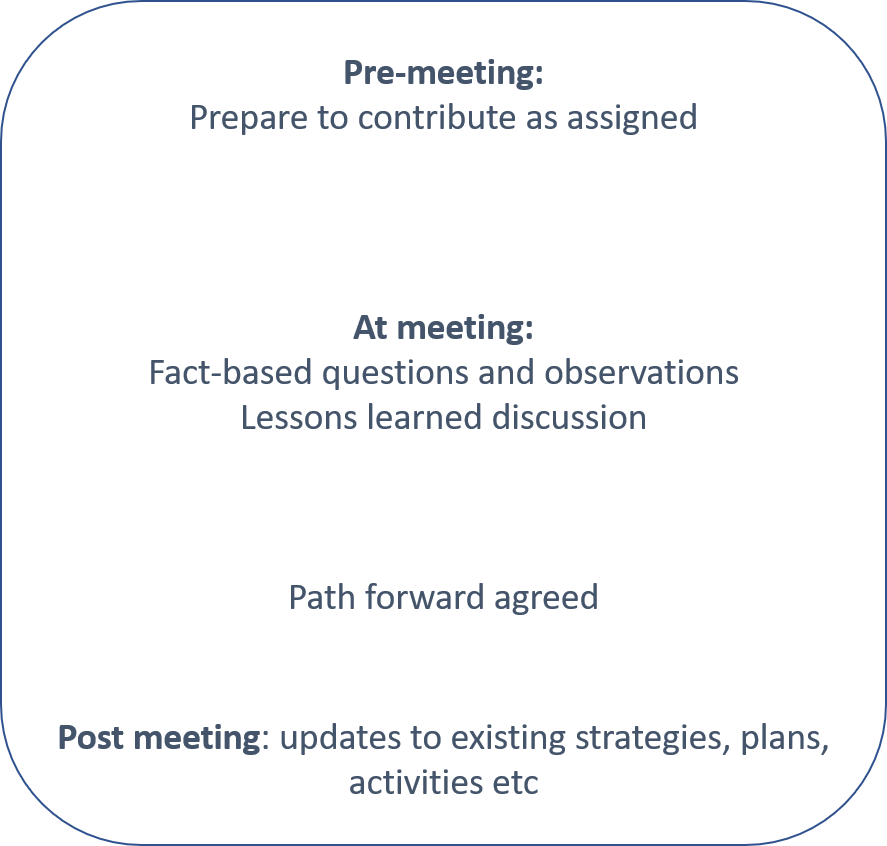
After the meeting has been opened, objectives shared and the process discussed, the review process follows these steps:
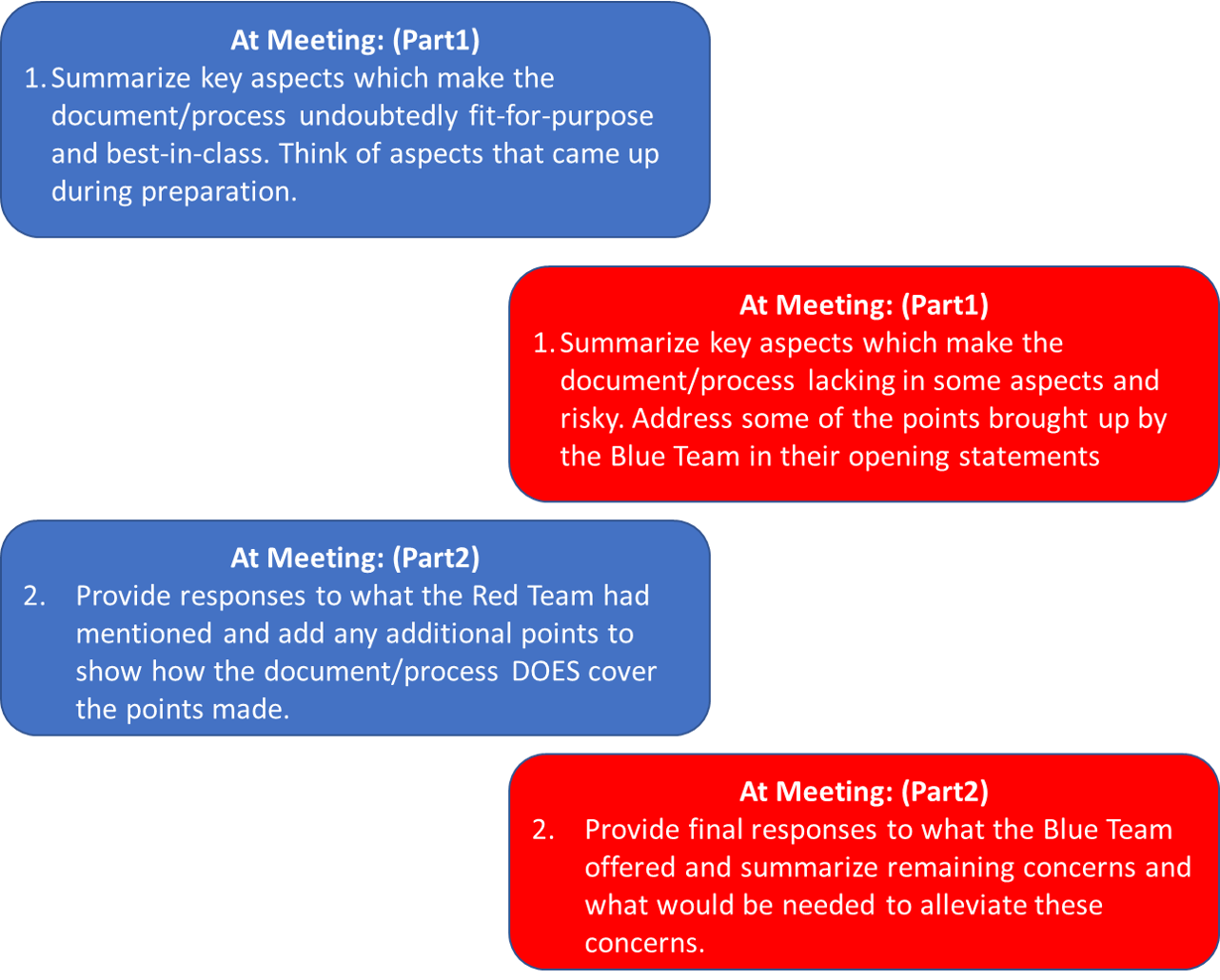
The Blue team summarizes the high-level benefits and explains how the current version of the document/policy is fit-for-purpose vs over-the-top in terms of mitigating, avoiding or managing risks associated with why the document/policy was originally created. (10 mins)
The Red team then gets 10 minutes to summarize risks or changes to laws, which means that the current policy or document is not currently fit-for-purpose. They may comment on some aspects raised by the Blue Team too.
The Blue team gets 10 – 15 mins to make their final statements: responding to anything specific that was mentioned by the Red team and also adding to any additional points related to key items they had mentioned during their opening summary. They would make specific mention of aspects that are strongly beneficial and need to remain in the policy/document.
The Red team then makes their final statements in 10 – 15 mins. They would especially summarize key gaps between the current policy/document and aspects that would need to be addressed in the next version.
Path forward
The final part of the meeting consists of all meeting participants discussing and summarizing improvements that would be needed to the next version of the policy/document. In the process, they may assign various meeting participants to do additional research, align with stakeholders not present at the meeting, and/or write the updates or additional segments to add to the current policy/document.
An additional meeting may be needed to check-in on progress and finalize the updates that have been agreed upon.
Tips:
Do not run this with groups larger than 15 people. It would lead to a longer meeting and some people feeling less involved and engaged.
Be sure to state that the meeting is to take no more than 1 hour. If the process is followed for too long a period, it waters down the intent – focus – and gets more into minute details which are often best dealt with in post-meeting assignments.
Be sure to assign someone to be the time-keeper to keep an eye on the process – ensuring the meeting stays focused on the agreed approach and time-commitment. And be sure to note the path forward actions to help the designated coordinator with follow-up actions and close-out activities.
In general, this interactive approach to review meetings leaves participants much more energized and positive about meeting outcomes.
Employees and Company Boards want the same thing – they want clarity around what you expect from employees, want feedback on how it is going from an outcomes perspective and want to know the steps you will take to fix it, in case outcomes are less than expected.
Most companies use a Balanced Scorecard approach whereby specific performance metrics in key performance or result areas from company strategies are used to set and monitor performance expectations into the company from the most senior roles to the most junior roles.
The benefits of this approach are numerous… for one you can get a good understanding of how well things are going with implementing your strategies in the company, you can make sure that all the initiatives being worked on relate to the strategy, identify organizational units or individual where things are going well or not so well – which mean you can provide support in the form of training for example. A balanced scorecard also helps to ensure you have organizational alignment where it is clear to every employee how he/she impacts the overall results of the company. And when an employee sees his or her own goals, it is easy for him/her to understand what exactly the company strategy and desired outcomes are about in a practical way.
Strategic Performance Areas
Having a cheat-sheet to get started may be useful…Performance Indicators can be set in many different areas. This list shows a few examples which may be handy as you read your own strategy and select the top performance areas that need to be impacted in your upcoming performance period.
In most cases 5 key performance areas would be chosen to balance current operations, growth goals, keeping current stakeholders satisfied and continuing to improve and innovate. e.g: 1) Financial outcome(s), 2) Quality outcome(s), 3) Customer satisfaction outcome(s), 4) Improving upon performance and efficiencies of previous years, and 5) Employee (leaders/specialists?) development and or retention outcomes.
Example
Let’s look at some specific KPIs and how they may translate into performance expectations into the organization. From high organizational levels deeper into the organization the goals become more specific to an individuals’ tasks and activities. In contrast, the goals of managers are typically focused on their ability to influence and lead the outcomes of teams or groups reporting into him or her. Managers ensure that things happen while in most cases the deeper you go into the organization, the more you see performance goals are based on the individual’s efforts to achieve an outcome.
Performance goals typically come in various types of outcomes based on how your KPI would require the right response to meet the company strategy.
Setting Expectations
.
Cascading goals
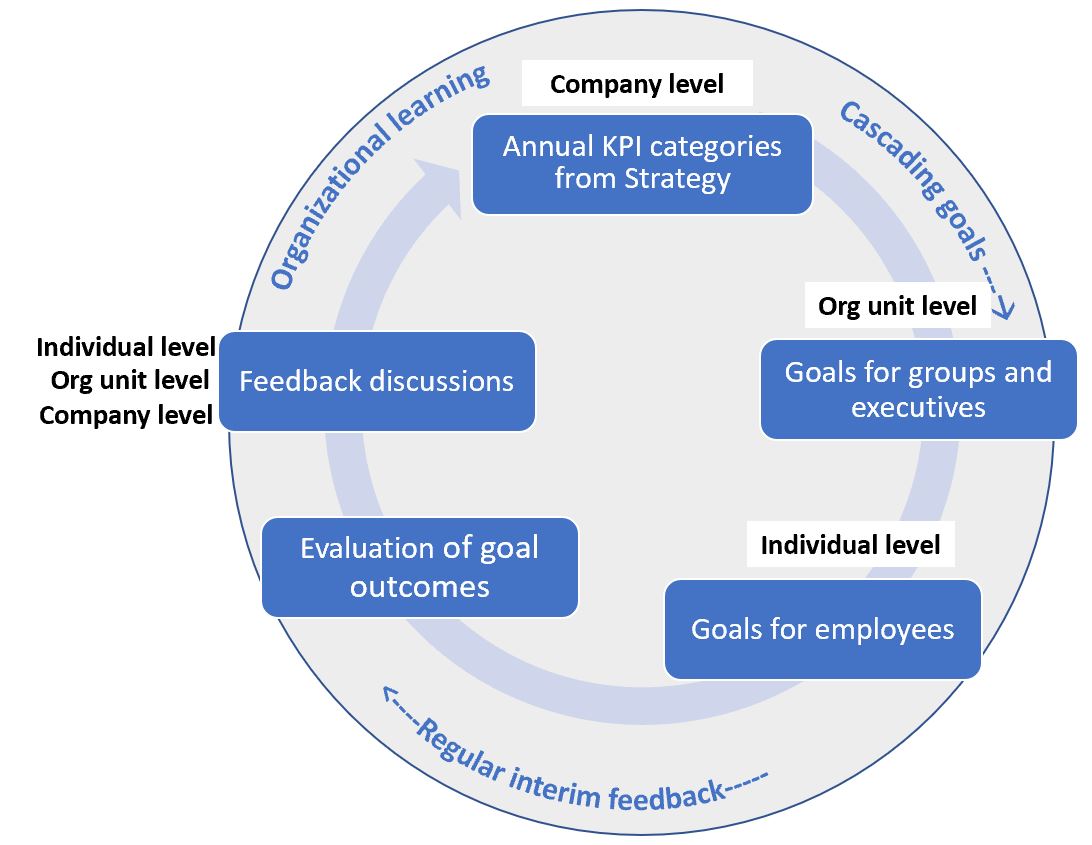
Starting with the company’s strategy (at the highest level) the CEO or executive team can easily identify the top 4 to 7 Performance Areas where focus is needed to drive outcomes needed in the coming year. From there the heads of functions or organizational units can identify what that means for each of their organizations. Then performance goals for each organizational unit manager can be determined . And the same process cascades down until performance goals have been set for everyone at the company. All of the goals finally relate to a big-picture framework of KPIs at the top level of the organization.
Most performance expectations are set as SMART goals and each employee would typically end up with between 3 and 7 (max) performance goals for the year.
The graphic below shows how at individual level the goal may be a specific part of the overall KPI but when it is all “rolled-up” organizationally the full organizational KPI can be achieved in full by all employees contributing to the desired outcome. Not every organization group or unit might support every high-level KPI. Think for example of an organizational unit responsible for the upkeep of facilities, there may not be direct goals that relate to revenue growth for that group.
Note Goal E: It does not relegate to a KPI at the broader organizational level. This happens often – for example that a functional organization has a specific focus which may not directly relate to the KPIs that were set on a company-wide basis. That could be something like finalize implementation of a digital tool which enables better efficiency the following year. If there are no high-level KPIs related to improving on existing performance/efficiency, Goal E would not have a direct link to the overall high-level KPIs set. For this reason, it is important to set the high-level KPIs in a broad and balanced way to ensure that most goals that would be important at a level deeper into the organization to maintain or improve a specific level of efficiency or service delivery can be matched with the high-level need for renewal or continuous improvement. Some companies do not think broader than revenue or growth goals.
Interim feedback
It is important for managers to monitor outcomes along the way – do not wait until the end of the year to discover that outcomes were not trending in the right direction. Spotting issues or delays early means you can rectify or influence rectification of the situation. Give employees feedback throughout the year – make them aware of outcomes that deviate from desired outcomes, train and coach them to improve outcomes that they are responsible for and give them on-the-job coaching and support when they are inexperienced in specific areas. Every outcome matters and contributes to the overall outcome.
Learning
Evaluating outcomes and discussing those with employees is the next step. This step also includes looking at relative performance outcomes among various organizational units and overall outcomes. This can lead to an improved understanding of where further improvements may be needed. Improvements can range from awareness training, making more information available, helping to upskill or cross-skill employees in various areas. It may also lead to understand misalignment with what suppliers can or are delivering or misalignment between customer expectations and what operations is able to deliver right now.
Use what you learn from discussing performance outcomes to influence future performance outcomes and support that might be needed for the next year.
In the final outcome of the performance period you will have individual scores that relate to individual performance. When you look one level higher you see the contributions of various employees in the same organizational unit and how each of them did on their own performance goals. If the goals were created to be an exact match – between goals set for the manager and those set for those reporting to the manager – the aggregate outcome of the team would determine the manager’s score.
Looking at the organization, it is easy to pinpoint where contributions by individuals, teams, managers may not have reached expected results in the outcomes. Understanding why this occurred would help learning from the past and improving going forward. Answering questions like:
Knowing what we know now, were these realistic expectations or do we need to first solve some key issues before we can make more progress in this area?
Do people need more training to make sure they are able to perform in new areas or with new outcomes (such as new markets or types of customers)?
Is this area so specialized that we need to hire some people with the specialized knowledge or experience that this team needs?
Most companies are on a learning path when it comes to their own performance management process and approach. If you are just starting, do expect it to be a journey and make sure you allow space for reviewing, reflecting and learning as you go. It may lead you to make adjustments to your strategy or the way the organization is structured, to name but a few ways that on-going organizational learning can benefit the greater organization.
Ultimately the goal of your performance management approach is to measure how much the efforts of those in the organization are helping you achieve your goals as a company, where are hidden barriers to succeeding with your organizational strategies and where are opportunities to accelerate results if you leverage great ideas and tools developed in any part of the organization. This makes your company sustainable into the future. Viable today and into the future by continuously evolving, learning and innovating without losing focus of the basic outcomes needed to drive profitability on an on-going basis.
Ever left a job interview frustrated? Because the interviewer seemed unprepared and asked seemingly random questions making it hard to discuss your achievements, interest in the role and how you planned to contribute to the success of the company. Or maybe you have been the recruiter who could not get ratings or post-interview notes from a manager because they did not jot anything down and could not give you any feedback after an interview they had conducted?
Getting the most out of the time you have to interview a candidate takes a lot of planning, focus and clarity on what exactly you want to establish. And yes, it also takes time management. An hour can fly past so fast without a plan!
To make interviews work well, the recruiter needs to do 3 things diligently:
Prepare an interview guide for each interviewer and provide them with that and any additional items such as the CV/Resume of the candidate, completed application forms and any other documents which have been provided by the candidate before the interview. Also include relevant notes from a screening call.
Prepare all interviewers with interview training so they can use the interview guide correctly and understand how to phrase questions and follow-up questions. Include the use of behavioral questions in the training, which are powerful in establishing what a candidate had done in previous situations given key competencies required for the role. [Providing interviewers with training on natural biases, will improve fairness of interview outcomes]
Follow up after the interview to collect notes and scores from interviewers. It is your summary of results that helps those making decisions about next steps in the recruitment process.
The Interview Guide
Helpingtheinterviewersplantosucceed
It is tough for interviewers to follow someone else’s plan verbatim and such an interview can come across as forced or staged. The preparation gives the interviewer a chance to consider rewording questions and possibly add their own questions. They may also want to change the sequence of questions. All of this will lead to a better and more natural interview experience for the job candidate.
2. Startinginastructuredway
Setting expectations and clarity about the structure of the interview upfront is helpful for a candidate to understand the approach you plan to follow. Most candidates feel more relaxed understanding the structure that you will follow.
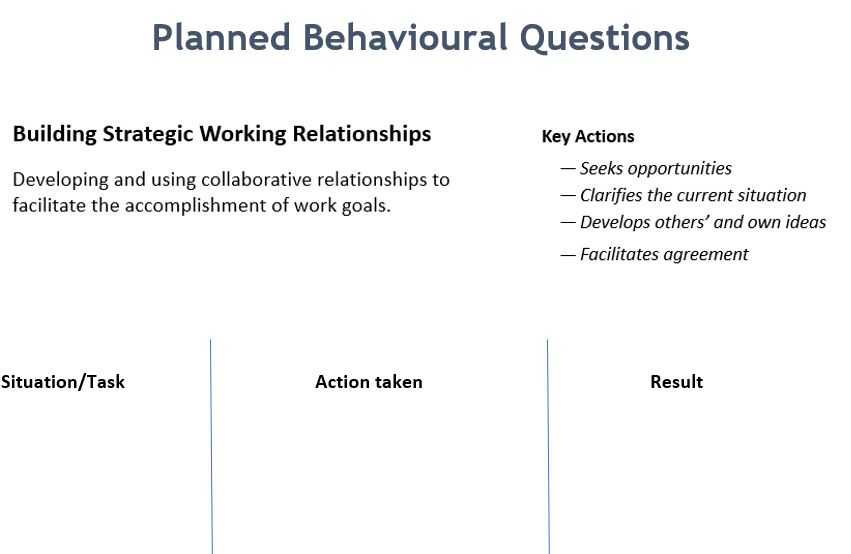
3. BehavioralQuestions – STARstyle
Note that it is not advised to ask more than 3 behavioral questions during a 60 minute interview. To explore answers and ask follow-up questions can take time and you do want to leave time to answer the candidate’s questions too. If doing a panel interview, divide the 3 behavioral questions among members of the interview panel.
4. Candidatequestionsandclosingtheinterview
Give the candidate an opportunity to ask questions to help him or her have a clear understanding of the role and how things work at your company. Then it is time to either ask any follow-up questions you may have left to the end (checking if you have enough time left to do so). One approach that is often used to give you time to check your notes is to ask the candidate a question and giving him or her some time to think about their answer (while you check your notes).
Remember to share the next steps with the candidate i.e. when the interview phase will end and decisions will be made for the next phase in the recruitment process. Or if you do not know, let the candidate know that the recruiter will be able to answer next step answers.
Next steps
Follow through with interviewers to ensure results and scores are collected in a timely fashion to support data-based decision-making regarding next steps.
Make sure you provide interviewers with a summary scoring sheet in the Interview Guide to select scores for answers obtained based on a pre-determined rating scale. This will avoid the need to go back and forth to interviewers while trying to understand their own way of scoring candidates.
Not everyone enjoys a highly structured interview and in some company cultures or for roles in creative functions, this may be seen as an unproductive way to test the creativity of candidates or showcase the unpredictable nature of the industry or the environment. Let common sense prevail to ensure you have an interview protocol that meets the need to fairly evaluate all job candidates in a consistent manner.
When your interview guides are online and so are your scoring sheets – this greatly improves your ability to quickly access post-interview notes and scores after interviews are completed.
Do not under-estimate the training needed for interviewers to understand the recruitment process or the importance of being able to demonstrate that a fair and consistent approach was used to evaluate candidates before selecting the final candidate.
Link to another post on this blog about using a Score Sheet for scoring job candidates after interviews
Link to a post on this blog about creating a Job Candidate Summary using all scores obtained after interviews
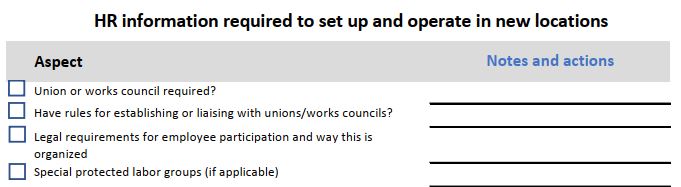
What if a valued customer wants you to do a project or support them from a new location where you do not currently have an office? Yes, research will be needed! But there are so many things that may be important, where would you start? This resource I am sharing is a handy starter-list for the research that HR is often expected to do.
The topics covered in the attached checklist include the following areas:
And in each case, the checklist contains the aspect to the left and leaves you some space to jot down notes pertaining to your company and your plans. (See example below) That way you can quickly create your next-step plans following your research.
Some points to ponder:
Trying to answer the question about how much to pay employees you plan to relocate to the new office – calculate their entire package before you start. Add in all benefits they are getting which may not be cash in their hands i.e. health insurance, pension contributions by the company etc. Considering the full package is the starting point, not the annual salary only.
Look for local tax breaks that may be available to those you plan to relocate. In some countries they may be able to pay lower personal taxes.
If the local language is neither English nor the language spoken at the office your planned expats work now – how can you help them learn the new language? Even if all business is conducted in one language, the planned expats would need to set up their lives locally including trips to the supermarket, making local friends, and finding local information online. Being able to understand some basic words or say some basic phrases in the local language could be very valuable as they get settled there.
How can you minimize the carbon footprint of that new location? Limiting flights in and out of that new office and only placing expats there when the work cannot be done remotely or using modern tools and platforms to accomplish business objectives and outcomes.
The shared resource above is a starter-list and may not include all the aspects you need to look at before mobilizing. It is a great tool for doing a high-level review of a location under consideration for a new office or site.
While you can find a lot of the information you need online, I strongly recommend engaging with recognized experts in establishing operations abroad. Laws change, new trends emerge which have not yet made it into laws and websites are not always updated in a timeous fashion. So do your own research (using the checklist above) to understand the “lay of the land”. If you want to go further, engage with experts who may be able to advise on additional aspects and possible solutions which you may have missed in your own first-pass research efforts.
Not shareholders – they are the ones who own shares in the company. Stakeholders are those groups of people who have a keen interest in the initiative or process that you are working on. It could be because your success or your failure will impact their groups or processes in their groups. It could also be because your initiative could generate risks which they would like to keep an eye on. For some reason, these people or groups care more than the average person or employee about the initiative that you are working on.
It is therefore smart to understand who they are and secondly to understand why they care so much about this initiative. And as a result of what you learn, you can plan to keep them happy and informed. If you don’t, you risk them blocking or stalling progress on your initiative, or (if in executive levels) they may put another person in place to supervise you to make sure their interests are well-managed and protected.
For your success as a project manager of an initiative – find out who the stakeholders are, find out what they need and make sure you meet their needs!
Find out who they are
Which groups have processes that overlap or connect to processes you are managing? Who are the receivers or end-users of what you are creating? Answers to these questions could help you start your list of stakeholders.
Tips:
Start outside your organizations – are there any authorities, special interest groups, communities, clients, suppliers who are somehow connected to the product or service that you are providing? They may be stakeholders!
Look at the high-level organization chart of your company. Do any of the groups you see contribute to, receive outcomes, or participate in key processes you are managing? If so, add them to your stakeholder list.
Look for individuals at management levels who may need to give others updates on your project or processes you manage. They may also be stakeholders.
What do they care about?
Once you have your list of stakeholders with their titles and even down to name level. It is time to validate their interest in your project or process.
What they need:
Why would they care about the outcomes of your process or the way you run the project? Do they need information for their role or group? Or do they use the outcomes from your project somehow?
What they want to avoid:
What outcomes or messages would each of the identified stakeholders want to avoid? Think of anything that would cause them to have to do extra work or have to explain unsatisfactory results.
Make a plan
Use the template below to document a plan that you follow throughout the year to ensure each of your stakeholder groups receive required data, updates or opportunities to provide input or suggestions to your project on a regular basis.
Check-in on a regular basis with your stakeholders whether it is a quarterly survey or a personal call from you. Make sure that you have not missed anything they need to know or be informed about and make sure that they are not dealing with rising frustration due to a lack of updates or output from your team!
Learning how to manage the expectations of stakeholders on an initiative is a great way to learn new skills which will become important as you get promoted to take on more responsibilities. People at higher levels in any organization succeed by keeping aligned with a lot of different personalities and groups and they do this by understanding the needs and concerns of these other parties and then managing that (in a similar way as managing stakeholder expectations) on an ongoing basis.
Need to provide a training workshop for managers on how to conduct job interviews? The slides I am sharing today can help you with that. You can turn it into an interactive online event or you can use it to create a face-to-face workshop. You could even turn it into a standalone training video if you provide your own voice-over to explain the various points further.
Remember, it is not a good idea to start with the slides and then just blindly using them for a workshop or other learning solutions without first considering the needs of your own intended training participants, interview process, etc.
After an initial explanation of what behavioral interviewing is and how it works, the slides focus on 5 steps that can help explain how to implement this approach as an interviewer.
Designing an Interview Training Workshop, use these steps as a guide:
Define the group of people who are the intended participants in your training workshop – what do they know, what do they need to know, (if they have done interviews already) what goes wrong, what goes right when they have done interviews in the past? What does all of that mean for what you need to accomplish with this workshop?
Define an overview of what you intend them to know and be able to do after the workshop. (You can only do so much during a workshop so be realistic on what the outcomes might be).
Define what will be included in further detail and exercises during the workshop (bullet points should help you further) in order to meet the goal(s) you have set in point 2 for the group you have defined in point 1.
Set a date when the workshop will be made available so you can remain focused on deadlines that help to meet that date.
Start working on the next level of detail – Consider that you may want to do a combination of training solutions like assigning some online training before they come to the workshop to cover some knowledge you want them all to have at the start of the workshop. Also, work out your bullet points into a “storyline” that logically structures the sequence of topics to be covered and exercises you will use to help build competency in using specific tools or approaches.
Use the slides I have attached for download (above). Using your answers to the points above – maybe you need ideas about how information can be sequenced? See if any of the sections in the slide deck help you fill in some of your planned learning areas. Maybe some of the exercises could be useful for your workshop?
A friend of mine always says (in Dutch) – you can better creatively borrow ideas from others than come up with something yourself, which is lesser. So use this slide deck, and borrow ideas from it to get your budding Interview Training Workshop to the next level!
Upgrading skills in specific employee groups could be achieved by introducing a new development program. Goals for the program could range from cross-training in key functional knowledge areas to accelerating development of specific groups. Development programs often run over several weeks or months and are attached to pre-defined outcomes to address specific identified learning needs.
Structuring your employee development plan, you will need to pay attention to at least 3 important aspects:
Setting up the curriculum
Preparing managers to be supportive
Preparing attendees to succeed
The overall program
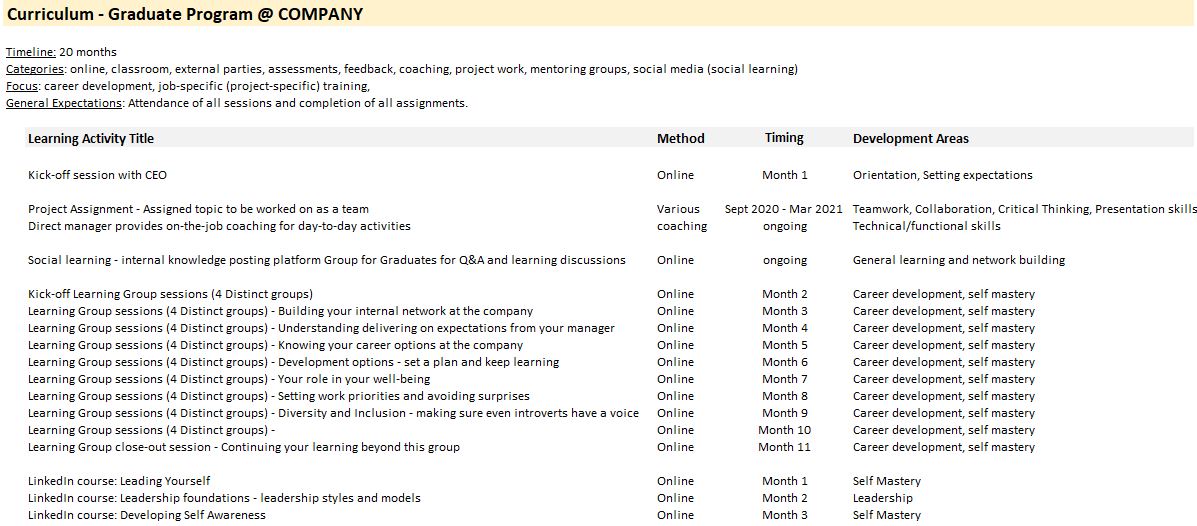
Setting up the curriculum over the development period means you decide how the various learning solutions are scheduled and planned to strengthen and support key messages throughout the time period that your program runs. Each aspect strengthens what had already been covered while adding additional knowledge. Including various learning methodologies (blended learning) enhances the learning experience and keeps it interesting.
Snapshot of a learning program for graduates
Note:
Always start by understanding what you are trying to address before you start designing your development program. What is the learning need? What is the business value of employees having this knowledge and experience?
When does the business need employees with these new skills, understanding and experiences? Is it short-term (within the next year), medium-term (between 1 and 2 years) or is it longer term (more than 2 years)? Knowing the timeframe also helps you decide what to develop internally vs outsourcing the entire program or parts of it.
Whoneedstolearn these new skills/behaviors? Be very clear who is your target population for this development program (How many years of experience do they have right now? What kind of experience do they already have – functional, geographic etc.).
Employees are more motivated and do better when their managers are onboard with their participation in the development program. Be sure to engage with managers before participants are told about the program. Managers need to understand the business context of the development program, why someone on his/her team is included in the program (if they were not nominated by the manager) and how to support the employee throughout the program. Some manages may need training or coaching in this regard.
Snapshot of a manager checklist
Employees participating in these kinds of development programs are often still working in their current roles. Supportive managers not only expect good results in their departments or projects, but also hold employees accountable for completing program assignments. This gives employees the best chance of completing the program successfully.
Development program attendees need to understand more than just the program contents and overview of dates. An orientation session for intended program attendees could help with that. The session gives them an opportunity to understand the business context and benefits to their own careers plus they can ask clarifying questions before committing to invest the time and effort needed to successfully complete the program.
Snapshot of Program Attendee checklist
And orientation session with development program attendees should include at least these topics:
A welcome message from an executive, usually the sponsoring executive, explaining the business value of the development program and also career benefits for attendees.
A message from Talent Development explaining program expectations, the blended learning approach, deadlines, the team assignment and any other relevant details of the program that attendees should know about at the start.
If the program existed before and there was a redesign or some changes were applied, explain how the current programs differs from previous versions some attendees may have heard about in the past.
Keeping learners motivated when a development program runs over many months can be a challenge. Helping to keep attendees focused on assignments and deadlines can be easier when you build in challenges which generate leader boards (friendly competition) or where individuals can earn points or badges by completing specific tasks. Adding recognition by the manager/group/department can also be helpful. Recognition can include anything from a small token offered to attendees after completing a specific portion of the program to being mentioned in the company newsletter.
Hopefully these three templates (see download links above) are useful as you review your own planned development program. Do download the 3 files above if you need to see the templates in detail.

























 The Rethink Shelf