

Employees and Company Boards want the same thing – they want clarity around what you expect from employees, want feedback on how it is going from an outcomes perspective and want to know the steps you will take to fix it, in case outcomes are less than expected.
Most companies use a Balanced Scorecard approach whereby specific performance metrics in key performance or result areas from company strategies are used to set and monitor performance expectations into the company from the most senior roles to the most junior roles.
The benefits of this approach are numerous… for one you can get a good understanding of how well things are going with implementing your strategies in the company, you can make sure that all the initiatives being worked on relate to the strategy, identify organizational units or individual where things are going well or not so well – which mean you can provide support in the form of training for example. A balanced scorecard also helps to ensure you have organizational alignment where it is clear to every employee how he/she impacts the overall results of the company. And when an employee sees his or her own goals, it is easy for him/her to understand what exactly the company strategy and desired outcomes are about in a practical way.
Strategic Performance Areas
Having a cheat-sheet to get started may be useful…Performance Indicators can be set in many different areas. This list shows a few examples which may be handy as you read your own strategy and select the top performance areas that need to be impacted in your upcoming performance period.
In most cases 5 key performance areas would be chosen to balance current operations, growth goals, keeping current stakeholders satisfied and continuing to improve and innovate. e.g: 1) Financial outcome(s), 2) Quality outcome(s), 3) Customer satisfaction outcome(s), 4) Improving upon performance and efficiencies of previous years, and 5) Employee (leaders/specialists?) development and or retention outcomes.

Example
Let’s look at some specific KPIs and how they may translate into performance expectations into the organization. From high organizational levels deeper into the organization the goals become more specific to an individuals’ tasks and activities. In contrast, the goals of managers are typically focused on their ability to influence and lead the outcomes of teams or groups reporting into him or her. Managers ensure that things happen while in most cases the deeper you go into the organization, the more you see performance goals are based on the individual’s efforts to achieve an outcome.

Performance goals typically come in various types of outcomes based on how your KPI would require the right response to meet the company strategy.

Setting Expectations
.
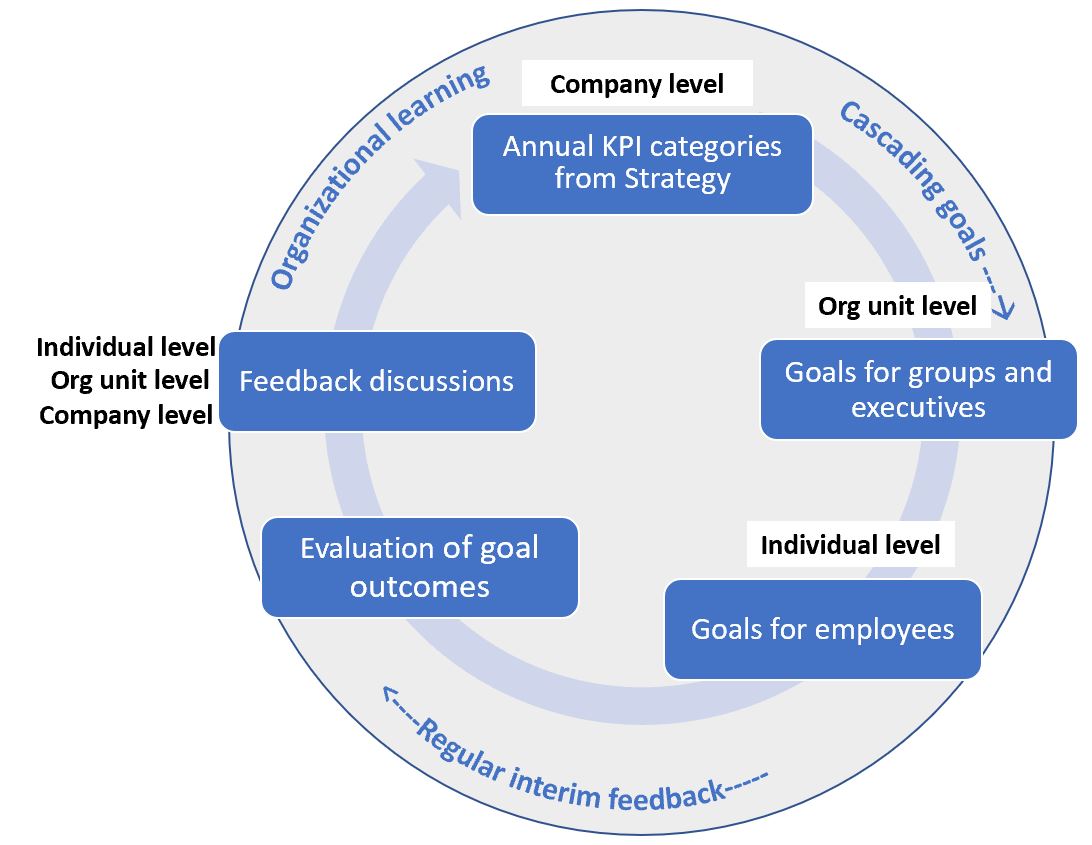
Cascading goals
Starting with the company’s strategy (at the highest level) the CEO or executive team can easily identify the top 4 to 7 Performance Areas where focus is needed to drive outcomes needed in the coming year. From there the heads of functions or organizational units can identify what that means for each of their organizations. Then performance goals for each organizational unit manager can be determined . And the same process cascades down until performance goals have been set for everyone at the company. All of the goals finally relate to a big-picture framework of KPIs at the top level of the organization.
Most performance expectations are set as SMART goals and each employee would typically end up with between 3 and 7 (max) performance goals for the year.
The graphic below shows how at individual level the goal may be a specific part of the overall KPI but when it is all “rolled-up” organizationally the full organizational KPI can be achieved in full by all employees contributing to the desired outcome. Not every organization group or unit might support every high-level KPI. Think for example of an organizational unit responsible for the upkeep of facilities, there may not be direct goals that relate to revenue growth for that group.
Note Goal E: It does not relegate to a KPI at the broader organizational level. This happens often – for example that a functional organization has a specific focus which may not directly relate to the KPIs that were set on a company-wide basis. That could be something like finalize implementation of a digital tool which enables better efficiency the following year. If there are no high-level KPIs related to improving on existing performance/efficiency, Goal E would not have a direct link to the overall high-level KPIs set. For this reason, it is important to set the high-level KPIs in a broad and balanced way to ensure that most goals that would be important at a level deeper into the organization to maintain or improve a specific level of efficiency or service delivery can be matched with the high-level need for renewal or continuous improvement. Some companies do not think broader than revenue or growth goals.

Interim feedback
It is important for managers to monitor outcomes along the way – do not wait until the end of the year to discover that outcomes were not trending in the right direction. Spotting issues or delays early means you can rectify or influence rectification of the situation. Give employees feedback throughout the year – make them aware of outcomes that deviate from desired outcomes, train and coach them to improve outcomes that they are responsible for and give them on-the-job coaching and support when they are inexperienced in specific areas. Every outcome matters and contributes to the overall outcome.
Learning
Evaluating outcomes and discussing those with employees is the next step. This step also includes looking at relative performance outcomes among various organizational units and overall outcomes. This can lead to an improved understanding of where further improvements may be needed. Improvements can range from awareness training, making more information available, helping to upskill or cross-skill employees in various areas. It may also lead to understand misalignment with what suppliers can or are delivering or misalignment between customer expectations and what operations is able to deliver right now.
Use what you learn from discussing performance outcomes to influence future performance outcomes and support that might be needed for the next year.
In the final outcome of the performance period you will have individual scores that relate to individual performance. When you look one level higher you see the contributions of various employees in the same organizational unit and how each of them did on their own performance goals. If the goals were created to be an exact match – between goals set for the manager and those set for those reporting to the manager – the aggregate outcome of the team would determine the manager’s score.

Understanding why this occurred would help learning from the past and improving going forward. Answering questions like:
- Knowing what we know now, were these realistic expectations or do we need to first solve some key issues before we can make more progress in this area?
- Do people need more training to make sure they are able to perform in new areas or with new outcomes (such as new markets or types of customers)?
- Is this area so specialized that we need to hire some people with the specialized knowledge or experience that this team needs?
Most companies are on a learning path when it comes to their own performance management process and approach. If you are just starting, do expect it to be a journey and make sure you allow space for reviewing, reflecting and learning as you go. It may lead you to make adjustments to your strategy or the way the organization is structured, to name but a few ways that on-going organizational learning can benefit the greater organization.
Ultimately the goal of your performance management approach is to measure how much the efforts of those in the organization are helping you achieve your goals as a company, where are hidden barriers to succeeding with your organizational strategies and where are opportunities to accelerate results if you leverage great ideas and tools developed in any part of the organization. This makes your company sustainable into the future. Viable today and into the future by continuously evolving, learning and innovating without losing focus of the basic outcomes needed to drive profitability on an on-going basis.

















 The Rethink Shelf