A new leader or manager has to quickly connect with the team and understand the objectives and issues around the team and their tasks if he or she wants to be effective in the shortest time possible. At times the team may know the person promoted to be the new leader or manager. The new leader or manager may also be hired from outside the company or someone who joined the team from a remote part of the organization where there had previously been very little to no interaction with team members. In all cases, the team members may have concerns and wonder how the new leader or manager will help the team and them as individuals succeed going forward.
The slides I am sharing can be used to facilitate a group session with the new leader/manager and the existing team. The focus of the session is to help them accelerate the connection and learning that needs to take place for the team to maintain momentum and reach their goals under new leadership. The session helps the team get to know the new leader/manager and voice their concerns. The new manager/leader also gets to know quickly what the team issues are and how the team feels about progress and possible team obstacles to success, which enables him/her to more accurately set the team’s priorities and focus areas for the next few months.
The resource includes some instructions for setting up the activities and also some timing estimates. The slides contain a basic ice breaker/check-in exercise at the start of the session. You could always change this activity for something that better fits with the group/team that you are working with, if needed.
For a simplified process of setting expectations with new leaders and/or new teams, you can download a file to help with that below.
Depending on how many issues the team has, the size of the team and how much they already know about the new leader/manager the entire session can take anything from 2 to 4 hours. If you are the facilitator you need to watch the time. Sometimes the first group discussion can take much longer than expected – when they share their answers. This means you need to plan up front : If they go over the planned timing for that portion of the agenda, will you let the discussion continue and defer the rest of the activities to a later date? Or what will you change to ensure you stay within the contracted time with the group while reaching the goals and objectives for the group session?
If time allows I strongly suggest that you include a team meal at the end of the session. This would allow for some informal social interaction between the new leader/manager and the team members, which further solidifies interpersonal relationships within the team and helps the new leader/manager have a good start with the team.
I am a strong believer in experiential learning – learning by or based on an experience and observation. Key learning points seem to be integrated faster and stronger when the learners are put in a situation where the skills they need to learn or apply are put to the test.
The exercise I am sharing (see download file below) is a group or team exercise focused on the style of a leader and how a leader approaches employee issues given their own background and preferences. The backdrop for the experience could be situational leadership or Emotional Intelligence for leaders. It is up to the trainer or facilitator to choose the right materials to suit the needs of the team or group.
The exercise requires some volunteers to engage in role-play based on specific scripts – included in the resource. There are “role sheets” to help those standing in as employees understand how that employee behaves and describes his or her style.
The key to this exercise is to showcase the possible dilemmas that leaders can face when confronted with employee behavior that seemingly goes against their own values or goals at work. The discussion after the role-play exercises is where the most value can be realized. Reflecting on what the group saw and experienced during the role-play and then relating that to their day-to-day work-life is where most insights tend to surface. This helps each leader determine how he or she could adopt a new mindset in dealing with difficult discussions with employees going forward.
This exercise works well for groups ranging from 8 to 16 people. Larger groups of 20 people or more can work too, but you may need to add in an additional step – a small group exercise. In that case, divide the group into smaller groups of 4 or 5 people and have them discuss the exercise debrief questions in the small groups before requesting each of the small groups to report back to the larger group for further discussion. You may want to consider an additional facilitator to assist if you are dealing with groups larger than 20 people.
Without emotional intelligence or a compassionate approach to interpersonal relationships even leaders with the best technical minds and education will never be great leaders with motivated followers. Exercises like the resource I share here can help trainers and facilitators bring home the importance of having the right approach and encourage a personal change process in developing leaders.
How many leaders are we developing for future leadership roles? Where should you be spending your employee development efforts? What is the best way to spend your training budget to contribute to the company’s ability to produce desired results? Being able to answer these questions, is the reason you would want to be able to do a talent audit.
You may benefit from doing a talent audit – review your team and your leaders to get to a thorough understanding of the needs of each individual and the capabilities of your entire team/organization.
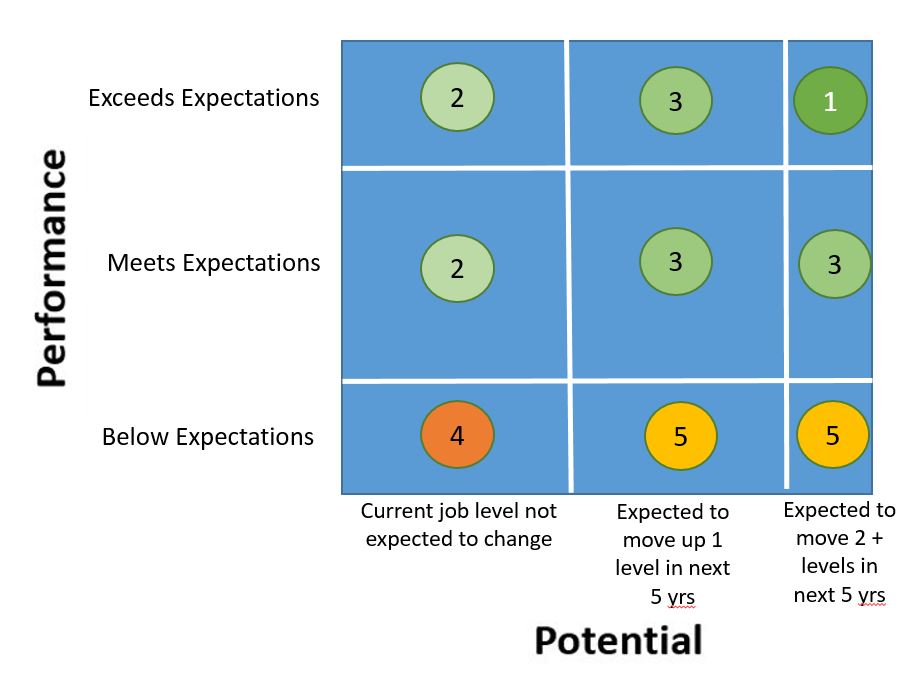
The vertical axis on this graphic is where you rate the performance of the employee and the horizontal scale is where you rate his or her potential to reach higher levels of leadership in the company if you develop him or her.
The green star example would be a leader who is performing exceptionally high and who also still has the potential to move up more levels within the company – maybe 2 or 3 levels more in the next few years.
The red star would represent a leader or employee who is not performing according to expectations at all and who has not shown any signs of being capable of or motivated to move up any levels in the company.
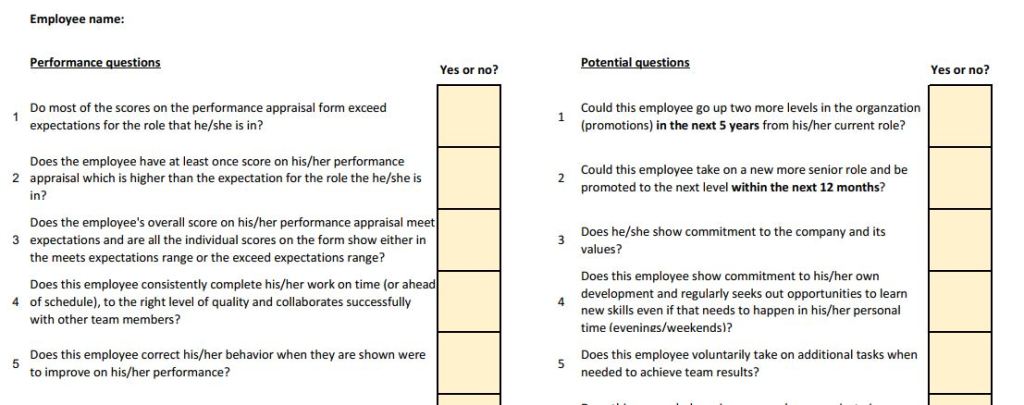
When you are used to looking at your leaders and teams in this way, you may not need to use a formal checklist, but you should be able to do this on the back of a napkin. Until you can do that the resource I am sharing below and which you can download, may be useful.
An easy checklist for employees and leaders is shown below – note how well they are performing in their current roles and then compare that to how much potential do they still have to move up a level or two in the company in the short to medium term.
Once you have the number of YES answers to the questions in the downloadable link above, you can plot where each leader or employee would be on chart like the one shown below. The maximum value would be 12 on the potential axis and 11 on the performance axis. Your scores will likely be somewhere between zero and those maximum numbers. The scale for both axis is 0 in the bottom left corner and the the top of Performance would be the maximum and the right side of the Potential axis is the maximum.
Using the checklist helps you determine where your current employees and leaders would fit on the model shown above. All you need to do is answer yes or no to the questions shown. When you get to the bottom count the number of times you answered yes and calculate the % yes score (total yes answers divided by number of questions).
Alternatively you can use the next figure (see below) to plot the employees. Review their latest performance review outcomes against the vertical scale: Exceeds Expectations, Meets Expectations and Below Expectations. Looking at the employee’s motivation, mindset and capabilities – does he or she have the potential to move up some levels in the company? Plot that against the horizontal axis.
To ensure a good perspective of the employee pool that you are reviewing, ask various executives/senior managers who have regular contact with the employees to complete the list of questions in the resource. Combine all the answers to arrive at the final plot on the graphic for the employees/ leaders. Always perform a sanity check before you complete the final plot – employees must have the motivation and interest to advance in their own careers and have great interpersonal relationship skills before you can plot them towards the middle and right side of the horizontal scale.
Once you have the employees plotted as stars or markers on the diagram you can move towards planning next steps.
Interpreting the numbers in the chart shown above:
These employees are able to grow to the top of the organization. Accelerate their development and make sure they have stretch-goal assignments.
These employees are good performers who need to be recognized and you should keep them engaged. Retention is the word, especially if they possess key skills that are hard to find in the market.
These employees need training, coaching and a structured approach to improve on their skills and competencies. Since they have the motivation, ambition and ability to move to higher roles in the company, the gap between future role requirements and current performance assessments should be driving the development actions needed.
This group needs to be addressed fast. Or you can coach/motivate this employee to improve performance or you need to let them go. They are taking management energy away from growth and are not contributing to the company’s success. (If their below expectations performance is related to health issues – manage according to the local laws and agreements with unions etc.)
The performance of these employees has to improve. There are several reasons why someone could be plotted in this group. a) some executives/managers see potential here, but the employees’ own motivation or ambition may not align with that – move the employee into the correct group – towards the left; b) personal or interpersonal issues may be at work here – try to resolve; c) employee does not understand what is required from a performance perspective – ensure clear goals and expectations are set and train/coach and review regularly to ensure that performance does improve.
This process is not static and you should review your plots at least once a year. It is possible for employees to move into other areas of the graphic after they get the promotion they worked towards or their motivation and ambition at work may change.
This annual review is an exercise that should include the executive team or management team for that location, because it is important that the senior team understands the talent and leadership potential that is available at that location. It is also important that multiple views are incorporated and discussed during the review sessions. It all starts with doing the first talent audit though and this tool will hopefully help you do that.
Leading and managing a group of people at a single location is not an easy task and managers often tell me it is the people-side that wears them down. When your team is very diverse and located at different remote locations instead of at one location, the challenges and risks of the team not reaching goals multiply. The resource I am sharing today is a checklist for team leaders or managers/supervisors of remote teams and it focuses primarily, but not exclusively, on the the people-side.
The downloadable checklist above lists a number of items to consider when you are leading a dispersed or remote team. This may be a useful check for team leads or project managers to ensure they are taking into account the additional challenges that remote teams bring and are taking the appropriate actions and precautions to manage the interpersonal and communications aspects on such a project.
The checklist items are grouped by the following main topics:
Critical Skills for Supervising International Project teams
Setting Goals and Expectations
Giving Feedback and Coaching
The team
Communication
Establishing a Good Start
Working with dispersed team members can be very interesting and it can be fun to learn about other cultures and other perspectives. However, those same interesting differences can make remote teamwork frustrating and difficult. The checklist shared here can go a long way towards helping you, as the team leader, take advantage of leading a diverse team while successfully managing the harder part of leading teams.
The ability to reflect and learn from experiences and observations is one I most commonly associate with and admire in the best leaders that I have met over the years. This resource can be used to help leaders reflect on their own behaviors to identify development and improvement needs.
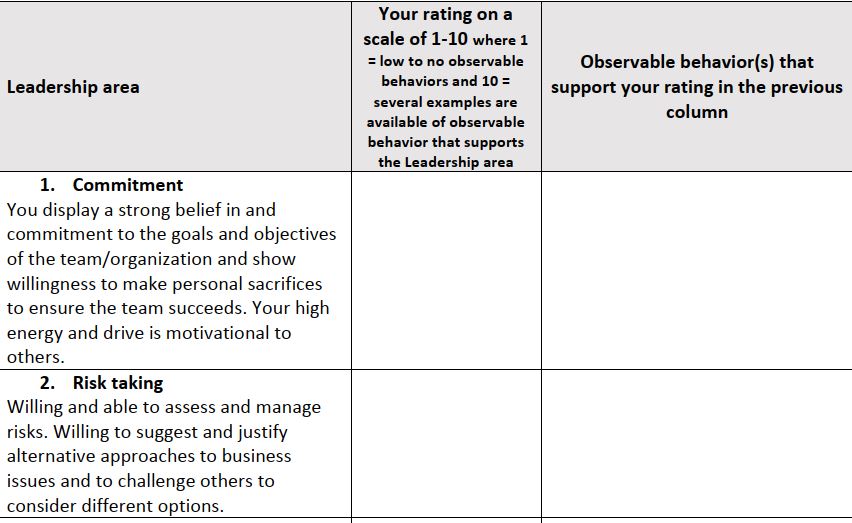
The leadership rating worksheet shared contains a sheet for self rating and also a sheet which can be shared with others for feedback purposes.
The resource (see downloadable file above) is not only helpful for leaders in rating themselves and uncovering possible developmental needs, but can also be used as a 360-type feedback tool. In that case the leader rates himself or herself and then requests feedback from others – in more senior roles, same level peers or in lower hierarchical roles – interacting with the leader on a regular basis. The 360 view can help eliminate any blind-spots that a leader may have concerning his or her own leadership behaviors as the perspectives are from others who often interface with the leader.
The leadership aspects covered in this resource are:
Commitment
Risk taking
Motivational style
Open-mindedness
Diversity conscious
Trustworthiness
Continuous learning
Self-adjustment
Steadiness
Each of the aspects come with a brief description to ensure ratings are comparable after you have obtained feedback from others.
Uses for this resource include:
Updating your own development plan and setting new goals and priorities for your own development activities
Discussing the results with a coach or mentor to get guidance on what to focus on and how to plan next steps to improve on key leadership aspects.
If a manager rates all of the leaders working in his or her department using this tool you can compare the leaders to each other in terms of strengths and development needs. This would be useful information to help select the best development programs for the team over the next year (for example).
Developing leadership skills is a lifelong journey. We can all learn to do better in some aspects over time and tools like this one can be a very useful check-in for reflection even for those who have been leaders for a long time. It is also true that we expect more from leaders in a globalized business world and concepts like “diversity conscious” and “cross cultural” skills are becoming very important for leaders to be effective on a global scale.
Trustworthiness is the undisputed main characteristic that we look for in a leader and frankly also in any other person we encounter on a daily basis. Trust is a topic that is often discussed in a business context after employee satisfaction or engagement survey results are known in organizations. The topic also often comes up when leadership training or development is considered.
The resource I am sharing consists of some slides highlighting the nature and importance of trust in teams and then it has an exercise which you can do with a group of leaders.
You can use this (download above) file in a few ways:
As a quick exercise (about 20 to 30 minutes) with meeting participants where Trust and Leadership is the topic of conversation or discussion. For example: in a meeting to discuss a recent employee survey where trust came up as an area to be addressed.
As a sub-section within a leadership training course where Trust and Leadership is an aspect of the course.
As a coaching discussion topic where it is important for someone to learn more about actions and behaviors that can contribute to being viewed as more trustworthy.
These slides won’t teach someone all of the aspects of trust and leadership, but they do provide a context for you to explore the topic. You may always choose to follow-up with more exercises or conversations about the topic in future.
(Note that the last “Slide” in the resource is not for display purposes, but for you to print out so that the small groups in the exercise have a way to capture their thoughts while going through the exercise.)
Setting a strategy for an organization requires a focus on aspects internally and external to your organization. Once you have set your strategic growth targets you would need to look at how you need things to change internally to support those growth targets. You may want to set your signs on improving profitability, increasing organizational effectiveness or moving leadership behaviors closer to your values and vision for the organization.
The resource I am sharing can help you align some of the most important internal aspects with your strategy to improve your chances of successfully executing on the strategy.
Most organizations are able to successfully navigate through the process of setting a strategy. Many organizational leaders find execution and implementation of the strategy the hardest part to achieve. I believe this is mostly because internal aspects that are needed to support the strategy are not always taken into account in the execution plan.
The framework (See download option above) and questions to address in each case help you by acting as a checklist. Reviewing the execution plan, this list will help you consider how to engage, involve, and inform stakeholders in the process. It helps ensure that every aspect of your execution plan reinforces your strategic objectives leading to a better implementation plan.
The areas to ensure alignment are:
Company values and culture
Leadership (behavior and mindset)
Workforce capability
Organization structure
Organization processes
Systems (Automation)
Performance Management and Metrics
The sequence would always be to first select a strategy you would like to pursue with the organization and then use this resource to plan the implementation portion of the activity.
Setting strategies is often an iterative process as changes from inside or outside of companies require an adjustment in approach. Remember to check the impact of further changes on the same checklist (see above) to ensure you maintain the strategy alignment.
A new project is best started by getting the entire project leadership team on the same page. This relates to commercial terms, project scope, key milestones and other important contractual terms and conditions. It is also vital for the project leaders to understand how they will execute this project – who is going to do what exactly to make sure we execute this project scope to the best of our abilities?
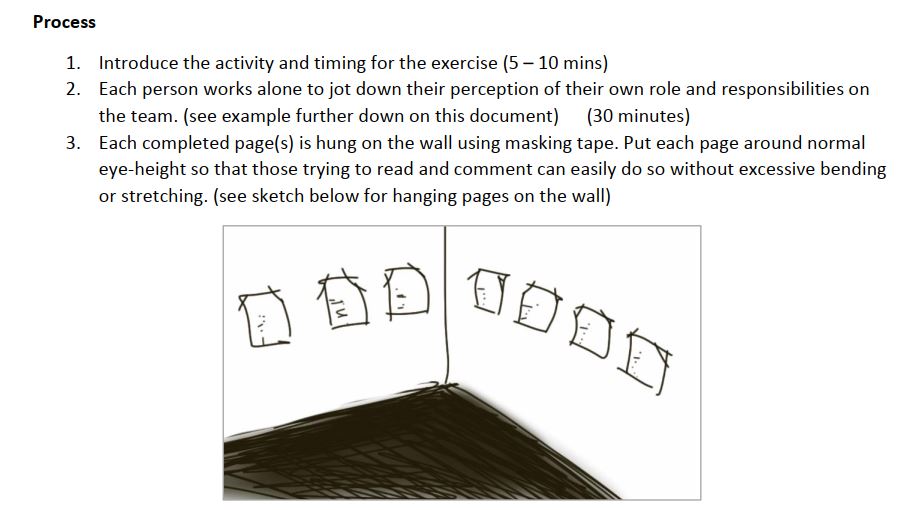
The resource I am sharing here describes a process you can follow as part of an early team-building activity to clarify and agree team roles and responsibilities down to individual levels.
In this activity the project leaders are gathered together and a facilitator takes them through this process. (See downloadable process description below).
You can use this activity after first running a sub-group responsibility definition activity which defines project interfaces or relative responsibilities for decisions and processes by functional or other sub-groups on the team. (see Defining team interfaces) Using this sequence means you drive home how the overall project outcomes are managed by sub-groups on the team and then right down to individual roles in those same processes.
This exercise can also be used when there is a change in phase or focus on the project or the composition of the team changes greatly. At those times it is important to keep the team’s momentum going by ensuring that roles and responsibilities remain clear throughout the changes.
Clarifying individual role and responsibilities also supports the performance management process. When individuals receive feedback regarding their performance it is important that they already understand what performance and role expectations are.
Having individual roles documented can also support bringing new team members up to speed fast. It helps explaining expected team functioning and who they should talk to while making their contributions to successful team outcomes.
Project teams simply function better when everyone understands how he or she is expected to contribute to the team’s goals. This activity does help greatly in clarifying expected individual contributions. I do suggest you distribute the final agreed pages with the team for reference purposes.
Staff reduction, mass employee lay-offs or a reduction in force, is a critical process. Consequences for not complying with labor laws or not acting and communicating correctly can be far-reaching.
Declining workloads or under-performing groups are some of the reasons that lead to the decision to reduce staff. Not executing staff reductions correctly can expose the company to many liabilities and potentially law suits.
There are several steps to take in this process and in most countries there are specific requirements which may include employee and/or union consultation and involvement and some steps could also be subject to approvals by governmental organizations. In many countries there are very specific justifications that a company has to be able to provide to show that the process of selecting who to lay off was fair and equitable and that no discrimination took place.
It is important that managers understand the correct process to follow for staff reductions and that they are able to for example conduct employee notification meetings in the right manner.
The resource you can download above contains a few slides which may be useful at a manager orientation meeting to ensure the principles and approach to follow with this staff reduction is well understood by the managers. There are also slides highlighting the human impact of staff reductions and the need to ensure that those who remain with the company are supported through the emotions when they see other trusted and well-liked colleagues leave.
Without proper preparation of the managers/supervisors before the notification meetings take place you risk them making incorrect statements or forgetting to make important statements. Sometimes unprepared managers act in ways that could be interpreted as discriminatory. The slides will help you minimize that risk as you first orient managers/supervisors in a group and then have each manager/supervisor work with his/her HR Representative to practice how to conduct the notification meeting correctly during the staff reduction process.
Remember:
It is not only the impacted employees who are going to have an emotional reaction to the staff reduction, employees intended to remain at the company may be losing valued friendly connections with peers – even friendships. Be sure to reassure those whom you intend to stay with the company to stop them from looking around for other jobs during the uncertainty that is created in the workforce when a reduction in staff is planned or in progress.
It is very important to plan the notification meetings to take place very fast. The shorter the time of uncertainty and people waiting to be called in for a meeting, the better your chances of restoring the morale of the remaining employees and avoid retention risks.
During times like these is when your company’s values should drive decision-making and how you talk to employees. Your branding messages can claim honorable conduct and make promises of fair treatment, but it is during staff reductions that you get to prove that you meant it. Employees will remember how you conducted the staff reduction more than they will remember what is written on your posters about company values.
(HR/Office Manager) Remember also to check in with the managers and supervisors who conducted the notification meetings. It is tough to tell a number of people that their jobs will go away and watch their emotional reactions to that.
The staff reduction process is tough on everyone and it is vital that you plan it and conduct it exactly according to the rules and laws of the country where the people are employed. Internally you also need to make sure your planning includes an orientation process for those managers and supervisors who have a role in the notification meetings. And most importantly, check in with those who will remain after the notification meetings are complete to ensure that your business activities can resume soon after.
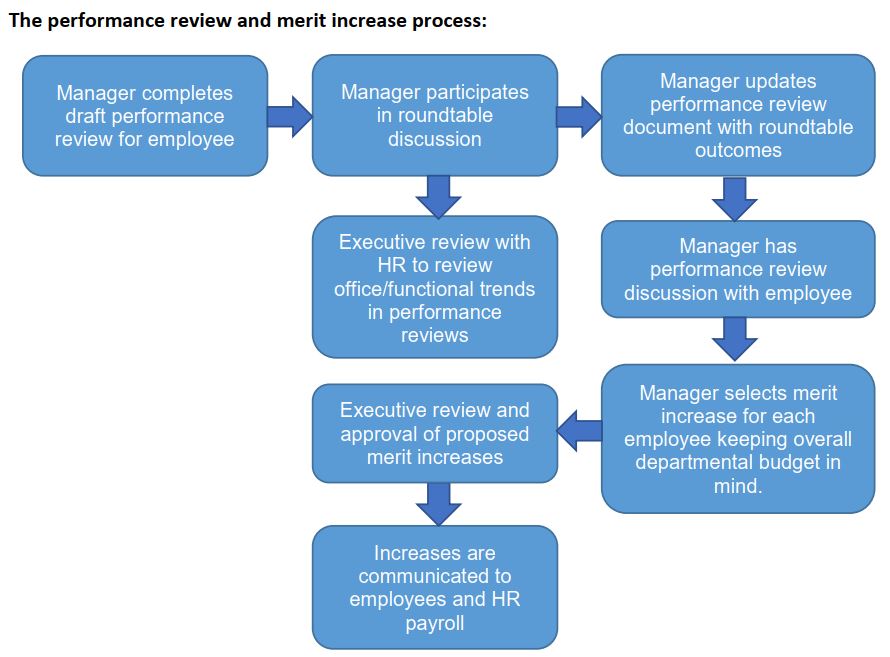
Employee performance outcomes is one important aspect to be reviewed when it comes to considering merit increases. It is not the only consideration though. Overall merit increase budgets, inflation, changes in external benchmarks for specific roles, current compensation ratios etc. are all additional elements which would impact actual merit increases per department and employee.
The resource I have here ties a specific overall individual performance review score to a specific range of possible merit increases. Some managers require a highly structured and fixed process for determining % changes and this is one way to create one. One should however also be sure to consider the other aspects mentioned above: budget for increases that year, company performance in the last year (overall), the market value of specific roles (roles that are in high demand). Compensation has a powerful influence on employee engagement and retention, but it is not the only one. Employees also care about career growth, flexible benefits and being helped to develop further.
I would caution anyone to consider unintended outcomes when attempting to standardize and establish rigid structures for considering individual performance and linking that in a fixed way to merit increase percentages. While intentions may be good: to reward your best performers for their contributions and to ensure those with lesser performance improve or leave the company, a process that is overly structured could fail to accomplish that intention.
The approach shared above – see download link – indicates one way in which a group has established a direct link tying the performance review process directly to the merit increase process. This example does not take into account some of the considerations highlighted above when it comes to selecting the actual increase percentage and I chose to share this resource anyway, because it does happen that HR is asked for a process like the attached on a regular basis and I want to make an example available to you if you find yourself in that situation.
I do suggest you consider ways to incorporate the other aspects as outlined above when you finalize your proposal to implement a more structured approach to tie performance management to compensation review.
My main advice is to think it through carefully to ensure your good intentions have the best chance of being reinforced by your performance management process and pay-for-performance approach . And I would also add that you should remain flexible in working with your documented process. Be ready and willing to adjust and update it as you gather input about how successful your process is in driving desired outcomes – results and behavior that you and the executives would like to see in your pool of employees.












 The Rethink Shelf