Exercise: Practice difficult employee conversations (for Leaders)


roleplay final

I am a strong believer in experiential learning – learning by or based on an experience and observation. Key learning points seem to be integrated faster and stronger when the learners are put in a situation where the skills they need to learn or apply are put to the test.

The exercise I am sharing (see download file below) is a group or team exercise focused on the style of a leader and how a leader approaches employee issues given their own background and preferences. The backdrop for the experience could be situational leadership  or Emotional Intelligence for leaders. It is up to the trainer or facilitator to choose the right materials to suit the needs of the team or group.

The exercise requires some volunteers to engage in role-play based on specific scripts – included in the resource. There are “role sheets” to help those standing in as employees understand how that employee behaves and describes his or her style.

The key to this exercise is to showcase the possible dilemmas that leaders can face when confronted with employee behavior that seemingly goes against their own values or goals at work. The discussion after the role-play exercises is where the most value can be realized. Reflecting on what the group saw and experienced during the role-play and then relating that to their day-to-day work-life is where most insights tend to surface. This helps each leader determine how he or she could adopt a new mindset in dealing with difficult discussions with employees going forward.

This exercise works well for groups ranging from 8 to 16 people. Larger groups of 20 people or more can work too, but you may need to add in an additional step – a small group exercise. In that case, divide the group into smaller groups of 4 or 5 people and have them discuss the exercise debrief questions in the small groups before requesting each of the small groups to report back to the larger group for further discussion. You may want to consider an additional facilitator to assist if you are dealing with groups larger than 20 people.

Without emotional intelligence or a compassionate approach to interpersonal relationships even leaders with the best technical minds and education will never be great leaders with motivated followers. Exercises like the resource I share here can help trainers and facilitators bring home the importance of having the right approach and encourage a personal change process in developing leaders.

Checklist for Team Leader with a remote team


table final

Leading and managing a group of people at a single location is not an easy task and managers often tell me it is the people-side that wears them down. When your team is very diverse and located at different remote locations instead of at one location, the challenges and risks of the team not reaching goals multiply. The resource I am sharing today is a checklist for team leaders or managers/supervisors of remote teams and it focuses primarily, but not exclusively, on the the people-side.

The downloadable checklist above lists a number of items to consider when you are leading a dispersed or remote team. This may be a useful check for team leads or project managers to ensure they are taking into account the additional challenges that remote teams bring and are taking the appropriate actions and precautions to manage the interpersonal and communications aspects on such a project.

The checklist items are grouped by the following main topics:

  1. Critical Skills for Supervising International Project teams
  2. Setting Goals and Expectations
  3. Giving Feedback and Coaching
  4. The team
  5. Communication
  6. Establishing a Good Start

Working with dispersed team members can be very interesting and it can be fun to learn about other cultures and other perspectives. However, those same interesting differences can make remote teamwork frustrating and difficult. The checklist shared here can go a long way towards helping you, as the team leader, take advantage of leading a diverse team while successfully managing the harder part of leading teams.

Evaluating Leaders – a template


pen writing final

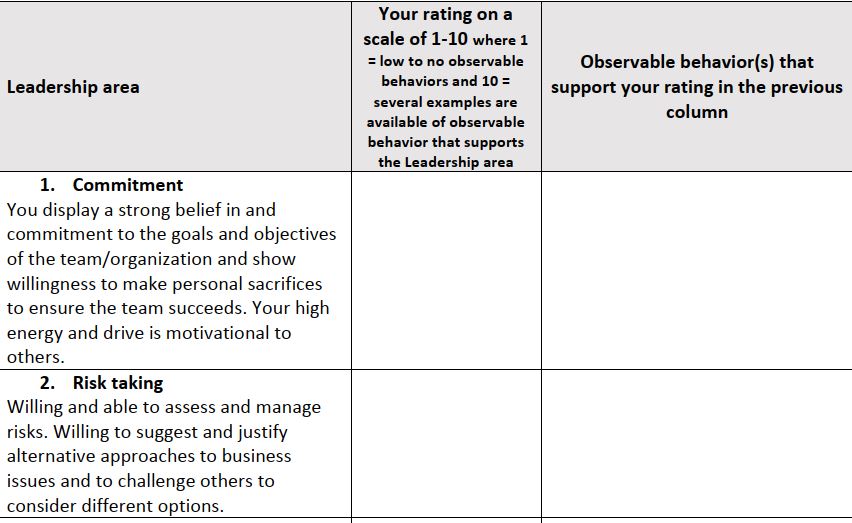
The ability to reflect and learn from experiences and observations is one I most commonly associate with and admire in the best leaders that I have met over the years. This resource can be used to help leaders reflect on their own behaviors to identify development and improvement needs.

The leadership rating worksheet shared contains a sheet for self rating and also a sheet which can be shared with others for feedback purposes.

The resource (see downloadable file above) is not only helpful for leaders in rating themselves and uncovering possible developmental needs, but can also be used as a 360-type feedback tool. In that case the leader rates himself or herself and then requests feedback from others – in more senior roles, same level peers or in lower hierarchical roles – interacting with the leader on a regular basis. The 360 view can help eliminate any blind-spots that a leader may have concerning his or her own leadership behaviors as the perspectives are from others who often interface with the leader.  

The leadership aspects covered in this resource are:

  • Commitment
  • Risk taking
  • Motivational style
  • Open-mindedness
  • Diversity conscious
  • Trustworthiness
  • Continuous learning
  • Self-adjustment
  • Steadiness

Each of the aspects come with a brief description to ensure ratings are comparable after you have obtained feedback from others.

Uses for this resource include:

  1. Updating your own development plan and setting new goals and priorities for your own development activities
  2. Discussing the results with a coach or mentor to get guidance on what to focus on and how to plan next steps to improve on key leadership aspects.
  3. If a manager rates all of the leaders working in his or her department using this tool you can compare the leaders to each other in terms of strengths and development needs. This would be useful information to help select the best development programs for the team over the next year (for example).

Developing leadership skills is a lifelong journey. We can all learn to do better in some aspects over time and tools like this one can be a very useful check-in for reflection even for those who have been leaders for a long time. It is also true that we expect more from leaders in a globalized business world and concepts like “diversity conscious” and “cross cultural” skills are becoming very important for leaders to be effective on a global scale.

Leadership and Trust : Training slides


trust4

Trustworthiness is the undisputed main characteristic that we look for in a leader and frankly also in any other person we encounter on a daily basis.  Trust is a topic that is often discussed in a business context after employee satisfaction or engagement survey results are known in organizations. The topic also often comes up when leadership training or development is considered.

The resource I am sharing consists of some slides highlighting the nature and importance of trust in teams and then it has an exercise which you can do with a group of leaders.

You can use this (download above) file in a few ways:

  • As a quick exercise (about 20 to 30 minutes) with meeting participants where Trust and Leadership is the topic of conversation or discussion. For example: in a meeting to discuss a recent employee survey where trust came up as an area to be addressed.
  • As a sub-section within a leadership training course where Trust and Leadership is an aspect of the course.
  • As a coaching discussion topic where it is important for someone to learn more about actions and behaviors that can contribute to being viewed as more trustworthy.

These slides won’t teach someone all of the aspects of trust and leadership, but they do provide a context for you to explore the topic. You may always choose to follow-up with more exercises or conversations about the topic in future.

(Note that the last “Slide” in the resource is not for display purposes, but for you to print out so that the small groups in the exercise have a way to capture their thoughts while going through the exercise.)

Organizational Strategy Framework


framework final

Setting a strategy for an organization requires a focus on aspects internally and external to your organization. Once you have set your strategic growth targets you would need to look at how you need things to change internally to support those growth targets. You may want to set your signs on improving profitability, increasing organizational effectiveness or moving leadership behaviors closer to your values and vision for the organization.

The resource I am sharing can help you align some of the most important internal aspects with your strategy to improve your chances of successfully executing on the strategy.

Most organizations are able to successfully navigate through the process of setting a strategy. Many organizational leaders find execution and implementation of the strategy the hardest part to achieve. I believe this is mostly because internal aspects that are needed to support the strategy are not always taken into account in the execution plan.

The framework (See download option above) and questions to address in each case help you by acting as a checklist. Reviewing the execution plan, this list will help you consider how to engage, involve, and inform stakeholders in the process. It helps ensure that every aspect of your execution plan reinforces your strategic objectives leading to a better implementation plan.

The areas to ensure alignment are:

  1. Company values and culture
  2. Leadership (behavior and mindset)
  3. Workforce capability
  4. Organization structure
  5. Organization processes
  6. Systems (Automation)
  7. Performance Management and Metrics

The sequence would always be to first select a strategy you would like to pursue with the organization and then use this resource to plan the implementation portion of the activity.

Setting strategies is often an iterative process as changes from inside or outside of companies require an adjustment in approach. Remember to check the impact of further changes on the same checklist (see above) to ensure you maintain the strategy alignment.

How good are your meetings? – Exercise


Most teams have challenges when it comes to ensuring optimal collaboration and effectiveness during meetings. It is true that many people are not fond of meetings and the list of pet peeves include that meetings are too long, do not reach any outcomes or agreements, are one-way conversations etc.  The tool I am sharing today can help teams become more aware of their particular downfalls and habits which contribute to having less effective meetings.

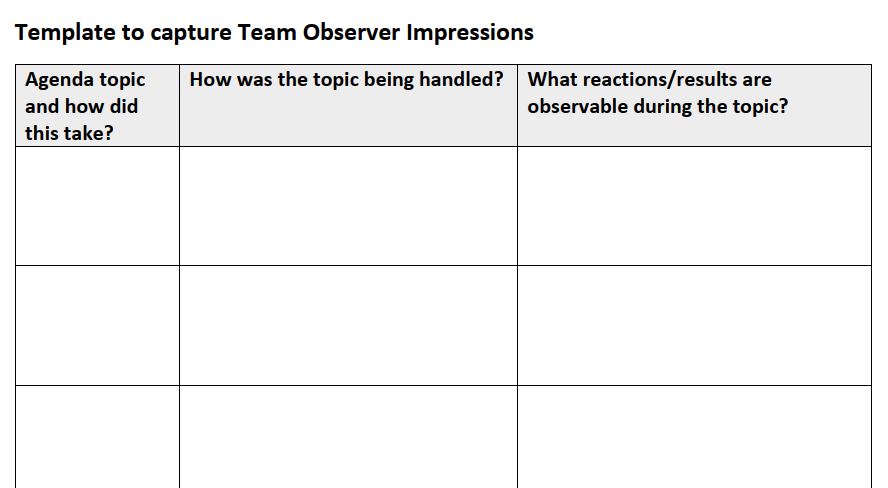
The exercise requires the assignment of an observer to help make behaviors, team dynamics, habits and meeting inefficiencies visible to the team by simply observing them during a meeting.

The assigned observer can be a team member (rotate the assignment to other team members for multiple team meeting observations) or it can be a trusted outsider (typically from Human Resources or Training & Development). The resource includes a template for the assigned observer to use when capturing impressions of the team during a meeting. The process of capturing observations, presenting observations and dealing with observations as a team is also described in the shared resource.

Reflections:

  • It does not really matter which specific questions are considered for observations or how exactly the team receives the feedback, the important part is to give the team a way to see themselves through the eyes of someone who is not participating in the meeting and thereby learning about themselves. The feedback information can be used for team improvements and also for individual learning. Individuals can learn how their own behaviors are contributing to team successes or inefficiencies and have the opportunity to consciously choose helpful behaviors going forward.
  • Typical team improvement actions that comes from using this kind or review are: having a concise set of team meeting rules which is either permanently displayed in the team meeting room or displayed on a screen at the start of each meeting to remind them of the behaviors they have decided to emphasize or eliminate in team meetings; implementing specific roles such as for example a time-keeper for each meeting to ensure that meetings, discussions and agenda topics are not dragged out too long and that an additional meeting be set instead to complete some topics which were too complicated to solve during a regular team meeting.
  • If you have used team measurement tools on a team you may also have a session where the team becomes aware of the likely blind-spots it may have due to the presence of specific personalities and styles in that team (based on the specific team effectiveness tool you have used with the team). The sum of the individuals present in meetings can lead to the greater team having specific blind-spots, which can be mitigated once the team becomes aware of them and are able to take actions (i.e. assign someone to take on a specific role which may be “missing ” in the team due to its specific contingent of members).

Planning Developmental Assignments – Process and Preparing Assignee


global travel5

A decade ago it seemed to be more common for employees to be on developmental assignments for longer periods of time. These days the duration of assignments seems to have become shorter. The required steps are not much different though.

It is vital for the organization to have a clear process around the mobilization, preparation, sustaining, return, development of assignees and there are multiple organizations (internally and possibly externally if outsourced) which need to contribute to the process in order to make the assignment a successful one for the company and the employee

Some of the biggest unintended outcomes of assignments are:

  • The employee (and/or family) did not fully understand what they were getting into and found it too overwhelming at the assignment location – wished to return earlier or resigned.
  • Employee did not understand how the assignment was adding to his or her skill sets or competencies and he or she ended up frustrated and demotivated.
  • Employee on assignment no longer felt connected to the home office and were anxious about what happens after the assignment – wished to return earlier or resigned.
  • Employees (and families) experienced a high level of anxiety associated with the assignments due to inadequate preparation and support before, during and after return to home location.

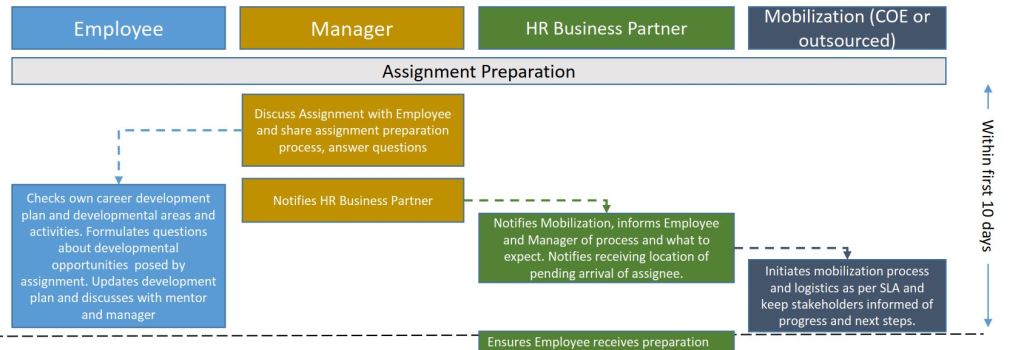
The process flow shared here shows a simplified version of how a developmental assignment should be planned and executed before mobilization, during and after an assignment has ended. It takes into account the logistics part, which may be an internal organization (Center of Excellence) or an outsourced party, the role of the manager, the role of the employee and how the Business Partner can contribute to ensure the entire process yields the desired outcomes. There are also some suggestions for surveys to capture any feedback to identify useful improvements to the process.

Some additional tips:

  • Make sure that managers are clear on the process, the various steps and the specific roles and responsibilities. Most employees will ask their managers for advice and information first. The role of the manager is very important to ensure future retention of the employee by staying in touch and ensuring the employee continues to feel valued by the organization during and after the assignment.
  • Create or outsource a solid assignment preparation program for employees (and families as applicable). This includes cultural awareness training, language training (if applicable) and developing the right mindset and approach to living in a new country for a period of time.
  • Apply attention and diligence when outsourcing logistics and defining the SLAs associated with mobilization. Lost goods, delays in finding accommodation, faulty or missing paperwork can cause a lot of unnecessary distraction and anxiety on the part of an employee on assignment. Conduct regular audits and have discussions with an outsourcing partner/COE using the surveys as a basis to provide input aimed at improving the experience of assignees.
  • Ensure either the Business Partner or the Manager has discussions with the employees to be sent on the assignment to ensure they understand how to leverage the opportunity to improve on their own skill sets/competencies and how they should contribute to the learning of those at the assignment location and again to the learning of those at the home office upon their return.

Preparation and Training

Training and support in these areas (see below) will help each assignee and his/her family – should they accompany the assignee – the best opportunity to understand the assignment requirements and the local culture better. And having an improved awareness will enable the assignee (and family) to have a solid plan of how they would set-up their start-up activities at the new location for a successful assignment experience and conclusion.

Being sent on an assignment is both an opportunity and a responsibility for the assignee. It can bring out the best and worst in a person as he/she (and the family) face huge life changes compared to life at the home office. The experience can lead to increased maturity, improved leadership skills and understanding and increased knowledge and skills if managed properly. As the manager, business partner or any other stakeholder in the process, it is important you ensure there is a clear process mapped out which details the various steps by process contributor and that each stakeholder is acutely aware of the bigger picture while performing own parts.

Risk Management TEMPLATE


Considering risks is a high priority for any project execution planning activity. It is important to also frequently re-assess during the project life-time. The project team should check the status of the risk plan against reality at various moments in time to ensure all risks are captured and accurately reflected along with mitigation or risk avoidance plans as required.

A risk plan is simply a plan that helps you identify where obstacles to successful outcomes could appear and what you could do about it. In some cases a potential risk can be avoided by taking some preventative actions in time. Some risks or obstacles could be things that can happen at any moment and some would only occur under specific circumstances. The project team should consider the key elements of the  project plan – where would the project plan have the highest risk of failing if key milestones or achievements are not met? That is the starting point of the template that I am sharing with you.

The risk mitigation template  shows you how to identify risks, identify the risk level of a possible obstacle to project success, determine what can be done to avoid or mitigate an issue/obstacle to success  and of course select who exactly should take the actions in the event that the risk is realized or upfront as a preventative measure.

Just download the attachment and complete the sections in yellow for each of the key elements of your project plan. Then answer the questions as outlined at the top of each column for each of the key parts of your plan.

When you review the plan look at the elements that were rated as “high risk” that it could occur and also a “high impact” if that risk did materialize. Focus your attention more on those items, but it is also true that sometimes a “low risk” obstacle could have a high impact on the project so be sure to review every element of the risk plan when you do your regular risk plan checks.

Every plan has risks and great returns on investments are often associated with a higher level of risks. The objective is not to avoid risks completely since the ability to manage risks well and willingness to accept and manage risks can be a competitive advantage in the marketplace. This template can help you increase your awareness of risks and learn how to manage them throughout your project. Becoming better at risk management will make you a valuable project member and business partner.

Preparing for a Coaching Session


Coaching sessions and programs are more successful when there are clear coaching goals and actions planned are documented. These developmental actions and activities should be reviewed and updated on a regular basis. It helps both the coach and the person being coached to maintain focus on desired outcomes..

Many employees who are new to coaching have misguided expectations about the coaching process and their own role in it. They expect the coach would show up at each session ready to provide them with useful information and advice and all they needed to do was to show up. In reality the coaching process works much better when both parties actively participate and prepare for each session.

Coaching process JAG

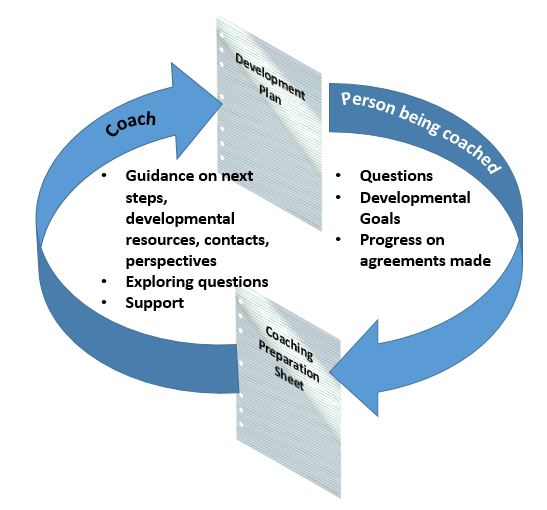
This process graphic shows that each party in the coaching process provides input and participates in the process. The results are written down and shared to ensure a common understanding of the goals and that progress towards goal achievement is maintained.

Preparation worksheet for Coaching

Tips:

  • For those being coached: make sure you get your completed preparation sheet to your coach at least a few days before the session so that the coach can take your feedback into account. This helps him or her prepare to answer your questions and obtain any additional information and resources that may be useful to you at this time and bring it to the session.
  • For coaches: take note of the questions and struggles that may be noted in the preparation sheet. Consider how you can best help address those issues and which resources can you provide to help in the process? What is the best way to approach the coaching session – given those questions, issues and of course the overall goals that had been set for the coaching process?
  • Do remember to look back at previous preparation sheets and also the updated development plan on occasion (maybe once every 6 months) to recognize and appreciate progress made to date and to help motivate those being coached to take the next steps that may be required towards ultimate goal achievement.

Coaching is a shared responsibility between the coach and the person being coached. Only then, does the process yield the best results. And preparation is a key part of this shared responsibility.

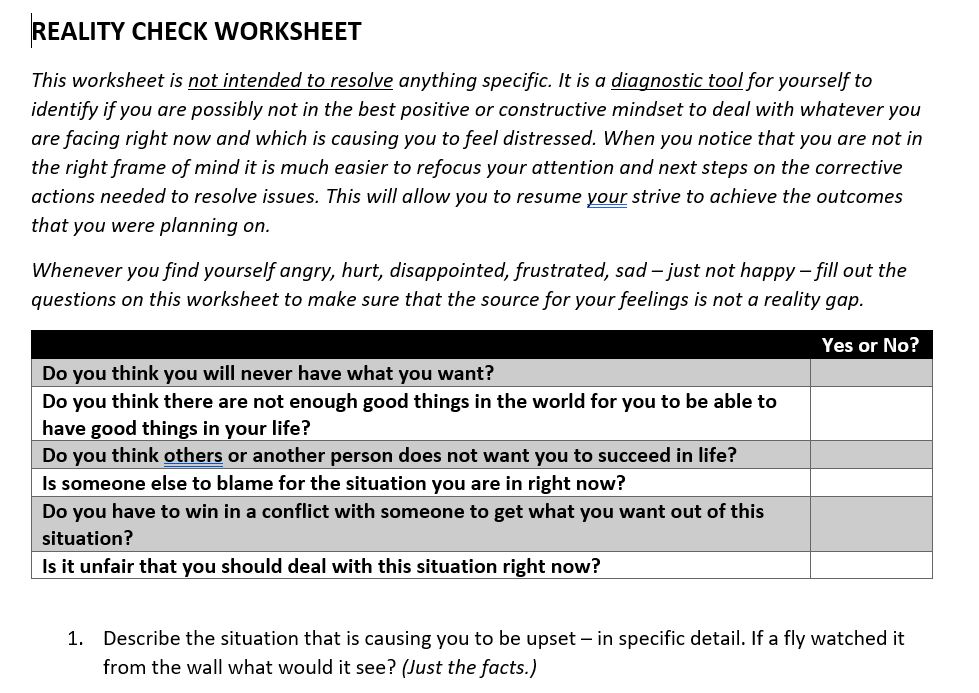
Use a reality-check worksheet for a Positive Mindset


The success of a leader, a manager or an ambitious employee depends largely on the mindset that he or she operates on. When we are in a positive state of mind we can focus on our goals and collaborate and communicate in positive ways which inspire and motivate others to help us succeed in our goals.

It is unfortunately also possible for us to get pulled away from the positive state of mind when we are in high stress situations for a long period of time and when we allow ourselves to go down a spiral of negative thinking. Successful leaders and managers have learned how to quickly realize when this happens and to start implementing corrective actions and adjustments to their way of thinking. This self-awareness and regulating their own emotions help them rapidly get back to a focused mind and closer to the outcomes that they are planning for.

Expectations and Reality Curves

This model shows the blue path which I call the Expectation Trap or summarized as the kind of thinking that believes “things should not be this way”. This kind of thinking very easily moves us out of a positive mindset and it is aligned with going against reality. We wish that reality was different and we build this on our expectations of how good things should be and how badly others are acting or behaving as if others are actually causing the negative outcomes which we do not want to see.  The green curve is the way out of the negative thinking. It is a different mindset which aligns with 1) doing a reality check and using that as the basis for moving towards a better way of thinking, 2) learning from the past, 3) changing or improving the plans we had before something happened to interrupt our progress and then 4) moving into the new direction with a positive focus and determination.

The first step, doing a reality check – is often the toughest and once a person is already in a negative state of mind it is really hard for him or her to realize that it is necessary to do this.

Use the outcomes from this worksheet for further discussions with your mentor/coach or adviser. It may be that you need some coaching or just someone to be a sounding board for you as you talk through the situation and how to resolve it in the best way.

Some tips:

  • Be sure to really connect with the negative feelings when you complete the worksheet. Some people are really good at being able to temporarily switch off their emotions to focus on business – but for this form, do make sure you are connecting with how it feels inside of you when you think about that situation or event that had caused you to feel pulled away from your positive mindset and down the Expectation Trap.
  • Do take the steps necessary to resolve any upsetting situation/event. There is nothing worse than unfinished business behind you. It slows you down and drains you of positive mental energy that you need to accomplish the goal(s) that you have set for yourself. Your coach/mentor or adviser can help you with that if you are not sure how to resolve the upset so you can leave it behind you.