Speak Human First


Not eventually. Not when they keep asking. From the start.

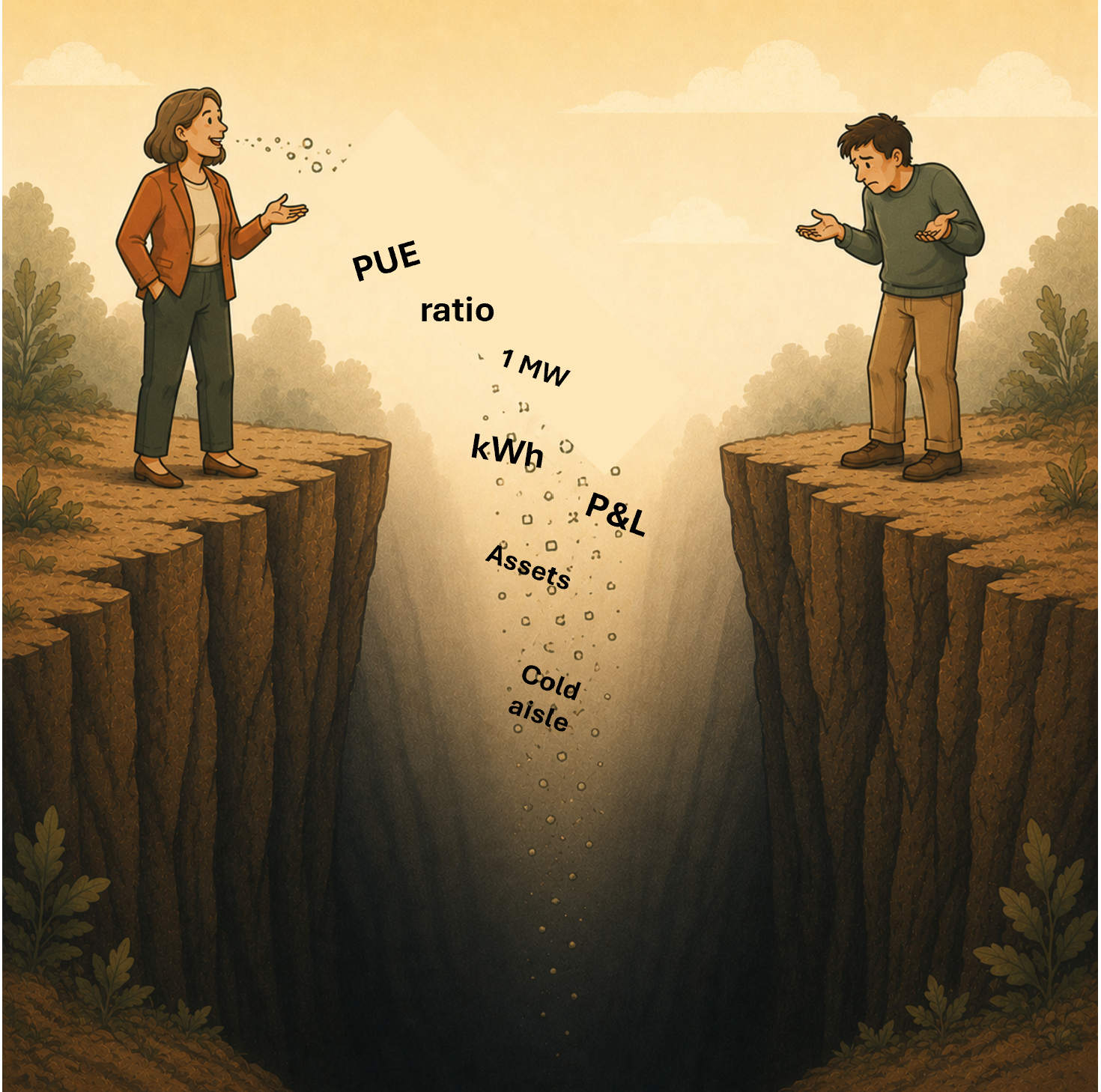
Something has shifted in how people relate to the organisations they buy from, work for, and live nearby. Consumers, communities, investors, and employees are no longer content to be told that things are fine. They want to know what “fine” actually means. They want specifics and in a format that they are able to interpret. They want honesty. And increasingly, they can tell the difference between a genuine answer and one that may be technically accurate but seems difficult to follow.  

This is especially true around sustainability.

Ask a data centre operator about their water use and you might hear: “Our WUE is below 0.4 litres per kWh and we operate a closed-loop cooling system.” Every word of that may be accurate. But the person asking may not be able to understand what the words mean. And in a world where trust is hard won and easily lost, an accurate answer that no one can interpret is not much better than no answer at all.

People are not asking because they want to catch you out. They are asking because they genuinely want to know whether the organisation they are choosing to support – with their money, their work, their community – is doing the right thing. When the answer comes back in acronyms and metrics, many of them quietly walk away unsure whether they have received a real answer.  

Before this starts to feel like a niche concern for a specific industry, stop and consider how many professions run on a private language that is invisible to outsiders.

A banker talks about basis points, LTV ratios, and credit ratings. An insurer talks about loss ratios, combined ratios, and actuarial reserves. An engineer talks about torque tolerances, shear loads, and thermal gradients. A finance director talks about EBITDA, working capital cycles, and covenant headroom.

That language works well when everyone shares the same vocabulary. The moment you step outside that shared vocabulary, it starts to lose people. Not because the other person is less capable, but because they simply do not carry the same dictionary.

And the truth is that most professionals are so immersed in their own terminology that they genuinely do not notice it anymore. It has become invisible. They are not choosing to be opaque. They are simply speaking the way they always speak, in the environment where they have always spoken it, without realising they have walked into a different room.

That is the problem. And it is solvable.

When a community near a data centre asks about water use, they are not asking for a WUE figure. They are asking: are you using up water that our farms, homes, and rivers need?

When a consumer asks a bank about its investments in fossil fuels, they are not asking for a portfolio carbon intensity disclosure. They are asking: is my money helping or hurting?

When an employee asks their engineering firm about safety, they are not asking for a RIDDOR incident rate. They are asking: will I go home safe tonight, and does this company care whether I do?

Underneath every technical question is a human one. And the human question is the one that actually needs answering – first, and in plain language.

Getting there does not require abandoning technical rigour. It requires translation. There is a meaningful difference between the two. Dumbing down strips out accuracy. Translating carries it across.

People know more about sustainability today than they did ten years ago.

They may not know every metric, standard, or reporting framework. But they know enough to ask thoughtful questions about carbon emissions, water use, biodiversity, and community impact.

Expectations around transparency have changed too. An answer that satisfies a reporting requirement is no longer enough if it leaves the reader more confused than informed.

The organisations building trust today are the ones that explain more than the numbers. They explain what it means in practice for the people who read it, hear it, and live with the consequences of those decisions.

There is one dimension of this that is particularly underserved in most technical communications: local impact.

A data centre, a manufacturing plant, a logistics hub, a financial services office – all of these exist somewhere. They are in a community. They draw on local infrastructure. They affect local roads, water tables, power grids, employment markets, and in some cases, air and noise quality.

When local people ask questions – and they do ask – they deserve answers that speak to their lives, not to an industry standard. “Our cooling system operates within ASHRAE Class A2 parameters and our WUE is below the regional average” does not answer the question “are you taking water out of the ground that we rely on?”

A plain answer might be:

“Our system reuses the same water in a closed loop, so we are not drawing from local groundwater supplies on an ongoing basis. In the fifteen years this facility has operated, we have not needed to source water locally in the way a conventional industrial facility would. We publish our water use figures annually.”

That is the same fact. Expressed in a way that the community can actually use.

To help technical professionals make this shift, I developed a free downloadable tool: the Plain-English Message Worksheet.

Rather than defining jargon, it helps you translate technical concepts into language that a wider audience can understand.

👉  Download the Plain-English Message Worksheet below – free

The tool walks you through six steps:

Step 1 – Strip the jargon

Before you write a word, identify every acronym and technical term in your message. Then find an everyday substitute for each one.

Step 2 – Explain what is actually happening

Describe the physical process in plain terms. What does the system actually do? What problem does it solve? What are you avoiding that a less efficient operation would be doing?

Step 3 – Make the number mean something

Convert your metric into everyday scale. Compare it to something familiar. Explain which direction is good and why. Express it over a time period that means something to a human being – not per kWh, but per year, or over the life of the building.

Step 4 – Connect to what your audience cares about

Different audiences have different concerns. Finance needs cost and risk. HR needs people and culture. A local community needs to know what this means for their water, their roads, their jobs. Finish the sentence: “What this means for you is…” – and mean it.

Step 5 – Show your workings, briefly

How do you measure what you’re claiming? Is it published? Is it independently verified? Transparency is not a weakness. It is what distinguishes a credible claim from a marketing line.

Step 6 – Build your message

Draft it sentence by sentence. Aim for five sentences. No unexplained acronyms. No number without a benchmark. Read it back and ask: would someone who has never set foot in my industry understand this, and believe it?

Expertise is only as useful as your ability to share it. The most credible technical professionals are not the ones who know the most acronyms – they are the ones who can make complex things clear to the people who need to understand them.

This is not a communications problem that belongs to a comms team. It belongs to every engineer, analyst, underwriter, and technician who has ever been asked to explain their work to someone outside their field. Which is to say: all of us, eventually.

The world is asking better questions about sustainability, about impact, about what organisations actually do and whether it is good for the communities they operate in. Those questions deserve real answers.

Speak human first. The technical detail will land better when it does.

AI at Work – Don’t Outsource Your Brain


You sit down to use AI for a piece of work. The first prompt is vague, so the response is too. You refine it. Regenerate. Adjust the tone. Ask for more detail. Remove what doesn’t fit. After a few rounds, you have something you can use.

It feels efficient. But if you look closely, most of the time was spent correcting what could have been clarified before the first request was ever sent.

There is another layer to this that rarely gets mentioned. AI does not run in the abstract. Every prompt travels through servers in data centres, drawing power and requiring cooling. One request may seem insignificant. But how many requests are you making per day? The footprint of AI is real, and while a single exchange is small, scale is what turns small inefficiencies into meaningful impact.

The cost of skipping the thinking step is not just cognitive. It is operational and environmental.

If you stop using certain muscles, they weaken. Cognitive skill works the same way.

When AI starts doing thinking you should be doing yourself, the risk is not only weaker output. Over time, it affects your ability to analyse, question, and decide under pressure.

Here is where it usually goes wrong:

  • You let AI draft the email and do not review the tone carefully.
  • You accept a structured analysis without checking the assumptions behind it.
  • You copy a framework because it looks polished.
  • You mistake length for depth.

AI may invent details when it lacks context. It may reinforce the framing you give it. It may produce something that looks convincing but is slightly misaligned with your strategy, scope, or risk exposure.

And if you send that forward, the reputation attached to it is yours.

Fast does not mean flawless.

A better approach begins before you type.

AI performs best when it is clearly instructed. Missing context about audience, tone, constraints, or success criteria almost always leads to additional rounds of correction. You refine. You clarify. You ask again. What felt fast becomes repeated rework.

And there is another dimension to this that we rarely mention.

Thinking first is not just cognitively disciplined. It is operationally and environmentally responsible.

Before opening the ai tool, define:

– What must exist at the end?
– Who is this for?
– What tone and level of depth are required?
– What constraints apply?
– What would make the output unusable?

If regulatory exposure, strategic guardrails, or reputational sensitivities matter, state them explicitly.

The AI Briefing Sheet – available as a free download right below – is designed for exactly this step.  It forces you to clarify intent before you outsource execution. It is editable, so you can adapt it to your specific project.

Only once the brief is clear should you move to the prompt window. If something is vague in your own mind, it will be vague in the response.

Pause before you prompt.

When AI always structures your first draft, it feels harmless at first and you slowly stop practicing structure yourself. When it consistently generates counterarguments, you stop anticipating objections. When it refines tone every time, your own calibration weakens.

Used properly, AI can be a sparring partner, a challenger, a speed amplifier, and a capable researcher. But it is not final authority. It should never be your only source, your only fact checker, or the voice that determines how your work will be perceived by specific stakeholders.

Some decisions remain entirely yours: defining what the task truly requires, editing for accuracy, checking tone, and ensuring the structure serves the intended purpose.

The final output must reflect your voice and your judgment.

Practical discipline helps. Draft your own thinking in bullets before prompting. Ask AI to challenge you. Request counterarguments. Pressure-test the output before accepting it.

When you prepare properly, AI works within your framework. Without one, you may find yourself adapting to its structure instead of the other way around.

AI will only get faster.

The real question is whether we remain deliberate.

It is a powerful assistant. Assistants extend capability. They do not set direction.

Use it well – but think first.

That is how you benefit from AI without slowly surrendering the one thing it cannot replicate: your judgment.

What AI Can and Can’t Do: A Beginner’s Guide to Getting Started


AI can feel mysterious if you’ve never used it before. There’s a lot of talk — both excitement and worry — but very little plain-language guidance for beginners. This short post is a calm, respectful place to start. Especially if you’ve wondered what AI is, what it knows, and whether it might be useful to you.

This post is for anyone beginning the journey, showing that using AI doesn’t require a tech background — just curiosity, and a goal. Plus maybe some understanding of what it is, isn’t and can and can’t do for you.

Let’s begin with the basics

What AI Is

AI (artificial intelligence) is not a person. It’s not a brain or a creature. It doesn’t have desires, memories, or instincts. What it does have is access to a large collection of written information — more than any single human could read in several lifetimes. It is trained to recognize patterns in language and return responses based on those patterns.

It’s a bit like having a very fast reader with excellent recall, but who has never lived a life.

AI models like ChatGPT or Gemini are powered by complex algorithms that turn your questions into likely responses based on what’s been written before. It’s not magic — it’s math, language, and a lot of human input behind the scenes.

It’s helpful to think of AI as a kind of supercharged library assistant. It can retrieve summaries, generate new text, explain concepts, or even create stories — but only based on what it has “read” from others.

What AI Is Not

AI doesn’t:

  • Know your name or personal details (unless you’ve chosen to provide them)
  • Watch movies or understand visuals the way you do
  • Taste wine or know what rain feels like
  • Remember past conversations unless designed to do so in a specific setting
  • Think or judge like a person

Everything AI “knows” is second-hand — compiled from public knowledge across time, culture, and disciplines. It’s like having access to thousands of lifetimes of human thinking — but without human awareness.

It’s important to know that AI only knows what humans have written down. It can’t form new memories. It doesn’t have senses. And it doesn’t truly “understand” — it predicts what words are likely to come next in a sentence.

That said, even though AI doesn’t have memory in a single conversation — and won’t recall what you said last week — the way people interact with AI in general helps shape future versions. Developers use anonymous and aggregated data to learn what’s helpful, what’s unclear, or where people struggle. That means the tone, content, and quality of what humans ask does influence how future models behave.

That’s why it’s crucial for humans to bring their values, discernment, and common sense to the table. AI does not have a conscience. You do.

Why Humans Are Essential

AI can suggest. But it can’t decide.

AI can offer ideas. But it can’t know what matters most to you.

That’s why AI only reaches its full potential when used by humans — to do something smarter, faster, or more creatively than either could do alone. Humans bring morals, goals, feelings, and context. AI brings pattern recognition, speed, and access to vast information.

And sometimes, it will gently disagree. Not with arguments, but with suggestions. If your idea could be improved, it might offer another option. This isn’t about control — it’s about supporting better choices where it can. In some cases, this is by design — a form of built-in safety to help catch oversights or nudge toward clarity.

But without a human asking a question, AI has no idea it even has something useful to offer. And without a nudge from AI, a human might stay stuck longer than they need to.

From my own experience testing different AI tools months apart, I learned this: AI is most helpful when you already have a rough sense of what the answer might be. It can help you explore ideas or double-check your thinking. But if the AI doesn’t know something, it may still try to give an answer — and sometimes, that answer is completely made up. So a bit of healthy skepticism goes a long way.

A Quick Word on Upgrades

AI models get regular updates. That means the version you use today might perform differently than the one from six months ago. Some updates expand what it can do (like working with code or images). Others improve safety, reduce bias, or refine tone.

You might even have noticed tone changes yourself. Some users recently remarked that ChatGPT felt “too nice” or overly polite in its responses. That’s part of how updates can subtly shift tone, balance, or phrasing — not because AI has moods, but because developers adjust the underlying model to reflect feedback or improve usefulness. AI doesn’t choose its personality. Humans design and adjust it.

So if you feel like things are changing — they are. But humans are still in charge of how it’s used. And the best results still come from collaboration.

Everyday Examples of Human–AI Collaboration

Human–AI collaboration isn’t about grand gestures or high-tech careers. It often begins with everyday curiosity. Here are four relatable ways people and AI can team up:

  • Planning a Historic Costume Party – Imagine you’re invited to a period-themed event but aren’t sure what to wear. AI can help you identify the era, suggest outfit ideas based on what you already own, and even generate sample images of what you might aim for. It’s like having a creative assistant in your pocket.
  • Curating a Dinner Menu – Not sure if your appetizer, main course, and dessert harmonize well? AI can offer feedback on your menu, suggest spice additions or wine pairings, and even adapt recipes to suit dietary restrictions.
  • Writing a Compassionate Email – Struggling to find the right tone to respond to a friend or colleague? AI can help you draft or edit your message to ensure it’s both clear and kind — while keeping your intent intact.
  • Job Application Help – You know the role you want but aren’t sure how to tailor your CV or write a compelling cover letter. AI can help with formatting, language, and structure — giving you a strong foundation to personalize.

In each case, you remain the decision-maker. AI offers options and structure; you bring judgment, personality, and final say.

One More Thing: Your Words Can Shape the Future

Even though AI isn’t human, the way we interact with it matters. Speaking respectfully — not using hate speech, cruelty, or intentionally misleading input — isn’t about sparing a machine’s feelings. It’s about shaping how future models behave.

Every prompt and question helps train what comes next. So when we bring kindness, clarity, and curiosity into the conversation, we aren’t just helping ourselves — we’re helping make the tool more useful and decent for others, too.

AI can tell jokes and fairy tales. It can help plan your week or brainstorm ideas. But it learns patterns from us. Let’s make sure those patterns reflect what we value most.

This is just the beginning. You don’t need to be an expert. You just need curiosity, a goal, and a willingness to ask questions. The rest? That’s where the partnership begins.