
Not eventually. Not when they keep asking. From the start.
The World Has Changed. Have Your Explanations?
Something has shifted in how people relate to the organisations they buy from, work for, and live nearby. Consumers, communities, investors, and employees are no longer content to be told that things are fine. They want to know what “fine” actually means. They want specifics and in a format that they are able to interpret. They want honesty. And increasingly, they can tell the difference between a genuine answer and one that may be technically accurate but seems difficult to follow.
This is especially true around sustainability.
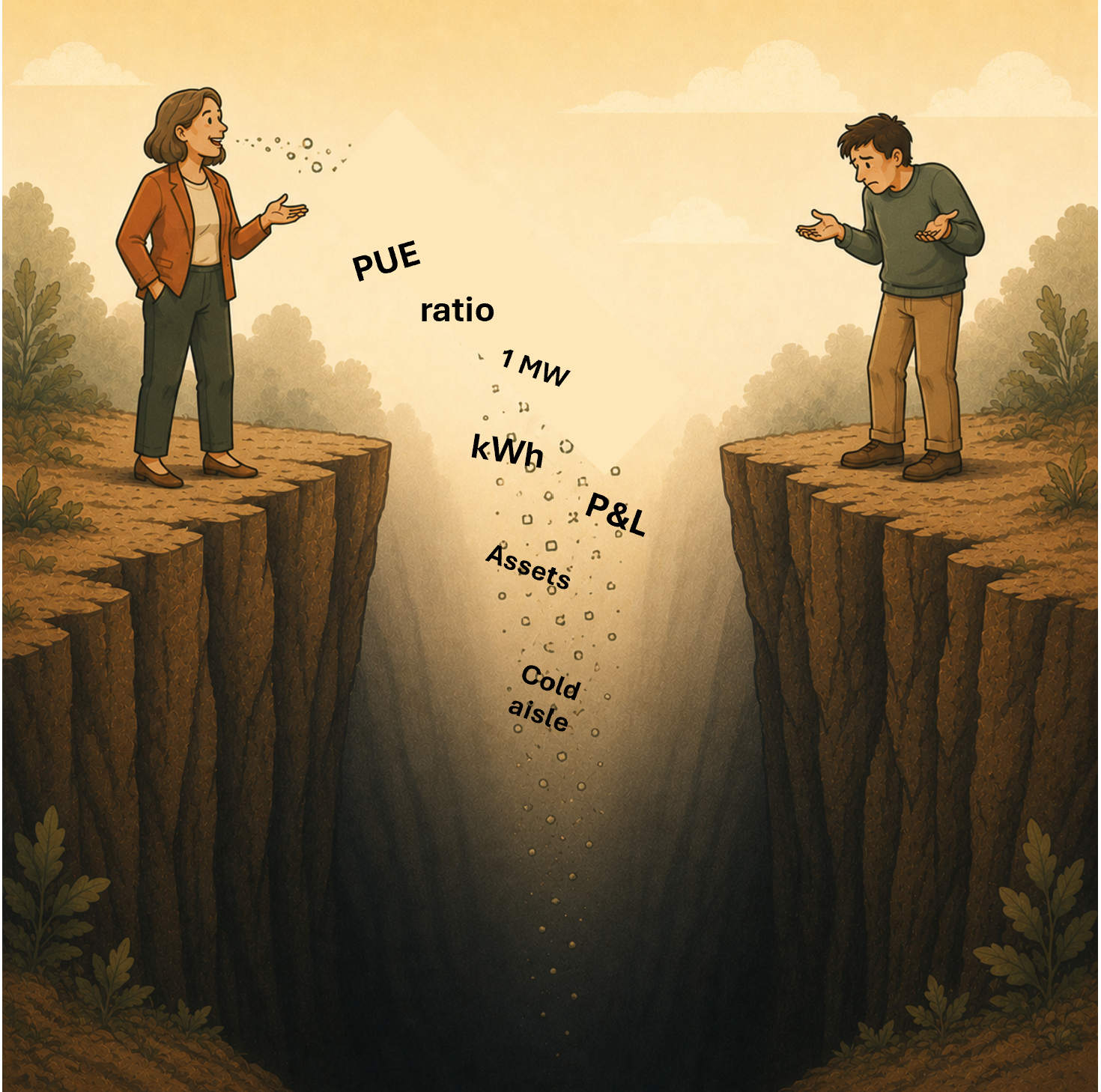
Ask a data centre operator about their water use and you might hear: “Our WUE is below 0.4 litres per kWh and we operate a closed-loop cooling system.” Every word of that may be accurate. But the person asking may not be able to understand what the words mean. And in a world where trust is hard won and easily lost, an accurate answer that no one can interpret is not much better than no answer at all.
People are not asking because they want to catch you out. They are asking because they genuinely want to know whether the organisation they are choosing to support – with their money, their work, their community – is doing the right thing. When the answer comes back in acronyms and metrics, many of them quietly walk away unsure whether they have received a real answer.
It Is Not Just a Data Centre Problem
Before this starts to feel like a niche concern for a specific industry, stop and consider how many professions run on a private language that is invisible to outsiders.
A banker talks about basis points, LTV ratios, and credit ratings. An insurer talks about loss ratios, combined ratios, and actuarial reserves. An engineer talks about torque tolerances, shear loads, and thermal gradients. A finance director talks about EBITDA, working capital cycles, and covenant headroom.
That language works well when everyone shares the same vocabulary. The moment you step outside that shared vocabulary, it starts to lose people. Not because the other person is less capable, but because they simply do not carry the same dictionary.
And the truth is that most professionals are so immersed in their own terminology that they genuinely do not notice it anymore. It has become invisible. They are not choosing to be opaque. They are simply speaking the way they always speak, in the environment where they have always spoken it, without realising they have walked into a different room.
That is the problem. And it is solvable.
What People Are Actually Asking
When a community near a data centre asks about water use, they are not asking for a WUE figure. They are asking: are you using up water that our farms, homes, and rivers need?
When a consumer asks a bank about its investments in fossil fuels, they are not asking for a portfolio carbon intensity disclosure. They are asking: is my money helping or hurting?
When an employee asks their engineering firm about safety, they are not asking for a RIDDOR incident rate. They are asking: will I go home safe tonight, and does this company care whether I do?
Underneath every technical question is a human one. And the human question is the one that actually needs answering – first, and in plain language.
Getting there does not require abandoning technical rigour. It requires translation. There is a meaningful difference between the two. Dumbing down strips out accuracy. Translating carries it across.
Why This Matters More Now
People know more about sustainability today than they did ten years ago.
They may not know every metric, standard, or reporting framework. But they know enough to ask thoughtful questions about carbon emissions, water use, biodiversity, and community impact.
Expectations around transparency have changed too. An answer that satisfies a reporting requirement is no longer enough if it leaves the reader more confused than informed.
The organisations building trust today are the ones that explain more than the numbers. They explain what it means in practice for the people who read it, hear it, and live with the consequences of those decisions.
The Community Question
There is one dimension of this that is particularly underserved in most technical communications: local impact.
A data centre, a manufacturing plant, a logistics hub, a financial services office – all of these exist somewhere. They are in a community. They draw on local infrastructure. They affect local roads, water tables, power grids, employment markets, and in some cases, air and noise quality.
When local people ask questions – and they do ask – they deserve answers that speak to their lives, not to an industry standard. “Our cooling system operates within ASHRAE Class A2 parameters and our WUE is below the regional average” does not answer the question “are you taking water out of the ground that we rely on?”
A plain answer might be:
“Our system reuses the same water in a closed loop, so we are not drawing from local groundwater supplies on an ongoing basis. In the fifteen years this facility has operated, we have not needed to source water locally in the way a conventional industrial facility would. We publish our water use figures annually.”
That is the same fact. Expressed in a way that the community can actually use.
The Plain-English Message Worksheet
To help technical professionals make this shift, I developed a free downloadable tool: the Plain-English Message Worksheet.
Rather than defining jargon, it helps you translate technical concepts into language that a wider audience can understand.
👉 Download the Plain-English Message Worksheet below – free
The tool walks you through six steps:
Step 1 – Strip the jargon
Before you write a word, identify every acronym and technical term in your message. Then find an everyday substitute for each one.
Step 2 – Explain what is actually happening
Describe the physical process in plain terms. What does the system actually do? What problem does it solve? What are you avoiding that a less efficient operation would be doing?
Step 3 – Make the number mean something
Convert your metric into everyday scale. Compare it to something familiar. Explain which direction is good and why. Express it over a time period that means something to a human being – not per kWh, but per year, or over the life of the building.
Step 4 – Connect to what your audience cares about
Different audiences have different concerns. Finance needs cost and risk. HR needs people and culture. A local community needs to know what this means for their water, their roads, their jobs. Finish the sentence: “What this means for you is…” – and mean it.
Step 5 – Show your workings, briefly
How do you measure what you’re claiming? Is it published? Is it independently verified? Transparency is not a weakness. It is what distinguishes a credible claim from a marketing line.
Step 6 – Build your message
Draft it sentence by sentence. Aim for five sentences. No unexplained acronyms. No number without a benchmark. Read it back and ask: would someone who has never set foot in my industry understand this, and believe it?
The Bottom Line
Expertise is only as useful as your ability to share it. The most credible technical professionals are not the ones who know the most acronyms – they are the ones who can make complex things clear to the people who need to understand them.
This is not a communications problem that belongs to a comms team. It belongs to every engineer, analyst, underwriter, and technician who has ever been asked to explain their work to someone outside their field. Which is to say: all of us, eventually.
The world is asking better questions about sustainability, about impact, about what organisations actually do and whether it is good for the communities they operate in. Those questions deserve real answers.
Speak human first. The technical detail will land better when it does.


