Stop. Check. Reset

You don’t have to be falling apart to be running out of capacity – your ability to think clearly, manage what life asks of you and still have energy left for yourself.
We tend to notice when something finally becomes a problem. We are exhausted. Work feels harder. Commitments become burdensome. Things that normally wouldn’t bother us start to irritate us. Eventually, something has to change.
But what was happening three months earlier? That is perhaps the more useful question.
Declining capacity rarely announces itself. More often, small things begin to change. You have less energy. Decisions take more effort. Patience gets shorter. Things you normally enjoy get pushed aside. Your free time gets filled without necessarily leaving you restored.
And because many of us are remarkably good at compensating, we can continue functioning while missing the pattern ourselves. That’s why paying attention matters.
Performing doesn’t necessarily mean everything is fine
When demands increase, many of us compensate. We reorganise, work longer, cover gaps and squeeze in another priority. Our personal lives often make room for it.
For a while, that works. But our ability to compensate can hide declining capacity – from ourselves as well as those around us.
I wrote previously about clearing your mental RAM when unfinished tasks, worries and reminders are competing for attention. That can reduce cognitive load. But what if the RAM keeps filling up faster than you can clear it?
That deserves a closer look.
Look for change, not perfection
There isn’t one universal version of a healthy working day. One person happily spends six hours talking to people and finishes energised. Another needs quiet thinking time between meetings. Some people naturally work in bursts; others prefer a steady rhythm.
So rather than asking whether your working habits match somebody else’s definition of healthy, compare yourself with yourself.
Think about the last three months.
- Are you more tired at the end of an ordinary working day than you used to be?
- Are relatively small interruptions irritating you?
- Are you postponing decisions or conversations you would normally just deal with?
- Are you finding it harder to concentrate deeply?
- Have you stopped doing some of the things that normally help you recover?
- When was the last time you took two or more days off simply to relax?
And perhaps most importantly:
Are several of these things changing at the same time?
One difficult week is a difficult week. A pattern of difficult weeks is different.
Don’t just measure workload
Burnout isn’t only about how much work you have. It is also about what that work demands from you. Uncertainty, conflict, responsibility without enough authority, or spending too much time on work that drains rather than energises you can all consume capacity.
Sometimes there is no single big problem. It is the accumulation that matters. So don’t just count the workload. Look at the pattern.
Look at the cost, not just the hours
Extra work has a cost beyond the hours themselves. An extra hour working may mean an hour less sleeping, walking, pursuing an interest or simply allowing your mind to disengage.
Repeated over time, we aren’t just adding work or commitments. We are removing opportunities to restore our capacity. I call that the Capacity Cost – what we lose when work or other commitments repeatedly take the place of time that could restore us.
I recognise this trap in myself. I enjoy working, so if I haven’t decided how I want to use my time afterwards, it is remarkably easy to just keep going. Nothing has been cancelled, so it doesn’t feel as though I’ve given anything up.
But restoration also needs intention. If we don’t deliberately make room for it, something else will readily fill the space. Perhaps we need to take our restoration time as seriously as we take our commitments.
Try the Capacity Cost & Recharge Map
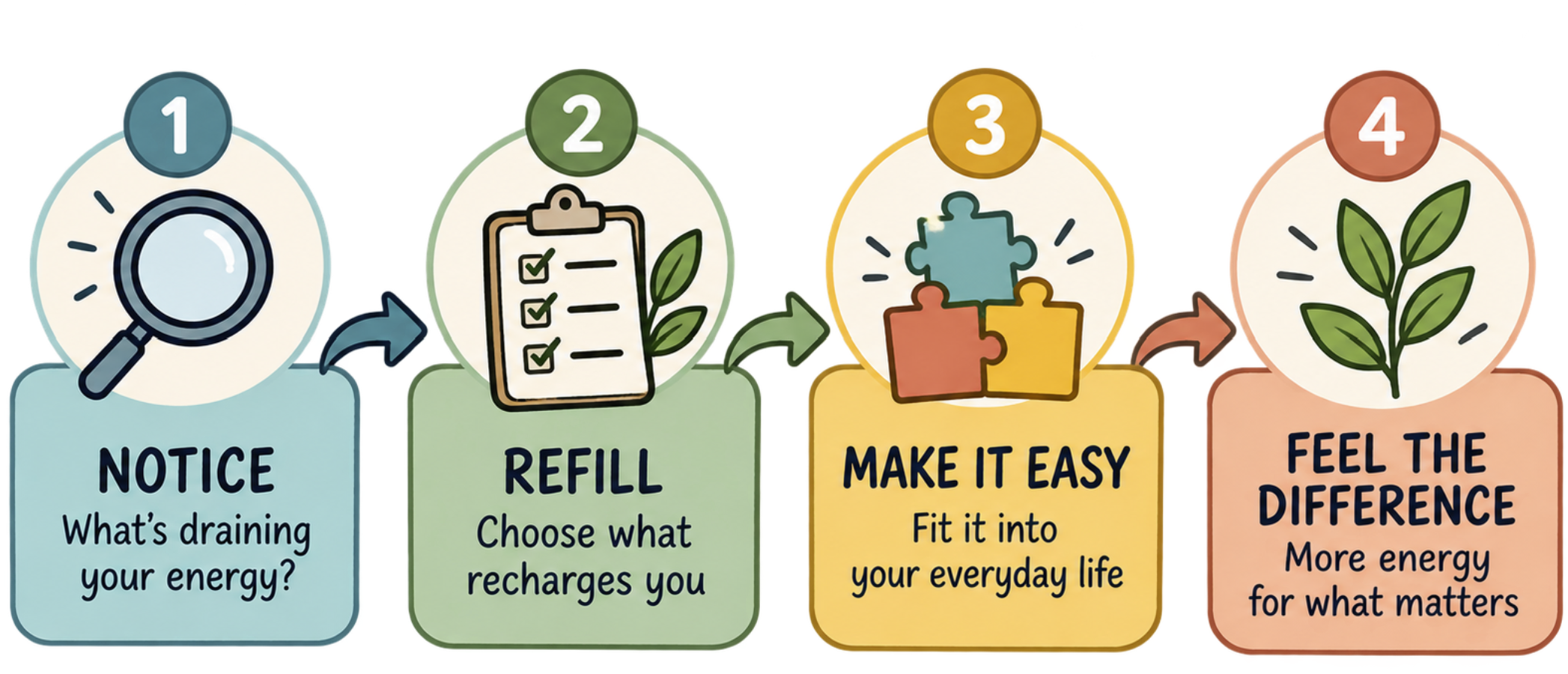
I am sharing the Burnout Before It Happens – Capacity Cost & Recharge Map to help make the time trade-off visible. (The worksheet shared below is free to download)
It does not diagnose burnout or give you a burnout score. Instead, it helps you work through four questions:
- What has changed from my normal?
Use the traffic-light check to notice changes in your energy, thinking, behaviour, relationships and recovery – and how long those changes have been there. - What is work costing me?
Look back over the last seven days. Record the disposable hours work consumed and, importantly, what you would otherwise have done with them. - What genuinely restores me?
Build your own recharge menu. Don’t choose what you think you should do. Choose things you actually want to do and that leave you feeling restored or energised. - What will I exchange?
Don’t try to redesign your life in two days. Start small. Reclaim one or two hours this week for something that genuinely restores or energises you, protect that time and see what you notice. Choose some of your disposable time and deliberately create an opportunity to recharge by exchanging hours you might otherwise spend working for something from your recharge list. Then decide what you will do within the next 48 hours to protect that time.
A few tips and watch-outs
- Be honest about “temporary”. A difficult fortnight really can be temporary. But if the same conditions have continued for one or two months without a clear end in sight, challenge the assumption. It may have quietly become your normal way of working.
- Don’t turn recovery into another obligation. Another should can easily become another task you don’t do. Choose things you enjoy and that are easy to start. Ask: “Will I look forward to doing this again?” and “How easy is it to start?” Sometimes the best choices simply fit into what you already do – like walking for a few minutes from your standing desk to clear your head.
- Protect the time before work claims it. Put it in your calendar. Contact the friend. Book the ticket. Move the meeting. Take the day off. The tool asks you to take one practical action within 48 hours because good intentions are remarkably easy to schedule for some mythical quieter week.
- Watch the pattern, not one week. Use the four-week experiment. The spreadsheet tracks the hours work took from your disposable time, the hours you deliberately reclaimed and your resulting Net Capacity Cost. You are looking for patterns, not perfection.
Earlier is easier
We maintain equipment before it fails. We manage project risks before they become incidents. Yet with ourselves, we often wait for the warning light to become a breakdown.
So don’t just ask: “Can I keep going?” You probably can.
Ask instead: “What is it costing me?”
Then: “What can I change?”
You may not be able to remove the biggest pressure, but you can change something – delegate, postpone, stop or protect your time to restore.
You don’t have to solve everything today. Just stop allowing quality time to slip you by.
Stop. Check. Reset.