Linking Performance Reviews and Merit Increases


Employee performance outcomes is one important aspect to be reviewed when it comes to considering merit increases. It is not the only consideration though. Overall merit increase budgets, inflation, changes in external benchmarks for specific roles, current compensation ratios etc. are all additional elements which would impact actual merit increases per department and employee.

The resource I have here ties a specific overall individual performance review score to a specific range of possible merit increases. Some managers require a highly structured and fixed process for determining % changes and this is one way to create one. One should however also be sure to consider the other aspects mentioned above: budget for increases that year, company performance in the last year (overall), the market value of specific roles (roles that are in high demand). Compensation has a powerful influence on employee engagement and retention, but it is not the only one. Employees also care about career growth, flexible benefits and being helped to develop further.

I would caution anyone to consider unintended outcomes when attempting to standardize and establish rigid structures for considering individual performance and linking that in a fixed way to merit increase percentages. While intentions may be good: to reward your best performers for their contributions and to ensure those with lesser performance improve or leave the company, a process that is overly structured could fail to accomplish that intention.
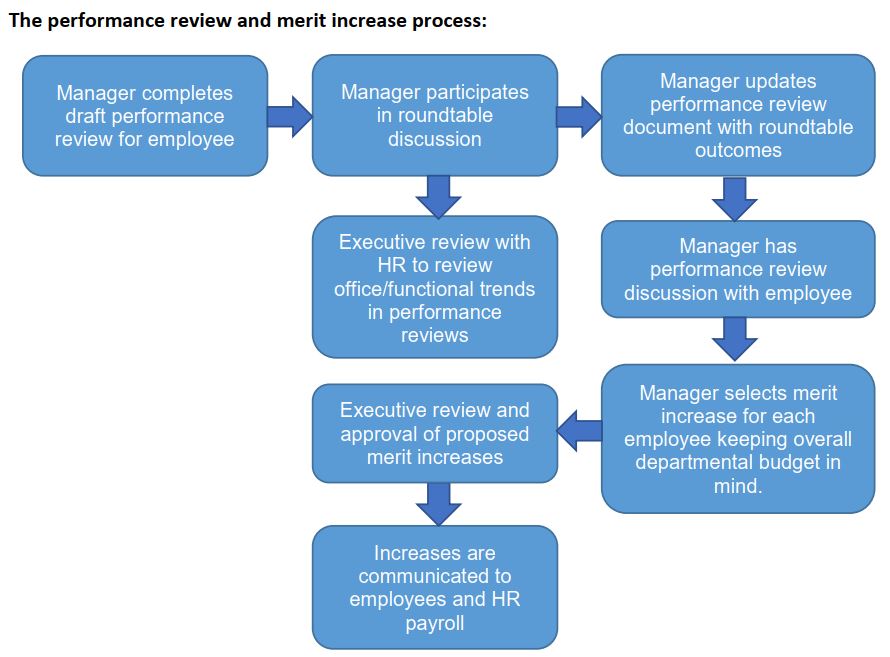
The approach shared above – see download link – indicates one way in which a group has established a direct link tying the performance review process directly to the merit increase process. This example does not take into account some of the considerations highlighted above when it comes to selecting the actual increase percentage and I chose to share this resource anyway, because it does happen that HR is asked for a process like the attached on a regular basis and I want to make an example available to you if you find yourself in that situation.

I do suggest you consider ways to incorporate the other aspects as outlined above when you finalize your proposal to implement a more structured approach to tie performance management to compensation review.

My main advice is to think it through carefully to ensure your good intentions have the best chance of being reinforced by your performance management process and pay-for-performance approach . And I would also add that you should remain flexible in working with your documented process. Be ready and willing to adjust and update it as you gather input about how successful your process is in driving desired outcomes – results and behavior that you and the executives would like to see in your pool of employees.

Performance Management – setting up the annual process


final perf imp

The HR function manages a few processes which take place at various points over a 12-month period. Think of the annual salary reviews, annual training needs analysis, bonus calculations and performance management processes.

It is important to managers to have a clear understanding of each of these processes and when they take place throughout the year. If you set all of these processes on a regular annual schedule it helps managers to correctly anticipate next steps in processes and provide input required in a timely manner.

The process

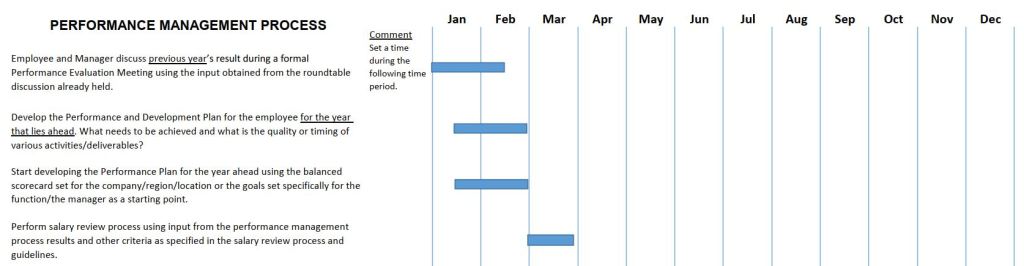
This generic performance management process schedule I am sharing with you (see download option below) shows the various basic steps that would need to be followed over a 12 month period. There are references to the link with a salary/compensation review process and also the link with identifying and reviewing individual development needs and progress along achieving improvement goals.

Download a copy below

Implementing a process like this would need a change management plan if your organization has never done anything like this before. Even if you have had some form of a performance management process in place, but would now like to expand on it to include some of the elements shown in the attachment, a change management plan would be recommended. Before you start you would of course ensure that the manager/director, who is accountable for the performance management process at your organization, is aligned with your ideas and suggestions and strongly supports the direction you would like to take.

The benefits of having a documented process for Performance Management are:
  • It is easy for HR to ensure new employees, current employees, new supervisors and existing managers understand the process and their role in the process.
  • It is a way to help stakeholders understand and then prepare for the input and actions they need to complete in order to support the process.
  • Linked to a balanced score card, the process can make it clear to individuals/departments how they collectively and as individuals support the attainment of larger organizational performance goals.
  • Knowing that there are check-in moments for feedback and discussion moments around performance expectations, progress and development needs and activities can be a strong way to reinforce employee engagement. Many employees tend to consider other employment options when they feel that their development and career progression goals are not being met by their current employer.

This list is not exhaustive. For more information about benefits see links like Benefits of performance management or Importance of Performance Management

Prepare to Negotiate – Tips and a Worksheet


arm wrestle
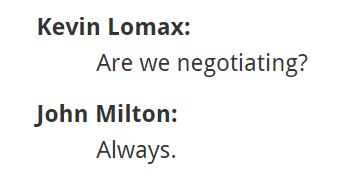
(The Devil’s Advocate, 1997)

The quote from the movie, The Devil’s Advocate, sums it up perfectly. Whether we like it or not, in life we are negotiating more often than we think we are.

Negotiation skills is something that most people can improve upon. There are several training options available if you want to make this a developmental priority. And there are also a few training games which offer you the opportunity to test your negotiating skills in role-plays.

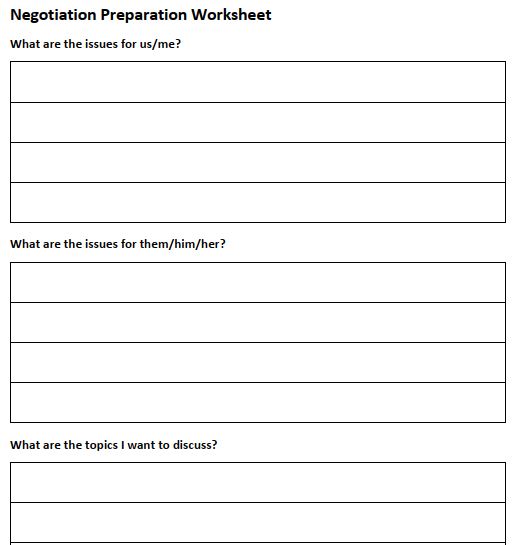
The resource that I am sharing is more generic and it helps you jot down some important notes before enter a negotiating process.

The worksheet, which you can download above, can help both experienced and new negotiators to organize their thoughts and prepare for a negotiation. Having your notes available during the negotiation discussions can help you maintain your focus and avoid distractions or knee-jerk reactions during crucial moments and stages of the discussion.

Uses:

  • Preparing for actual negotiations.
  • In training sessions to train participants on how to prepare and demonstrate the importance of this planning during a role-play later.
  • Prepare for discussion with supervisor/manager on salary increase.
  • Document your thinking going into a negotiation to support a post-negotiation lessons-learned reflection later which can help you and your team to continuously improve upon your past performances.

Cross-cultural Negotiations

When negotiating with someone who is from another cultural background than your own, remember that you will need to watch out for communicational disconnects based on having some of the following misaligment:

  • If the negotiating parties do not have the same first language and at least one party is negotiating in a non-native language there could be misunderstandings around the use of words of phrases. Use simple language and engage with translators if you want to avoid misunderstandings. .
  • Having different cultural views and perspectives, the relative importance of not only items negotiated but interaction with each other (from a relationship perspective) during the breaks or meals during days of negotiation could lead to unintended misunderstandings. Some actions or comments could even negatively impact the trust in the interpersonal relationship.
  • Depending on one’s view of the world, one tends to project your own views onto others as if everyone thinks and reasons like your would. That can lead to using methods of persuasion that would work in your own culture and it may be ineffective with others cultures. . Learn about the culture of key negotiators on the other side and learn what might persuade them vs only looking at your own experience and perspectives.
  • Establishing and maintaining trust can vary from one culture to another. Be slow to distrust the other party from another culture based on limited evidence of low-trust actions. Always engage with a cultural coach to help you correctly interpret the actions and communications from those from other cultures that you may be negotiating with.
  • Remember that negotiations are often not a one-time activity, but a business relationship that may span months or even years depending on how often roles changes at either party’s company. Take time to understand and get to know the other person or party that you often need to negotiate with. The more you know about the person and his or her preferences and views, the more successful your negotiations are likely to be.

Prepare by knowing a few key aspects about the other party

Checklist

Not all negotiations result in a definite outcome. In many cases discussions can take place over a long period of time. The better you are at understanding the other party and what her or she wants and values compared to your own needs and values, the better your chances would be to reach a win-win outcome for both yourself and the other party. And you will be able to leave the door open for successful future negotiations if you pay the right attention to the interpersonal relationship with the other party and not only to getting your own needs met in a win-lose way.

Planning Developmental Assignments – Process and Preparing Assignee


global travel5

A decade ago it seemed to be more common for employees to be on developmental assignments for longer periods of time. These days the duration of assignments seems to have become shorter. The required steps are not much different though.

It is vital for the organization to have a clear process around the mobilization, preparation, sustaining, return, development of assignees and there are multiple organizations (internally and possibly externally if outsourced) which need to contribute to the process in order to make the assignment a successful one for the company and the employee

Some of the biggest unintended outcomes of assignments are:

  • The employee (and/or family) did not fully understand what they were getting into and found it too overwhelming at the assignment location – wished to return earlier or resigned.
  • Employee did not understand how the assignment was adding to his or her skill sets or competencies and he or she ended up frustrated and demotivated.
  • Employee on assignment no longer felt connected to the home office and were anxious about what happens after the assignment – wished to return earlier or resigned.
  • Employees (and families) experienced a high level of anxiety associated with the assignments due to inadequate preparation and support before, during and after return to home location.

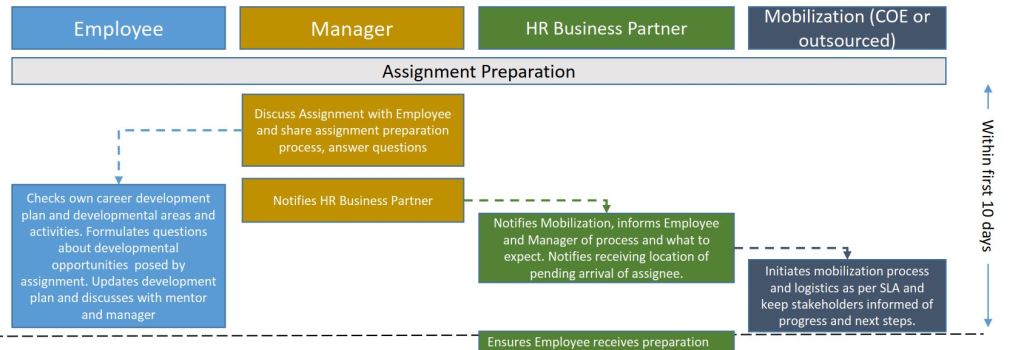
The process flow shared here shows a simplified version of how a developmental assignment should be planned and executed before mobilization, during and after an assignment has ended. It takes into account the logistics part, which may be an internal organization (Center of Excellence) or an outsourced party, the role of the manager, the role of the employee and how the Business Partner can contribute to ensure the entire process yields the desired outcomes. There are also some suggestions for surveys to capture any feedback to identify useful improvements to the process.

Some additional tips:

  • Make sure that managers are clear on the process, the various steps and the specific roles and responsibilities. Most employees will ask their managers for advice and information first. The role of the manager is very important to ensure future retention of the employee by staying in touch and ensuring the employee continues to feel valued by the organization during and after the assignment.
  • Create or outsource a solid assignment preparation program for employees (and families as applicable). This includes cultural awareness training, language training (if applicable) and developing the right mindset and approach to living in a new country for a period of time.
  • Apply attention and diligence when outsourcing logistics and defining the SLAs associated with mobilization. Lost goods, delays in finding accommodation, faulty or missing paperwork can cause a lot of unnecessary distraction and anxiety on the part of an employee on assignment. Conduct regular audits and have discussions with an outsourcing partner/COE using the surveys as a basis to provide input aimed at improving the experience of assignees.
  • Ensure either the Business Partner or the Manager has discussions with the employees to be sent on the assignment to ensure they understand how to leverage the opportunity to improve on their own skill sets/competencies and how they should contribute to the learning of those at the assignment location and again to the learning of those at the home office upon their return.

Preparation and Training

Training and support in these areas (see below) will help each assignee and his/her family – should they accompany the assignee – the best opportunity to understand the assignment requirements and the local culture better. And having an improved awareness will enable the assignee (and family) to have a solid plan of how they would set-up their start-up activities at the new location for a successful assignment experience and conclusion.

Being sent on an assignment is both an opportunity and a responsibility for the assignee. It can bring out the best and worst in a person as he/she (and the family) face huge life changes compared to life at the home office. The experience can lead to increased maturity, improved leadership skills and understanding and increased knowledge and skills if managed properly. As the manager, business partner or any other stakeholder in the process, it is important you ensure there is a clear process mapped out which details the various steps by process contributor and that each stakeholder is acutely aware of the bigger picture while performing own parts.

Life Balance Blueprint – a Template


Understanding Your Starting Point: A Blueprint for Balanced Living

Before embarking on a journey of self-improvement, it’s essential to assess your current position. This template will guide you through a self-evaluation, helping you identify strengths, weaknesses, and life areas that require greater attention. By understanding your starting point, you can set realistic goals and create a personalized plan for achieving a more balanced and fulfilling life.

A Holistic Approach to Self-Assessment

Many coaches utilize tools like this template to help clients gain a broader perspective on their lives. By examining various aspects of life, such as career, relationships, health, and finances, coaching clients can identify areas of strength and areas that need improvement. This holistic approach provides a clearer picture of overall well-being and facilitates more effective goal-setting.

Consider using this template as a yearly check-in to track progress and ensure a balanced lifestyle.

Addressing Burnout Through Self-Assessment

If you’re experiencing signs of burnout, this tool can be a valuable aid. By examining your life from a holistic perspective, you can identify areas where your actions and schedule choices may not align with your values. This self-awareness can help you make necessary lifestyle adjustments to restore balance and turn things around.

Imagine your life looked like a pizza

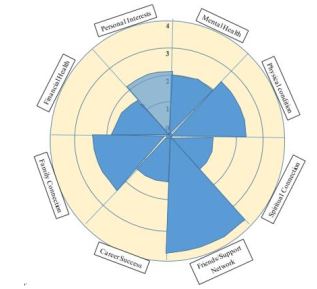
The starting point is to imagine your life has segments or aspects that matter to you. Imagine there is a segment called Financial Health which is important to you because you like to have nice new clothes and a nice car. So you would have to make sure you pay attention to being able to earn money so that you are able to buy those things that matter to you. Another segment may be friends – and it would be important to spend time with your friends or you may find they are less engaged with you. This is how one starts to identify what each of those “pizza slices” of your life may be.

Visualizing Your Life Balance

After completing the self-assessment below, color-code each segment to visualize your life balance. A high score in one area might contrast sharply with a low score in another. This visual representation provides a clear picture of where your focus lies and where you might need to make adjustments.

This template can be the basis for evaluating your “life set-up” and then you can work with your coach to discuss how balanced this is for you given your priorities in life. If you want to increase the outcomes in a specific area, simply start setting some goals in that area and then plan to follow through with actions to help achieve them.

Partnering with a Coach for Personalized Guidance

While self-assessment is valuable, working with a coach can provide deeper insights and personalized guidance. A coach can help you interpret your results, set meaningful goals, and create a tailored action plan. Additionally, having a coach to hold you accountable can increase your motivation and ensure you stay on track.

Achieving a Balanced Life: The Power of Prioritization

By regularly assessing your life balance and identifying areas that require attention, you can take proactive steps to enhance your overall well-being. Remember, life balance is not about perfection; it’s about consciously prioritizing the areas that matter most to you. By aligning your actions with your values, you can create a more fulfilling and harmonious life.

Inbox Exercise for leadership development


Inbox exercises are often used when there is an evaluation of leadership/management style and skills or training in time management, judgment or decision-making. I believe the value of this resource lies in revealing the thought processes of an exercise participant. It reveals HOW the person going through the exercise reasons and reacts to typical tasks that they could face as a manager or supervisor.

While you can keep track of how many pages the person completed within the time provided or how many of the actions the person chose aligned with what is considered “correct” in your company (and desired company culture) the highest value (for me) is the coaching conversations that can be had around the reasons that the actions were chosen. These conversations can really help leaders understand their impact on others and improve their self-awareness as a result.

The exercise setup

The attached inbox exercise requires you to print out items and provide them to intended participants in the exercise. The first page describes the situation which you should share with the participant(s) as part of the exercise. The next two pages are then for your eyes only and they will help you to understand the set-up and what you, as the facilitator, should do with that particular exercise page. The section that follows behind the “Worksheet” page is provided to participants once the Q and A portion of the instructions discussion is over.

Once the participant understands the scenario the worksheets are handed out to him/her to complete. This is the inbox exercise and it is usually a timed exercise. Exercises include aspects like this:

Considerations:

  • If you choose to include priory setting as one of the test elements, consider using something like the Eisenhower/Covey matrix:
eisenhower covey priority box

You can read more about it here : Priority matrix write-up  If you decide to   include priority-setting as an element, this  approach will give you a  better   foundation for debriefing discussions.

  • You can use this exercise with a class of participants and then I would suggest you have each participant check the work of his/her neighbor once the exercise has been timed-out. Read out the action considered best for each of the incidents and assign a score for correct answers. Of course you can use your own judgment when some participants have similar answers/responses, but just worded it differently.
  • I prefer to use this with a small group of people who are in a coaching program. The results of their work can then be debriefed more fully with their coaches who can explore their responses deeper by asking questions around : how did they interpret the note/incident? Why did they choose that action? Did they consider other options? If so, which ones? How/why did they decide to select that particular action? How did the limited time impact their thinking and responses?

Leaders learn through reflection and an experience such as this inbox exercise is full of opportunities to reflect on own actions, choices and mindsets. The hardest part about improving one’s mindset or way of doing things, is gaining awareness of one’s own style or impact on others. The specific examples that come out of this inbox exercise is a very tangible basis for reflection with a coach and then choosing better ways in the future.

Coaching Effectiveness Survey


While it is a good idea for coaches to periodically discuss how well the process may be working for those that they are coaching, it is also a good idea for HR/Learning and Development to get feedback on the coaching program on an annual basis. Occasional informal feedback from the person being coached to the coach directly may help the coach improve the person’s coaching experience and outcomes reached.

A formal annual survey helps the department responsible for managing and monitoring the coaching program to understand a few things:

  • General questions that coaching participants may still have about the process or program objectives.
  • How to improve the training of coaches to improve developmental outcomes.
  • How well the relationships are working between coaches and those being coached. Perhaps an intervention may be needed in cases where a high level of dissatisfaction is recorded?
  • Whether the coaching process is working well in general – meetings are held on a regular basis and the right topics are being discussed.

Coaching survey

The coaching survey above (see download option) contains questions you may want to consider for your annual coaching effectiveness survey and it also contains some suggested wording for the introduction email to those who are being coached to explain the survey and its purposes.

Gather the survey feedback and analyze it for overall coaching program effectiveness, but also look at individual responses to see if anyone is having a particularly negative view about his or her coach or the coaching process.  When you take action on individual responses pay close attention to the confidentiality statement you put in the email that went with the survey. Do not reveal someone’s input to his or her coach unless it was expressly established that the survey respondent consent to this course of action. Also use the information gathered from the survey to improve your orientation slides for the next coaching program and to improve future training you offer to coaches.

Other coaching resources that may be useful for setting up your coaching program: preparing for coaching, coaching questions, coaching program orientation slides.

Coaching Program Orientation – Presentation


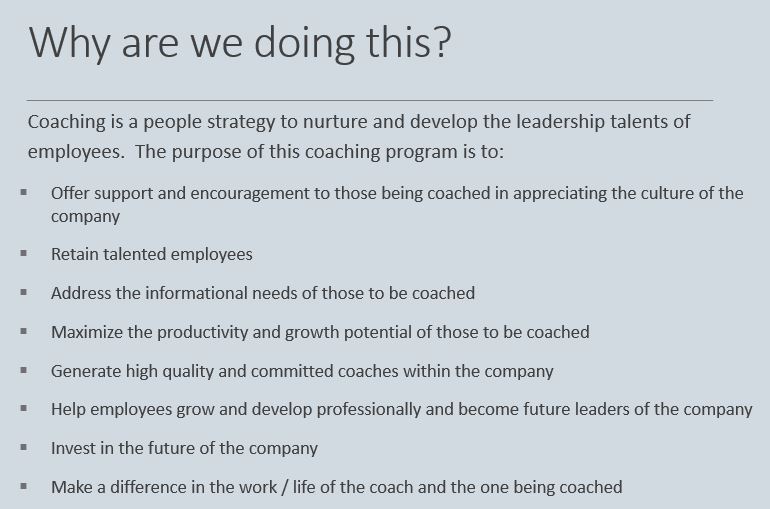
All coaching programs should contain an orientation as one of the starting elements. This session should cover the objectives of the program, what the expectations are for both coaches and those to be coached and any other general information that would be important for the participants of your coaching program. You can choose to combine the two groups for the session or you could choose to do separate sessions for coaches and those to be coached. If you choose the former you may want to add a training or reminder section of any specific coaching aspects that you wish to empathize.

Slides for the orientation meeting

The download file above contains a series of slides to help you get started creating your own. It shows some of the typical questions that coaching program participants may have and answers that may be relevant, but of course subject to your edits to suit your specific needs.

Tips:

  • Be sure to have a Q and A portion to answer any specific questions that anyone may have.
  • The front part of the presentation which sets the scene in terms of “no entitlement to promotion etc.” would be relevant if you have experienced that as an issue in your workforce or talented employee pool. In some cultures that may be seen as “offensive” or even “threatening” that it would be mentioned. So be culturally sensitive when you consider keeping that comment.
  • In the roles section I mention HR as the function supporting the coaching program – depending on your organization that could be your Learning and Development department, your Organization Development (OD) group or any other department/group.
  • Be sure to provide the coaches and those to be coached with all the tools they will need. If not printed and handed out at your orientation session, then perhaps a soft copy on a USB stick or per email after the session. Coaching questions or Preparation for Coaching

Preparing for a Coaching Session


Coaching sessions and programs are more successful when there are clear coaching goals and actions planned are documented. These developmental actions and activities should be reviewed and updated on a regular basis. It helps both the coach and the person being coached to maintain focus on desired outcomes..

Many employees who are new to coaching have misguided expectations about the coaching process and their own role in it. They expect the coach would show up at each session ready to provide them with useful information and advice and all they needed to do was to show up. In reality the coaching process works much better when both parties actively participate and prepare for each session.

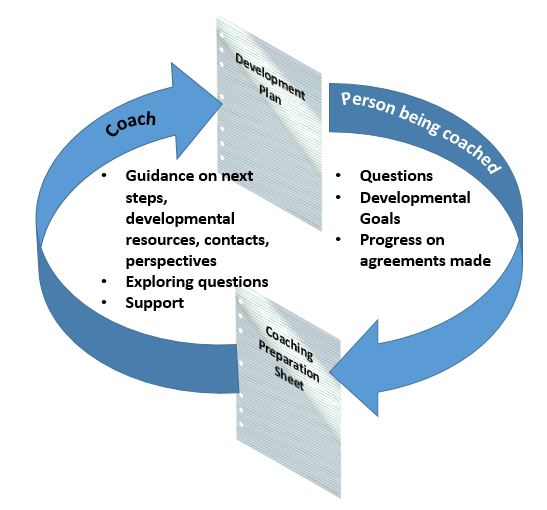
Coaching process JAG

This process graphic shows that each party in the coaching process provides input and participates in the process. The results are written down and shared to ensure a common understanding of the goals and that progress towards goal achievement is maintained.

Preparation worksheet for Coaching

Tips:

  • For those being coached: make sure you get your completed preparation sheet to your coach at least a few days before the session so that the coach can take your feedback into account. This helps him or her prepare to answer your questions and obtain any additional information and resources that may be useful to you at this time and bring it to the session.
  • For coaches: take note of the questions and struggles that may be noted in the preparation sheet. Consider how you can best help address those issues and which resources can you provide to help in the process? What is the best way to approach the coaching session – given those questions, issues and of course the overall goals that had been set for the coaching process?
  • Do remember to look back at previous preparation sheets and also the updated development plan on occasion (maybe once every 6 months) to recognize and appreciate progress made to date and to help motivate those being coached to take the next steps that may be required towards ultimate goal achievement.

Coaching is a shared responsibility between the coach and the person being coached. Only then, does the process yield the best results. And preparation is a key part of this shared responsibility.

Questions for Coaching


Many managers mistakenly think coaching is about “telling” others what they should be doing. While some very inexperienced people may need you to tell them what to do or how to do it, most others need to learn and explore topics and new skills or behaviors with their coaches instead. The hard part for many coaches is to listen and ask the right questions. And also to refrain from taking up most of the airtime during coaching sessions talking about their own lives and their own stories or just offering advice. While children happily accept new information simply because you tell them how things are, adults prefer to explore and learn by comparing and assimilating what you are sharing with what they already know and have learned in their pasts.

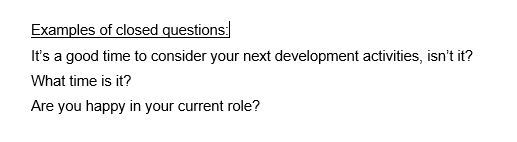
closed question examples
Closed Questions

Coaching sessions is about asking open-ended questions which leads to learning and exploring. Asking the right questions is not an easy assignment to have as a coach. Some questions shut others down while limiting them to “yes” or “no” answers which does not allow for a rich conversation of exploration around the topic concerned. Closed questions are those that can be answered by a simple yes or no answer.

More useful questions to ask :

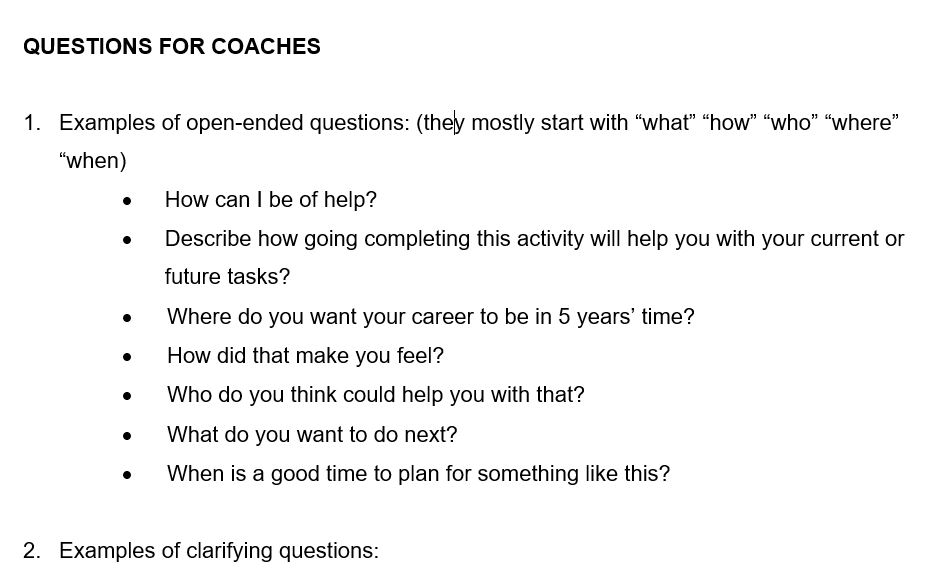
  • Open-ended questions help others expand on ideas and contribute to the conversation vs staying mostly in listening-mode. These kinds of questions can help you discover the other person’s thought processes, motivations and how they feel about a topic or an option.
  • Clarifying questions are helpful to ensure you understood your conversation partner correctly. When people get going on topics that they feel quite excited or passionate about they can sometimes lose sight of how familiar you are with that same topic. To ensure you (the coach) are able to follow along, you may need to pause, look back and clarify any comment made which you were unable to place within the context of the topic being discussed.
  • Paraphrasing. This is a useful technique to summarize what you heard so far and help move the conversation towards a decision or planning a specific path forward (action). It also helps ensure that your impressions of what was said are correct. It can be very validating for someone to hear their own words summarized correctly by another trusted person (in this case you, as the coach).

This list of questions for coaches (which you can download above) can help you to ask the right questions at your next coaching session. I recommend you read through this as you prepare for the session, but do not commit yourself to asking specific pre-determined questions regardless of how the conversation goes. The important part about asking questions at a coaching session is that you (the coach) show up with a mindset of curiosity. That opens up the exploration in the conversation and enables learning to take place which is vital for adults in their learning process.

Use the links to other content which I show below and also the resource I am sharing above as a way to prepare for and get into inquiry mode before the planned coaching session.

These are great questions to consider asking when you coach: Life Coaching Questions    Coaching questions for managers