Team Activity – Defining Project Interfaces


Most projects are made up of several sub-groups of people. On a construction project you can imagine there is a group of people tasked with looking after the physical safety of people working on the site. You can also imagine another group that looks after checking that materials and installed units meet quality requirements. These sub-groups of people have interfaces with each other whereby they exchange and share information, documents and outcomes. They also provide and request support from other groups to start, complete and execute a process. Most of the time project inefficiencies occur across the interfaces with internal and external sub-groups or functions.

The best way to ensure efficiency and effectiveness across project interfaces is to increase transparency around assumptions that people have . Test whether they are accurate and understood by others on the project.

Note that project interfaces can also refer to processes that involve multiple functions in the home office environment or the company structure. These “external” groups to the project may be setting high-level processes and goals, which create the environment that the project team needs to operate in. Examples may include HR, Finance, the group that tracks compliance with corporate policies and procedures etc.

This team building activity that I am sharing helps various interfacing groups understand differences that may exist between how they think they should be interfacing with other groups and what the actual expectations from other groups are.

This activity can be used in many different ways:

  • Clearing up interface issues among geographically dispersed groups working on the same processes or projects;
  • Clarifying how different functions should interface with one another on a project;
  • Clarifying any differences in perspective among cultural groups or different shifts of people in the same function working on the same tasks interfacing with one another; and
  • Getting clarity on how multiple projects should interface with each other and/or the corporate groups they work with.

The reason that interfaces with other groups tend to be where delays and frustrations occur is because it is common for people to analyze and optimize processes only for the portion that they are responsible for. This perspective means they often overlook how their efforts impact others or how the efforts of others impact them and they fail to take the bigger picture into account. This activity will support efforts to improve the outcomes of inter-group processes as you work towards greater successes on your projects and initiatives.

Activity for project teams – Diversity


colored circles

Your project team is very diverse and you are concerned that this may impact how your project will be executed – will you be able to achieve your overall project goals or will there be a lot of internal strife, misunderstandings and disagreements? Will they work against each other and have the wrong assumptions about each other and the project goals and metrics? If so, this team-building activity may help.

The downloadable resource I am sharing is a team activity you can use to help project team members understand that different groups of people can have different views on the various aspects of running a project and also the relative importance of key project processes. This activity makes those possible disconnects transparent which helps you lead clarification discussions with the team/group. While the activity itself is quite simple, the discussion that comes after the initial assignment is where the value lies and that will take up most of your time.

Further tips and ideas:

  • You can segregate meeting participants in various ways related to the most important diversity aspects you wish to highlight within the team. As a variation you may choose to run the first part of the exercise more than once and each time segregating the group of participants in a different way. Options include: cultures, locations where they are from or live, level of life experience, function etc.
  • There are several topics listed for discussion towards the end and it would be wise to prioritize them for your own convenience, as a facilitator. If you are running out of time towards the end you can then ensure you are covering the most important topics during the time you have available after the initial portion of the exercise.
  • Be sure to stress that diversity is a plus for team creativity and finding new solutions. The objective of this activity is to help work out some of the downsides of diversity without marginalizing any one or group or impose judgement.

Non-homogeneous teams may be tougher to manage than homogeneous teams, but the pay-off in creating new and innovative team solutions coupled with individuals learning new skills and perspectives from other team members can be very rewarding. As a team leader or facilitator you just need to make sure you have the right tools, such as this activity, available to help non-homogeneous teams succeed.

Ice Breaker for international teams


all hands2

In our globalized world it is very common for employees to have regular contact with people from other cultures and they may attend meetings at various international locations. When you are executing projects on a global scale it increases the importance of ensuring that communication and collaboration go as smoothly as possible in order to meet your project objectives.

Cultures and sub-cultures

You may be surprised to learn that even seemingly basic project concepts could have different interpretations across cultures and sub-cultures. This exercise that I am sharing with you focuses on intercultural aspects of international teams and can help by clarifying assumptions and expectations at an early stage of your project.

When I think of different cultures on a project team, I also include sub-cultures such as between different regions in the same country or different functional groups in the same company. (This link can provide context if you want to look at cultures more closely.)

In the exercise, participants answer questions from their own perspective being as true as possible to how things are done at the location or group that they represent in the exercise. Most people who have lived internationally for some years have already adapted to habits and ways that conform to expectations and habits for their new location and how people do things there. If your intention is to highlight the richness of different perspectives you have present at the event where you run this ice breaker – ask participants to think back to a time when they lived in location X or worked with group Y – how would they answer the question then?

The downloadable document above contains several project-related scenarios which can be used to explore differences in approaches and mindsets within your project team. You may also choose to use the topic of diversity and inclusion as an on-going exploration within your team where you could select one of the topics at each of your meetings instead of trying to cover all of them during a team-building event.

This ice-breaker can be a good item to include in a project kick-off meeting or when you are adding a few more people to the team from a different office/location. This exercise also works well when you have team members who are from the same country, but are from different offices. (It is not uncommon for offices/locations to have slightly different approaches).

Early exploration of different mindsets and assumptions among team members can be a valuable foundation to ensure smoother relationships and better collaboration on your project.  Feel free to suggest additional important scenarios to consider for discussion after you have reviewed the attachment I shared in this post.

Prepare to Negotiate – Tips and a Worksheet


arm wrestle
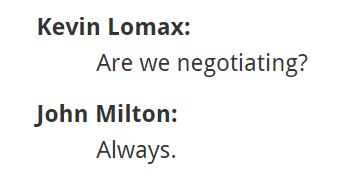
(The Devil’s Advocate, 1997)

The quote from the movie, The Devil’s Advocate, sums it up perfectly. Whether we like it or not, in life we are negotiating more often than we think we are.

Negotiation skills is something that most people can improve upon. There are several training options available if you want to make this a developmental priority. And there are also a few training games which offer you the opportunity to test your negotiating skills in role-plays.

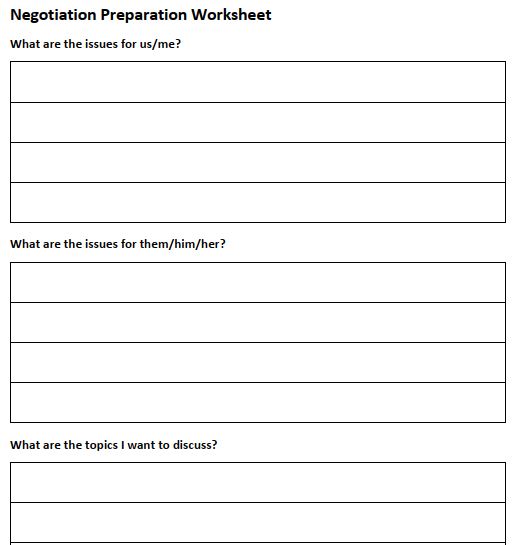
The resource that I am sharing is more generic and it helps you jot down some important notes before enter a negotiating process.

The worksheet, which you can download above, can help both experienced and new negotiators to organize their thoughts and prepare for a negotiation. Having your notes available during the negotiation discussions can help you maintain your focus and avoid distractions or knee-jerk reactions during crucial moments and stages of the discussion.

Uses:

  • Preparing for actual negotiations.
  • In training sessions to train participants on how to prepare and demonstrate the importance of this planning during a role-play later.
  • Prepare for discussion with supervisor/manager on salary increase.
  • Document your thinking going into a negotiation to support a post-negotiation lessons-learned reflection later which can help you and your team to continuously improve upon your past performances.

Cross-cultural Negotiations

When negotiating with someone who is from another cultural background than your own, remember that you will need to watch out for communicational disconnects based on having some of the following misaligment:

  • If the negotiating parties do not have the same first language and at least one party is negotiating in a non-native language there could be misunderstandings around the use of words of phrases. Use simple language and engage with translators if you want to avoid misunderstandings. .
  • Having different cultural views and perspectives, the relative importance of not only items negotiated but interaction with each other (from a relationship perspective) during the breaks or meals during days of negotiation could lead to unintended misunderstandings. Some actions or comments could even negatively impact the trust in the interpersonal relationship.
  • Depending on one’s view of the world, one tends to project your own views onto others as if everyone thinks and reasons like your would. That can lead to using methods of persuasion that would work in your own culture and it may be ineffective with others cultures. . Learn about the culture of key negotiators on the other side and learn what might persuade them vs only looking at your own experience and perspectives.
  • Establishing and maintaining trust can vary from one culture to another. Be slow to distrust the other party from another culture based on limited evidence of low-trust actions. Always engage with a cultural coach to help you correctly interpret the actions and communications from those from other cultures that you may be negotiating with.
  • Remember that negotiations are often not a one-time activity, but a business relationship that may span months or even years depending on how often roles changes at either party’s company. Take time to understand and get to know the other person or party that you often need to negotiate with. The more you know about the person and his or her preferences and views, the more successful your negotiations are likely to be.

Prepare by knowing a few key aspects about the other party

Checklist

Not all negotiations result in a definite outcome. In many cases discussions can take place over a long period of time. The better you are at understanding the other party and what her or she wants and values compared to your own needs and values, the better your chances would be to reach a win-win outcome for both yourself and the other party. And you will be able to leave the door open for successful future negotiations if you pay the right attention to the interpersonal relationship with the other party and not only to getting your own needs met in a win-lose way.

How good are your meetings? – Exercise


Most teams have challenges when it comes to ensuring optimal collaboration and effectiveness during meetings. It is true that many people are not fond of meetings and the list of pet peeves include that meetings are too long, do not reach any outcomes or agreements, are one-way conversations etc.  The tool I am sharing today can help teams become more aware of their particular downfalls and habits which contribute to having less effective meetings.

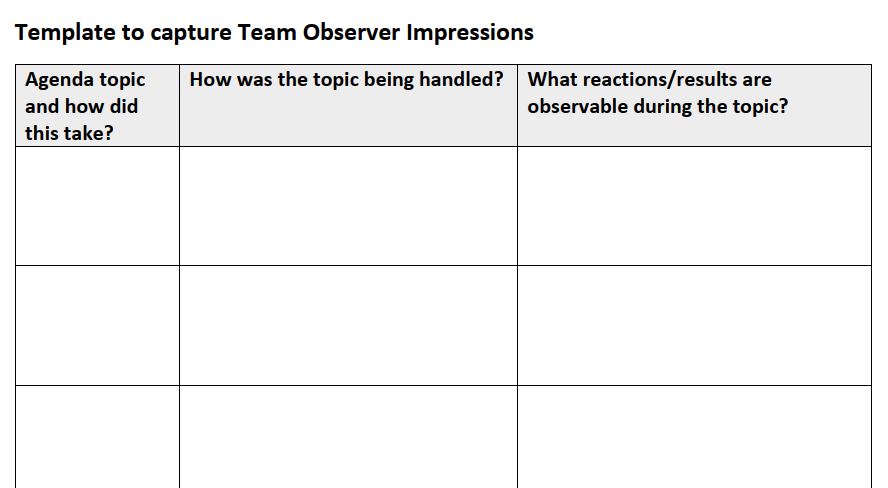
The exercise requires the assignment of an observer to help make behaviors, team dynamics, habits and meeting inefficiencies visible to the team by simply observing them during a meeting.

The assigned observer can be a team member (rotate the assignment to other team members for multiple team meeting observations) or it can be a trusted outsider (typically from Human Resources or Training & Development). The resource includes a template for the assigned observer to use when capturing impressions of the team during a meeting. The process of capturing observations, presenting observations and dealing with observations as a team is also described in the shared resource.

Reflections:

  • It does not really matter which specific questions are considered for observations or how exactly the team receives the feedback, the important part is to give the team a way to see themselves through the eyes of someone who is not participating in the meeting and thereby learning about themselves. The feedback information can be used for team improvements and also for individual learning. Individuals can learn how their own behaviors are contributing to team successes or inefficiencies and have the opportunity to consciously choose helpful behaviors going forward.
  • Typical team improvement actions that comes from using this kind or review are: having a concise set of team meeting rules which is either permanently displayed in the team meeting room or displayed on a screen at the start of each meeting to remind them of the behaviors they have decided to emphasize or eliminate in team meetings; implementing specific roles such as for example a time-keeper for each meeting to ensure that meetings, discussions and agenda topics are not dragged out too long and that an additional meeting be set instead to complete some topics which were too complicated to solve during a regular team meeting.
  • If you have used team measurement tools on a team you may also have a session where the team becomes aware of the likely blind-spots it may have due to the presence of specific personalities and styles in that team (based on the specific team effectiveness tool you have used with the team). The sum of the individuals present in meetings can lead to the greater team having specific blind-spots, which can be mitigated once the team becomes aware of them and are able to take actions (i.e. assign someone to take on a specific role which may be “missing ” in the team due to its specific contingent of members).

Building Squares – Team Activity


building squares

The basic learning points of this activity would include the importance of communication in teams, helping others develop by letting them make their own mistakes (and learning from them), and recognizing the importance of the contribution by each team member (vs taking over an activity/project and not allowing all team members to participate in important team activities).

This is a team activity which you can either use as an ice-breaker or an energizer between two other agenda items. It does not take much time to execute, but it does require some upfront preparation. The upside is, once you have made these squares and the puzzle pieces you can always re-use them in future with other groups and teams. (Remember to store the pieces in separate envelopes to keep the different puzzles from getting mixed up).

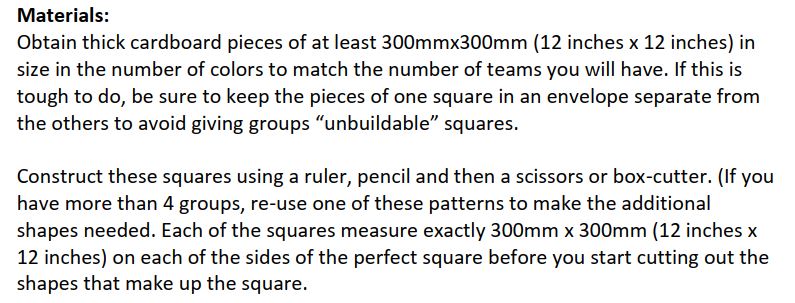
The instruction sheet (which you can download below) details how to make these squares, how to set up the activity and offers some debriefing questions to use afterwards. The activity does not take long to complete and does not typically create a lot of anger/frustration or resentment between people or teams leading to the need for longer debriefing and discussion sessions.

Variation options:

  • If you have more time and would like to get more points across to the teams you could consider moving the puzzles to other tables for additional rounds. Each team then has a new puzzle to complete. This way the challenge is different to the teams for further activity rounds and the additional instruction or activity handicap you introduce could take them deeper into the experience of working together as a team. For example: you could lift the rule around “no talking” to see if the teams find the challenge easier or harder?
  • You could also give them the same puzzle they had in the first round and let them practice to see how fast they can complete it (with or without talking as per your instruction). Then when each table/team feels that they have optimized their ability to complete the puzzle you can take one person from each table and have them join a new table. Each team would then have one new team member and no time to practice with the new team member. Then ask the tables to compete seeing who can complete the puzzle the fastest.

Meeting Energizers – Examples


energy

Business meetings or group events can be exhausting especially if they span several days and contain mostly sessions where presentations are made and do not have any or many interactive sessions. It can be challenging to keep meeting participants engaged and energized during such meetings and it is not uncommon to spot people struggling to keep their eyes open during long afternoon sessions. The first session after lunch can be especially tough and don’t forget the impact of jet-lag on participants from other time-zones.

one example: Making rain (see below)

The list which you can download above shows some activities that can be done with meeting participants to help them feel re-energized during a meeting. These short exercises are best done between agenda items and can take anything from 2 to 7 minutes to complete so they are not a major disruption to your planned agenda.

You would typically need an open space where participants can gather for these exercises. This space could be in the front between the projection screen and the first tables/chairs or it could be in the back of the room behind the last tables and chairs.  It is a good idea to mention that you need this space when you arrange the set-up of the room.

As the leader of the meeting or the facilitator you should always have a few of these quick energizer exercises on a sheet of paper or in the back of your mind to use on the spot. When you notice that the energy and responsiveness of the group is dropping you should be able to quickly conduct an energizing exercise to revive the energy and the alertness of the group attending your event or business meeting.

Icebreaker – Advertising boards


posters

This icebreaker works well with new teams or when you have had quite a few new members who recently joined a team.  The time, materials and space requirements are very economical so this is easy to combine with team meetings. Running this exercise can help you lead a new team into the right discussions to break down barriers to trust among (new) team members.

This ice breaker is a simple exercise which requires very limited instructions to get started and completed.

The most valuable part of this exercise is most likely the debriefing questions you (as the facilitator) choose to use: (some options)

  • Did anyone see something on an advertising board that was surprising about team members?
  • What are the strengths you think this team has?
  • Where do you think this team could get into trouble (given these team members and what you now know about them?)

This exercise is fun to do and the creativity of your teams may surprise you!

I would recommend that you use this exercise as part of a series of exercises to help new teams succeed in the long run. The Team Effectiveness Snapshot can be a great follow-up tool to introduce to the new team to help them on their journey of trust building and achieving a high level of performance.

Brand-new teams typically work well since most of the team members are “playing nice” at first, but as the team moves through the various stages of team formation  things can change. A lot of teams never make it out of the Storming phase so early introduction of team orientation, induction and assessment tools to help teams understand naturally occurring team dysfunctions can help them deal with these situations successfully. The advertising board icebreaker is a great way for teams in forming mode to break through the “niceness” and go a little deeper into the “who are you really” and “what do you bring to this team” discussion.

Conflict Resolution between Teams – an Activity


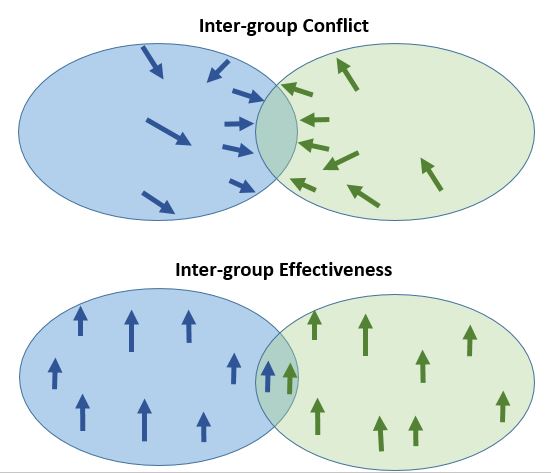
Teams or groups mostly get upset with each other due to ill-defined or badly executed processes or unclear interface issues between them. There are of course other reasons too, but whatever the cause inter-team upsets can cause an overall failure to achieve planned outcomes and a project/location not achieving targets.

Intergroup conflict and effectiveness

This process that can be used to help two (or more) teams/groups work through their issues with each other and how they are impacting each other.

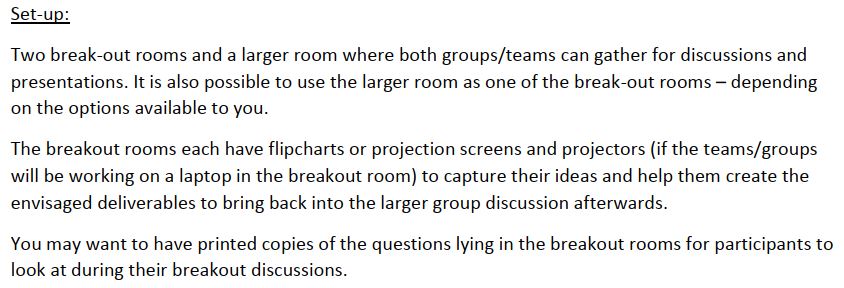
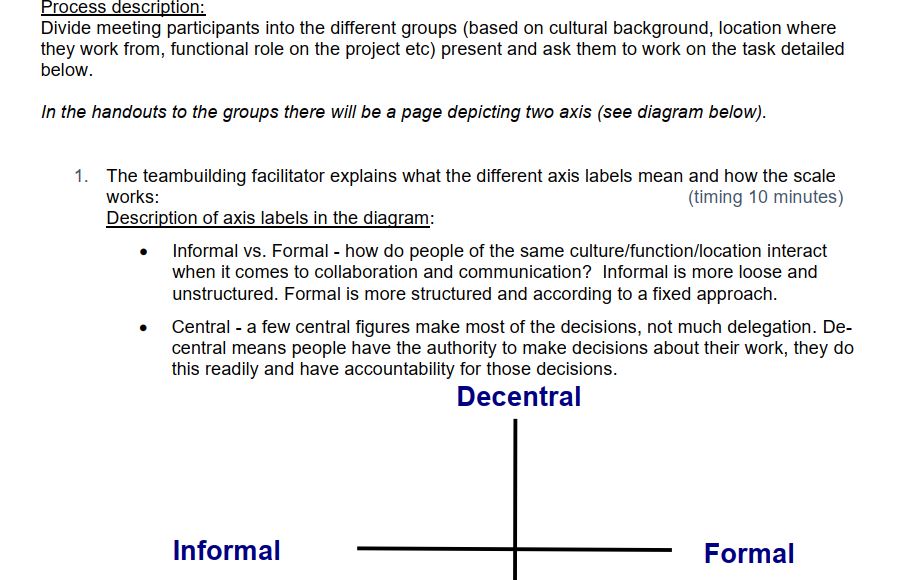
The process and activity is described in the document which you can download above. Estimated timing for each step of the process is also included. The timing is based on only two groups/teams working through the process. If you add teams/groups, do add additional presentation and discussion time to the combined portions of the process.

Each group or team have an assignment to work on independently and when the groups all gather together the results are presented and discussed in the larger group. The objective is to improve everyone’s understanding of exactly where things go wrong, what works and what does not work and how we will move forward with a new agreement of how we will work together.

The process requires at least one facilitator provided the combined groups comprise of no more than 18 people. If you combine more than two groups I would also consider having an additional facilitator to assist in the breakout sessions. The opening and closing sessions should be attended by one senior manager or executive that interfaces with all of the attending groups – to make opening comments to set the scene and establish the importance of the meeting and also to close off the event with encouraging and appreciative comments.

Note this:

  • The process is flexible and it would be up to you, as the facilitator, to make judgment calls along the way. Looking at how you are doing on timing and how well the process is going you may choose to avoid the second breakout session and instead have that discussion in the combined-group setting.
  • This process may not work well if the inter-group/team dysfunctions have been going on for quite some time and the frustration levels are high. In such cases I would recommend that you prepare for the session by first doing a pre-session interview with all or most of the intended participants. That way you can prepare for an intervention having a clear understanding of the issues at hand and the mindsets of those that will be attending. This may cause you to choose for a more comprehensive intervention.
  • If more than one facilitator is involved, do make sure every facilitator is completely aware of how the process will work. This is especially important when you choose to make some changes along the way – i.e. skipping the 2nd breakout session in favor of a large group discussion on the same topic.  It can be quite frustrating for groups/teams when they receive mismatched instructions from different facilitators for the activity they are to complete.

Ice Breaker Questions


meeting (2)

Starting a meeting or dealing with the after-lunch session involving a group of people often requires that you use some sort of ice breaking exercise or activity to help participants get to know each other better, have some fun and in many cases move around the room a bit. Most facilitators have their own set of ice breaking activities and exercises in their mind in case they need it. If you are new at it, you may need some inspiration and this post may be for you!

How would you go about it?

There is a list of questions you can download below. Use them and then you have a few ways to use them for ice breaking activities:

  1. Use it to start the meeting and incorporate the introductions and capture expectations at the same time. Ask each participant to share his/her name, location, role, expectations for the session/day and then answer one of the questions on the list. (There is a reason to ask them to share their answer to one of the questions AFTER they stated their expectations – so you have time to write down their expectations on a flip-chart before the next participant starts sharing)
  2. Use it at the start of the meeting. Ask participants to get up and move around the room while introducing themselves to others they encounter along the way. Sharing their answer to the question you gave the group and asking the other person to share his/her answer to the same question. Let them mingle in this way for about 5 to 10 minutes (depending on the size of your group). Ask them to return to their seats and ask a volunteer (or a few) to share the most surprising response they heard.
  3. If the group is small (12 people or less). Ask each person to provide an answer to the question you selected on a post-in note. Collect all of them. Read out the answer and have participants try to guess who responded in this way. (Rules for this exercise includes that the writer of the answer cannot participate in guessing who wrote it).
  4. If you have more time, you can do this: Give the group a question and ask them to first consider how they would answer it and write their own answers down on a post-it note. Then you ask them to walk around in the room and when they encounter another meeting participant, to guess what the other would have answered then have the other reveal how they really did answer the question. The other then guesses the first person’s response and again the first person would reveal how he or she really did answer that question. Encourage them to briefly discuss why they guessed the answer in the way that they did. It can get to deeper discussions about assumptions we make about people – whether we already know them or not. You can time the interactions and give them a signal when to move on to a new conversation participant to engage with around guessing each other’s answers. When everyone has completed the conversations you can debrief the group with questions like: How often were you right in what you guessed the other person would say? Did you learn anything surprising from those you talked to ? (aspects of his/her personality that you had no idea about?) How accurate do you think guessing is when it comes to how other people think?

Ice breakers can be really effective in breaking down barriers to making contact with people you have never met before at a meeting or training event. Yes, extroverts mostly don’t have any difficulties approaching and talking to strangers, but introverts often do. These kinds of exercises help everyone to get to know each other without feeling too inhibited during the initial contact moments.