Ice Breaker for international teams


all hands2

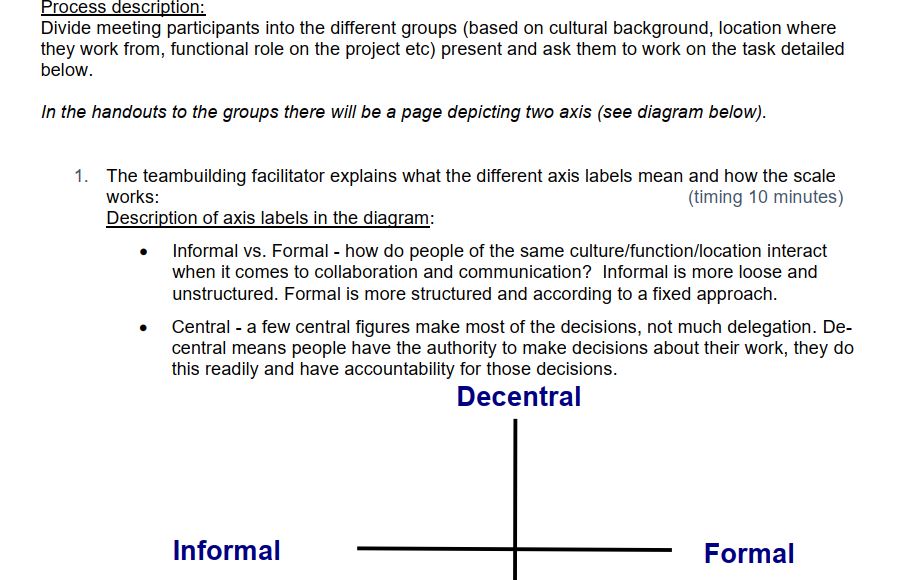
In our globalized world it is very common for employees to have regular contact with people from other cultures and they may attend meetings at various international locations. When you are executing projects on a global scale it increases the importance of ensuring that communication and collaboration go as smoothly as possible in order to meet your project objectives.

Cultures and sub-cultures

You may be surprised to learn that even seemingly basic project concepts could have different interpretations across cultures and sub-cultures. This exercise that I am sharing with you focuses on intercultural aspects of international teams and can help by clarifying assumptions and expectations at an early stage of your project.

When I think of different cultures on a project team, I also include sub-cultures such as between different regions in the same country or different functional groups in the same company. (This link can provide context if you want to look at cultures more closely.)

In the exercise, participants answer questions from their own perspective being as true as possible to how things are done at the location or group that they represent in the exercise. Most people who have lived internationally for some years have already adapted to habits and ways that conform to expectations and habits for their new location and how people do things there. If your intention is to highlight the richness of different perspectives you have present at the event where you run this ice breaker – ask participants to think back to a time when they lived in location X or worked with group Y – how would they answer the question then?

The downloadable document above contains several project-related scenarios which can be used to explore differences in approaches and mindsets within your project team. You may also choose to use the topic of diversity and inclusion as an on-going exploration within your team where you could select one of the topics at each of your meetings instead of trying to cover all of them during a team-building event.

This ice-breaker can be a good item to include in a project kick-off meeting or when you are adding a few more people to the team from a different office/location. This exercise also works well when you have team members who are from the same country, but are from different offices. (It is not uncommon for offices/locations to have slightly different approaches).

Early exploration of different mindsets and assumptions among team members can be a valuable foundation to ensure smoother relationships and better collaboration on your project.  Feel free to suggest additional important scenarios to consider for discussion after you have reviewed the attachment I shared in this post.

Performance Management – setting up the annual process


final perf imp

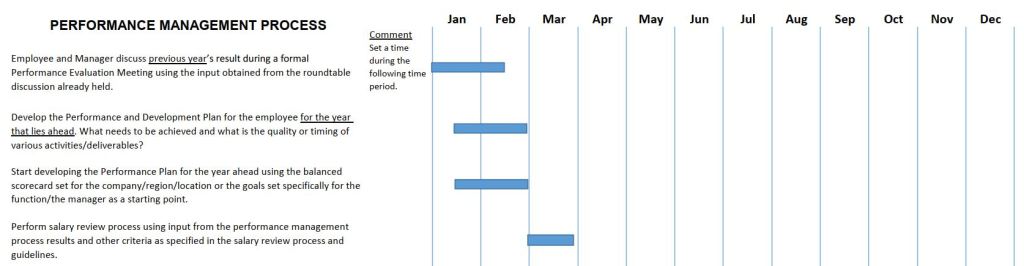
The HR function manages a few processes which take place at various points over a 12-month period. Think of the annual salary reviews, annual training needs analysis, bonus calculations and performance management processes.

It is important to managers to have a clear understanding of each of these processes and when they take place throughout the year. If you set all of these processes on a regular annual schedule it helps managers to correctly anticipate next steps in processes and provide input required in a timely manner.

The process

This generic performance management process schedule I am sharing with you (see download option below) shows the various basic steps that would need to be followed over a 12 month period. There are references to the link with a salary/compensation review process and also the link with identifying and reviewing individual development needs and progress along achieving improvement goals.

Download a copy below

Implementing a process like this would need a change management plan if your organization has never done anything like this before. Even if you have had some form of a performance management process in place, but would now like to expand on it to include some of the elements shown in the attachment, a change management plan would be recommended. Before you start you would of course ensure that the manager/director, who is accountable for the performance management process at your organization, is aligned with your ideas and suggestions and strongly supports the direction you would like to take.

The benefits of having a documented process for Performance Management are:
  • It is easy for HR to ensure new employees, current employees, new supervisors and existing managers understand the process and their role in the process.
  • It is a way to help stakeholders understand and then prepare for the input and actions they need to complete in order to support the process.
  • Linked to a balanced score card, the process can make it clear to individuals/departments how they collectively and as individuals support the attainment of larger organizational performance goals.
  • Knowing that there are check-in moments for feedback and discussion moments around performance expectations, progress and development needs and activities can be a strong way to reinforce employee engagement. Many employees tend to consider other employment options when they feel that their development and career progression goals are not being met by their current employer.

This list is not exhaustive. For more information about benefits see links like Benefits of performance management or Importance of Performance Management

Risk Management TEMPLATE


Considering risks is a high priority for any project execution planning activity. It is important to also frequently re-assess during the project life-time. The project team should check the status of the risk plan against reality at various moments in time to ensure all risks are captured and accurately reflected along with mitigation or risk avoidance plans as required.

A risk plan is simply a plan that helps you identify where obstacles to successful outcomes could appear and what you could do about it. In some cases a potential risk can be avoided by taking some preventative actions in time. Some risks or obstacles could be things that can happen at any moment and some would only occur under specific circumstances. The project team should consider the key elements of the  project plan – where would the project plan have the highest risk of failing if key milestones or achievements are not met? That is the starting point of the template that I am sharing with you.

The risk mitigation template  shows you how to identify risks, identify the risk level of a possible obstacle to project success, determine what can be done to avoid or mitigate an issue/obstacle to success  and of course select who exactly should take the actions in the event that the risk is realized or upfront as a preventative measure.

Just download the attachment and complete the sections in yellow for each of the key elements of your project plan. Then answer the questions as outlined at the top of each column for each of the key parts of your plan.

When you review the plan look at the elements that were rated as “high risk” that it could occur and also a “high impact” if that risk did materialize. Focus your attention more on those items, but it is also true that sometimes a “low risk” obstacle could have a high impact on the project so be sure to review every element of the risk plan when you do your regular risk plan checks.

Every plan has risks and great returns on investments are often associated with a higher level of risks. The objective is not to avoid risks completely since the ability to manage risks well and willingness to accept and manage risks can be a competitive advantage in the marketplace. This template can help you increase your awareness of risks and learn how to manage them throughout your project. Becoming better at risk management will make you a valuable project member and business partner.

Conflict Resolution between Teams – an Activity


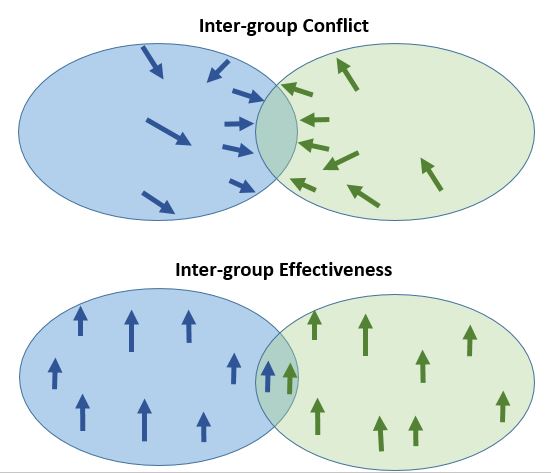
Teams or groups mostly get upset with each other due to ill-defined or badly executed processes or unclear interface issues between them. There are of course other reasons too, but whatever the cause inter-team upsets can cause an overall failure to achieve planned outcomes and a project/location not achieving targets.

Intergroup conflict and effectiveness

This process that can be used to help two (or more) teams/groups work through their issues with each other and how they are impacting each other.

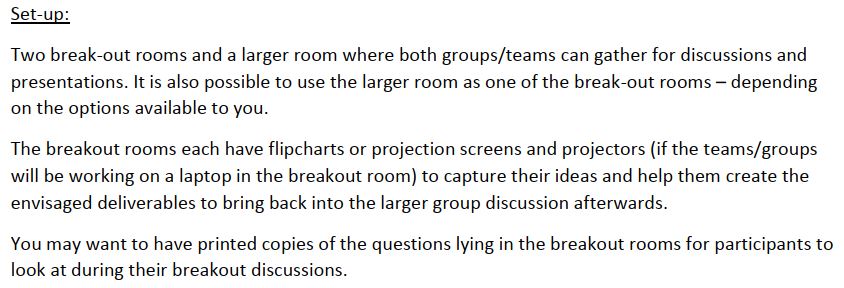
The process and activity is described in the document which you can download above. Estimated timing for each step of the process is also included. The timing is based on only two groups/teams working through the process. If you add teams/groups, do add additional presentation and discussion time to the combined portions of the process.

Each group or team have an assignment to work on independently and when the groups all gather together the results are presented and discussed in the larger group. The objective is to improve everyone’s understanding of exactly where things go wrong, what works and what does not work and how we will move forward with a new agreement of how we will work together.

The process requires at least one facilitator provided the combined groups comprise of no more than 18 people. If you combine more than two groups I would also consider having an additional facilitator to assist in the breakout sessions. The opening and closing sessions should be attended by one senior manager or executive that interfaces with all of the attending groups – to make opening comments to set the scene and establish the importance of the meeting and also to close off the event with encouraging and appreciative comments.

Note this:

  • The process is flexible and it would be up to you, as the facilitator, to make judgment calls along the way. Looking at how you are doing on timing and how well the process is going you may choose to avoid the second breakout session and instead have that discussion in the combined-group setting.
  • This process may not work well if the inter-group/team dysfunctions have been going on for quite some time and the frustration levels are high. In such cases I would recommend that you prepare for the session by first doing a pre-session interview with all or most of the intended participants. That way you can prepare for an intervention having a clear understanding of the issues at hand and the mindsets of those that will be attending. This may cause you to choose for a more comprehensive intervention.
  • If more than one facilitator is involved, do make sure every facilitator is completely aware of how the process will work. This is especially important when you choose to make some changes along the way – i.e. skipping the 2nd breakout session in favor of a large group discussion on the same topic.  It can be quite frustrating for groups/teams when they receive mismatched instructions from different facilitators for the activity they are to complete.

Problem Solving Template


puzzle (2)

It can be frustrating to try and figure out where things went wrong when the outcomes you had hoped for, did not work out. Sometimes it could be an object or piece of equipment that is not working well. It could also be a process that is at fault or perhaps it is human action or inaction that is causing the lack of performance.

This template helps one to work what you know and finding the facts in order to fix the issues that are stopping you from obtaining the right outcomes. This offers a better chance of discovering the root cause that is stopping you from achieving the planned good results.

After defining at the top what the problem is which you would like to solve, the worksheet takes you through a systematic process covering: The What, Where, When and How Big aspects are. Across the top moving from left to right on the columns, the worksheet has space to write down what you can see (what is observed) and it moves to any facts you are aware of which could relate to the observations, then writing down what the differences are between what you have observed and the facts until you finally arrive at the last column where you are able to narrow things down to the most likely causes that things are not working out with the problem you are trying to address.

It may seem tedious at first to complete the information indicated, but when the reasons or causes are less obvious this is a great way to summarize what you know about the situation in one place. We often know more than we realize and we simply need a way to put things together logically to spot the reasons behind a malfunctioning element in a failing piece of equipment or a process.

This tool can be used by an individual or in a group context. Sometimes it helps to have more than one person look at the same information and brainstorm through the elements shown in this template to get to the root cause(s). I also recommend that you retain a copy of this completed template to serve as a “lessons learned” to others.  I believe each one of us and every company/team should continuously strive to learn to remain competitive and innovative (creative). Others may be able to solve future issues by reviewing your completed sheet for the issue you solved.

How to set priorities in an action plan


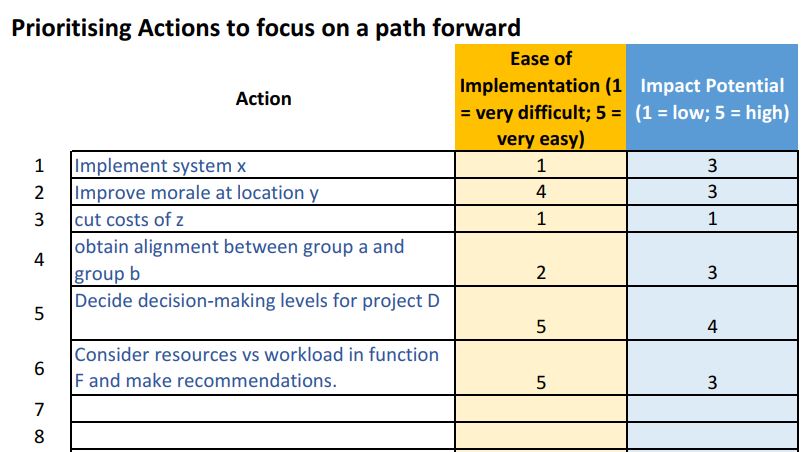
After a survey, a brainstorming session or a discussion it is often true that you end up with a long list of actions that should be put into an action plan. With many actions, maybe only a small number of people available to execute on those actions and possibly a small budget available for some of the actions, this could seem overwhelming.  The important question is: How can you prioritize the actions so you can make the most of the available resources (people to work on them) and funding (available budget)? And on top of that make sure that the most important actions are completed first?

Rate all the projects or activities on two questions:

  • what is the level of impact on your company, project, company if you completed that project/activity? (high means it would me a very big difference (positively))
  • how hard is it to implement this? (referring to available resources, skills and knowledge needed, tools needed, funding needed) (very difficult means you have very limited resources and budget and this project or activity would need more than you have available right now)

Use the scores obtained to plot your planned projects or activities onto this graphic: (the graphic shows an example based on the table and ratings above)

What to focus on?

Use the guide below to understand which of your projects or activities should be a high priority, low priority or medium priority with possible additional research needed.

One the one hand the question is: can you overcome what is difficult about that particular activity or project? Can you (for example) convince someone make more funding available if you present a very solid business case to highlight the value to the company or the project?

Or can you get more people to help? The other question to look into is whether the impact is really as low as you imagine? Speak to others to hear their views of how such a project or activity could possibly benefit more areas than you think. Perhaps the project is much more valuable than you think and it moves into the “green” quadrant meaning it should be a high priority for you to work on and complete.

If your dots appear in one of the yellow sections, you have some questions to ponder. If you can solve the question in each case you may be able to move that particular action into a different “zone” by changing the score. This means you are able to for example make it easier to implement by solving an issue which made it particularly difficult to implement. Or it could mean you realize the business impact is bigger than you previously realized because the company could gain a competitive edge if you implemented that particular action.  Your final action plan for immediate focus areas should contain those actions which finally end up in the green zone on the legend.

Be sure to communicate the reasoning behind your high priority actions to the key stakeholders in the outcomes of the action plan. They may have additional insights to share which could further cause you to change the scoring of actions.

You can use the Action Plan posted here to capture the actions that you will implement, monitor status of and report on regularly.

Coaching Effectiveness Survey


While it is a good idea for coaches to periodically discuss how well the process may be working for those that they are coaching, it is also a good idea for HR/Learning and Development to get feedback on the coaching program on an annual basis. Occasional informal feedback from the person being coached to the coach directly may help the coach improve the person’s coaching experience and outcomes reached.

A formal annual survey helps the department responsible for managing and monitoring the coaching program to understand a few things:

  • General questions that coaching participants may still have about the process or program objectives.
  • How to improve the training of coaches to improve developmental outcomes.
  • How well the relationships are working between coaches and those being coached. Perhaps an intervention may be needed in cases where a high level of dissatisfaction is recorded?
  • Whether the coaching process is working well in general – meetings are held on a regular basis and the right topics are being discussed.

Coaching survey

The coaching survey above (see download option) contains questions you may want to consider for your annual coaching effectiveness survey and it also contains some suggested wording for the introduction email to those who are being coached to explain the survey and its purposes.

Gather the survey feedback and analyze it for overall coaching program effectiveness, but also look at individual responses to see if anyone is having a particularly negative view about his or her coach or the coaching process.  When you take action on individual responses pay close attention to the confidentiality statement you put in the email that went with the survey. Do not reveal someone’s input to his or her coach unless it was expressly established that the survey respondent consent to this course of action. Also use the information gathered from the survey to improve your orientation slides for the next coaching program and to improve future training you offer to coaches.

Other coaching resources that may be useful for setting up your coaching program: preparing for coaching, coaching questions, coaching program orientation slides.

Preparing for a Coaching Session


Coaching sessions and programs are more successful when there are clear coaching goals and actions planned are documented. These developmental actions and activities should be reviewed and updated on a regular basis. It helps both the coach and the person being coached to maintain focus on desired outcomes..

Many employees who are new to coaching have misguided expectations about the coaching process and their own role in it. They expect the coach would show up at each session ready to provide them with useful information and advice and all they needed to do was to show up. In reality the coaching process works much better when both parties actively participate and prepare for each session.

Coaching process JAG

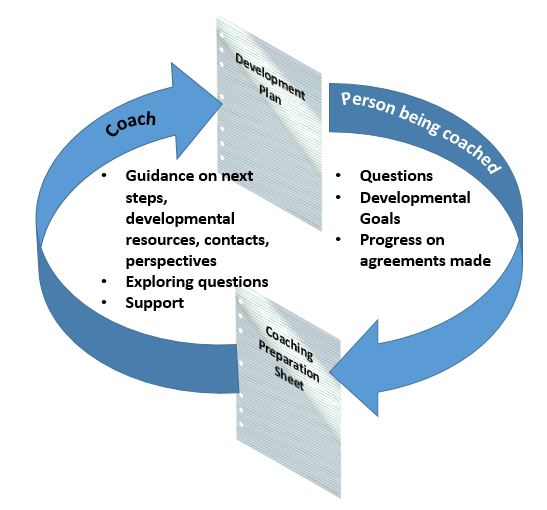
This process graphic shows that each party in the coaching process provides input and participates in the process. The results are written down and shared to ensure a common understanding of the goals and that progress towards goal achievement is maintained.

Preparation worksheet for Coaching

Tips:

  • For those being coached: make sure you get your completed preparation sheet to your coach at least a few days before the session so that the coach can take your feedback into account. This helps him or her prepare to answer your questions and obtain any additional information and resources that may be useful to you at this time and bring it to the session.
  • For coaches: take note of the questions and struggles that may be noted in the preparation sheet. Consider how you can best help address those issues and which resources can you provide to help in the process? What is the best way to approach the coaching session – given those questions, issues and of course the overall goals that had been set for the coaching process?
  • Do remember to look back at previous preparation sheets and also the updated development plan on occasion (maybe once every 6 months) to recognize and appreciate progress made to date and to help motivate those being coached to take the next steps that may be required towards ultimate goal achievement.

Coaching is a shared responsibility between the coach and the person being coached. Only then, does the process yield the best results. And preparation is a key part of this shared responsibility.

Questions for Coaching


Many managers mistakenly think coaching is about “telling” others what they should be doing. While some very inexperienced people may need you to tell them what to do or how to do it, most others need to learn and explore topics and new skills or behaviors with their coaches instead. The hard part for many coaches is to listen and ask the right questions. And also to refrain from taking up most of the airtime during coaching sessions talking about their own lives and their own stories or just offering advice. While children happily accept new information simply because you tell them how things are, adults prefer to explore and learn by comparing and assimilating what you are sharing with what they already know and have learned in their pasts.

closed question examples
Closed Questions

Coaching sessions is about asking open-ended questions which leads to learning and exploring. Asking the right questions is not an easy assignment to have as a coach. Some questions shut others down while limiting them to “yes” or “no” answers which does not allow for a rich conversation of exploration around the topic concerned. Closed questions are those that can be answered by a simple yes or no answer.

More useful questions to ask :

  • Open-ended questions help others expand on ideas and contribute to the conversation vs staying mostly in listening-mode. These kinds of questions can help you discover the other person’s thought processes, motivations and how they feel about a topic or an option.
  • Clarifying questions are helpful to ensure you understood your conversation partner correctly. When people get going on topics that they feel quite excited or passionate about they can sometimes lose sight of how familiar you are with that same topic. To ensure you (the coach) are able to follow along, you may need to pause, look back and clarify any comment made which you were unable to place within the context of the topic being discussed.
  • Paraphrasing. This is a useful technique to summarize what you heard so far and help move the conversation towards a decision or planning a specific path forward (action). It also helps ensure that your impressions of what was said are correct. It can be very validating for someone to hear their own words summarized correctly by another trusted person (in this case you, as the coach).

This list of questions for coaches (which you can download above) can help you to ask the right questions at your next coaching session. I recommend you read through this as you prepare for the session, but do not commit yourself to asking specific pre-determined questions regardless of how the conversation goes. The important part about asking questions at a coaching session is that you (the coach) show up with a mindset of curiosity. That opens up the exploration in the conversation and enables learning to take place which is vital for adults in their learning process.

Use the links to other content which I show below and also the resource I am sharing above as a way to prepare for and get into inquiry mode before the planned coaching session.

These are great questions to consider asking when you coach: Life Coaching Questions    Coaching questions for managers

How to start Coaching your direct reports


I often hear from managers that they don’t know how to approach coaching their direct reports. It appears the word coaching implies to them that they must have some special insights and skills which would qualify them to coach someone else. Most managers do not realize that they actually know a lot about the company, how things work, how things should be working and how it is going generally. Perhaps all they need is a way to get the conversation going?

Sometimes employees have questions, which are easy to address and other times you need time to get back to them with answers.

Coaching may seem a little less daunting if you had this checklist ( see download button above) of topics to discuss with employees as a group or as individuals. There is a lot to be said for group coaching sessions! They can also be very effective in developing a group of people who may roughly all have the similar development needs and questions for you.

As their manager, you can open a conversation covering one of the questions on the sheet and just state “I can imagine you may have some questions or would like to know more about….” (use one of the questions shown on the sheet). Once the conversation is kicked-off it often happens that the employee will start to bring up more specific questions that he or she may have.

coaching process 4 steps

This graphic shows the basic 4 steps that can be used to start and keep a good coaching relationship going. Trust is a key component and building trust is important – honesty, integrity and showing employees that you care about their work, their careers and their well-being all help to build trust.

Coaching can be a highly structured program requiring a lot of specialized communication and coaching skills and training. It can also be simply helping employees understand the basics around their roles, the company and how things work in their environment. It is your role as their manager to coach them and develop their knowledge, skills and competencies on an on-going basis. If you need more training and support with regards to coaching, do talk to your HR or L&D representative. In the interim, this conversation-starting summary sheet may be helpful to you!