Activity for project teams – Diversity


colored circles

Your project team is very diverse and you are concerned that this may impact how your project will be executed – will you be able to achieve your overall project goals or will there be a lot of internal strife, misunderstandings and disagreements? Will they work against each other and have the wrong assumptions about each other and the project goals and metrics? If so, this team-building activity may help.

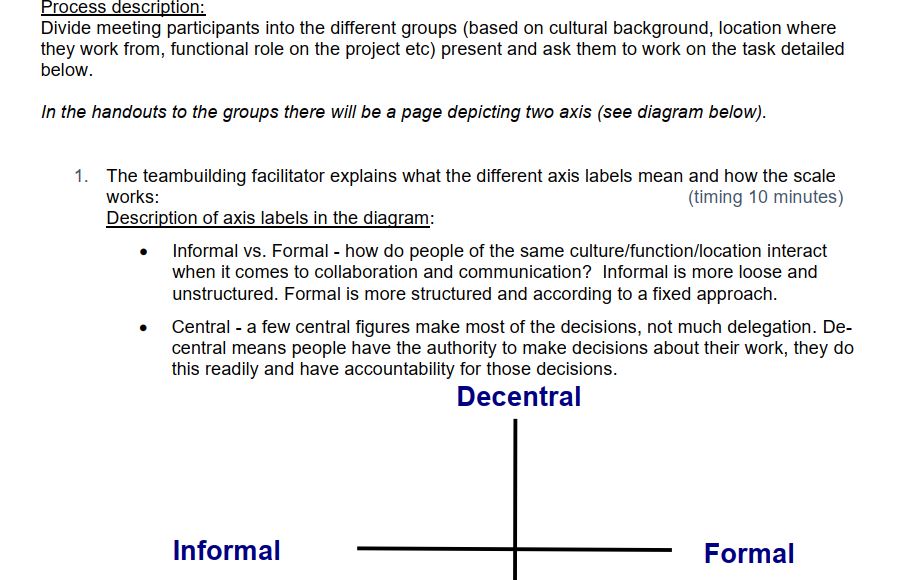
The downloadable resource I am sharing is a team activity you can use to help project team members understand that different groups of people can have different views on the various aspects of running a project and also the relative importance of key project processes. This activity makes those possible disconnects transparent which helps you lead clarification discussions with the team/group. While the activity itself is quite simple, the discussion that comes after the initial assignment is where the value lies and that will take up most of your time.
Further tips and ideas:

  • You can segregate meeting participants in various ways related to the most important diversity aspects you wish to highlight within the team. As a variation you may choose to run the first part of the exercise more than once and each time segregating the group of participants in a different way. Options include: cultures, locations where they are from or live, level of life experience, function etc.
  • There are several topics listed for discussion towards the end and it would be wise to prioritize them for your own convenience, as a facilitator. If you are running out of time towards the end you can then ensure you are covering the most important topics during the time you have available after the initial portion of the exercise.
  • Be sure to stress that diversity is a plus for team creativity and finding new solutions. The objective of this activity is to help work out some of the downsides of diversity without marginalizing any one or group or impose judgement.

Non-homogeneous teams may be tougher to manage than homogeneous teams, but the pay-off in creating new and innovative team solutions coupled with individuals learning new skills and perspectives from other team members can be very rewarding. As a team leader or facilitator you just need to make sure you have the right tools, such as this activity, available to help non-homogeneous teams succeed.

Ice Breaker for international teams


all hands2

In our globalized world it is very common for employees to have regular contact with people from other cultures and they may attend meetings at various international locations. When you are executing projects on a global scale it increases the importance of ensuring that communication and collaboration go as smoothly as possible in order to meet your project objectives.

Cultures and sub-cultures

You may be surprised to learn that even seemingly basic project concepts could have different interpretations across cultures and sub-cultures. This exercise that I am sharing with you focuses on intercultural aspects of international teams and can help by clarifying assumptions and expectations at an early stage of your project.

When I think of different cultures on a project team, I also include sub-cultures such as between different regions in the same country or different functional groups in the same company. (This link can provide context if you want to look at cultures more closely.)

In the exercise, participants answer questions from their own perspective being as true as possible to how things are done at the location or group that they represent in the exercise. Most people who have lived internationally for some years have already adapted to habits and ways that conform to expectations and habits for their new location and how people do things there. If your intention is to highlight the richness of different perspectives you have present at the event where you run this ice breaker – ask participants to think back to a time when they lived in location X or worked with group Y – how would they answer the question then?

The downloadable document above contains several project-related scenarios which can be used to explore differences in approaches and mindsets within your project team. You may also choose to use the topic of diversity and inclusion as an on-going exploration within your team where you could select one of the topics at each of your meetings instead of trying to cover all of them during a team-building event.

This ice-breaker can be a good item to include in a project kick-off meeting or when you are adding a few more people to the team from a different office/location. This exercise also works well when you have team members who are from the same country, but are from different offices. (It is not uncommon for offices/locations to have slightly different approaches).

Early exploration of different mindsets and assumptions among team members can be a valuable foundation to ensure smoother relationships and better collaboration on your project.  Feel free to suggest additional important scenarios to consider for discussion after you have reviewed the attachment I shared in this post.

Prepare to Negotiate – Tips and a Worksheet


arm wrestle
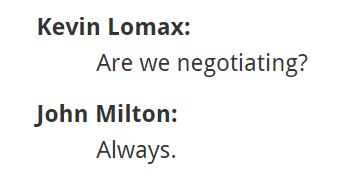
(The Devil’s Advocate, 1997)

The quote from the movie, The Devil’s Advocate, sums it up perfectly. Whether we like it or not, in life we are negotiating more often than we think we are.

Negotiation skills is something that most people can improve upon. There are several training options available if you want to make this a developmental priority. And there are also a few training games which offer you the opportunity to test your negotiating skills in role-plays.

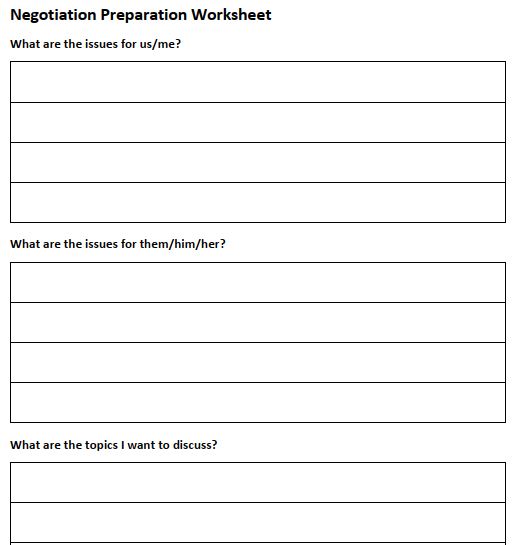
The resource that I am sharing is more generic and it helps you jot down some important notes before enter a negotiating process.

The worksheet, which you can download above, can help both experienced and new negotiators to organize their thoughts and prepare for a negotiation. Having your notes available during the negotiation discussions can help you maintain your focus and avoid distractions or knee-jerk reactions during crucial moments and stages of the discussion.

Uses:

  • Preparing for actual negotiations.
  • In training sessions to train participants on how to prepare and demonstrate the importance of this planning during a role-play later.
  • Prepare for discussion with supervisor/manager on salary increase.
  • Document your thinking going into a negotiation to support a post-negotiation lessons-learned reflection later which can help you and your team to continuously improve upon your past performances.

Cross-cultural Negotiations

When negotiating with someone who is from another cultural background than your own, remember that you will need to watch out for communicational disconnects based on having some of the following misaligment:

  • If the negotiating parties do not have the same first language and at least one party is negotiating in a non-native language there could be misunderstandings around the use of words of phrases. Use simple language and engage with translators if you want to avoid misunderstandings. .
  • Having different cultural views and perspectives, the relative importance of not only items negotiated but interaction with each other (from a relationship perspective) during the breaks or meals during days of negotiation could lead to unintended misunderstandings. Some actions or comments could even negatively impact the trust in the interpersonal relationship.
  • Depending on one’s view of the world, one tends to project your own views onto others as if everyone thinks and reasons like your would. That can lead to using methods of persuasion that would work in your own culture and it may be ineffective with others cultures. . Learn about the culture of key negotiators on the other side and learn what might persuade them vs only looking at your own experience and perspectives.
  • Establishing and maintaining trust can vary from one culture to another. Be slow to distrust the other party from another culture based on limited evidence of low-trust actions. Always engage with a cultural coach to help you correctly interpret the actions and communications from those from other cultures that you may be negotiating with.
  • Remember that negotiations are often not a one-time activity, but a business relationship that may span months or even years depending on how often roles changes at either party’s company. Take time to understand and get to know the other person or party that you often need to negotiate with. The more you know about the person and his or her preferences and views, the more successful your negotiations are likely to be.

Prepare by knowing a few key aspects about the other party

Checklist

Not all negotiations result in a definite outcome. In many cases discussions can take place over a long period of time. The better you are at understanding the other party and what her or she wants and values compared to your own needs and values, the better your chances would be to reach a win-win outcome for both yourself and the other party. And you will be able to leave the door open for successful future negotiations if you pay the right attention to the interpersonal relationship with the other party and not only to getting your own needs met in a win-lose way.

How good are your meetings? – Exercise


Most teams have challenges when it comes to ensuring optimal collaboration and effectiveness during meetings. It is true that many people are not fond of meetings and the list of pet peeves include that meetings are too long, do not reach any outcomes or agreements, are one-way conversations etc.  The tool I am sharing today can help teams become more aware of their particular downfalls and habits which contribute to having less effective meetings.

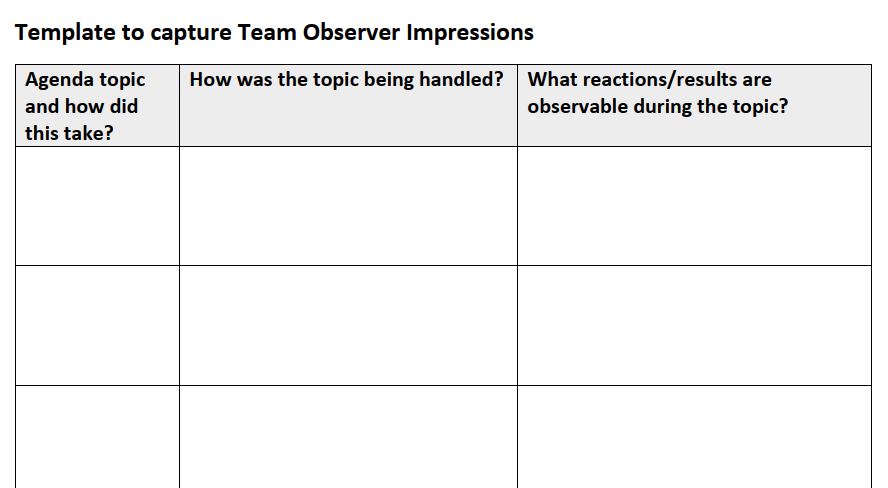
The exercise requires the assignment of an observer to help make behaviors, team dynamics, habits and meeting inefficiencies visible to the team by simply observing them during a meeting.

The assigned observer can be a team member (rotate the assignment to other team members for multiple team meeting observations) or it can be a trusted outsider (typically from Human Resources or Training & Development). The resource includes a template for the assigned observer to use when capturing impressions of the team during a meeting. The process of capturing observations, presenting observations and dealing with observations as a team is also described in the shared resource.

Reflections:

  • It does not really matter which specific questions are considered for observations or how exactly the team receives the feedback, the important part is to give the team a way to see themselves through the eyes of someone who is not participating in the meeting and thereby learning about themselves. The feedback information can be used for team improvements and also for individual learning. Individuals can learn how their own behaviors are contributing to team successes or inefficiencies and have the opportunity to consciously choose helpful behaviors going forward.
  • Typical team improvement actions that comes from using this kind or review are: having a concise set of team meeting rules which is either permanently displayed in the team meeting room or displayed on a screen at the start of each meeting to remind them of the behaviors they have decided to emphasize or eliminate in team meetings; implementing specific roles such as for example a time-keeper for each meeting to ensure that meetings, discussions and agenda topics are not dragged out too long and that an additional meeting be set instead to complete some topics which were too complicated to solve during a regular team meeting.
  • If you have used team measurement tools on a team you may also have a session where the team becomes aware of the likely blind-spots it may have due to the presence of specific personalities and styles in that team (based on the specific team effectiveness tool you have used with the team). The sum of the individuals present in meetings can lead to the greater team having specific blind-spots, which can be mitigated once the team becomes aware of them and are able to take actions (i.e. assign someone to take on a specific role which may be “missing ” in the team due to its specific contingent of members).

Risk Management TEMPLATE


Considering risks is a high priority for any project execution planning activity. It is important to also frequently re-assess during the project life-time. The project team should check the status of the risk plan against reality at various moments in time to ensure all risks are captured and accurately reflected along with mitigation or risk avoidance plans as required.

A risk plan is simply a plan that helps you identify where obstacles to successful outcomes could appear and what you could do about it. In some cases a potential risk can be avoided by taking some preventative actions in time. Some risks or obstacles could be things that can happen at any moment and some would only occur under specific circumstances. The project team should consider the key elements of the  project plan – where would the project plan have the highest risk of failing if key milestones or achievements are not met? That is the starting point of the template that I am sharing with you.

The risk mitigation template  shows you how to identify risks, identify the risk level of a possible obstacle to project success, determine what can be done to avoid or mitigate an issue/obstacle to success  and of course select who exactly should take the actions in the event that the risk is realized or upfront as a preventative measure.

Just download the attachment and complete the sections in yellow for each of the key elements of your project plan. Then answer the questions as outlined at the top of each column for each of the key parts of your plan.

When you review the plan look at the elements that were rated as “high risk” that it could occur and also a “high impact” if that risk did materialize. Focus your attention more on those items, but it is also true that sometimes a “low risk” obstacle could have a high impact on the project so be sure to review every element of the risk plan when you do your regular risk plan checks.

Every plan has risks and great returns on investments are often associated with a higher level of risks. The objective is not to avoid risks completely since the ability to manage risks well and willingness to accept and manage risks can be a competitive advantage in the marketplace. This template can help you increase your awareness of risks and learn how to manage them throughout your project. Becoming better at risk management will make you a valuable project member and business partner.

Delegate Smarter, Not Harder: A Practical Tracking Solution


Delegation isn’t just about offloading work; it’s about developing your team’s potential. By strategically assigning tasks, you not only free up your time but also equip your employees with new skills and responsibilities. However, keeping track of who’s doing what can be challenging. That’s why a clear system for delegating and monitoring tasks is essential for maximizing productivity and employee growth. The template I am sharing is a great way to keep track of not only who is working on which delegated task, but also what was the overall purpose of the delegated task.

Try to match the task or activity/project you need to delegate to the right person in your team given their current skills and competencies and also matched to current development needs each of them have.  The template is based on a list of categories to consider: (see second tab in template for the definitions shown below)

The delegation tracking sheet helps you keep track of the level of capability the person has – which uses the definitions above to help remind you how much support he or she might need with that task.

Use the drop down list in column B to select the category that applies to that task/project and the person that you are delegating to.  You can create more lines for delegated tasks by just inserting a line between the existing lines.

Reasons why this list can be very useful:

  • Keeping this list up to date and referring to it in a regular basis will help you remember when to check in on someone working on a delegated task or project.
  • You keep track of the reasons why you gave a specific task to someone – from a developmental perspective. This means you know how much support and coaching may be needed while the person is working on this task.
  • Avoid giving the same task to more than one person. There is nothing more demotivating to an employee than finding out another colleague is working on the exact same project as he or she is after having already spent several hours doing research and talking to people about the project in order to deliver a great result.

You can do more and accomplish more as a manager when you don’t have to rely on your memory alone to remember who is working on which tasks and projects for you.

Effective delegation is the cornerstone of successful management. By utilizing this template to track delegated tasks, managers can optimize workload distribution, identify development opportunities for team members, and ensure that projects stay on track. This proactive approach not only boosts productivity but also builds a culture of empowerment and growth within the team.

Crafting a Communication Plan: Your Roadmap to Change Success


Whether it’s a new process, a revamped strategy, or a technological overhaul, effective communication is essential for a smooth transition. A well-crafted communication plan outlines the who, what, when, where, and how of sharing information, ensuring everyone is on the same page and aligned with the change journey. Let’s dive into the key components of creating a powerful communication plan.

Tailoring Your Message to Your Audience

Effective communication means understanding who you’re talking to. Different groups will need different information. Start by identifying everyone who’s affected by the change. This could include employees or different groups of employees, customers, partners, and even the wider community. By mapping out your audience, you can tailor your messages to their specific needs and interests. Think about different functions, think about geographic locations, think about management levels, and think about people outside your company who may be affected.

Communication messages could be intended to explain why things have to change, what is going to change, when and how it is going to change, how the change is going (progress update) and what (if anything) people need to start doing, stop doing or what should change in the way they have acted in the past.

Continue reading “Crafting a Communication Plan: Your Roadmap to Change Success”

Post-survey Action Plan


You’ve got the employee survey results. Great! But don’t just let them gather dust. Find the biggest pain points, make an action plan, and get moving. It’s about turning those numbers into real improvements. Remember, less is often more. Focus on a few key areas instead of trying to fix everything at once. Let your team know you’re listening and planning to make needed changes.

The first template helps you pinpoint exactly what worked and what didn’t. Don’t just list random stuff – get specific. Once you know what to improve, create clear action steps. Make sure you can measure your progress and know when an action is complete by defining what done looks like.

Continue reading “Post-survey Action Plan”