Onboarding Plan Template


Onboarding Plan Template

One of the key reasons that companies lose new hires with some experience is that they fail to support these new hires adequately during their first few months. In some companies, it can be quite hard to understand how things work there, how to fit in and be successful, feel valued and included. Having a written onboarding plan from the start is a great way to bring more clarity to the person and also help them understand expectations during the crucial early months in their new roles in the new company.

The onboarding plan can be written as early as during the recruitment process. In one best-case scenario, it was shared with a senior executive right after his interview with the CEO. It was such an unexpected and appreciated action that the executive commented how refreshing he found the transparency and it made him see the hiring company as head-and-shoulders above the competition which led to him accepting the offer and joining the company a few months later.

The Process

While the plan can help clarify the set-up and structure for a new hire, it is important to set up review meetings with the newly hired managers or key hires. In some cases, reviews with an HRBP could be useful to understand for example how performance management is organized and how the process works. Such review moments could also clarify talent development programs and processes, which is useful to know for the new hire regarding his/her own career but also for helping the new hire manage the development actions for those who report to him/her.

Review meetings with the manager that the new hire reports to could help identify priorities and understand where to connect with more people or build additional internal or external relationships. The manager can also answer questions about activities planned to ensure desired outcomes are achieved after 30-days, 60-days, and 90-days as captured in the onboarding plan.

The people side of success

The template captures not only the tasks and activities needed to succeed in a new role but also identifies people with whom to build relationships. These are important relationships and contacts that the new hire would need to establish and maintain to ensure his/her success in the long run. They could be key client contact personnel or contacts from key suppliers or subcontractors. They could also be internal – people who know how things work and who can advise on the best course of action to get something done at that company.

And it is also important to identify people who can be trusted to keep things to themselves and who could advise on who to talk to before moving in specific directions for changes the new hire would like to implement. Either the HR Director/HRBP or the new hire’s manager may be helpful to identify who those contacts may be.

Note that confidants or advisors may also be external people such as professional coaches or consultants.

Accountability

While it is important from a company’s perspective to ensure key new hires are provided with onboarding plans, completing the details and setting priorities to accomplish the outcomes defined in the plan lie with the new hire. The success of the new hire is only partially dependent on helping him/her get up to speed faster by having review meetings and an onboarding plan and giving him or her access to professional helpers and advisors. The new hire remains accountable for his or her own performance and following through on the items recorded in the onboarding plan.

When both the process of onboarding works well and the new hire holds himself/herself accountable for the outcomes produced, the risks of failure due to onboarding gaps are lowered and retention success is more likely in the medium to long term!

Useful posts for new employee/ new manager onboarding and orientations :

https://jo-anngarbutt.org/2015/09/15/new-employee-on-boarding-checklist-template/

https://jo-anngarbutt.org/2016/03/01/starting-right-new-managerleader-and-team/

Checklists for Stretch Assignments


Stretch assignments are useful for learning and personal growth and development, because they purposefully contain elements that are challenging in areas where the assignee needs to develop. Designed correctly, a stretch assignment confronts one with the necessity  to get out of your comfort zone in order to succeed.

The starting point for designing such an assignment can be multiple data sources:

  • the person’s own development needs compared to established leadership competencies,
  • key proven areas of mastery that a company requires from their leaders to advance to the next level,
  • a mindset or  mindset shift that is required to move the company and its leaders into a new way of operating; or
  • to build competency in specific important areas that are or will be important to the future of the company.

A stretch is not defined in a general way, but rather it is very specific to a person. While a stretch could mean that one requirement is for the person (plus family, if appropriate) to move to an international location, it inevitably would also include other job-related challenges. Examples include supervising more people, having financial performance targets (for someone who has only had functional roles in the past) or having more complexity such as multiple geographical areas to manage. The key balance to maintain when designing stretch assignments is to ensure that the assignee is put under a certain amount of pressure to learn and grow, but not so much pressure that he or she fails.

Mitigating failure risks

There are a few things you can implement to help monitor how things are going with each assignee and to provide a “safety net” for an assignee to get support from.

  1. Assign subject-matter experts as coaches – depending on the scope of the assignment.
  2. Assign a leadership development coach to help the assignee reflect on experiences, frame up challenges and cognitively choose best solutions and explore new ways of operating to be more successful in the assigned areas of responsibility.
  3. Set up internal-company networking events for the assignees to meet, have opportunities to mingle and share experiences and also include a pre-determined learning event tied to overall leadership development objectives within the company.
  4. Set up a structure of communication moments with the “home” organization supervisor and colleagues – this is especially important if you plan to return the assignee to the same organization at the end of the assignment. Maintaining ties would greatly improve a successful return and reintegration after an assignment. Communication moments like these can also greatly help colleagues NOT on assignment to learn from the experiences and best-in-class solutions their colleague on assignment is mastering.

New and challenging assignments often cause assignees to experience some stress. Supporting assignees to successfully navigate through the new challenges means you should pay attention to a change in behavior or performance which could indicate that he or she is stuck on the learning curve. Signs that things are going wrong are important to notice early-on to maximize chances of turning things around and avoiding an assignment disappointment and/or incurring an assignee retention risk. Pre-departure training should be provided to both assignees and their coaches to understand and recognize signs that things may not be going well and to understand ways to become unstuck in every situation.

Some warning signals:

stretch-assignments-signs-of-failure

Expectations for goal achievement by assignees must be specifically captured in a plan and communicated to an assignee along with available rewards for over-achievement of goals. The specific strategic importance of the assignment should also be highlighted as well as the developmental needs to be addressed during the assignment.

Tips for stretch-assignment coordinators:

  1. Ensure that there is a structure that enables assignees to succeed and always follow-through with the check-in points and feedback activities to ensure all is well.
  2. Ensure that all those involved in assignments are clear on the role of management, role and responsibilities of supporting coaches, the role and responsibilities of assignees and the role and responsibilities of assignment supervisors and “home office” supervisors.
  3. Adequately prepare assignees for their assignments: cultural awareness training (for international assignments), language skills (where needed) and if accompanied by family members – consider a session to discuss the practicalities of moving to a new location with those family members present.
  4. Ensure that the assignees get interim feedback on how their assignments are going -at least 3 times per year, but more often if this can be managed. This provides opportunities to refocus and apply new approaches as needed to ensure the assignment is successful.
  5. Provide assignees and stakeholders in assignments ample notification about the end date of an assignment. This assures minimum surprises and helps everyone to plan actions leading to a well-organized return upon assignment completion.

When assignments are successful in achieving or exceeding on all the objectives, assignees should return from their experiences with increased confidence, leadership skills, and maturity. The personal growth and development they experienced should enhance their ability to make better decisions and build stronger interpersonal relationships with those they lead and follow. Being mindful of how to setup and manage stretch assignments can make all of that a reality.

Learning from Leavers: The Power of Exit Surveys -Template


Understanding the Why Behind Employee Departure

Employee turnover can be costly and disruptive. To address this challenge effectively, we must delve deeper into the reasons why people leave. By analyzing exit data and conducting thorough exit interviews, organizations can identify underlying issues and implement targeted retention strategies.

Unexpected employee resignations can often be alarming. More so if the resignations come from star employees whom you had high hopes for in terms of future expert or leadership roles at your company. How will it impact your project and your team, you may wonder? The question I would ask is, was it avoidable?

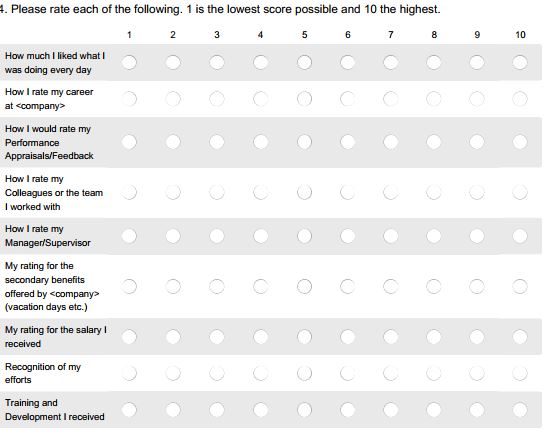
The Exit Interview helps with gathering feedback on employees’ decisions to leave the company and what next steps they are planning to further their careers elsewhere. This structured interview can greatly support your ability to narrow down the reasons for the exit and whether you have any large internal issues to address to avoid more people leaving the company.

While it appears to be a written survey, it works well as an interview conducted in person and then the interviewer (usually from HR) can complete the survey later in order to capture the answers from exiting employees in a structured way. Based on your company set-up and employee conditions you may want to add some questions or statements to be rated. Just avoid overloading the employee with too many questions. Perhaps you can remove some of the existing questions if you decide to add any?

Tips:

  • You could choose to use this as a survey which the departing employees complete independently. I would however recommend that you ask these questions as part of an exit interview conducted in person as it offers the opportunity to ask follow-up questions to clarify answers to make sure you really understand the factors that led to the decision to leave the company.
  • There is a good chance that the departing employee may not tell you the truth. Sometimes they are afraid you may give them a bad reference in the future if a prospective employer calls you up. Other times they may be worried about being the whistle-blower on an existing organizational issue in terms of potential impact on any friends they still have at the organization. It may be worth considering the use of an outsourced vendor to gather feedback from departing employees before or just after they have left.
  • Do take the time to review feedback received from exit interviews to determine whether you or anyone else at your company may need to take action to improve a situation, revise benefits, improve communications to employees on specific topics, etc. These actions may be exactly what is needed to prevent other employees from leaving for similar reasons.
  • Mind confidentiality around these interviews. Be sure to be honest with the departing employee on who will get to know about the information shared and stick to the agreement.
  • Talk to those employees who remain with the company and make sure they understand how much you value their continued service and loyalty to the team/organization. When a prominent person leaves – whether a subject matter expert or a much-liked leader – people may start wondering about their own careers and consider leaving too. Taking employee retention actions and communicating especially to those in key roles will go a long way toward putting people’s minds at rest.

Employee turnover is inevitable, but it doesn’t have to be detrimental. By conducting thorough exit interviews and analyzing the data, you can transform departures into opportunities for growth. By identifying and addressing the root causes of turnover, you can create a more engaged and loyal workforce, ultimately strengthening your organization’s overall performance.

Boost Your Onboarding Game: Survey Your New Hires


Uncovering the Onboarding Experience: The Power of Feedback

Your onboarding process sets the tone for an employee’s entire tenure. To ensure you’re creating a positive and productive experience, gather insights directly from the source: your new hires. By surveying employees during their initial months, you can identify areas of strength and opportunities for improvement, ultimately enhancing employee satisfaction and retention.

Measuring Onboarding Success Over Time

To gauge the effectiveness of your onboarding process, ongoing feedback is essential. By tracking survey results over time, you can identify trends, measure improvement, and pinpoint areas for further enhancement. Comparing responses across different locations can also highlight regional variations and inform targeted interventions.

Leveraging Technology for Effective Feedback

Gathering feedback from new hires is essential for refining your onboarding process. Fortunately, numerous online survey platforms, many offering free plans, can streamline this process. From Google Forms and Microsoft Forms to dedicated HR software, you can easily create and distribute surveys to collect valuable insights. If technology isn’t readily available, a traditional paper survey can also be effective. The key is to capture data that will inform improvements to your onboarding journey.

Tips:

  • Don’t make the survey very long or you will risk lower response rates, questions skipped, or repeated answers.
  • Watch out for questions that seem similar which frustrates survey respondents.
  • Make sure you are asking questions that would generate actionable answers. For example, I advise against asking “Did you feel good on your 1st day at the office?” If the survey respondent answered “no” you would have limited ability to avoid getting that response from future new employees.
  • Do take the time at least once per quarter (or shorter time periods if you are hiring several people) to review, analyze, and summarize the results obtained from the New Employee Surveys. That way you will be able to spot trends and identify specific focus areas for you and your HR/Learning and Development teams to address and improve upon going forward.

Onboarding Checklist: Set New Hires Up for Success


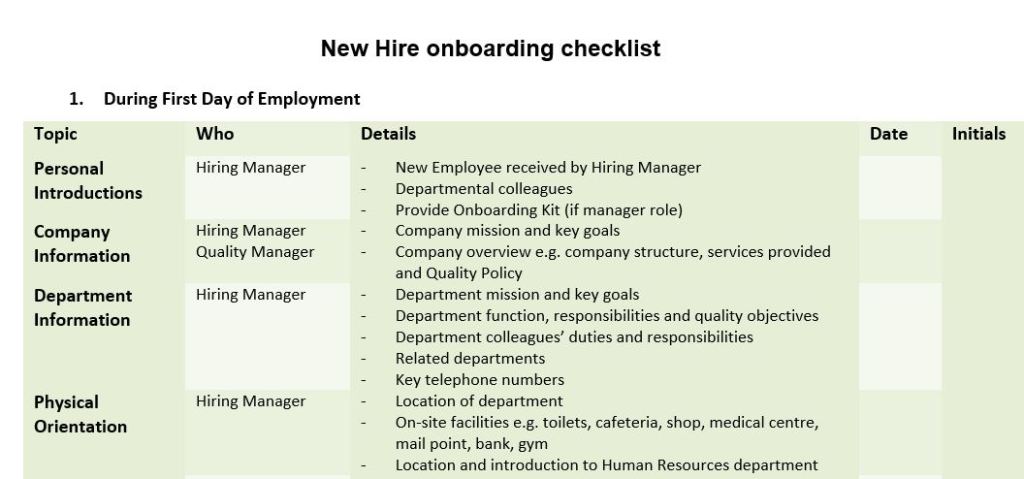
First impressions matter, especially when it comes to new hires. A well-structured onboarding process is crucial for setting employees up for success. By providing clarity, support, and a warm welcome, you can accelerate their productivity and boost job satisfaction. This process can be more successful when you create a plan and share it with the hiring manager and the new hire..

Onboarding: Your New Hire’s First Impression

A strong onboarding process is essential for employee satisfaction and retention. It’s not just about paperwork and introductions; it’s about setting new hires up for success from day one. By providing clear expectations, necessary tools, and a supportive environment, you can accelerate their productivity and foster a sense of belonging. Let’s explore how a well-structured onboarding checklist can make a difference.

People centered HR Processes MODEL

Laying the Groundwork for New Hire Success

A successful onboarding experience starts before a new employee even walks through the door. By planning and coordinating tasks in advance, you can create a seamless transition. This involves everything from communicating expectations to the new hire to aligning key stakeholders. The key players in setting up the plan and ensuring that everyone is ready to support the necessary meetings and onboarding discussions are usually the HR business partner and the Hiring manager. Effective onboarding isn’t just about paperwork; it’s about setting the stage for long-term employee satisfaction and productivity.

This template is a basic version and you should add your own additional items to help new employees understand your industry and company plus know how to navigate the office building, and business better. If the new employee will be in a customer-facing role you may need to include introductions to customers too.

A well-structured onboarding process is your secret weapon for talent retention and productivity. By providing a clear roadmap for new hires, you not only accelerate their ramp-up time but also create a positive and lasting first impression. Remember, a smooth onboarding experience sets the tone for an employee’s entire tenure.