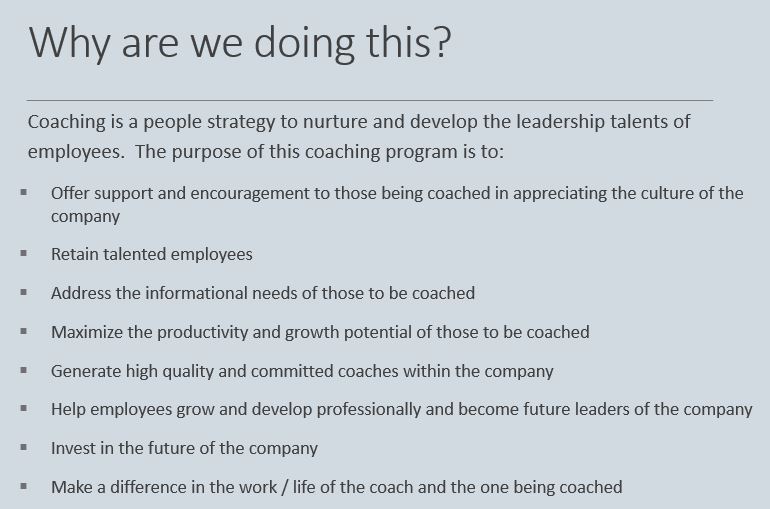
All coaching programs should contain an orientation as one of the starting elements. This session should cover the objectives of the program, what the expectations are for both coaches and those to be coached and any other general information that would be important for the participants of your coaching program. You can choose to combine the two groups for the session or you could choose to do separate sessions for coaches and those to be coached. If you choose the former you may want to add a training or reminder section of any specific coaching aspects that you wish to empathize.
The download file above contains a series of slides to help you get started creating your own. It shows some of the typical questions that coaching program participants may have and answers that may be relevant, but of course subject to your edits to suit your specific needs.
Tips:
Be sure to have a Q and A portion to answer any specific questions that anyone may have.
The front part of the presentation which sets the scene in terms of “no entitlement to promotion etc.” would be relevant if you have experienced that as an issue in your workforce or talented employee pool. In some cultures that may be seen as “offensive” or even “threatening” that it would be mentioned. So be culturally sensitive when you consider keeping that comment.
In the roles section I mention HR as the function supporting the coaching program – depending on your organization that could be your Learning and Development department, your Organization Development (OD) group or any other department/group.
Be sure to provide the coaches and those to be coached with all the tools they will need. If not printed and handed out at your orientation session, then perhaps a soft copy on a USB stick or per email after the session. Coaching questions or Preparation for Coaching
Coaching sessions and programs are more successful when there are clear coaching goals and actions planned are documented. These developmental actions and activities should be reviewed and updated on a regular basis. It helps both the coach and the person being coached to maintain focus on desired outcomes..
Many employees who are new to coaching have misguided expectations about the coaching process and their own role in it. They expect the coach would show up at each session ready to provide them with useful information and advice and all they needed to do was to show up. In reality the coaching process works much better when both parties actively participate and prepare for each session.
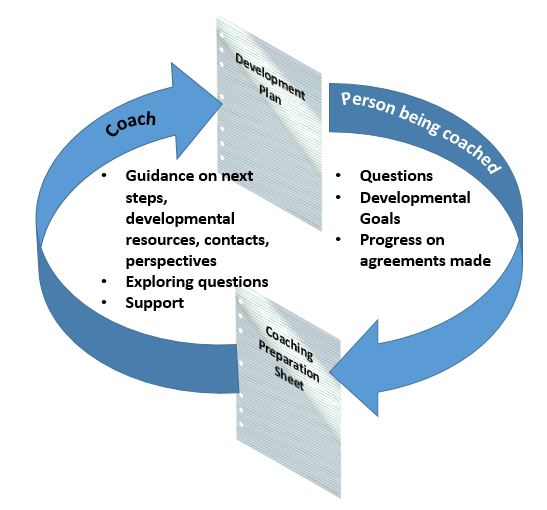
This process graphic shows that each party in the coaching process provides input and participates in the process. The results are written down and shared to ensure a common understanding of the goals and that progress towards goal achievement is maintained.
For those being coached: make sure you get your completed preparation sheet to your coach at least a few days before the session so that the coach can take your feedback into account. This helps him or her prepare to answer your questions and obtain any additional information and resources that may be useful to you at this time and bring it to the session.
For coaches: take note of the questions and struggles that may be noted in the preparation sheet. Consider how you can best help address those issues and which resources can you provide to help in the process? What is the best way to approach the coaching session – given those questions, issues and of course the overall goals that had been set for the coaching process?
Do remember to look back at previous preparation sheets and also the updated development plan on occasion (maybe once every 6 months) to recognize and appreciate progress made to date and to help motivate those being coached to take the next steps that may be required towards ultimate goal achievement.
Coaching is a shared responsibility between the coach and the person being coached. Only then, does the process yield the best results. And preparation is a key part of this shared responsibility.
Many managers mistakenly think coaching is about “telling” others what they should be doing. While some very inexperienced people may need you to tell them what to do or how to do it, most others need to learn and explore topics and new skills or behaviors with their coaches instead. The hard part for many coaches is to listen and ask the right questions. And also to refrain from taking up most of the airtime during coaching sessions talking about their own lives and their own stories or just offering advice. While children happily accept new information simply because you tell them how things are, adults prefer to explore and learn by comparing and assimilating what you are sharing with what they already know and have learned in their pasts.
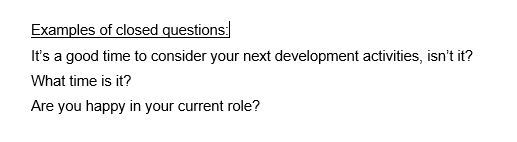
Closed Questions
Coaching sessions is about asking open-ended questions which leads to learning and exploring. Asking the right questions is not an easy assignment to have as a coach. Some questions shut others down while limiting them to “yes” or “no” answers which does not allow for a rich conversation of exploration around the topic concerned. Closed questions are those that can be answered by a simple yes or no answer.
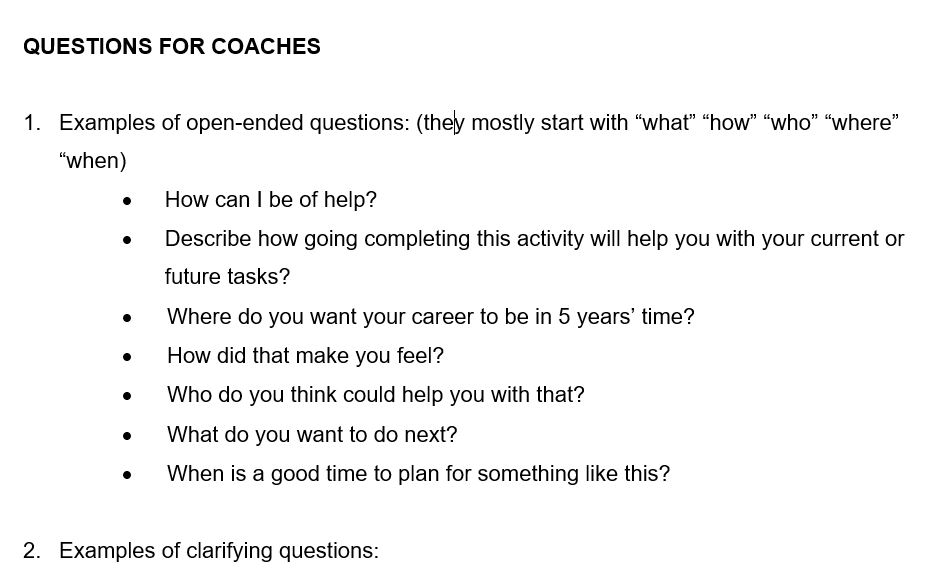
More useful questions to ask :
Open-ended questions help others expand on ideas and contribute to the conversation vs staying mostly in listening-mode. These kinds of questions can help you discover the other person’s thought processes, motivations and how they feel about a topic or an option.
Clarifying questions are helpful to ensure you understood your conversation partner correctly. When people get going on topics that they feel quite excited or passionate about they can sometimes lose sight of how familiar you are with that same topic. To ensure you (the coach) are able to follow along, you may need to pause, look back and clarify any comment made which you were unable to place within the context of the topic being discussed.
Paraphrasing. This is a useful technique to summarize what you heard so far and help move the conversation towards a decision or planning a specific path forward (action). It also helps ensure that your impressions of what was said are correct. It can be very validating for someone to hear their own words summarized correctly by another trusted person (in this case you, as the coach).
This list of questions for coaches (which you can download above) can help you to ask the right questions at your next coaching session. I recommend you read through this as you prepare for the session, but do not commit yourself to asking specific pre-determined questions regardless of how the conversation goes. The important part about asking questions at a coaching session is that you (the coach) show up with a mindset of curiosity. That opens up the exploration in the conversation and enables learning to take place which is vital for adults in their learning process.
Use the links to other content which I show below and also the resource I am sharing above as a way to prepare for and get into inquiry mode before the planned coaching session.
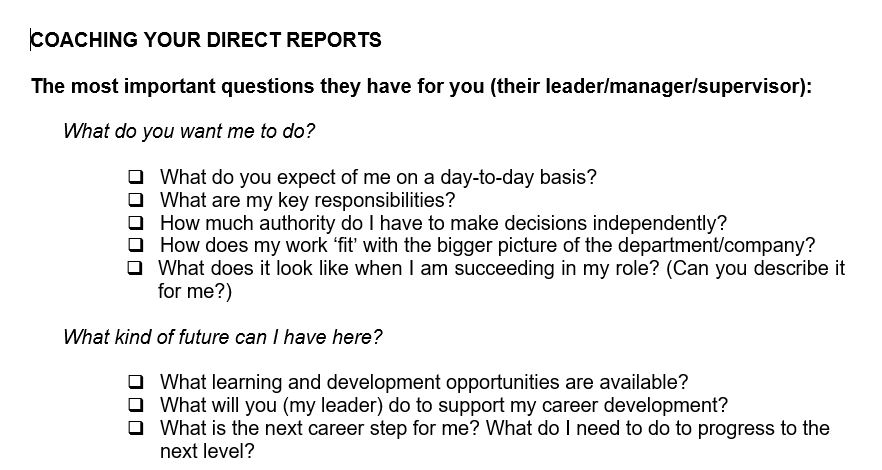
I often hear from managers that they don’t know how to approach coaching their direct reports. It appears the word coaching implies to them that they must have some special insights and skills which would qualify them to coach someone else. Most managers do not realize that they actually know a lot about the company, how things work, how things should be working and how it is going generally. Perhaps all they need is a way to get the conversation going?
Sometimes employees have questions, which are easy to address and other times you need time to get back to them with answers.
Coaching may seem a little less daunting if you had this checklist ( see download button above) of topics to discuss with employees as a group or as individuals. There is a lot to be said for group coaching sessions! They can also be very effective in developing a group of people who may roughly all have the similar development needs and questions for you.
As their manager, you can open a conversation covering one of the questions on the sheet and just state “I can imagine you may have some questions or would like to know more about….” (use one of the questions shown on the sheet). Once the conversation is kicked-off it often happens that the employee will start to bring up more specific questions that he or she may have.
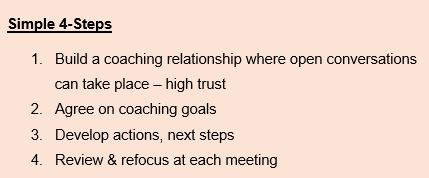
This graphic shows the basic 4 steps that can be used to start and keep a good coaching relationship going. Trust is a key component and building trust is important – honesty, integrity and showing employees that you care about their work, their careers and their well-being all help to build trust.
Coaching can be a highly structured program requiring a lot of specialized communication and coaching skills and training. It can also be simply helping employees understand the basics around their roles, the company and how things work in their environment. It is your role as their manager to coach them and develop their knowledge, skills and competencies on an on-going basis. If you need more training and support with regards to coaching, do talk to your HR or L&D representative. In the interim, this conversation-starting summary sheet may be helpful to you!
The strength of teams lies in their ability to achieve more as a group working together than as individuals working independently on various parts of a project or activity. The main obstacle to a team achieving the optimal performance level is the ability of the individual team members to work together collaboratively.
You can select the right team members based on the knowledge you need, the skills and competencies you need and the experience levels you need for a project. And the team performance can still be very disappointing if the team members do not communicate effectively, are not sharing information in a comprehensible way, and are not clear on how to coordinate with each other to avoid rework or waste their efforts working on the wrong items.
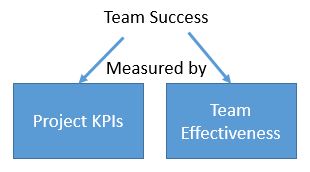
The success of a team is measured by more than one aspect. Examples include:
Achieving project milestones and objectives
Satisfied stakeholders
How well team members are working together – getting more done with more innovation and inclusiveness in a shorter period of time
Phases of a team
Any team will go through developmental phases starting from the first day the team members spend together. If these phases are navigated successfully, they can help team members build a high level of trust which enables the team to achieve a high performance level. The leader of a team has an important role to play throughout the phases of team development to help the team achieve their goals in the most effective and efficient .
Measuring team outcomes
Setting out to measure the progress of a team’s efforts is simply about communicating and then monitoring KPIs (Key Performance Indicators) on a regular basis. KPIs are typically set around costs, time to completion, quality of the product etc.
Measuring the cohesion between team members and how well the team is functioning is not that simple. Every team member most likely has his or her own opinion of how well the team is functioning and where improvements may be needed. Team members also would have opinions about whose “fault” it may be that things are not better. The question is often whether it is a lack of knowledge, a lack of motivation or actually interpersonal conflicts and distrust which is contributing the most to dysfunctions.
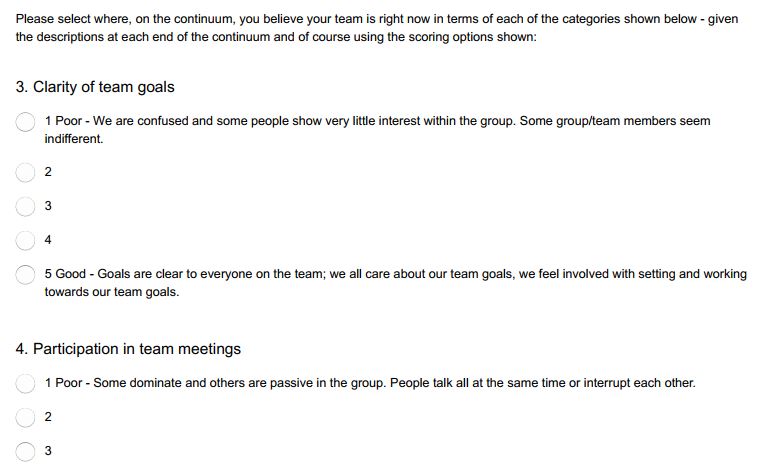
Using this short team effectiveness check, is a great way for leaders to take a quick look at how each of the team members see the team at that moment in time and identify where discussions may be needed to clarify or remove issues that may be hampering team functioning.
The purpose of this quick survey is to gather input from the team on their own perspectives. Remember that a perspective is just how one person sees things at that moment in time. It does not mean that the perspective of one person holds true for the rest of the team. It is important though that you understand whether one or more team members are not feeling included, engaged or unable to contribute based on a lack of internal alignment with other team members on goals etc
As the team leader or team coach, ask your team members to fill this out maybe once a month – more often if you are going through a difficult phase as a team and you are concerned about how well things are going for each team member. I would not do this more than once per week.
Note that your team dynamics will most likely change when you add members, remove members or when your project enters a completely new phase of functioning and performance expectations. At those moments you are likely to see a decline in previously recorded good scores for team effectiveness and functioning.
Use this tool as a way to quickly diagnose where the team is at and use it as a starting point for some team or one-on-one discussions to address concerns raised. Include an external person to facilitate difficult team discussions if you feel it may be helpful – someone from HR/Learning and Development/team coach may be able to use their expertise and skills in group dynamics, conflict resolution and interpersonal relationships to get your team out of a rough spot when it occurs.
One of the most frustrating elements of many managers’ calendars are meetings. If you ask people they mostly believe there are too many participants, that meetings take too long, and that some individuals talk too much and venture off-topic. And most people are unable to remember what was decided or which actions came out of the meeting. The tool I am sharing helps a chairperson to prepare for a meeting and it helps him or her communicate the specific overall objectives for the meeting and also for every agenda item.
Some of the meeting maladies mentioned above can be cured simply by creating and distributing an agenda to participants before having the meeting. This tool goes further though – it also helps to create clarity around each agenda item’s purpose in informing participants or driving decision-making to move a project or initiatives forward.
The template you can download above contains an example to illustrate its use. Just replace the agenda items shown with your own meeting agenda items and then complete each column as demonstrated to clarify who is responsible for each agenda item, the purpose of each item, and the allocated time and desired outcome for each of the agenda items. Do share the objectives, time available and expected outcomes with those who are assigned to each agenda item – it helps him or her be prepared to guide the conversation and discussion accordingly.
Suggestions
Even with an agenda and a well-planned meeting there may be times when things need to change as it becomes clear that a critical issue requires to be solved right-away. Give yourself the leeway to abandon the agenda for a particular meeting to deal with such a highly critical and important issue or set another meeting right after the planned meeting to address the issue.
Some successful chairpersons make use of meeting “agreements” or “ground rules” to further improve the quality of the meeting. Some have items such as “each speaker gets a maximum of 1 minute to make his or her point” and “we debate issues and we respect the opinions of others.”
To know if your meetings are getting better – get feedback from your meeting participants. Take a few minutes at the end of the meeting to ask what went well and what could be better in future – exactly how. Reviewing the feedback when you plan the next meeting can help you to be mindful of further improvements that can be included going forward.
I hope this tool helps you plan your next meeting and move closer to having productive meetings which helps you progress your project or initiative as you had hoped.
Giving and receiving feedback can be a delicate dance. It can be uncomfortable for both parties involved at times. However, it’s an essential part of growth and development. By getting better at giving feedback, planning what to say and opening the door to an open and honest discussion, we can help employees reach their full potential while driving organizational success.
This template helps a manager or supervisor think through the important aspects of giving feedback to an employee and helps to plan and prepare for the actual feedback meeting.
The template and approach also helps plan positive feedback to employees. This aspect is often neglected, but equally valuable in helping employees understand what specific actions and communications are valued and should be continued.
Some reminders:
Never give important feedback via an email or sending this worksheet to the employee. It should always be done in person or at least through a phone or video call. – if an in-person meeting is not possible.
The feedback should be given as soon as possible after the event to minimize surprises at the structured annual performance feedback meetings and to ensure the employee still has a good recollection of the situation or event that took place.
Do allow the employee to respond once you have shared the feedback to ensure that your message is understood by the employee and to allow you to understand any nuances to the situation which you may not have been aware of.
It is always a good idea to agree on a check-in moment at some time in the future. This is an opportunity to see if the employee may have further questions or comments at that time or perhaps he or she has been working on improving a particular skill related to the feedback you had shared and perhaps he or she could have some successes to share with you!
Sharing feedback with an employee, when it is not positive, can be tough to execute even with a tool like this. It depends a lot on your own style for managing conflict and whether you prefer to avoid conflict or situations where people may be upset with you. Take some time to learn more about your own conflict management style if giving feedback to employees remains a challenge for you even when you have used the template to prepare for the conversation.
Delegation isn’t just about offloading work; it’s about developing your team’s potential. By strategically assigning tasks, you not only free up your time but also equip your employees with new skills and responsibilities. However, keeping track of who’s doing what can be challenging. That’s why a clear system for delegating and monitoring tasks is essential for maximizing productivity and employee growth. The template I am sharing is a great way to keep track of not only who is working on which delegated task, but also what was the overall purpose of the delegated task.
Try to match the task or activity/project you need to delegate to the right person in your team given their current skills and competencies and also matched to current development needs each of them have. The template is based on a list of categories to consider: (see second tab in template for the definitions shown below)
The delegation tracking sheet helps you keep track of the level of capability the person has – which uses the definitions above to help remind you how much support he or she might need with that task.
Use the drop down list in column B to select the category that applies to that task/project and the person that you are delegating to. You can create more lines for delegated tasks by just inserting a line between the existing lines.
Reasons why this list can be very useful:
Keeping this list up to date and referring to it in a regular basis will help you remember when to check in on someone working on a delegated task or project.
You keep track of the reasons why you gave a specific task to someone – from a developmental perspective. This means you know how much support and coaching may be needed while the person is working on this task.
Avoid giving the same task to more than one person. There is nothing more demotivating to an employee than finding out another colleague is working on the exact same project as he or she is after having already spent several hours doing research and talking to people about the project in order to deliver a great result.
You can do more and accomplish more as a manager when you don’t have to rely on your memory alone to remember who is working on which tasks and projects for you.
Effective delegation is the cornerstone of successful management. By utilizing this template to track delegated tasks, managers can optimize workload distribution, identify development opportunities for team members, and ensure that projects stay on track. This proactive approach not only boosts productivity but also builds a culture of empowerment and growth within the team.
Making Informed Hiring Decisions: A Comparative Approach
Selecting the right candidate from a pool of qualified applicants is a critical task. To ensure objectivity and fairness, organizations must implement structured comparison methods. By carefully evaluating candidates against job requirements, we can make data-driven hiring decisions that reduce bias and increase the likelihood of long-term success.
After interviewing some candidates for a vacancy it is easy to start getting confused about how the candidates compare to each other. If you have used the template for capturing information during interviews Job Applicant Interview Record then you will have a stack of records from those who have interviewed the candidates you are currently considering. How to bring it all together?
The template I am sharing here will help you with that:
Interviewers can also use this sheet to score each candidate they interview for a vacancy and then provided completed sheets back to the recruiter who consolidates all input received into one summary for final discussion and decision-making.
Change column headings in this template to match the key criteria that you have used in your Interview Records for this vacancy and use the average scores that each of the candidates obtained from interviewers when you create this summary. The Totals column adds up the overall score for each candidate so you can see how the scores compare and which candidates have scored better than others. This template is useful to the recruiter in advising the Hiring Manager on the outcomes of interviews to plan the next steps for that vacancy.
Variation option:
You can add a row for weighting specific criteria in the spreadsheet. For example, if you believe that one of the items is much more important than the others – could be language skills or supervisory experience – you can decide to give it a higher importance by adding a higher “weighting” to it. (All of the weights for each of the rated categories together should add up to 100)
The overall scores are now created by multiplying the score for each category with the weighting that you have assigned – based on the higher importance of some items.
The Job Candidate Summary template can help you create one simple document that contains all of the feedback received about a candidate during the interview phase. And this greatly benefits a focused discussion about the next steps with the Hiring Manager.
A well-structured candidate comparison process is not just about selecting the best candidate; it’s also about protecting your organization. By documenting your evaluation process, you create a defensible record that can withstand scrutiny from both internal and external stakeholders. This transparency builds trust and ensures fairness throughout the hiring process. Moreover, providing candidates with constructive feedback based on a clear evaluation framework demonstrates your commitment to professional development and enhances your employer brand.
Employee turnover can be costly and disruptive. To address this challenge effectively, we must delve deeper into the reasons why people leave. By analyzing exit data and conducting thorough exit interviews, organizations can identify underlying issues and implement targeted retention strategies.
Unexpected employee resignations can often be alarming. More so if the resignations come from star employees whom you had high hopes for in terms of future expert or leadership roles at your company. How will it impact your project and your team, you may wonder? The question I would ask is, was it avoidable?
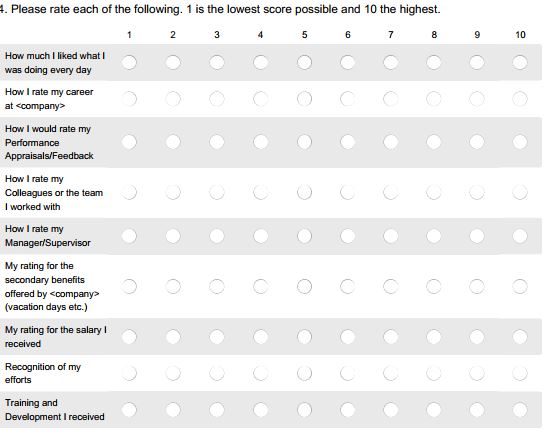
The Exit Interview helps with gathering feedback on employees’ decisions to leave the company and what next steps they are planning to further their careers elsewhere. This structured interview can greatly support your ability to narrow down the reasons for the exit and whether you have any large internal issues to address to avoid more people leaving the company.
While it appears to be a written survey, it works well as an interview conducted in person and then the interviewer (usually from HR) can complete the survey later in order to capture the answers from exiting employees in a structured way. Based on your company set-up and employee conditions you may want to add some questions or statements to be rated. Just avoid overloading the employee with too many questions. Perhaps you can remove some of the existing questions if you decide to add any?
You could choose to use this as a survey which the departing employees complete independently. I would however recommend that you ask these questions as part of an exit interview conducted in person as it offers the opportunity to ask follow-up questions to clarify answers to make sure you really understand the factors that led to the decision to leave the company.
There is a good chance that the departing employee may not tell you the truth. Sometimes they are afraid you may give them a bad reference in the future if a prospective employer calls you up. Other times they may be worried about being the whistle-blower on an existing organizational issue in terms of potential impact on any friends they still have at the organization. It may be worth considering the use of an outsourced vendor to gather feedback from departing employees before or just after they have left.
Do take the time to review feedback received from exit interviews to determine whether you or anyone else at your company may need to take action to improve a situation, revise benefits, improve communications to employees on specific topics, etc. These actions may be exactly what is needed to prevent other employees from leaving for similar reasons.
Mind confidentiality around these interviews. Be sure to be honest with the departing employee on who will get to know about the information shared and stick to the agreement.
Talk to those employees who remain with the company and make sure they understand how much you value their continued service and loyalty to the team/organization. When a prominent person leaves – whether a subject matter expert or a much-liked leader – people may start wondering about their own careers and consider leaving too. Taking employee retention actions and communicating especially to those in key roles will go a long way toward putting people’s minds at rest.
Employee turnover is inevitable, but it doesn’t have to be detrimental. By conducting thorough exit interviews and analyzing the data, you can transform departures into opportunities for growth. By identifying and addressing the root causes of turnover, you can create a more engaged and loyal workforce, ultimately strengthening your organization’s overall performance.










 The Rethink Shelf