Learning from Leavers: The Power of Exit Surveys -Template


Understanding the Why Behind Employee Departure

Employee turnover can be costly and disruptive. To address this challenge effectively, we must delve deeper into the reasons why people leave. By analyzing exit data and conducting thorough exit interviews, organizations can identify underlying issues and implement targeted retention strategies.

Unexpected employee resignations can often be alarming. More so if the resignations come from star employees whom you had high hopes for in terms of future expert or leadership roles at your company. How will it impact your project and your team, you may wonder? The question I would ask is, was it avoidable?

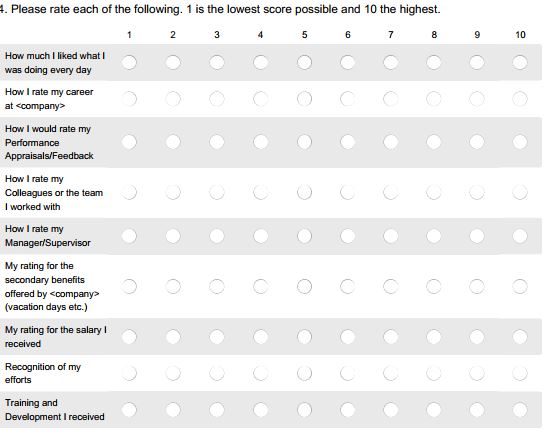
The Exit Interview helps with gathering feedback on employees’ decisions to leave the company and what next steps they are planning to further their careers elsewhere. This structured interview can greatly support your ability to narrow down the reasons for the exit and whether you have any large internal issues to address to avoid more people leaving the company.

While it appears to be a written survey, it works well as an interview conducted in person and then the interviewer (usually from HR) can complete the survey later in order to capture the answers from exiting employees in a structured way. Based on your company set-up and employee conditions you may want to add some questions or statements to be rated. Just avoid overloading the employee with too many questions. Perhaps you can remove some of the existing questions if you decide to add any?

Tips:

  • You could choose to use this as a survey which the departing employees complete independently. I would however recommend that you ask these questions as part of an exit interview conducted in person as it offers the opportunity to ask follow-up questions to clarify answers to make sure you really understand the factors that led to the decision to leave the company.
  • There is a good chance that the departing employee may not tell you the truth. Sometimes they are afraid you may give them a bad reference in the future if a prospective employer calls you up. Other times they may be worried about being the whistle-blower on an existing organizational issue in terms of potential impact on any friends they still have at the organization. It may be worth considering the use of an outsourced vendor to gather feedback from departing employees before or just after they have left.
  • Do take the time to review feedback received from exit interviews to determine whether you or anyone else at your company may need to take action to improve a situation, revise benefits, improve communications to employees on specific topics, etc. These actions may be exactly what is needed to prevent other employees from leaving for similar reasons.
  • Mind confidentiality around these interviews. Be sure to be honest with the departing employee on who will get to know about the information shared and stick to the agreement.
  • Talk to those employees who remain with the company and make sure they understand how much you value their continued service and loyalty to the team/organization. When a prominent person leaves – whether a subject matter expert or a much-liked leader – people may start wondering about their own careers and consider leaving too. Taking employee retention actions and communicating especially to those in key roles will go a long way toward putting people’s minds at rest.

Employee turnover is inevitable, but it doesn’t have to be detrimental. By conducting thorough exit interviews and analyzing the data, you can transform departures into opportunities for growth. By identifying and addressing the root causes of turnover, you can create a more engaged and loyal workforce, ultimately strengthening your organization’s overall performance.

Salary Review Simplified: A Practical Template


Fair compensation is essential for attracting, retaining, and motivating top talent. By conducting regular salary reviews, organizations can maintain internal equity and external competitiveness. This template helps to have a practical approach to evaluating employee compensation and making data-driven adjustments.

While large corporations often rely on sophisticated HR software for compensation management, smaller businesses can achieve similar results with a well-structured spreadsheet. This editable template allows for flexibility and customization, making it a practical choice for many organizations managing a smaller pool of employees.

The basic principles for using this tool:

  •  You need to make sure to retain employees and avoid employee turnover by reviewing his or her salary on a regular basis. Typically once per year.
  • Employees need feedback regarding job performance expectations and also their own performance delivered against the expectations. The compensation they receive should reflect not only the market value of the work they do for you but also their own level of delivery against expectations for that role. Performance that exceeded your expectations deserves to be rewarded. You could do it as a discretionary bonus or you could review the person’s annual salary and consider an increase.
  • Some employees bring increase requests to their bosses on a regular basis while others may just be waiting for their bosses to realize how much effort they put in and how many good results they are achieving. Without a solid salary review process which is run uniformly on an annual basis (at least), you could run the risk of not treating all of your employees in the same fair manner when it comes to salary reviews. It could happen that only those employees requesting regular increases are receiving them while those who do not ask, do not.
Continue reading “Salary Review Simplified: A Practical Template”

Training Certificate Example


When employees complete internal courses, one can be stuck with having to create a professional-looking training certificate for training participants. Not everyone has a knack for that, so here is a basic basic template (you can download it below) which can give you a good starting point for making your own training certificates. It is in *.ppt (Microsoft PowerPoint) format so you can edit the details as needed.

Receiving a training certificate is good way to recognize employees for completing required training courses and handing them out during a townhall meeting or other company event can help reinforce how much the company values the completions.

Using technology currently available to us it is more possible to avoid printing paper versions of a certificate. You can create the certificate electronically and also add digital signatures then save it as a *.pdf document or a picture. That way distribution can take place by means of sharing a hyperlink to the certificate or attaching an electronic file to an email addressed to the recipients.

Some tips:

  • When you customize the file or change elements, beware of creating something that is overly colorful and “busy” with competing elements – graphic and text.
  • When you insert digital signatures be very careful about who has access to those. It is a very sensitive graphic to have and can easily be abused if it falls into the wrong hands.

Personal Development Plan


Continuous learners have the best chances of being noticed for new opportunities and promotions. It is important to be structured around what you will focus on learning next. Ask for feedback from more senior people around you or from your manager/supervisor. Then create a personal development plan for yourself. As you complete learning goals, set new learning goals and update your personal development plan accordingly.

The best way to have a structured learning approach is to have a Development Plan. Creating your own development plan is the first step towards mapping out your learning needs and priorities. Ask someone with experience to help you with it. It could be your supervisor or manager and it can also be a coach or mentor that you are working with. Such a person should be able to provide you with valuable feedback as you aim to prioritize your planned development actions.

Start the plan

Continue reading “Personal Development Plan”