9 Tips for Compelling Competition Entries in Sustainability


Entering the project you are most proud of into an excellence competition is an exciting opportunity to showcase your hard work and achievements. But let’s face it, the competition can be stiff—especially when sustainability is a key judging criterion. Don’t worry, though; this post will guide you through how to focus on the right elements and tell a compelling story that highlights your project’s success without making things up. The secret? It’s all about having the right data, understanding what it means, and explaining why it matters.

Here are nine ways to make your project stand out and be memorable and remarkable:

1. Start With the Basics: Read the Rules

Before drafting your entry, carefully review the competition guidelines, especially sections on sustainability or innovation. These often hint at what judges value most—energy efficiency, water conservation, carbon reduction, waste avoidance, community impact, or even all of these. Align your entry with these priorities. And don’t stress over word limits—stay within 10% of the specified count, as they’re there to keep entries focused, not to demand a full thesis.

2. Tell a Story, Not Just the Facts

Before you start writing your entry, read the competition guidelines carefully. Pay special attention to any sections about sustainability or innovation. Competitions often provide clues about what the judges are looking for—energy efficiency, water conservation, carbon reduction, waste avoidance, community impact, or maybe all of the above. Tailor your entry to match these expectations.

3 Focus on Measurable Outcomes

Judges love numbers, so don’t shy away from sharing your data. If your project saved energy, reduced emissions, or cut costs, include the specifics. Here are some examples:

  • Energy Efficiency: “We installed energy-efficient lighting and reduced electricity usage by 30%, saving EUR 10,000 annually.”
  • Waste Reduction: “By reusing materials on-site, we diverted 95% of construction waste from landfills.”
  • Sustainability Impact: “The project’s solar panels now produce 20,000 kWh annually, enough to power 10 homes.”

Don’t have all the data? That’s okay—start with what you do have. Just be sure to explain how you measured these outcomes and why they’re meaningful.

4. Highlight What Makes Your Project Unique

Competitions are about standing out. Did you try something new that hadn’t been done before? Did you find a way to make the project faster, cheaper, or more sustainable? Maybe you combined existing methods or approaches in creative ways. For example:

  • “We used prefabricated components to speed up construction, reducing on-site waste and emissions.”
  • “Our landscaping included native plants, which cut water usage by 40% and boosted local biodiversity.”

Be clear about how your approach sets your project apart.

5. Talk About What You Learned

No project is perfect, and judges appreciate honesty. Talk about what went well but also acknowledge what didn’t. Maybe a new method didn’t work as planned, or you realized late in the process that a different approach would have been better. What’s important is that you show you learned from the experience.

For example:
“We underestimated the time required to train staff on the new energy management system, which delayed implementation. In the future, we would schedule training earlier to avoid this issue.”

6. Sustainability: More Than Just Energy

When we think of sustainability, energy efficiency often comes to mind first. But there’s more to it. Judges might also look for:

  • Circular Economy: Did you reuse, upcycle or recycle materials?
  • Water Conservation: Did your project reduce water usage?
  • Community Impact: Did the project benefit local communities or create jobs?
  • Biodiversity: Did your landscaping include native plants to support local ecosystems, or did you create green spaces that attract pollinators like bees and butterflies?
  • Positive Local Community Impact: Did you partner with local schools for educational programs or support community groups through funding or volunteer initiatives during the project?

By broadening your perspective, you can show how your project goes beyond energy savings to create lasting, meaningful impacts. Be sure to cover these aspects if they apply to your project.

7. Be Honest—Don’t Fake It

It’s tempting to stretch the truth to make your project look better but resist the urge. Judges have likely seen it all, and they’ll spot exaggerations a mile away. Instead, focus on presenting your project’s real achievements as clearly and confidently as possible.

8. Make It Easy to Follow 

A clear, well-organized entry can make all the difference. Judges don’t have time to untangle cluttered submissions, so present your work in a way that flows logically and is easy to digest. Use clear headings, concise bullet points, and short paragraphs to guide the reader. 

Think about your structure: 

  • Timeline Approach: Are you walking judges through processes, events, or project phases step by step? 
    • Top-Down Method: Are you starting with a big-picture overview and then zooming in on specific achievements or highlights? 
    • Comparative Lens: Are you showcasing measurable improvements by comparing past performance to present outcomes and projecting future benefits? 

If you’re including technical data, don’t let it overwhelm the narrative. Break it down into simple, relatable terms that anyone—even those without technical expertise—can understand. For example, instead of saying “airtightness of 0.6 ACH at 50 pascals,” explain how that translates into better energy savings or indoor comfort. 

A polished, intuitive format not only keeps the competition judges engaged but also ensures they don’t miss the full scope of your project’s excellence.

9. Think About the Future

Judges often like to see how your project has inspired or informed future efforts. Did it set a standard for your company or industry? Has it led to new ideas or processes? For example:

  • “The success of this project has prompted us to roll out similar solar energy systems at three other sites.”
  • “We are now working to integrate lessons learned into our next project to achieve even greater sustainability.”

Entering a competition isn’t just about winning—it’s about showcasing what makes your work exceptional. By focusing on measurable outcomes, sustainability, and what you’ve learned, you can create a compelling entry that stands out.

Remember: the judges aren’t looking for perfection—they’re looking for impact, innovation, and integrity. Follow this approach, and you’ll not only improve your chances of winning but also demonstrate why your project truly matters.

Now go tell your story—sustainably, of course!

Data Privacy Essentials: Your Compliance Starter Kit


Navigating the complex world of data protection can be overwhelming, especially for small organizations like charities and businesses.

The Perils of Data Breaches

When personal data falls into the wrong hands, the consequences can be devastating. Individuals may become victims of identity theft, financial loss, or emotional distress. Trust, once broken, is difficult to rebuild. Organizations face reputational damage, monetary penalties, and legal repercussions. Moreover, a data breach can erode public confidence in digital services, hindering innovation and economic growth. Safeguarding personal information is not just a legal obligation but a moral imperative.

Compliance

The General Data Protection Regulation (GDPR) has set a new global standard for data privacy in Europe. At this time there are several countries worldwide with similar compliance requirements – from Australia’s Privacy Act to California’s Consumer Privacy Act (CCPA), organizations across the globe are grappling with the complexities of safeguarding personal information.

Free draft forms and guidelines

Data protection can be a real headache, especially for small businesses and charities. That’s why this toolkit of draft forms and policies is here to help you get started with practical templates to help you stay compliant without the hassle.

Think of these draft documents as your trusty sidekick, providing a solid foundation for your data protection journey.

The toolkit has the following elements:

Data Protection draft Policy Template: Establish clear guidelines for handling personal data.

Data Breach draft Incident Report: Outline steps to take in case of a data breach.

Auditing and Monitoring draft Procedure: Maintain data protection compliance through regular checks.

Drat Data Subject Access Request (DSAR) Form: Efficiently handle requests for personal data.

Draft Data Protection Impact Assessment (DPIA) Form: Assess the potential risks of data processing activities.

While these may be a handy starting point, remember, that data protection is about more than just paperwork. To really protect your donors’, your employees’, your vendors’, and customers’ info, you’ll need to build a solid system that covers everything from training your staff to dealing with data breaches to having a process to report incidents, investigate and draw up an incident report and understanding the data you have and know if you have any risks if that data leaks out somehow.

  • Data protection impact assessments: You need to start out by identifying and managing high-risk data processing activities and making sure you address any high risks you identified in the process. Conduct regular assessments (maybe once a year) to identify potential vulnerabilities and implement appropriate data protection safeguards. [There is a draft form for that in the templates.]
  • Employee Training: Regular training to ensure staff understands their data protection responsibilities and can identify and prevent potential risks.
  • Data Minimization: Collect and retain only the necessary personal data and give them examples to help them understand what personal data is.
  • Rights of those whose data you have: Implement procedures to handle data access requests – they generally have the right to erasure or update of data you store, and other rights include the right to ask to see the personal data you keep on them. [There is a draft form that people can use to request access to the personal data you have]
  • Supplier Management: Ensure data processors comply with data protection requirements through contracts and oversight.
  • Incident Response: Develop a clear plan for responding to data breaches, including notification procedures. And make sure everyone knows which number to call or which email to use to report a suspected data breach. [there is draft information in the templates for how to report an incident and also questions to ask when talking to someone reporting a potential data breach.]
  • Continuous Monitoring and Review: Regularly assess data protection practices to identify and address potential vulnerabilities.

By combining the templates with these additional measures, you can help your organization build a strong foundation for data protection compliance and protect the privacy of your data subjects.

Tips for that interview


It is about knowing what you want to say when you answer the questions, but it is also about how you say it. Your credibility and success will depend on both – contents and delivery. While you can get feedback from others on your written answers (contents) and feel confident about that, until you have practiced the delivery, you are only halfway ready for the interview to get the job or role you so desperately want!

Steps

Collect maybe a handful of typical questions asked at interviews (there are several sites that would offer you suggestions for questions to prepare for). Also, look for some specific questions that are logically tied to the role description for the job.

Examples of typical questions include:

  • Give me a summary of your career history and why this role is right for you.
  • Tell me more about yourself.
  • Where do you see yourself in 5 yrs – career-wise?
  • Why are you interested in this role?
  • What is the achievement that you are most proud of in your life?
  • Tell me about the last time you got angry with a colleague?

2. Use the STAR methodology to construct answers on paper/screen to the typical questions you picked. If the question is not in the format “tell me about a time when” – you can still use the STAR method by answering “The situation was… X, I had to do Y, Here is what I did… Z, and the outcome was AA and this is why I believe/want/have this approach… (explain your answer)”. In some cases, STAR may not the be right way to go about giving an answer. (Link to explanation of how STAR methodology works)

3. Use structured messages (especially if STAR may not be the right approach for your answers) See post about how to structure messages. In principle – look for 3 key points you want to bring across to answer the question or explain something. The power of using 3 points is that humans remember 3 points and it satisfies something primal in us to hear answers in 3’s. Tell us first “There are 3 reasons why” and then tell us that one by one.

4. Practice your prepared answers a few times until you feel that you have reached a satisfactory level of delivering the right message in the right way – answering the questions you have selected.

5. Time to record yourself. Get out your video recorder/tablet/phone and record yourself answering the questions one by one.

How to use the recording(s) of yourself answering the questions:

How to review your recording

Turn off the sound! – Watch your body language and look for moments when you find your body language possibly distracting from your message. It could be that you keep sweeping your hair behind your ear, or you fiddle with a pen or your glasses or you do not make eye contact. Make notes about that to yourself.

Don’t watchlisten! – Watch it again without looking at the screen, just listen to your answers… does your voice sound steady? Is it clear? Do your answers come across crisply and credibly? Make notes for yourself.

Watch and listen! For the 3rd time, watch the recording with the sound on. How does your body language compliment your answers? Where do you wish you didn’t play with that object in front of you because it made your answer sound tentative? Or did you look away from the camera while saying something important? Make more notes.

6. Use your notes and adjust your answers as needed to improve on the contents. And practice answering them in a new way.

7. Find someone who has interviewed others in the past to listen to you. Ask him/her to ask the questions one by one and deliver your answers (updated words and delivery as per your adjustments). Ask for specific feedback on areas where your answers or delivery could be better.

Having made the adjustments and delivered your answers to the best of your ability on the day of the interview does not always mean the job is yours. There are many reasons why good candidates do not go to the next level of interviews. Do make sure you learn from your experience if you are not successful. Ask for specific feedback after the interview – regarding areas where they felt you did not meet expectations. Then use that as a checklist for the next time you prepare for an interview.

5 things to consider before launching your own surveys


It is easy to think “I will just create a quick survey for that” and then go off and email a link out to a group of people to collect responses. Looking at the big picture perspective, firstly be clear on your overall survey objectives and how you will use the input you receive.

Once you have defined that, take a few more minutes to think through 5 key aspects of launching a survey before you proceed:

  1. What exactly is the message?
  2. The platform you plan to use
  3. CHECK the text
  4. The intro matters
  5. The thank you

The message

Launching a survey is a message too

(It says: I want to know, I value your opinion, I am listening, Tell me what you think)

Take the time to write down all the messages about the survey that intended participants need to know. What do other stakeholders need to know – think of managers who may need to help you communicate to their groups about the survey. What do you need to make sure they know about it before your launch date?

People need to know what the survey is for and why it is important. What is this survey linked to and how do you hope to use the input to drive decision-making?

When can they expect the survey to be open and how will they access it? Link via email or QR codes around the building/email or will it be an app on their mobile devices?

Will you be emailing out the announcement of the survey or is there a communication plan that is much broader than the survey? Perhaps some messages will be on social media or notice boards? If you need to make a communication plan, this template can help:

Be sure to share this information with intended survey participants when you map out your communication messages:

  • This survey is coming on (date)
  • The reason we do this is (….)
  • What we hope to review/change/update/introduce as a result of this survey is (…)
  • Why we are asking for your input is (…..)
  • It will only take (…..) minutes of your time to complete
  • We will let you know about the results (time) and (how/where)
  • How will you protect their privacy and if the survey contains sensitive information – who will see it and how long will you maintain the data before destroying it?
  • Can they participate anonymously?

The platform

There are various survey platforms available these days – some are free, and others are not. In general, those with paying options come with additional features such as help to analyse your data, automatic graphic creations for communicating your survey results, text analysis options etc.

Whichever platform you choose to use, test it first. Create a quick survey and send out the link to some trusted colleagues or to yourself to see how it displays. Can you access the survey using the link without any firewalls or other error screens interfering with ease of access? Is it easy to complete the survey online? Is there a phone app for it? How well does the phone app work?

Also look at the reports you can get from the platform. To what degree does the platform offer you some level of analysis as a download? Can you download a spreadsheet which you then need to analyse yourself to create a presentation or a report? Knowing what remains for you to do is an important consideration in choosing the right platform for the survey.

Check the text

Make sure you have read each sentence out aloud. Missing words or repeated words can be overlooked when you just glance through your survey. Reading it out loud – word for word – often highlights areas that may need to be reworded or corrected. Answer these questions about your survey wording:

  • Do the instructions make sense? If I ask other people how they would interpret the instructions you plan to use, would they know what to do next?
  • Is each question or statement to be rated constructed in a simple way to avoid confused answers? i.e. do not ask about more than one thing at the same time such as “do you think it was easy to do and did you like the fun tests we handed out at cafeteria last week?” In this case your results could be hard to interpret. If the final scores are low, was it because people thought it was NOT easy or was it because they did NOT like it? Or was it both?
  • If the platform has a spell check function, use it. If it does not, copy and paste the text into a document where you are able to check spelling before you proceed to launch the survey

The intro matters

Even if you did a great job at communicating about the survey in your communication plan activities and presentation messages, people may not have seen or heard all of your early messages. Tell them the highlights in the introduction section of the survey: (after the survey title and before you start with your questions or statements to rate etc).

Intro points:

  • What it is FOR?
  • Why are THEY asked for input?
  • What will you DO with the information obtained?
  • Is it anonymous or will you be telling others what they said in the survey?
  • By WHEN do you expect their response to have been completed after which you will close the survey?
  • HOW LONG is it likely to take participants to complete the survey?

Say thank you

When people answer your surveys, they are prioritizing your request given other tasks that lie before them. They are making time out of often busy days to provide you with feedback. A simple thank you message can go a long way to ensure people are open to respond to future survey participation requests.

And while you are saying thank you, it may be an idea to provide a link to a website to visit if they want to find out more, volunteer or whatever other actions you would like them to take after completing the survey.

Surveys are so easy to create these days and the need to collect recent data and employee feedback is becoming more mainstream in companies than in previous decades. The annual employee survey is no longer the only way that change managers and management obtain feedback. Surveys can be a powerful feedback tool and yet, they can also create confusion and frustration if they are not communicated and launched with some forethought and planning.

Creating an Annual Communication Plan


comm plan graphic

Unless you are in a senior role in the communications group or department you probably never had to make an annual communication plan before. Recently I  was asked to help two people (one from a mid-sized and the other from a small company) who never had to make an annual communication plan before but were expected to create one now. Perhaps you are also tasked with making one? Or maybe you are asked to comment on one?

The basic idea behind an annual communication plan is to ensure that someone is planning to address targeted communications activities to various groups of people across all the available platforms that are used by the group or organization. The plan should typically include specific mention of dates, details of the intended contents of messages or specific focus areas, and be specific about who is responsible for each of the actions. That way everyone involved in executing activities from the communication plan is aware of his or her role and when deliverables would be due.

Planning to communicate is not the hard part of the assignment as most people are quite creative during brainstorming sessions related to what we can do and how to do it. The hard part is to write it all down so that we all know what will actually happen after we leave the meeting or brainstorming session.  And the next hard part is to apply self-discipline to execute according to the plan and update and review the plan on a regular basis.

The downloadable template above shows various aspects to consider when you look ahead to a year of planned communications. Of course, we know that plans are subject to changes happening around us on the project or changes in the company or in client needs. This means the plan is not static and you should review the plan on a regular basis to add or change items as needed. Remember to share updates you made with other team members who have activities assigned to them.

comms plan first column

The first column in the template contains a few communication channels to consider as you look at the messages you want to share and the intended target groups that your messages should reach. Ensure that you are using the right communication channels that you know to be in broad use by your intended target group of readers. And each of the headings could have multiple options for example meetings could be global meetings, regional meetings and local meetings where you would like the same message or a different version of the main message to be shared.

coms plan headers left side

The columns across the top of the template are mainly there to document who is doing what by when and when you are ready to publish and have published or delivered the message. This helps you measure progress on planned activities and shows where you may need to apply special focus to avoid delays.

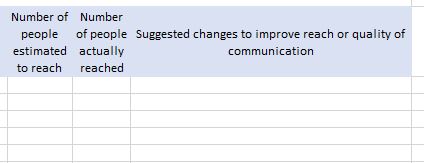
comms plan measures.JPG

The published date is important, not only to ensure that your intended actions were completed but also to measure the success of your communication activities after the activity has been completed. 

In this simple template, the only measure shown is based on the number of people reached. There are many more ways to measure the outcomes and success of your communication actions including:

  • How many people took a further action after reading or watching (if video) or listening to (if podcast) your message (i.e. liked it, clicked on the button for “more information etc),
  • How many people used it as a reference or highlighted it by linking to it, sharing it or tagging it,
  • How many people visited your website right after you have published or shared a new message?

Add additional columns to your plan (as needed) in order to capture any other important measures that you wish to track per message, date and communication channel.

General tips
  1. Plan to share the same message in many different ways to optimize the number of times and ways that your intended audiences receive the message during a relatively short timespan.
  2. Not every communication message can be forecasted and planned over a 12-month period but without at least a guideline of topics that you would like to share over a 12-month period, the chances of missing opportunities to impact your intended audiences are bigger. Remember, you can always update and make changes when unplanned events occur while you progress through your plan.
  3. Experiment with a mix of ways to communicate – create messages to be shared face-to-face with credible speakers and follow up with something online and perhaps also a film on your website.
  4. Do use metrics to track results against your goals. It is the best way to know what works and what needs to be improved. Having proven successes also adds credibility to your communication plan and activities.

When tasked with creating an Annual Communication Plan, you may never need to become an expert at creating this kind of plan, yet it is still in your best interests to capture your thoughts about planned communication activities, responsibilities, deadlines, and metrics in a concise way. This template is only one way to achieve this. Once you have created the plan in a structured way people can review it, comment on it and manage to it and it ensures alignment within the team as you make progress with your communication objectives.