Protect Your Organization: Your Risk Assessment Step-by-Step Guide


In today’s world, unexpected things happen. That’s why it’s important to be prepared. This free template download below will help you identify potential problems and figure out how to fix them. You can keep your organization safe and strong by staying ahead of risks.

Remember, this isn’t a one-time thing. You need to keep reviewing and updating this checklist to make sure it’s always relevant. With a little effort, you can create a stronger organization that is able to withstand life’s little surprises.

Here are two examples of big problems that can hurt an organization:

  1. Hackers stealing information: Bad guys can steal important stuff like customer data or company secrets. This can ruin your reputation and cost you a lot of money.
  2. Mother Nature strikes back: Hurricanes, floods, or earthquakes can damage your business and disrupt operations.

A Risk Assessment: Your Roadmap to a Safer Future

In today’s uncertain world, risks are everywhere. From financial losses to reputational damage, the potential consequences can be severe. That’s where a risk assessment comes in. By identifying potential threats and understanding their impact, you can take proactive steps to protect your organization.

So, what exactly is a risk assessment? It’s like a crystal ball, helping you see potential problems before they happen. Think of it as a map that guides you through the dangers ahead. By understanding the risks you face, you can develop strategies to avoid or reduce them.

But how do you do it? It’s actually simpler than you might think. Let’s break it down into two key steps:

  1. Identify the risks: Think about all the things that could go wrong. Financial losses? Safety issues? Reputation damage? Write them down.
  2. Assess the impact and probability: For each risk, figure out how bad it would be if it happened (the impact) and how likely it is to happen (the probability).

By combining these two factors, you can rank the risks that pose the biggest threat to your organization. Then, you can create a plan to tackle them.

Have a strategy for risk management

A strong risk management plan is like a safety net for your business. By spotting potential problems and having a plan to deal with them, you can protect your money, keep your good name, and build a stronger, more stable company.

  • Find potential threats: By understanding the risks you face, you can take proactive steps to prevent or mitigate them.
  • Protect your assets: Effective risk management helps safeguard your organization’s financial resources, reputation, and operations.
  • Make informed decisions: Risk strategies give valuable insights that can inform smart decisions and resource allocation.
  • Guarantee long-term sustainability: You can build a more resilient and sustainable organization by managing risks effectively.

What is risk?

A risk is simply a potential problem or danger. It’s something that might happen in the future that could cause harm or loss to your organization. Think of it as a threat that you need to be prepared for.

A risk assessment is a proactive tool that helps you discover potential threats to your organization and develop strategies to mitigate their impact. By understanding the risks you face, you can take steps to avoid or manage them effectively, protecting your assets and ensuring long-term success.

Unpacking the two ratings

What is the meaning of risk impact?

Impact refers to the potential consequences or severity of a risk event. It measures the harm or damage that could result if the risk occurs. For example, a high-impact risk might involve significant financial loss, reputational damage, or operational disruption.

How to look at probability or likelihood

Probability refers to the probability of a risk event occurring. It measures the chances that the risk will materialize. For example, a high-probability risk is more likely to happen than a low-probability risk.

By considering both the impact and probability of a risk, you can focus your efforts on mitigating the most significant threats to your organization.
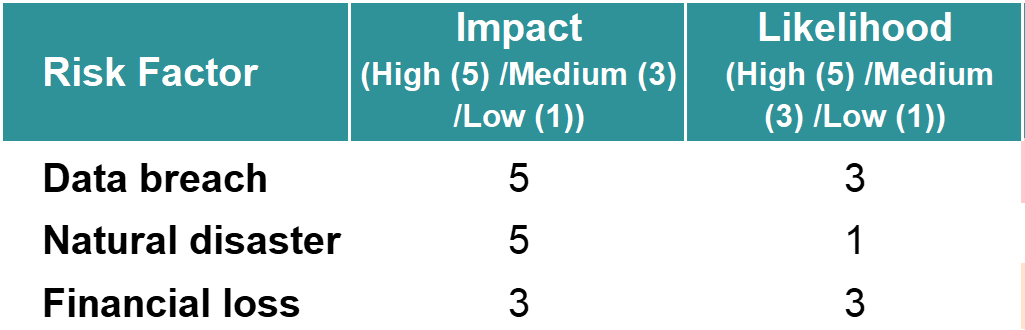
Assessing Risks: A Step-by-Step Guide

Identify Potential Risks:

  • Brainstorm a list of potential risks that could affect your organization. Consider risks that could impact your financial situation, the way you are able to run your organizational processes, your reputational, and risks that relate to legal issues – think about compliance and adhering to legal requirements and regulations.

2. Evaluate Impact:

Assess the potential impact of each risk on a scale of 1-5 where you use either a 1 a 3 or a 5 to rate the impact of every risk you noted in case they happened:

  • 1: Low impact (minor financial loss or inconvenience)
  • 3: Medium impact (noticeable financial loss or disruption)
  • 5: High impact (significant financial loss, reputational damage, or operational disruption)

3. Assess Probability:

  • Estimate the probability of each risk occurring on a scale of 1-5. Use a number 1, 3, or 5 to rate the probability or likelihood that the risks you have would happen:
    • 1: Very low probability
    • 3: Medium Probability
    • 5: High Probability

4. Calculate Overall Risk:

  • The download template below will multiply the impact rating by the probability rating to determine the overall risk level.
  • Rank risks based on the calculated overall risk score. The higher the score, the more important it is to have a plan to avoid it, lower its impact (mitigation), or manage it if there is no way you can avoid it.

5. Develop Risk Strategies

This is where you spot potential problems and make a plan to deal with them. It could be to protect your money, keep your good name, and build a stronger, more stable organization.

Here are some types of strategies that might be needed:

  • Risk Avoidance: Remove or avoid the risk completely by putting some form of protection in place to ensure it can’t easily happen.
  • Risk Reduction: Instead of just letting problems happen, take steps to make them less likely or less harmful. Or you could say it is about implementing measures to reduce the likelihood or impact of the risk.
  • Risk Transfer: Instead of taking on the risk yourself, pass it on to someone else, like an insurance company.
  • Risk Acceptance:  Sometimes, risks are unavoidable. Instead of trying to stop them completely, be prepared for them. Have a backup plan in case things go wrong.

Taking Action: Protecting Your Organization

Once you’ve identified and assessed your risks, it’s time to act. Focus on the risks with the highest scores and implement your mitigation strategies. Remember, a risk assessment isn’t a one-time thing. Review it regularly to make sure it’s still relevant and up to date.

Share your risk assessment with key leaders in your organization. Their insights can help you refine your strategies and check to be sure they align with your overall business goals. By actively managing risks, you’re taking a proactive step toward protecting your organization and securing its long-term success.


Data Privacy Essentials: Your Compliance Starter Kit


Navigating the complex world of data protection can be overwhelming, especially for small organizations like charities and businesses.

The Perils of Data Breaches

When personal data falls into the wrong hands, the consequences can be devastating. Individuals may become victims of identity theft, financial loss, or emotional distress. Trust, once broken, is difficult to rebuild. Organizations face reputational damage, monetary penalties, and legal repercussions. Moreover, a data breach can erode public confidence in digital services, hindering innovation and economic growth. Safeguarding personal information is not just a legal obligation but a moral imperative.

Compliance

The General Data Protection Regulation (GDPR) has set a new global standard for data privacy in Europe. At this time there are several countries worldwide with similar compliance requirements – from Australia’s Privacy Act to California’s Consumer Privacy Act (CCPA), organizations across the globe are grappling with the complexities of safeguarding personal information.

Free draft forms and guidelines

Data protection can be a real headache, especially for small businesses and charities. That’s why this toolkit of draft forms and policies is here to help you get started with practical templates to help you stay compliant without the hassle.

Think of these draft documents as your trusty sidekick, providing a solid foundation for your data protection journey.

The toolkit has the following elements:

Data Protection draft Policy Template: Establish clear guidelines for handling personal data.

Data Breach draft Incident Report: Outline steps to take in case of a data breach.

Auditing and Monitoring draft Procedure: Maintain data protection compliance through regular checks.

Drat Data Subject Access Request (DSAR) Form: Efficiently handle requests for personal data.

Draft Data Protection Impact Assessment (DPIA) Form: Assess the potential risks of data processing activities.

While these may be a handy starting point, remember, that data protection is about more than just paperwork. To really protect your donors’, your employees’, your vendors’, and customers’ info, you’ll need to build a solid system that covers everything from training your staff to dealing with data breaches to having a process to report incidents, investigate and draw up an incident report and understanding the data you have and know if you have any risks if that data leaks out somehow.

  • Data protection impact assessments: You need to start out by identifying and managing high-risk data processing activities and making sure you address any high risks you identified in the process. Conduct regular assessments (maybe once a year) to identify potential vulnerabilities and implement appropriate data protection safeguards. [There is a draft form for that in the templates.]
  • Employee Training: Regular training to ensure staff understands their data protection responsibilities and can identify and prevent potential risks.
  • Data Minimization: Collect and retain only the necessary personal data and give them examples to help them understand what personal data is.
  • Rights of those whose data you have: Implement procedures to handle data access requests – they generally have the right to erasure or update of data you store, and other rights include the right to ask to see the personal data you keep on them. [There is a draft form that people can use to request access to the personal data you have]
  • Supplier Management: Ensure data processors comply with data protection requirements through contracts and oversight.
  • Incident Response: Develop a clear plan for responding to data breaches, including notification procedures. And make sure everyone knows which number to call or which email to use to report a suspected data breach. [there is draft information in the templates for how to report an incident and also questions to ask when talking to someone reporting a potential data breach.]
  • Continuous Monitoring and Review: Regularly assess data protection practices to identify and address potential vulnerabilities.

By combining the templates with these additional measures, you can help your organization build a strong foundation for data protection compliance and protect the privacy of your data subjects.

Are Your Appliances Draining Your Wallet?


Many homeowners are surprised to learn that their appliances are silently draining their wallets. Appliances like space heaters, water heaters, and home air conditioners are the biggest culprits. But don’t worry, there’s a solution!

By making smart choices about the appliances, you buy and how you use them, you can significantly reduce your energy costs while helping the environment.

Energy Efficiency: Your Pocket’s Best Friend

Electricity is measured in Watts or Kilowatt (kW)  and electricity bills usually show charges by kWh – as it is a measure of electricity used over hours.

What are the benefits of paying attention to energy efficiency?

  • Cost Savings: Energy-efficient appliances consume less electricity, leading to lower energy bills per month and per year. Energy labels can help compare various appliance models being considered for purchase to help you save in the long run.
  • Product Longevity: Energy-efficient appliances often have longer lifespans, ultimately saving you money as fewer replacements may be needed during 10 years for example. It also lowers electric and electronic waste, benefiting the circular economy – less waste is generated!
  • Environmental Impact: Reducing your household’s energy consumption helps to lower greenhouse gas emissions.

Do you know which household appliances are secretly draining your wallet? It’s time to shed light on your energy thieves. Before buying new appliances, understand their energy consumption. A little knowledge can save you a lot!

The following graphic illustrates typical energy consumption for common household appliances under high and low usage conditions. By analyzing this type of data for appliances you plan to buy, you can identify potential areas for energy savings over the coming years. You achieve this by making informed decisions about appliance usage and upgrade options and implementing the best energy-efficient alternatives!

Energy Labels

Energy labels are your secret weapon against sky-high energy bills. These handy stickers reveal how much energy each appliance guzzles. By choosing appliance models with the best energy ratings, you’ll not only save money but also help the planet.

How to read energy labels

Energy labels reveal how much energy an appliance guzzles, helping you choose wisely. Look for the energy efficiency rating (usually A-G) – the closer to A, the better. This label (see example to the left) shows energy use in kilowatt-hours (kWh) per 1,000 hours. Multiply this by your electricity rate to see the appliance’s cost for every 1,000 hours it is in use. Knowing that, you can pick the appliance that saves you money over the coming years by reducing the amount of energy used!

Let’s do the math!

Imagine your new fridge has an energy label showing it uses 400 kilowatt-hours (kWh) of electricity a year. If your electricity costs 30 cents per kWh, that fridge alone could add up to €120 to your annual bill. Yikes! This is why choosing energy-efficient appliances is a no-brainer.

Calculation example

Kettles might seem harmless, but they can secretly drain your wallet. These little appliances often cause energy spikes that can be easily spotted on your energy monitor. Let’s compare two kettles: Kettle A, an older model, and Kettle B, a newer, energy-efficient one.

The Kettle Challenge: Which Model Saves You Money?

Scenario: Boiling one cup of water (250ml)

Kettle A: Older model, less efficient, with a power rating of 3000 watts.

  • It takes 2 minutes to boil the water.

Kettle B: Newer model, more efficient, with a power rating of 2000 watts.

  • It takes 2 minutes and 30 seconds to boil the water.

Energy Consumption Calculation:

  • Energy (kWh) = Power (kW) x Time (hours)

Kettle A:

  • Energy consumed = (3000 watts / 1000) * (2 minutes / 60 minutes) = 0.1 kWh

Kettle B:

  • Energy consumed = (2000 watts / 1000) * (2.5 minutes / 60 minutes) = 0.083 kWh

The energy usage for Kettle B is less than the energy usage calculated for Kettle A.

Conclusion:

Even though Kettle B takes longer to boil the water, it consumes less energy due to its lower power rating. Over time, using a more energy-efficient kettle can result in significant energy savings.

Choose Wisely, Save Significantly

Investing in energy-efficient appliances is like planting a money tree in your home. They can slash your electricity bills without breaking the bank. Plus, you’ll be helping the planet one watt at a time. So, next time you’re shopping for a new fridge or washing machine, look for those energy-saving labels. Your wallet (and the Earth) will thank you!