
From Skills Gap to Training Plan: A Strategic Approach


Training departments are usually expected to provide an annual plan showing training classes and learning interventions which will be offered over the course of the year. Managers want to see when they can plan to send employees to attend specific training courses and they also would like to see that the training plan addresses key areas where performance improvement may be needed for their departments or business units. Lastly, there is also usually the need to create a budget for the planned training. All of these focus areas are covered in the templates that can be downloaded below.

What kind of training should you provide?

Consider the following sources of information which could help:

  • Company strategies for growth and developing into new markets or expanding in existing markets – what skills would be needed?
  • Based on current performance – which skills need to be introduced and which skills should be improved upon?
  • Looking at employee career goals, which skills do you need to focus on in order to help move employees to being promotion-ready?
  • Which skills do managers believe would help their teams succeed better given performance targets and customer demands?

Summary of the kinds of Training Needs to Identify

Tools and Templates

Here are three tools that can help you with conducting a training needs analysis. The first tool highlights individual training needs per employee and is based on employee self assessments. The second tool is a training needs view from a manager’s perspective focusing on the top 3 highest training needs for each employee in his/her group/team/department. The last tool helps you budget for the planned training.

  • Self-rated individual training needs. The quality of the results you obtain from this tool depends on whether you have a good career development tool/framework in place, motivated employees who maintain and work on their own development plans on an on-going basis and whether your managers/supervisors provide quality performance feedback to employees on a regular basis.
  • Manager assessment of department/team. Using knowledge of employee performance in his/her department, the manager selects the top 3 courses that each employee would need to improve own performance and/or to grow further in his/her career. Be sure to share course details with the managers too – what is the duration of the course and what aspects of the topic is covered?
  • Training needs and budgeting. This spreadsheet helps you budget for the planned courses. Check actual spending against this estimate to track the accuracy of your original budget and accurate allocation of items charged to your training budget.

Tips for training needs analysis:

  • Create a training needs analysis process that you follow consistently every year. This helps managers get into a rhythm of providing you with the required information on time for you to submit budget requests for the following year/quarter.
  • Be clear with managers which part of the training costs would be booked to their own budgets. For example – where do employees charge their time when they are in a training class? To your budget or to their manager’s budget?
  • Ask yourself how much training does it make sense to provide internally vs using an external vendor. Make wise trade-offs in terms of training costs, best value for money, expertise needed to provide the training etc.
  • Determining the training plan for the following year should also include a good review of the training evaluations and feedback obtained from course participants during the lasts year. Are your current training classes good enough or do they need to be improved or outsourced?

Training Certificate Example


When employees complete internal courses, one can be stuck with having to create a professional-looking training certificate for training participants. Not everyone has a knack for that, so here is a basic basic template (you can download it below) which can give you a good starting point for making your own training certificates. It is in *.ppt (Microsoft PowerPoint) format so you can edit the details as needed.

Receiving a training certificate is good way to recognize employees for completing required training courses and handing them out during a townhall meeting or other company event can help reinforce how much the company values the completions.

Using technology currently available to us it is more possible to avoid printing paper versions of a certificate. You can create the certificate electronically and also add digital signatures then save it as a *.pdf document or a picture. That way distribution can take place by means of sharing a hyperlink to the certificate or attaching an electronic file to an email addressed to the recipients.

Some tips:

  • When you customize the file or change elements, beware of creating something that is overly colorful and “busy” with competing elements – graphic and text.
  • When you insert digital signatures be very careful about who has access to those. It is a very sensitive graphic to have and can easily be abused if it falls into the wrong hands.

Training Evaluation Forms


Beyond the Basics: The Importance of Effective Training Evaluation

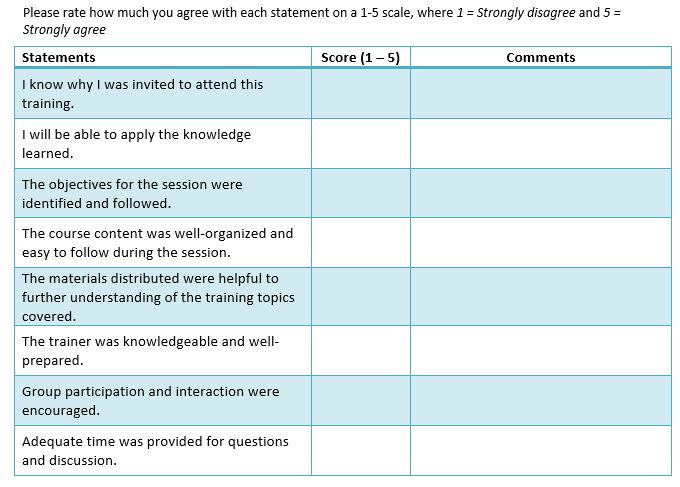
It’s easy to get caught up in the logistics of training – did people show up, did they enjoy the food, was the room comfortable? While these factors are important, they don’t tell us if the training actually worked. To truly measure the effectiveness of a training program, we need to dig deeper.

Focusing solely on surface-level feedback, like how attendees felt about the event or the trainer, is like judging a book by its cover. It might look good on the outside, but what really matters is what’s inside – the knowledge gained, the skills developed, and the behavior changes that occur.

To delve deeper you may want to consider questions like:
Continue reading “Training Evaluation Forms”

Personal Development Plan


Continuous learners have the best chances of being noticed for new opportunities and promotions. It is important to be structured around what you will focus on learning next. Ask for feedback from more senior people around you or from your manager/supervisor. Then create a personal development plan for yourself. As you complete learning goals, set new learning goals and update your personal development plan accordingly.

The best way to have a structured learning approach is to have a Development Plan. Creating your own development plan is the first step towards mapping out your learning needs and priorities. Ask someone with experience to help you with it. It could be your supervisor or manager and it can also be a coach or mentor that you are working with. Such a person should be able to provide you with valuable feedback as you aim to prioritize your planned development actions.

Start the plan

Continue reading “Personal Development Plan”

Employee Satisfaction Score


Smiley Charts

Sometimes you don’t want to run a full employee engagement survey, but you just want to do a quick check to see how things are going. Call it a “mood meter” or a high level check to see if you can catch some underlying issues that may require further investigation.

Of course it is understood that a quick check is not meant for applications where the correlation between questions and outcomes require a statistically defensible position. HR folks and OD folks sometimes just need a quick tool that would help you see if there may be a trend that is worth looking into further at your location. Sometimes the trend you see can be as simple as a low level of responses to your quick check.

Continue reading “Employee Satisfaction Score”

About the Author


Jo-Ann Garbutt

What I bring to people and groups that I work with….

  • Compassion and a genuine interest to be helpful
  • Creativity in coming up with new solutions or improving existing ones
  • Catalyst, helping others move forward towards their own goals and objectives

Over the years I have been blessed to work with smart and gifted people and they have shared ideas and resources with me to help me achieve my goals. This is my way of giving back and helping others. Some resources are not so easy to find or if you did find it, it is tough to know how to use the tools that may be available.

I am sharing what I have in my vast number of storage folders and adding some tips and comments to make it easier to interpret and use the tools and resources. To view and obtain your own copy of the shared resource, simply download them by clicking on the nearby button. Please feel free to comment or ask questions if anything is not immediately obvious once you have reviewed the post and the free tools, resources, or examples shared.

Those who will most likely benefit from these postings may include HR Practitioners, Trainers, Coaches, Organization Development enthusiasts and anyone who wishes to develop him or herself and/or his/her teams.