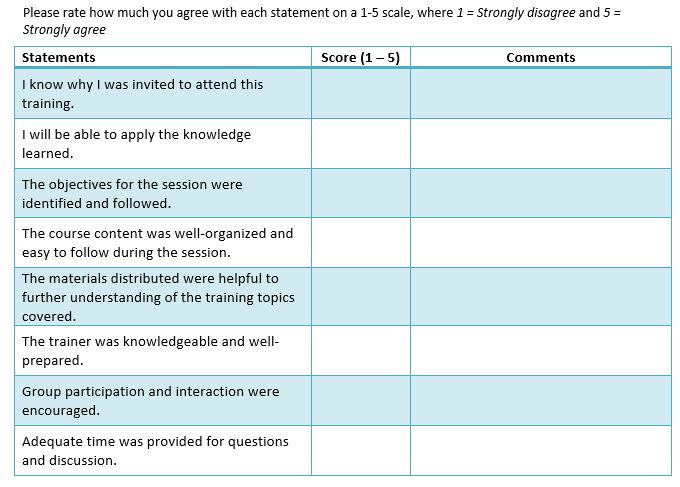
Coaching Effectiveness Survey


While it is a good idea for coaches to periodically discuss how well the process may be working for those that they are coaching, it is also a good idea for HR/Learning and Development to get feedback on the coaching program on an annual basis. Occasional informal feedback from the person being coached to the coach directly may help the coach improve the person’s coaching experience and outcomes reached.

A formal annual survey helps the department responsible for managing and monitoring the coaching program to understand a few things:

  • General questions that coaching participants may still have about the process or program objectives.
  • How to improve the training of coaches to improve developmental outcomes.
  • How well the relationships are working between coaches and those being coached. Perhaps an intervention may be needed in cases where a high level of dissatisfaction is recorded?
  • Whether the coaching process is working well in general – meetings are held on a regular basis and the right topics are being discussed.

Coaching survey

The coaching survey above (see download option) contains questions you may want to consider for your annual coaching effectiveness survey and it also contains some suggested wording for the introduction email to those who are being coached to explain the survey and its purposes.

Gather the survey feedback and analyze it for overall coaching program effectiveness, but also look at individual responses to see if anyone is having a particularly negative view about his or her coach or the coaching process.  When you take action on individual responses pay close attention to the confidentiality statement you put in the email that went with the survey. Do not reveal someone’s input to his or her coach unless it was expressly established that the survey respondent consent to this course of action. Also use the information gathered from the survey to improve your orientation slides for the next coaching program and to improve future training you offer to coaches.

Other coaching resources that may be useful for setting up your coaching program: preparing for coaching, coaching questions, coaching program orientation slides.

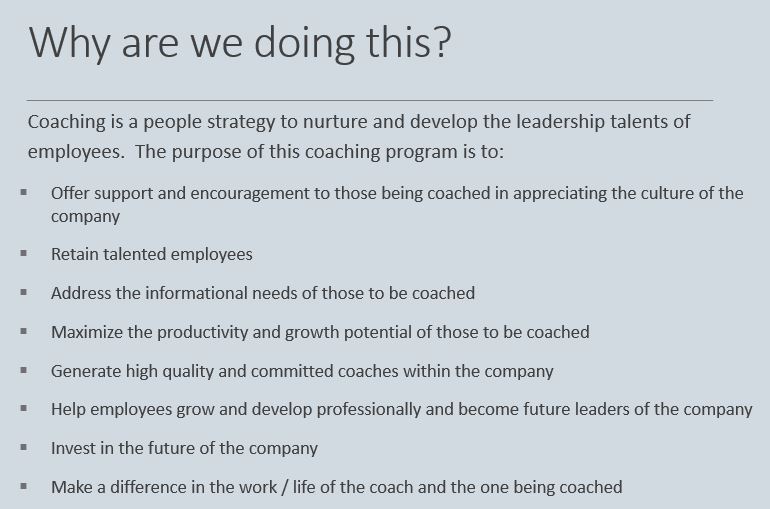
Coaching Program Orientation – Presentation


All coaching programs should contain an orientation as one of the starting elements. This session should cover the objectives of the program, what the expectations are for both coaches and those to be coached and any other general information that would be important for the participants of your coaching program. You can choose to combine the two groups for the session or you could choose to do separate sessions for coaches and those to be coached. If you choose the former you may want to add a training or reminder section of any specific coaching aspects that you wish to empathize.

Slides for the orientation meeting

The download file above contains a series of slides to help you get started creating your own. It shows some of the typical questions that coaching program participants may have and answers that may be relevant, but of course subject to your edits to suit your specific needs.

Tips:

  • Be sure to have a Q and A portion to answer any specific questions that anyone may have.
  • The front part of the presentation which sets the scene in terms of “no entitlement to promotion etc.” would be relevant if you have experienced that as an issue in your workforce or talented employee pool. In some cultures that may be seen as “offensive” or even “threatening” that it would be mentioned. So be culturally sensitive when you consider keeping that comment.
  • In the roles section I mention HR as the function supporting the coaching program – depending on your organization that could be your Learning and Development department, your Organization Development (OD) group or any other department/group.
  • Be sure to provide the coaches and those to be coached with all the tools they will need. If not printed and handed out at your orientation session, then perhaps a soft copy on a USB stick or per email after the session. Coaching questions or Preparation for Coaching

Meeting Makeover: Improve Your Meetings with this Template


One of the most frustrating elements of many managers’ calendars are meetings. If you ask people they mostly believe there are too many participants, that meetings take too long, and that some individuals talk too much and venture off-topic. And most people are unable to remember what was decided or which actions came out of the meeting. The tool I am sharing helps a chairperson to prepare for a meeting and it helps him or her communicate the specific overall objectives for the meeting and also for every agenda item.

Some of the meeting maladies mentioned above can be cured simply by creating and distributing an agenda to participants before having the meeting. This tool goes further though – it also helps to create clarity around each agenda item’s purpose in informing participants or driving decision-making to move a project or initiatives forward.

The template you can download above contains an example to illustrate its use. Just replace the agenda items shown with your own meeting agenda items and then complete each column as demonstrated to clarify who is responsible for each agenda item, the purpose of each item, and the allocated time and desired outcome for each of the agenda items.  Do share the objectives, time available and expected outcomes with those who are assigned to each agenda item – it helps him or her be prepared to guide the conversation and discussion accordingly.

Suggestions

  • Even with an agenda and a well-planned meeting there may be times when things need to change as it becomes clear that a critical issue requires to be solved right-away.  Give yourself the leeway to abandon the agenda for a particular meeting to deal with such a highly critical and important issue or set another meeting right after the planned meeting to address the issue.
  • Some successful chairpersons make use of meeting “agreements” or “ground rules” to further improve the quality of the meeting. Some have items such as “each speaker gets a maximum of 1 minute to make his or her point” and “we debate issues and we respect the opinions of others.”
  • To know if your meetings are getting better – get feedback from your meeting participants. Take a few minutes at the end of the meeting to ask what went well and what could be better in future – exactly how. Reviewing the feedback when you plan the next meeting can help you to be mindful of further improvements that can be included going forward.

I hope this tool helps you plan your next meeting and move closer to having productive meetings which helps you progress your project or initiative as you had hoped.

Delegate Smarter, Not Harder: A Practical Tracking Solution


Delegation isn’t just about offloading work; it’s about developing your team’s potential. By strategically assigning tasks, you not only free up your time but also equip your employees with new skills and responsibilities. However, keeping track of who’s doing what can be challenging. That’s why a clear system for delegating and monitoring tasks is essential for maximizing productivity and employee growth. The template I am sharing is a great way to keep track of not only who is working on which delegated task, but also what was the overall purpose of the delegated task.

Try to match the task or activity/project you need to delegate to the right person in your team given their current skills and competencies and also matched to current development needs each of them have.  The template is based on a list of categories to consider: (see second tab in template for the definitions shown below)

The delegation tracking sheet helps you keep track of the level of capability the person has – which uses the definitions above to help remind you how much support he or she might need with that task.

Use the drop down list in column B to select the category that applies to that task/project and the person that you are delegating to.  You can create more lines for delegated tasks by just inserting a line between the existing lines.

Reasons why this list can be very useful:

  • Keeping this list up to date and referring to it in a regular basis will help you remember when to check in on someone working on a delegated task or project.
  • You keep track of the reasons why you gave a specific task to someone – from a developmental perspective. This means you know how much support and coaching may be needed while the person is working on this task.
  • Avoid giving the same task to more than one person. There is nothing more demotivating to an employee than finding out another colleague is working on the exact same project as he or she is after having already spent several hours doing research and talking to people about the project in order to deliver a great result.

You can do more and accomplish more as a manager when you don’t have to rely on your memory alone to remember who is working on which tasks and projects for you.

Effective delegation is the cornerstone of successful management. By utilizing this template to track delegated tasks, managers can optimize workload distribution, identify development opportunities for team members, and ensure that projects stay on track. This proactive approach not only boosts productivity but also builds a culture of empowerment and growth within the team.

Boost Teamwork with an Indoor Scavenger Hunt


Looking to inject some fun and creativity into your workday? A scavenger hunt is a fantastic way to boost team morale, encourage collaboration, and foster a sense of camaraderie. Whether you’re in a bustling office or a quiet workspace, an indoor scavenger hunt can be a refreshing break from the routine, offering a unique opportunity for employees to connect and engage in a fun, competitive activity.

Crafting the Perfect Scavenger Hunt

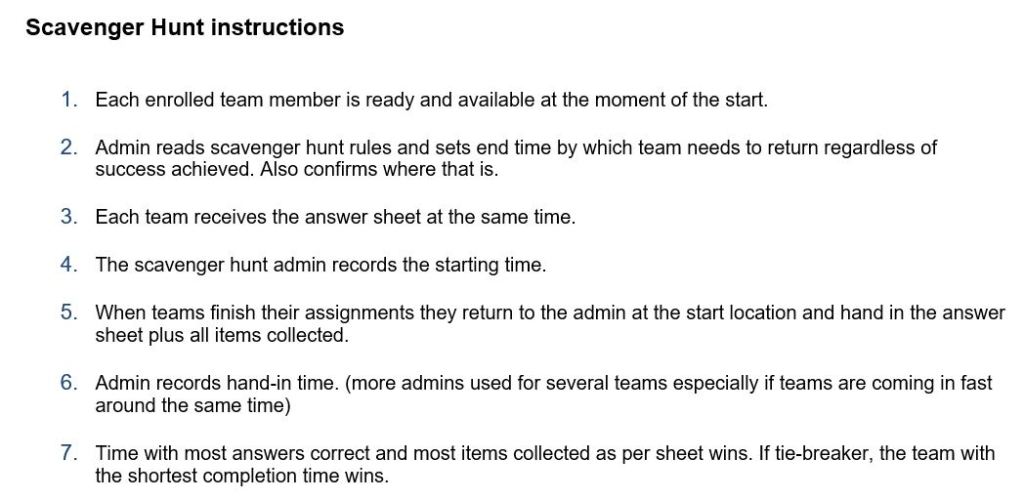
To maximize engagement and fun, tailor the hunt to your team’s size and time constraints. Smaller teams (3-4 people) might require more time to complete challenges than larger groups (5-6 people). Consider dividing larger teams into sub-groups to foster collaboration and friendly competition. The template shown before took around 2 – 2.5 hours for 10 teams of 4 people to complete.

Design a worksheet that includes a mix of questions, physical challenges, and creative tasks. Setting a time limit adds excitement and encourages teamwork. The team that successfully completes the most challenges within the allotted timeframe emerges victorious.

Remember, the goal is to create a fun and engaging experience that brings your team closer together.

When the group is ready, you would first share the instructions with them. Be sure to include areas that they are not to visit or boundaries for the exercise. Include the maximum time they should take to work on the assignment and where everyone should meet at the end of that period – whether they were able to complete the task or not.

Continue reading “Boost Teamwork with an Indoor Scavenger Hunt”

Crafting a Communication Plan: Your Roadmap to Change Success


Whether it’s a new process, a revamped strategy, or a technological overhaul, effective communication is essential for a smooth transition. A well-crafted communication plan outlines the who, what, when, where, and how of sharing information, ensuring everyone is on the same page and aligned with the change journey. Let’s dive into the key components of creating a powerful communication plan.

Tailoring Your Message to Your Audience

Effective communication means understanding who you’re talking to. Different groups will need different information. Start by identifying everyone who’s affected by the change. This could include employees or different groups of employees, customers, partners, and even the wider community. By mapping out your audience, you can tailor your messages to their specific needs and interests. Think about different functions, think about geographic locations, think about management levels, and think about people outside your company who may be affected.

Communication messages could be intended to explain why things have to change, what is going to change, when and how it is going to change, how the change is going (progress update) and what (if anything) people need to start doing, stop doing or what should change in the way they have acted in the past.

Continue reading “Crafting a Communication Plan: Your Roadmap to Change Success”

From Skills Gap to Training Plan: A Strategic Approach


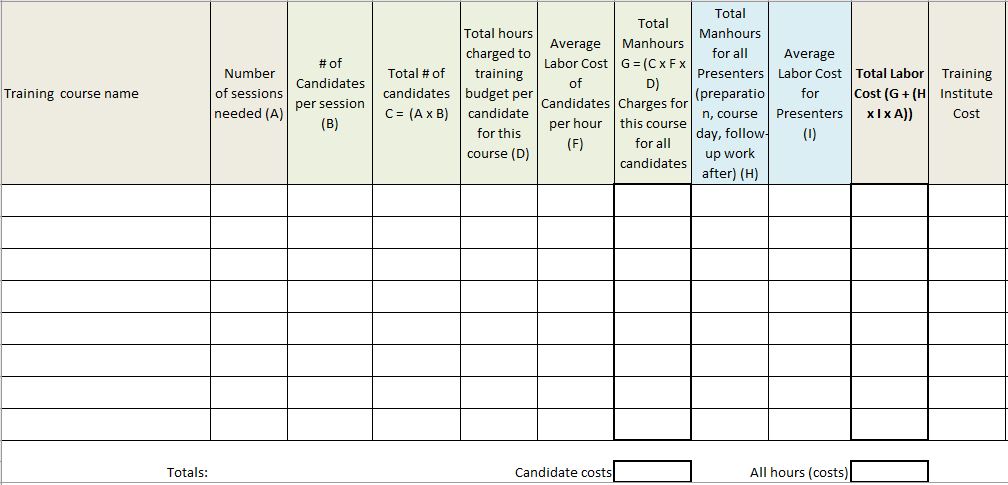
Training departments are usually expected to provide an annual plan showing training classes and learning interventions which will be offered over the course of the year. Managers want to see when they can plan to send employees to attend specific training courses and they also would like to see that the training plan addresses key areas where performance improvement may be needed for their departments or business units. Lastly, there is also usually the need to create a budget for the planned training. All of these focus areas are covered in the templates that can be downloaded below.

What kind of training should you provide?

Consider the following sources of information which could help:

  • Company strategies for growth and developing into new markets or expanding in existing markets – what skills would be needed?
  • Based on current performance – which skills need to be introduced and which skills should be improved upon?
  • Looking at employee career goals, which skills do you need to focus on in order to help move employees to being promotion-ready?
  • Which skills do managers believe would help their teams succeed better given performance targets and customer demands?

Summary of the kinds of Training Needs to Identify

Tools and Templates

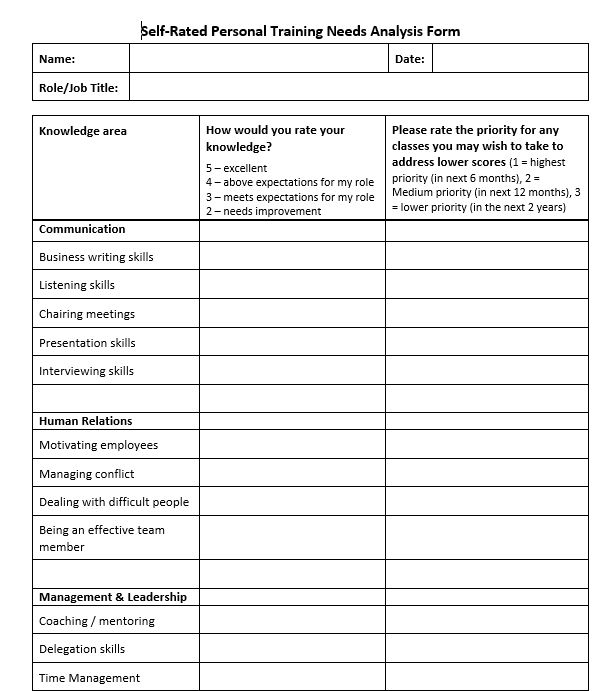
Here are three tools that can help you with conducting a training needs analysis. The first tool highlights individual training needs per employee and is based on employee self assessments. The second tool is a training needs view from a manager’s perspective focusing on the top 3 highest training needs for each employee in his/her group/team/department. The last tool helps you budget for the planned training.

  • Self-rated individual training needs. The quality of the results you obtain from this tool depends on whether you have a good career development tool/framework in place, motivated employees who maintain and work on their own development plans on an on-going basis and whether your managers/supervisors provide quality performance feedback to employees on a regular basis.
  • Manager assessment of department/team. Using knowledge of employee performance in his/her department, the manager selects the top 3 courses that each employee would need to improve own performance and/or to grow further in his/her career. Be sure to share course details with the managers too – what is the duration of the course and what aspects of the topic is covered?
  • Training needs and budgeting. This spreadsheet helps you budget for the planned courses. Check actual spending against this estimate to track the accuracy of your original budget and accurate allocation of items charged to your training budget.

Tips for training needs analysis:

  • Create a training needs analysis process that you follow consistently every year. This helps managers get into a rhythm of providing you with the required information on time for you to submit budget requests for the following year/quarter.
  • Be clear with managers which part of the training costs would be booked to their own budgets. For example – where do employees charge their time when they are in a training class? To your budget or to their manager’s budget?
  • Ask yourself how much training does it make sense to provide internally vs using an external vendor. Make wise trade-offs in terms of training costs, best value for money, expertise needed to provide the training etc.
  • Determining the training plan for the following year should also include a good review of the training evaluations and feedback obtained from course participants during the lasts year. Are your current training classes good enough or do they need to be improved or outsourced?

Training Evaluation Forms


Beyond the Basics: The Importance of Effective Training Evaluation

It’s easy to get caught up in the logistics of training – did people show up, did they enjoy the food, was the room comfortable? While these factors are important, they don’t tell us if the training actually worked. To truly measure the effectiveness of a training program, we need to dig deeper.

Focusing solely on surface-level feedback, like how attendees felt about the event or the trainer, is like judging a book by its cover. It might look good on the outside, but what really matters is what’s inside – the knowledge gained, the skills developed, and the behavior changes that occur.

To delve deeper you may want to consider questions like:

Continue reading “Training Evaluation Forms”