HR Function checkup – Feedback from internal customers


In the same way that companies would approach external customers to gather their views on what is going well and what needs improvement (customer satisfaction), the HR function should reach out to its internal customers to find out how satisfied they are with the services and support that they receive. It is true that there are more than one model for HR service delivery, but that does not change the fact that it is wise to gather feedback on the services and support that you do provide given the structure and focus for HR in your company.

The HR function is often guilty of focusing its developmental and improvement efforts exclusively on helping other departments and neglects using those same skills and expertise to improve the HR function as a whole and developing the people who deliver the HR services to others.

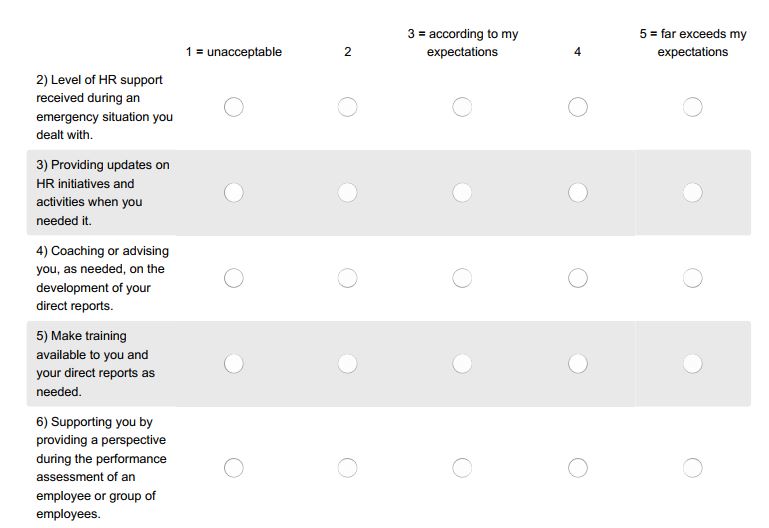
HR Function – Feedback Survey

This survey can help you gather the information you need from your internal customers to help you identify specific areas of excellence in HR and also those areas where improvement may be needed. When improvement is needed it will often imply additional training and development of some HR representatives (HRBPs or Generalists) and may also  include communicating the HR vision and goals more clearly within the HR function. Remember to recognize and reward those who were part of delivering excellent services when you review the survey results.

Tips:

  • Add comment fields next to scores if you want to be certain to capture specific comments about the scores.
  • Do be sure to provide survey participants with feedback on the outcome of the survey and the actions that you plan to take as a result of the survey. This motivates participants to continue providing you with valuable feedback in the future.
  • Create an action plan and communicate that clearly within the HR function so that everyone understands which areas you plan to address and how you plan to do that. It may help to set specific metrics around your planned improvements to make it easier to report progress.
  • Regularly update stakeholders – internal to the HR function and those who are internal customers in your company – on the progress of improvement efforts as you implement the post-survey action plan.
  • Remember to celebrate successes (milestones and outcomes achieved) and be prepared to add additional actions to your plan in cases where your improvement efforts are not reaping the results you had planned for.

Having a standard survey which you use ever year gives the opportunity to track the progress in specific questions over time and helps with trend analysis and showing % improvements over time.

Analyze how you use your time


“All we have to decide is what to do with the time that is given us.” (Gandalf)

J.R.R. Tolkien, The Fellowship of the Ring

How you choose to spend your time is a good indicator of the activities and people who are most important to you in your life. It shows your priorities clearly. How well do your daily activities reflect your priorities?

Have you faced any of these challenges?

Personal Development. Maybe you have considered taking an evening class to improve your skills or obtain a qualification you need, but you are not sure how you will find time to attend that class because of your busy life.  Taking a closer look at how you spend the time that you do have may help you see opportunities to change your schedule and make more time for career development activities.

Leaders and managers have many priorities to manage and often feel there are not enough hours in every day to accomplish the business objectives they have set for themselves and their teams. Taking a closer look at how you spend every day and every week my give you some interesting insights. You may discover areas where you could refocus yourself or delegate activities to free up more time for those other priorities.

Performance feedback could be indicating that your supervisor/manager feels you are not using your time at the office in productively. This template can also help you discover where he or she may be right and whether you are actually using your time optimally to achieve the performance goals that you and your boss have agreed upon.

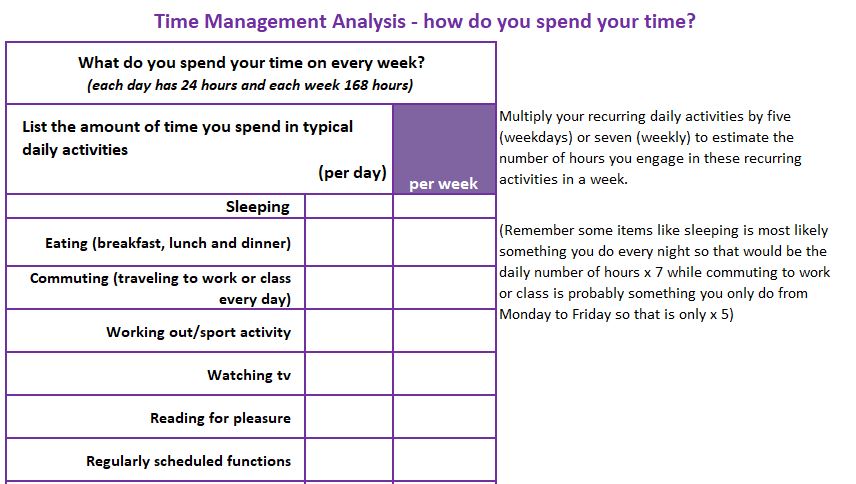
The template, which you can download below, helps you to take stock of what you are doing with all of the time that you have available to you. I once discovered that 30% of my time was at my own discretion and I created a mantra for myself “make the 30% count.” Whenever I caught myself involved in an activity that I had labeled as of low value to me given my own goals and values, I would just remind myself of the mantra and shift my focus to a higher value activity.

Should you need more development in how to be more effective at work, I suggest you look for a class on time management tools. These classes typically focus on how to get better at email management, how to better plan your day to do the right type of activities at the right time of the day (energy management) and also how to get better at keeping track of your highest priorities and making sure that you are working on the right items at various check-in moments with yourself during the day. A coach or a buddy can also help you with this by not only sharing tools with you but also helping to keep you accountable for the goals and outcomes you have committed to.

I hope your efforts to take a closer look at how you spend your time has given you the awareness of how much time you have available to spend at your own discretion. Are you using your time wisely? Are you doing things that will get you closer to the goals you have for your life?

I found one has to repeat these quick checks on a regular basis – maybe every 6 months – to make sure you are still on the path you had set for yourself when it comes to being in charge of the time you have.

Preparing to give employee feedback – Template


feedback

Feedback: A Two-Way Street

Giving and receiving feedback can be a delicate dance. It can be uncomfortable for both parties involved at times. However, it’s an essential part of growth and development. By getting better at giving feedback, planning what to say and opening the door to an open and honest discussion, we can help employees reach their full potential while driving organizational success.

This template helps a manager or supervisor think through the important aspects of giving feedback to an employee and helps to plan and prepare for the actual feedback meeting.

The template and approach also helps plan positive feedback to employees. This aspect is often neglected, but equally valuable in helping employees understand what specific actions and communications are valued and should be continued.

Some reminders:

  • Never give important feedback via an email or sending this worksheet to the employee. It should always be done in person or at least through a phone or video call. – if an in-person meeting is not possible.
  • The feedback should be given as soon as possible after the event to minimize surprises at the structured annual performance feedback meetings and to ensure the employee still has a good recollection of the situation or event that took place.
  • Do allow the employee to respond once you have shared the feedback to ensure that your message is understood by the employee and to allow you to understand any nuances to the situation which you may not have been aware of.
  • It is always a good idea to agree on a check-in moment at some time in the future. This is an opportunity to see if the employee may have further questions or comments at that time or perhaps he or she has been working on improving a particular skill related to the feedback you had shared and perhaps he or she could have some successes to share with you!

Sharing feedback with an employee, when it is not positive, can be tough to execute even with a tool like this. It depends a lot on your own style for managing conflict and whether you prefer to avoid conflict or situations where people may be upset with you. Take some time to learn more about your own conflict management style if giving feedback to employees remains a challenge for you even when you have used the template to prepare for the conversation.

Delegate Smarter, Not Harder: A Practical Tracking Solution


Delegation isn’t just about offloading work; it’s about developing your team’s potential. By strategically assigning tasks, you not only free up your time but also equip your employees with new skills and responsibilities. However, keeping track of who’s doing what can be challenging. That’s why a clear system for delegating and monitoring tasks is essential for maximizing productivity and employee growth. The template I am sharing is a great way to keep track of not only who is working on which delegated task, but also what was the overall purpose of the delegated task.

Try to match the task or activity/project you need to delegate to the right person in your team given their current skills and competencies and also matched to current development needs each of them have.  The template is based on a list of categories to consider: (see second tab in template for the definitions shown below)

The delegation tracking sheet helps you keep track of the level of capability the person has – which uses the definitions above to help remind you how much support he or she might need with that task.

Use the drop down list in column B to select the category that applies to that task/project and the person that you are delegating to.  You can create more lines for delegated tasks by just inserting a line between the existing lines.

Reasons why this list can be very useful:

  • Keeping this list up to date and referring to it in a regular basis will help you remember when to check in on someone working on a delegated task or project.
  • You keep track of the reasons why you gave a specific task to someone – from a developmental perspective. This means you know how much support and coaching may be needed while the person is working on this task.
  • Avoid giving the same task to more than one person. There is nothing more demotivating to an employee than finding out another colleague is working on the exact same project as he or she is after having already spent several hours doing research and talking to people about the project in order to deliver a great result.

You can do more and accomplish more as a manager when you don’t have to rely on your memory alone to remember who is working on which tasks and projects for you.

Effective delegation is the cornerstone of successful management. By utilizing this template to track delegated tasks, managers can optimize workload distribution, identify development opportunities for team members, and ensure that projects stay on track. This proactive approach not only boosts productivity but also builds a culture of empowerment and growth within the team.

How to record Job Applicant Interview results


Hiring the right person is crucial for your team’s success. Without a structured approach to evaluating candidates, unconscious biases can creep in, leading to suboptimal hiring decisions. By capturing detailed impressions during the interview process, you can make data-driven choices that benefit your organization.

For instance, the “like me” bias can influence hiring decisions. We all have gut feelings about people, and it’s natural to connect with some candidates more than others. However, relying solely on intuition can lead to hiring mistakes. A structured interview process helps you balance your gut instinct with objective data. By capturing detailed notes and using consistent and defined evaluation criteria, you can make more informed and unbiased hiring decisions.

The downloadable template (below) helps you gather precise feedback from candidates, ensuring their qualifications, experience, and job approach align perfectly with the job’s needs. Avoid making decisions about whether or not to hire a person during the interview. Instead, focus on gathering the relevant data needed to make those decisions. Using a structured interview record can go a long way toward helping you do just that.

Continue reading “How to record Job Applicant Interview results”

Succession Plan Template


succession

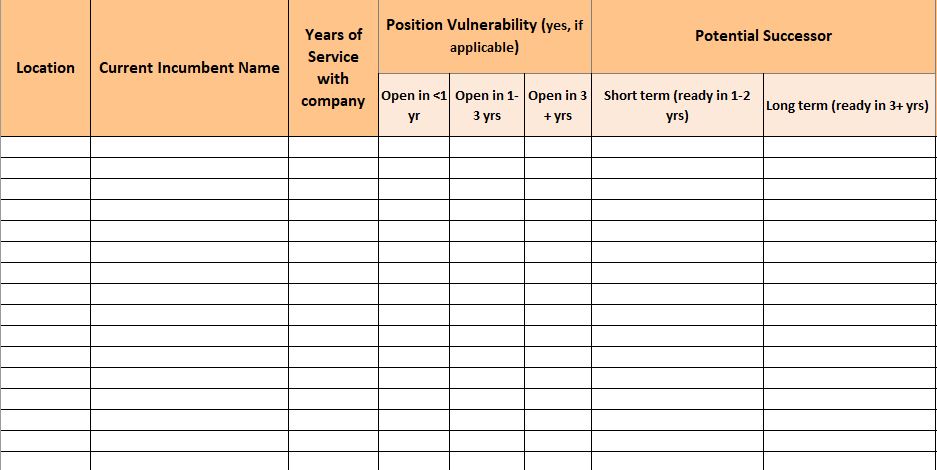
Every leader wants to build a high-performing team capable of taking the reins. That’s where succession planning comes in. It’s not just about preparing for the day you move on; it’s about developing a pipeline of talent ready to step up when opportunities arise. By investing in your team’s growth, you’re not only ensuring business continuity but also fostering a culture of development and advancement. People retire, people leave their roles and, new roles are created during reorganizations and restructuring efforts. All of these scenarios may create the need for someone else to take over in a leadership role and the question becomes… do you have anyone available internally who is promotion-ready?

Knowing who can step into a key role when needed is crucial. It’s like having a bench full of star players ready to take the field. By keeping a close eye on your team’s strengths and potential, you can ensure a smooth transition and minimize disruptions when leadership changes occur.

Continue reading “Succession Plan Template”

From Skills Gap to Training Plan: A Strategic Approach


Training departments are usually expected to provide an annual plan showing training classes and learning interventions which will be offered over the course of the year. Managers want to see when they can plan to send employees to attend specific training courses and they also would like to see that the training plan addresses key areas where performance improvement may be needed for their departments or business units. Lastly, there is also usually the need to create a budget for the planned training. All of these focus areas are covered in the templates that can be downloaded below.

What kind of training should you provide?

Consider the following sources of information which could help:

  • Company strategies for growth and developing into new markets or expanding in existing markets – what skills would be needed?
  • Based on current performance – which skills need to be introduced and which skills should be improved upon?
  • Looking at employee career goals, which skills do you need to focus on in order to help move employees to being promotion-ready?
  • Which skills do managers believe would help their teams succeed better given performance targets and customer demands?

Summary of the kinds of Training Needs to Identify

Tools and Templates

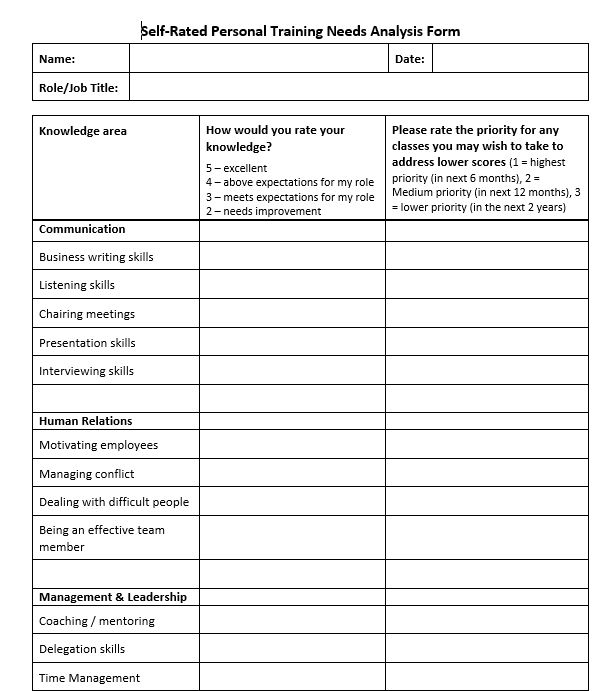
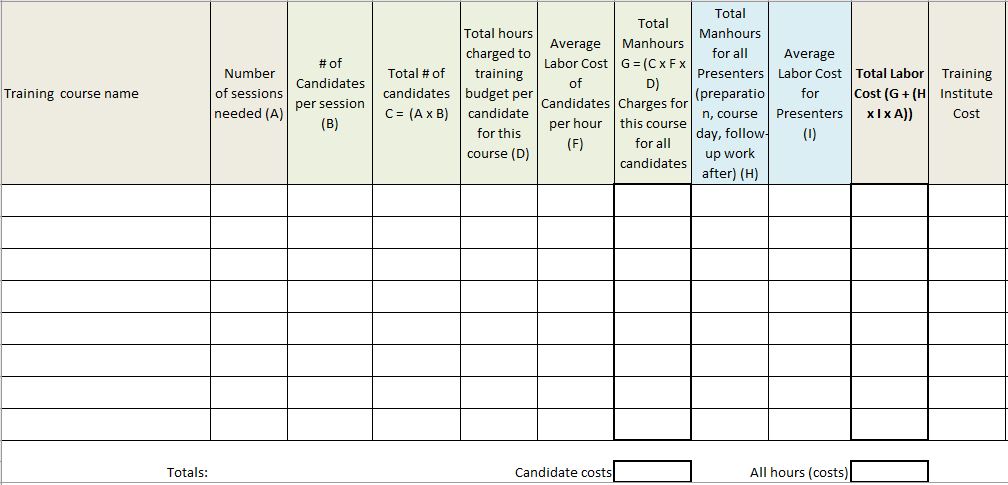
Here are three tools that can help you with conducting a training needs analysis. The first tool highlights individual training needs per employee and is based on employee self assessments. The second tool is a training needs view from a manager’s perspective focusing on the top 3 highest training needs for each employee in his/her group/team/department. The last tool helps you budget for the planned training.

  • Self-rated individual training needs. The quality of the results you obtain from this tool depends on whether you have a good career development tool/framework in place, motivated employees who maintain and work on their own development plans on an on-going basis and whether your managers/supervisors provide quality performance feedback to employees on a regular basis.
  • Manager assessment of department/team. Using knowledge of employee performance in his/her department, the manager selects the top 3 courses that each employee would need to improve own performance and/or to grow further in his/her career. Be sure to share course details with the managers too – what is the duration of the course and what aspects of the topic is covered?
  • Training needs and budgeting. This spreadsheet helps you budget for the planned courses. Check actual spending against this estimate to track the accuracy of your original budget and accurate allocation of items charged to your training budget.

Tips for training needs analysis:

  • Create a training needs analysis process that you follow consistently every year. This helps managers get into a rhythm of providing you with the required information on time for you to submit budget requests for the following year/quarter.
  • Be clear with managers which part of the training costs would be booked to their own budgets. For example – where do employees charge their time when they are in a training class? To your budget or to their manager’s budget?
  • Ask yourself how much training does it make sense to provide internally vs using an external vendor. Make wise trade-offs in terms of training costs, best value for money, expertise needed to provide the training etc.
  • Determining the training plan for the following year should also include a good review of the training evaluations and feedback obtained from course participants during the lasts year. Are your current training classes good enough or do they need to be improved or outsourced?