You sit down to use AI for a piece of work. The first prompt is vague, so the response is too. You refine it. Regenerate. Adjust the tone. Ask for more detail. Remove what doesn’t fit. After a few rounds, you have something you can use.
It feels efficient. But if you look closely, most of the time was spent correcting what could have been clarified before the first request was ever sent.
There is another layer to this that rarely gets mentioned. AI does not run in the abstract. Every prompt travels through servers in data centres, drawing power and requiring cooling. One request may seem insignificant. But how many requests are you making per day? The footprint of AI is real, and while a single exchange is small, scale is what turns small inefficiencies into meaningful impact.
The cost of skipping the thinking step is not just cognitive. It is operational and environmental.
Where we go wrong
If you stop using certain muscles, they weaken. Cognitive skill works the same way.
When AI starts doing thinking you should be doing yourself, the risk is not only weaker output. Over time, it affects your ability to analyse, question, and decide under pressure.
Here is where it usually goes wrong:
You let AI draft the email and do not review the tone carefully.
You accept a structured analysis without checking the assumptions behind it.
You copy a framework because it looks polished.
You mistake length for depth.
AI may invent details when it lacks context. It may reinforce the framing you give it. It may produce something that looks convincing but is slightly misaligned with your strategy, scope, or risk exposure.
And if you send that forward, the reputation attached to it is yours.
Fast does not mean flawless.
Think before you prompt
A better approach begins before you type.
AI performs best when it is clearly instructed. Missing context about audience, tone, constraints, or success criteria almost always leads to additional rounds of correction. You refine. You clarify. You ask again. What felt fast becomes repeated rework.
And there is another dimension to this that we rarely mention.
Thinking first is not just cognitively disciplined. It is operationally and environmentally responsible.
Before opening the ai tool, define:
– What must exist at the end? – Who is this for? – What tone and level of depth are required? – What constraints apply? – What would make the output unusable?
If regulatory exposure, strategic guardrails, or reputational sensitivities matter, state them explicitly.
The AI Briefing Sheet – available as a free download right below – is designed for exactly this step. It forces you to clarify intent before you outsource execution. It is editable, so you can adapt it to your specific project.
Only once the brief is clear should you move to the prompt window. If something is vague in your own mind, it will be vague in the response.
Pause before you prompt.
Staying Mentally Fit in an AI World
When AI always structures your first draft, it feels harmless at first and you slowly stop practicing structure yourself. When it consistently generates counterarguments, you stop anticipating objections. When it refines tone every time, your own calibration weakens.
Used properly, AI can be a sparring partner, a challenger, a speed amplifier, and a capable researcher. But it is not final authority. It should never be your only source, your only fact checker, or the voice that determines how your work will be perceived by specific stakeholders.
Some decisions remain entirely yours: defining what the task truly requires, editing for accuracy, checking tone, and ensuring the structure serves the intended purpose.
The final output must reflect your voice and your judgment.
Practical discipline helps. Draft your own thinking in bullets before prompting. Ask AI to challenge you. Request counterarguments. Pressure-test the output before accepting it.
When you prepare properly, AI works within your framework. Without one, you may find yourself adapting to its structure instead of the other way around.
AI will only get faster.
The real question is whether we remain deliberate.
It is a powerful assistant. Assistants extend capability. They do not set direction.
Use it well – but think first.
That is how you benefit from AI without slowly surrendering the one thing it cannot replicate: your judgment.
We’ve all been there. It’s 11:00 PM. The day was a success – mostly – but your head is still spinning. You’re dictating reminders into your phone. You’re replaying meeting snippets in your mind, trying to unpack what was actually said. To top it off, you just found the dog destroyed your favorite sweatshirt, and the evidence is all over the floor.
You’re exhausted, but you’re too wired to sleep. Your mental RAM is at 100%, and your “processor” is overheating.
Mental clutter – tasks, worries, and that nagging sense you’ve forgotten something – slows your thinking and drains your motivation. High performance and a peaceful mind both require a clean slate.
In a world where leaders are currently facing high levels of burnout and cognitive load, a structured “Worry-to-Action Pipeline” is exactly the kind of pragmatic, tested tool you have come to expect from this blog!
Here is a no-nonsense, 4-step process to move your worries from your head onto paper, and turn that noise into a concrete to-do list.
Grab a pen. Let’s get to work.
Step 1: The Raw Dump
Dump every thought, fear, and reminder spinning in your head on paper. Write them down. Don’t filter, don’t judge, and definitely don’t try to solve them yet. Just write or type until the “RAM” is empty and no more thoughts come.
If your head is spinning too fast to type, use your phone to dictate a voice note. Once it’s out of your system, move those notes to a larger screen – like your laptop or tablet – where you can actually see the “mess” you’ve collected in your mind.
The outcome: moves you from “feeling” the chaos to “seeing” the data.
Step 2: Categorize to Conquer
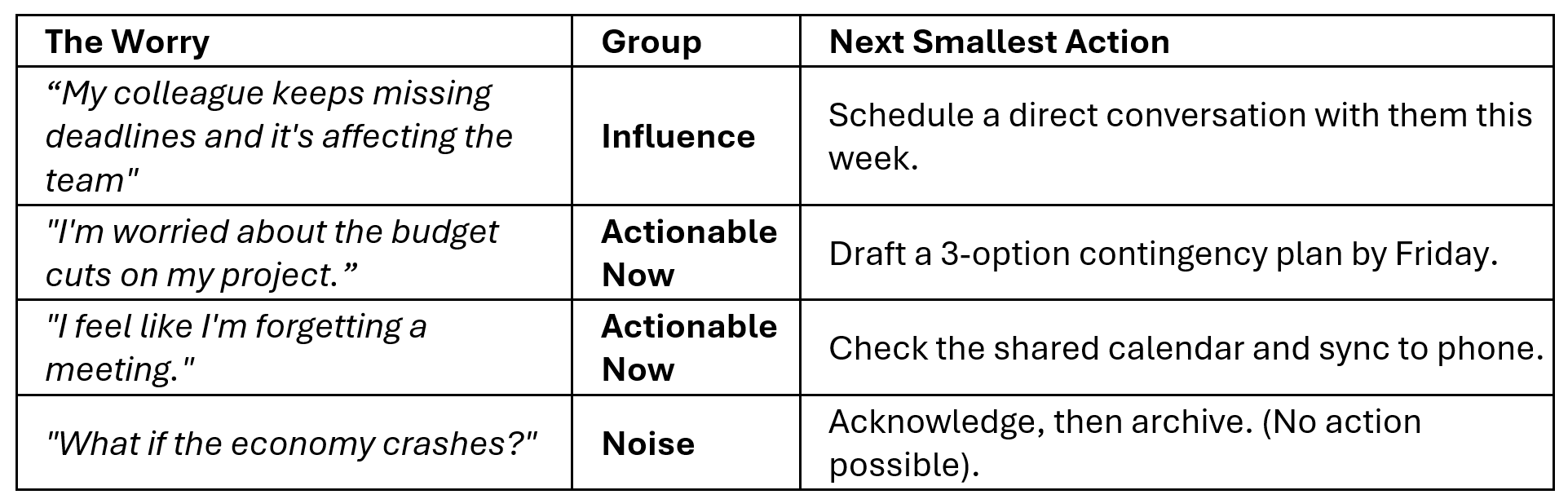
Don’t just look at the mess -sort it. Grab three highlighters (or use the highlight tool on your screen) and assign every item to one of these three buckets:
Actionable Now (Green): Things you can act on in the next 24 hours. No excuses—just tasks you can do today or tomorrow (e.g., “Email the client”).
Influence (Yellow): Things you can’t fix alone but can nudge. This requires a conversation with a colleague, a friend, or an expert. (e.g., Improving team morale when a manager is difficult to approach).
The Noise (Red): Things you cannot change. This includes the past, yesterday’s mistakes, or other people’s opinions. (e.g., The dog eating your clothes while you were out).
Examples:
Step 3: Clear the Green (The 48-Hour Rule)
The “Actionable Now” items are the easiest to solve, yet they often cause the most background noise.
The 48-Hour Rule: If it’s Green, give it a specific time slot in your calendar within the next two days. If you don’t schedule it, it stays in your head.
The “Parking Lot”: If it truly isn’t urgent and can wait longer than two weeks, move it out of your daily view. Put a reminder in your calendar for a future date and delete it from your current list.
The outcome: reduces the number of active “tabs” open in your brain. If it’s scheduled or “parked,” your brain can stop processing it.
Step 4: Delegate and Release
For the items left on your list – the Yellow and the Red – you only need one simple decision each.
For your Yellow items (things you can influence but not fix alone): identify the one person you need to involve and write their name next to the item. That’s your action. You’re not solving it tonight – you’re simply deciding who carries it forward with you. One name. Done.
For your red items – choose a small ritual of release. Red items are RAM-drainers – things you cannot change, control, or solve tonight. But simply crossing them out rarely works. Your brain needs a small, deliberate act to believe it has actually let go.
Choose a ritual that suits you:
Tear it up. Transfer all your red items onto a separate page. Then tear that page – slowly and deliberately – into small pieces. The physical act of destruction signals to your brain that processing time on these is officially closed.
Box it. Not ready to destroy them? Fold the page and place it in a dedicated box – a shoebox, a tin, anything with a lid. This isn’t surrender; it’s containment. Tell yourself: if this still matters in two weeks, it will still be in the box. Most of the time, when you check, it won’t.
Either way, once the red items are off your main list and out of your hands – torn up or lidded away – your brain has its permission to stop processing them tonight.
Close the list. You’re done for tonight.
Tonight, you don’t need to solve everything. You just need to stop carrying it all at once. A pen, a page, and twenty minutes is enough to move from spinning to settled – and to wake up tomorrow with a clearer head and a shorter list. Your brain will thank you for it.
I started writing this in September 2025. I should have published it then. The growing frequency of extreme weather has only made the message more urgent.
Last year’s storm season left many homes without power, water, or communication for days at a time. Roads were blocked, services were stretched thin, and some communities found themselves scrambling to cope.
The reality is that most of us weren’t prepared for how long recovery efforts would take. And with weather patterns becoming more unpredictable, this season is shaping up to be no different. A little preparation now can mean the difference between anxiety and confidence when the winds pick up or the rain won’t stop.
Why This Matters Right Now
While forecasting systems are valuable, the impact, timing, and severity of storms can outpace warnings. Even the best warning systems miss sudden changes. We’ve seen flooding in areas that weren’t historically flood-prone, power outages lasting longer than anyone expected, and communities cut off because access roads were too dangerous to travel.
And sometimes, there’s no warning at all. Heavy rainfall on already saturated ground can trigger flooding overnight. Strong winds can knock out power lines or damage infrastructure in minutes. These realities make storm readiness a skill every household should take seriously.
Why Storms Feel Harder to Predict
Climate Change: More intense storms and unpredictable weather patterns mean traditional “storm seasons” are harder to define. Some events may not be predicted, and we have seen that warnings do not always go out on time. You need to be watchful. Check a reliable weather app and be aware of the state that soil in your area may be in – dry (very dry)? Perhaps that creates a harder surface for water to soak into and could lead to fast surface water movement.
Infrastructure Limitations: Utility teams work hard, but restoration takes time, especially in rural areas or after widespread damage. Recovery may take longer than expected, delaying your return to normal life.
Geography: Know your environment – tree cover, low-lying areas, and road access all play a role. Consider that you may need to get your household to higher ground depending on the weather event you are preparing for.
Hidden Hazards: Recent rainfall or ground saturation means flooding risk isn’t always obvious.
The Cost of Being Unprepared
When a storm hits, it’s not just about losing power for a few hours. It’s about making sure your family has safe drinking water, warmth, food, and a way to communicate. Being unprepared adds stress in an already difficult time, while being ready brings peace of mind and even positions you to help neighbours.
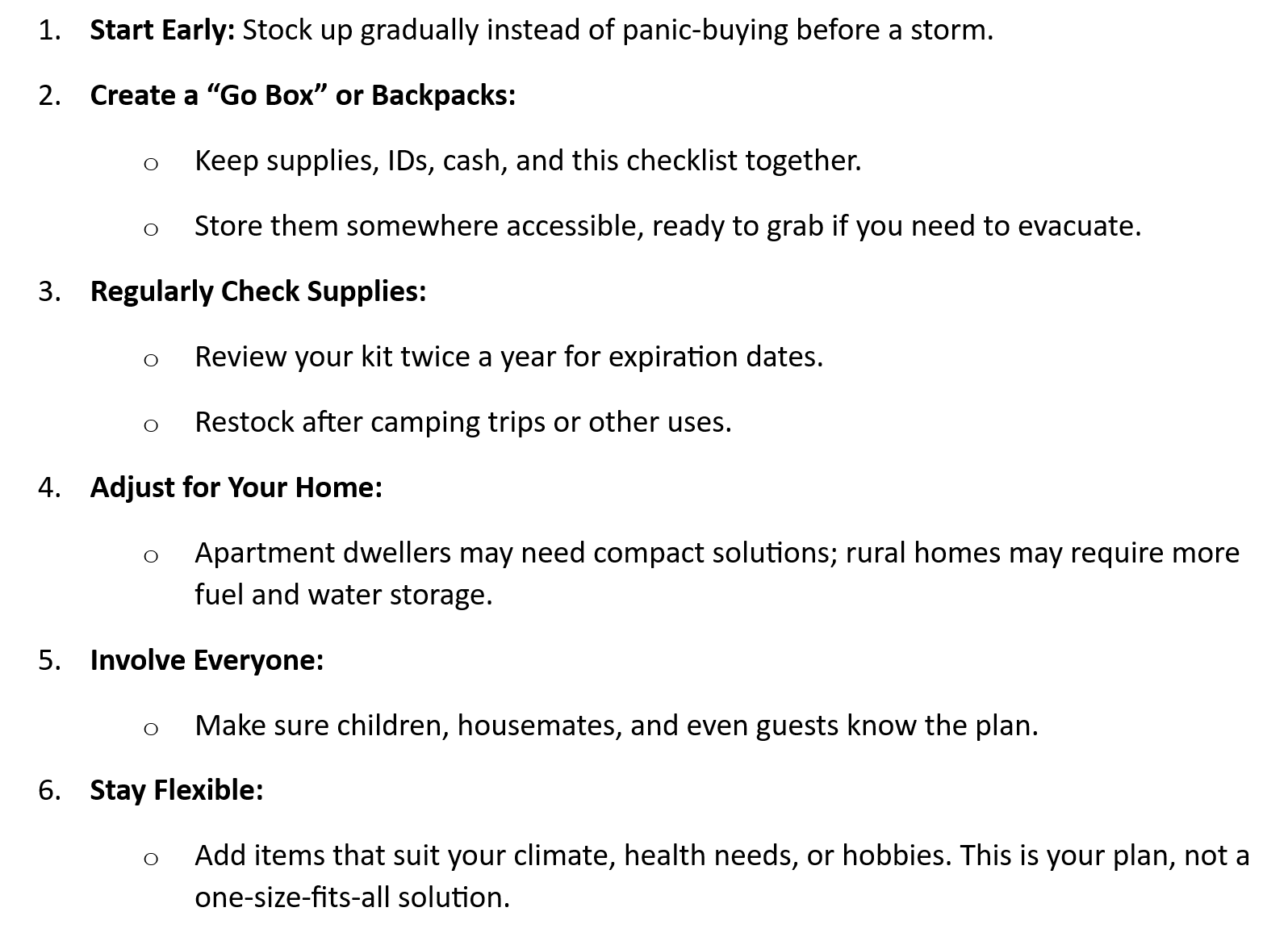
I’ve created a practical checklist based on lessons learned from last year’s storms — and from my own experience of seeing how quickly things can spiral. Once downloaded, this tool is:
Editable: Add or remove items specific to your family, pets, or home.
Comprehensive: Goes beyond food and water to include communication, travel readiness, and planning with housemates or renters.
Free: Download it, print it, and make it your own.
Preparedness isn’t just about “storm season.” Sudden heavy rainfalls, extended winds, or flash floods can happen with little or no warning. Watch the weather, stay aware of ground conditions, and take action early.
Small steps today mean you’ll face whatever storms come next with confidence. Instead of scrambling, you’ll know exactly where your supplies are, how to reach loved ones, and how to ride out a few days off the grid safely.
Entering the project you are most proud of into an excellence competition is an exciting opportunity to showcase your hard work and achievements. But let’s face it, the competition can be stiff—especially when sustainability is a key judging criterion. Don’t worry, though; this post will guide you through how to focus on the right elements and tell a compelling story that highlights your project’s success without making things up. The secret? It’s all about having the right data, understanding what it means, and explaining why it matters.
Here are nine ways to make your project stand out and be memorable and remarkable:
1. Start With the Basics: Read the Rules
Before drafting your entry, carefully review the competition guidelines, especially sections on sustainability or innovation. These often hint at what judges value most—energy efficiency, water conservation, carbon reduction, waste avoidance, community impact, or even all of these. Align your entry with these priorities. And don’t stress over word limits—stay within 10% of the specified count, as they’re there to keep entries focused, not to demand a full thesis.
2. Tell a Story, Not Just the Facts
Before you start writing your entry, read the competition guidelines carefully. Pay special attention to any sections about sustainability or innovation. Competitions often provide clues about what the judges are looking for—energy efficiency, water conservation, carbon reduction, waste avoidance, community impact, or maybe all of the above. Tailor your entry to match these expectations.
3 Focus on Measurable Outcomes
Judges love numbers, so don’t shy away from sharing your data. If your project saved energy, reduced emissions, or cut costs, include the specifics. Here are some examples:
Energy Efficiency: “We installed energy-efficient lighting and reduced electricity usage by 30%, saving EUR 10,000 annually.”
Waste Reduction: “By reusing materials on-site, we diverted 95% of construction waste from landfills.”
Sustainability Impact: “The project’s solar panels now produce 20,000 kWh annually, enough to power 10 homes.”
Don’t have all the data? That’s okay—start with what you do have. Just be sure to explain how you measured these outcomes and why they’re meaningful.
4. Highlight What Makes Your Project Unique
Competitions are about standing out. Did you try something new that hadn’t been done before? Did you find a way to make the project faster, cheaper, or more sustainable? Maybe you combined existing methods or approaches in creative ways. For example:
“We used prefabricated components to speed up construction, reducing on-site waste and emissions.”
“Our landscaping included native plants, which cut water usage by 40% and boosted local biodiversity.”
Be clear about how your approach sets your project apart.
5. Talk About What You Learned
No project is perfect, and judges appreciate honesty. Talk about what went well but also acknowledge what didn’t. Maybe a new method didn’t work as planned, or you realized late in the process that a different approach would have been better. What’s important is that you show you learned from the experience.
For example: “We underestimated the time required to train staff on the new energy management system, which delayed implementation. In the future, we would schedule training earlier to avoid this issue.”
6. Sustainability: More Than Just Energy
When we think of sustainability, energy efficiency often comes to mind first. But there’s more to it. Judges might also look for:
Circular Economy: Did you reuse, upcycle or recycle materials?
Water Conservation: Did your project reduce water usage?
Community Impact: Did the project benefit local communities or create jobs?
Biodiversity: Did your landscaping include native plants to support local ecosystems, or did you create green spaces that attract pollinators like bees and butterflies?
Positive Local Community Impact: Did you partner with local schools for educational programs or support community groups through funding or volunteer initiatives during the project?
By broadening your perspective, you can show how your project goes beyond energy savings to create lasting, meaningful impacts. Be sure to cover these aspects if they apply to your project.
7. Be Honest—Don’t Fake It
It’s tempting to stretch the truth to make your project look better but resist the urge. Judges have likely seen it all, and they’ll spot exaggerations a mile away. Instead, focus on presenting your project’s real achievements as clearly and confidently as possible.
8. Make It Easy to Follow
A clear, well-organized entry can make all the difference. Judges don’t have time to untangle cluttered submissions, so present your work in a way that flows logically and is easy to digest. Use clear headings, concise bullet points, and short paragraphs to guide the reader.
Think about your structure:
Timeline Approach: Are you walking judges through processes, events, or project phases step by step?
Top-Down Method: Are you starting with a big-picture overview and then zooming in on specific achievements or highlights?
Comparative Lens: Are you showcasing measurable improvements by comparing past performance to present outcomes and projecting future benefits?
If you’re including technical data, don’t let it overwhelm the narrative. Break it down into simple, relatable terms that anyone—even those without technical expertise—can understand. For example, instead of saying “airtightness of 0.6 ACH at 50 pascals,” explain how that translates into better energy savings or indoor comfort.
A polished, intuitive format not only keeps the competition judges engaged but also ensures they don’t miss the full scope of your project’s excellence.
9. Think About the Future
Judges often like to see how your project has inspired or informed future efforts. Did it set a standard for your company or industry? Has it led to new ideas or processes? For example:
“The success of this project has prompted us to roll out similar solar energy systems at three other sites.”
“We are now working to integrate lessons learned into our next project to achieve even greater sustainability.”
Conclusion: Show the Big Picture
Entering a competition isn’t just about winning—it’s about showcasing what makes your work exceptional. By focusing on measurable outcomes, sustainability, and what you’ve learned, you can create a compelling entry that stands out.
Remember: the judges aren’t looking for perfection—they’re looking for impact, innovation, and integrity. Follow this approach, and you’ll not only improve your chances of winning but also demonstrate why your project truly matters.
Feeling overwhelmed by your to-do list? It’s time for a fresh approach. Whether you’re figuring out what new tasks to start, which processes to stop, or where to make improvements—including sustainability initiatives—this simple method will help you cut waste and boost efficiency. Think of it as a game-changer for your workflow, empowering your team to work smarter, not harder, while making real progress. Change doesn’t have to be overwhelming; it’s about making strategic, impactful adjustments that lead to better results, smoother workflows, and more sustainable outcomes.
A Fresh Approach to Tackling Chaos
Ever feel like your to-do list is out of control? This simple method helps bring clarity, meaning, and direction to your tasks. Whether you’re deciding what new actions to take, which processes need tweaking, or which habits to drop, this approach will streamline your workflow, boost productivity, and make your routine more manageable.
Even the best processes lose their effectiveness over time or fail to take advantage of the improved availability of better tools and templates, signaling the need to reassess. While big changes can be costly, small adjustments often get things back on track. The method I’ll share is perfect for team brainstorming, making it easier to identify areas for improvement together.
Think of it like tidying up a familiar room. Some things need to go, while others just need a small fix. This tool helps you do the same with your work, identifying what needs to change, what new actions to start, and what habits to stop.
Importantly, it’s also about working smarter with sustainability in mind. Rethinking processes to reduce waste, conserve resources, and adopt eco-friendly practices not only improves efficiency but also builds a more sustainable work environment for the future.
What to Start
Think of yourself as a gardener, planning to refresh and revive your garden. To improve a process or outcome at work or in a volunteer setting, you need to plant new “seeds”—ideas and actions that hold the potential to bring positive change. These are the things you want to start doing to make a meaningful impact.
Ask yourself: What new tools, strategies, or approaches could help streamline work, solve problems, or improve how people experience your organization or team? It might be a fresh approach to a recurring issue or an idea that could make things more efficient. Like planting new flowers in a garden, these initiatives will need your time and attention to grow and flourish.
By starting these key actions, you create opportunities for improvement and success and build an environment that thrives on new ideas and growth.
What to stop
When we talk about what needs to stop in the workplace, we’re focusing on behaviors and habits that hold everyone back. Think of gossip—it’s like a poison that erodes trust and divides teams. Then there’s micromanagement, which stifles creativity and leaves people feeling frustrated and demotivated. And multitasking? While it might seem productive, it often leads to mistakes and burnout. By eliminating these negative behaviors, we can create a more positive, collaborative, and efficient work environment.
Stopping isn’t just about behaviors, though; it’s also about simplifying how we work. This means cutting out unnecessary steps, avoiding redundant processes, and leveraging technology to make tasks easier and faster. It’s about working smarter, not harder.
The key to success is getting everyone involved. When the team collaborates and shares insights, it becomes easier to identify which tasks or processes don’t add value—and figure out the best ways to eliminate them. This not only streamlines workflow but also helps the entire team feel more aligned, motivated, and connected.
What to change
When identifying what needs to be changed, it’s about finding those processes or tasks that work to some extent but aren’t quite hitting the mark. These are not things you want to stop completely, but they could benefit from refinement or improvement. The goal is to enhance their efficiency or effectiveness rather than overhaul them entirely.
This step is about finding out with your team where bottlenecks occur, where confusion arises, or where inefficiencies creep in. Perhaps you uncover small tweaks that make a big difference. For example, a task might be taking longer than necessary because of an outdated step, or perhaps communication between teams could be improved to streamline a handoff.
Other possible candidates for change may lie in opportunities to improve: Are there tasks that could be automated? Is there a process that could be shortened or simplified without sacrificing quality? Sometimes it’s as simple as adjusting timelines or reallocating resources to better fit the demands of a project.
The key is not to throw out processes that have potential but to fine-tune them. By making small, thoughtful adjustments, you can improve the overall flow and outcomes. Involving the entire team in identifying these areas for change ensures that the solutions are practical, realistic, and beneficial for everyone.
Setting up time with the team
To kick off improvements, start by gathering input from everyone involved in the workflow. Set up a dedicated meeting where each person can share their unique insights. By involving the whole team, you’ll gain a diverse range of perspectives, helping you identify opportunities for improvement far more effectively than if you were working alone.
To make the session productive, team up with coworkers and dedicate about an hour to look for ways to enhance how you work, the environment you work in, or how your organization delivers value—whether it’s to customers, clients, or those benefiting from your volunteer efforts.
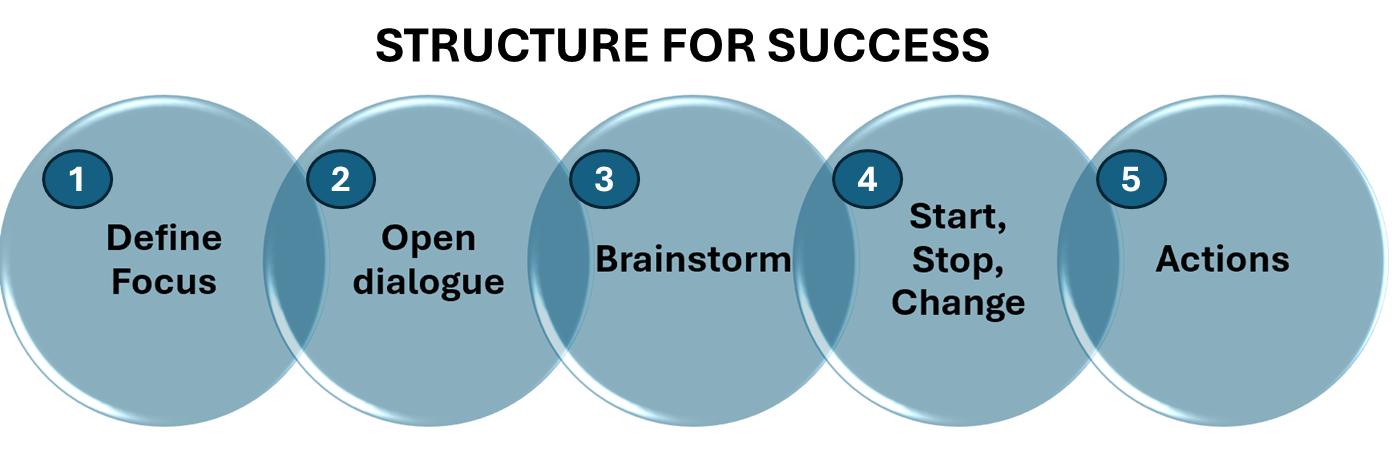
Here’s how to structure your session for success:
Define the Focus: Clearly outline what the session is about. Are you looking to improve a specific process, boost safety, streamline workflows, or enhance customer/recipient satisfaction? Make sure everyone understands the goal before diving into discussions.
Encourage Open Dialogue: Create a safe space for everyone to share their ideas, frustrations, and suggestions. Emphasize that all feedback is valuable and will contribute to positive change.
Brainstorm Together: Work as a group to explore ways to make things better, smarter, and safer. This could involve improving the way tasks are done, optimizing the workspace, or enhancing the delivery of value to customers or the community.
Capture Ideas: Use Stop, Start, and Change flipchart pages to organize ideas. After brainstorming, categorize the suggestions:
Stop: What isn’t working and needs to stop?
Start: What new actions, processes, or tools should be introduced?
Change: What existing processes could be improved with a few adjustments?
5. Assign Actions: Once ideas are gathered, assign ownership for each action. Ensure there’s follow-up so the insights gained from the session translate into real improvements. Also, set up a follow-up recurring meeting to review how things are going to discuss if you need to change or improve how you are implementing actions to be more successful and avoid obstacles to success.
By following this structure, you’ll ensure that your team collaborates effectively and walks away with actionable steps to make meaningful changes.
Keep Stakeholders in the Loop
After the meeting, it’s important to keep key stakeholders, such as your supervisor or others involved in the implementation, informed about the progress. Provide them with an update on the discussions, including the proposal for items to start, stop, or change. This transparency ensures they are aware of the team’s efforts and can offer support as needed. Additionally, ask for their feedback and suggestions. This will help ensure that no key opportunities for improvement are missed and that the plan is as comprehensive as possible. Engaging others in this way enhances collaboration and strengthens the overall success of the initiative.
Now It’s Your Turn to Change the Game
Taking a structured approach to what you start, stop, and change can really improve how your team works and help you reach your sustainability goals. I encourage you to take a fresh look at your team, your environment, and how you get things done. Find ways to not only make customers happier and save money, but also to reduce waste, save resources, and lessen your impact on the planet. Involving your team in this process will help everyone work smarter and feel more motivated as they see their ideas making a difference. Whether you’re working or volunteering, these changes can lead to a more rewarding and sustainable experience. Now is the time to act—start looking for where you can make a real difference for your team and the environment.
Looking to lower your electricity bill? It starts with understanding when and how you use electricity. By reviewing your energy usage, you can spot the times when you use the most power and which appliances consume the most. This information is key to cutting costs.
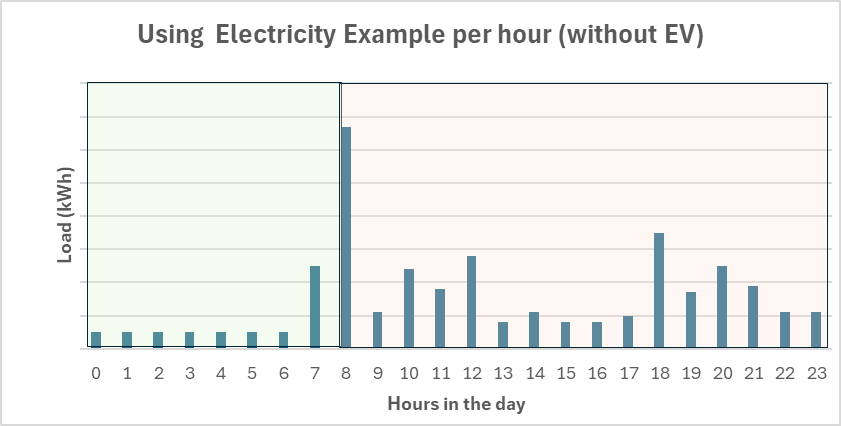
Below is an example that shows how much electricity a household uses each hour. The taller the bar, the more energy is used during that hour. You can see a spike around 8 AM, likely because people are getting ready for work or school. In contrast, early morning hours, when the household is asleep, show much lower energy use. This example might also reflect a home using efficient heating during winter, resulting in lower usage overnight.
Cut Costs with Time-of-Use Rates
Think of the electricity grid like a busy road. During rush hour, traffic slows down because everyone is on the road at the same time. The same thing happens with electricity—during peak hours (like afternoons and early evenings), lots of people are using power, which puts stress on the grid.
In the chart below, you’ll see the household’s energy use in two colors: green and orange. Green represents times when electricity is cheaper, while orange shows when it’s more expensive. As you can see, most of the electricity is being used during the orange (expensive) hours. If the household shifted some tasks, like running the washing machine, dryer, or dishwasher, to the green (cheaper) times, they could save money. Even small changes like this can make a big difference on their electricity bill.
Understanding Time-of-Use Tariffs for Electricity
Some utility companies offer plans that charge you based on when you use electricity. The rates vary depending on the time of day—electricity is cheaper during certain hours and more expensive during others. By understanding how these time-of-use tariffs work, you can adjust your habits and save money on your electric bill.
Why Do Power Companies Offer Variable Electricity Rates?
Variable electricity rates work like offering different prices to drive on the roads at different times of day. When more people use the roads at quieter times, traffic flows smoothly. Similarly, when more people use electricity during off-peak hours (when the grid is less busy), it helps utility companies avoid overloads and keep the system running smoothly.
By charging higher rates during peak hours, utility companies encourage people to shift their energy use to less busy times. This reduces strain on the grid and helps prevent blackouts or other issues during periods of high demand—like when everyone is cooking dinner or watching TV. During off-peak times, such as late at night when most people are asleep, electricity is cheaper because demand is lower.
This pricing system, known as Time-of-Use (TOU) tariffs, means that electricity costs vary throughout the day, giving you the opportunity to save money by using energy during cheaper, off-peak hours.
Example: How Variable Rates Can Save You Money
Let’s look at an example to show how time-of-use tariffs can impact your electricity bill. We’ll compare two scenarios: one where a household uses a variable rate plan, and another where they don’t. In both cases, the household uses 150 kWh of electricity in a month, so the only difference is the plan they’re on. This will help illustrate how using the same amount of energy can cost less when you take advantage of variable rates.
A Time-of-Use Electricity Tariff
For this example, let’s assume that electricity costs €0.18 per kilowatt-hour (kWh) during the day, from 8 AM to midnight. At night, from midnight to 8 AM, the cost drops to €0.10 per kWh.
Now, if your total electricity usage for the month is 150 kWh, and you use 100 kWh during the day and 50 kWh at night, your electricity bill would be calculated like this:
Daytime usage: 100 kWh x €0.18/kWh = €18
Nighttime usage: 50 kWh x €0.10/kWh = €5
Total bill: €18 + €5 = €23
Without a Variable Rate for Electricity
If there’s only one flat rate for electricity throughout the day, the cost is often higher. Let’s say the rate is €0.21 per kWh. In this case, the family’s monthly bill would be:
Total bill: 150 kWh x €0.21 = €31.50
As you can see, the household with a time-of-use plan pays less (€23) compared to the flat-rate plan (€31.50). This shows that variable rates can save you money, even though the peak-time rates are sometimes higher than a flat rate.
What can you do?
If your utility provider offers time-of-use or variable tariffs, where you pay less during certain times of the day, here are some steps you can take to maximize your savings:
Install a Smart Meter: A smart meter tracks your electricity use hour by hour, so you can see exactly when and how much energy you’re using. Many utility companies offer free installations, giving you better control over your energy habits.
Adjust Your Daily Habits: Shifting energy-heavy tasks like laundry or dishwashing to off-peak hours can significantly reduce your bill. Even small changes can add up over time.
Monitor Your Usage: If your utility offers an app or online portal, check your electricity usage regularly. Look for patterns and try to match high energy use with specific activities (e.g., running the washing machine). This helps you identify when to shift energy use to cheaper times.
Upgrade to Energy-Efficient Appliances: When it’s time to replace appliances, choose energy-efficient models. These not only use less electricity but can save even more if run during off-peak hours.
Use Smart Appliances: Some appliances can be programmed to run during off-peak times automatically. Set them to start when rates are lower, and enjoy the savings without having to think about it.
Install a Programmable Thermostat: Adjust your thermostat to lower the temperature during peak hours to reduce heating and cooling costs.
Invest in Energy Monitoring Devices: These devices show real-time energy usage, helping you identify which appliances are using the most electricity. With this information, you can turn off unnecessary devices or shift their use to cheaper times.
Taking these simple steps can help you cut costs and make the most of your time-of-use tariff plan.
In conclusion, saving on your electricity bill is easier than you might think. By simply shifting your energy use to off-peak hours and being mindful of when and how much electricity you use, you can make a big difference in your monthly costs. Small adjustments, like running appliances at cheaper times or using energy-efficient devices, can lead to significant savings over time. With just a little effort and smarter energy habits, you’ll not only reduce your bill but also take control of your household’s energy use.
Navigating the complex world of data protection can be overwhelming, especially for small organizations like charities and businesses.
The Perils of Data Breaches
When personal data falls into the wrong hands, the consequences can be devastating. Individuals may become victims of identity theft, financial loss, or emotional distress. Trust, once broken, is difficult to rebuild. Organizations face reputational damage, monetary penalties, and legal repercussions. Moreover, a data breach can erode public confidence in digital services, hindering innovation and economic growth. Safeguarding personal information is not just a legal obligation but a moral imperative.
Compliance
The General Data Protection Regulation (GDPR) has set a new global standard for data privacy in Europe. At this time there are several countries worldwide with similar compliance requirements – from Australia’s Privacy Act to California’s Consumer Privacy Act (CCPA), organizations across the globe are grappling with the complexities of safeguarding personal information.
Free draft forms and guidelines
Data protection can be a real headache, especially for small businesses and charities. That’s why this toolkit of draft forms and policies is here to help you get started with practical templates to help you stay compliant without the hassle.
These templates are a great starting point but remember, data protection compliance is more than just paperwork. You’ll need to tailor these documents to fit your unique business and consult with legal experts when required.
Think of these draft documents as your trusty sidekick, providing a solid foundation for your data protection journey.
The toolkit has the following elements:
Data Protection draft Policy Template: Establish clear guidelines for handling personal data.
While these may be a handy starting point, remember, that data protection is about more than just paperwork. To really protect your donors’, your employees’, your vendors’, and customers’ info, you’ll need to build a solid system that covers everything from training your staff to dealing with data breaches to having a process to report incidents, investigate and draw up an incident report and understanding the data you have and know if you have any risks if that data leaks out somehow.
Data protection impact assessments: You need to start out by identifying and managing high-risk data processing activities and making sure you address any high risks you identified in the process. Conduct regular assessments (maybe once a year) to identify potential vulnerabilities and implement appropriate data protection safeguards. [There is a draft form for that in the templates.]
Employee Training: Regular training to ensure staff understands their data protection responsibilities and can identify and prevent potential risks.
Data Minimization: Collect and retain only the necessary personal data and give them examples to help them understand what personal data is.
Rights of those whose data you have: Implement procedures to handle data access requests – they generally have the right to erasure or update of data you store, and other rights include the right to ask to see the personal data you keep on them. [There is a draft form that people can use to request access to the personal data you have]
Supplier Management: Ensure data processors comply with data protection requirements through contracts and oversight.
Incident Response: Develop a clear plan for responding to data breaches, including notification procedures. And make sure everyone knows which number to call or which email to use to report a suspected data breach. [there is draft information in the templates for how to report an incident and also questions to ask when talking to someone reporting a potential data breach.]
Continuous Monitoring and Review: Regularly assess data protection practices to identify and address potential vulnerabilities.
By combining the templates with these additional measures, you can help your organization build a strong foundation for data protection compliance and protect the privacy of your data subjects.
Staged Promotions – Accelerate role-readiness using focused development with check-ins
Leaders are not always ready the moment you need them to step into a new role. An inexperienced leader can increase risks in continued customer satisfaction, operational / execution risks, and employee satisfaction and retention. Using a a staged promotion could be a way to mitigate risks, while ensuring that leadership development is accelerated and monitored with defined targets on knowledge gained and skills and competencies gained during each period within a specified timeline.
Process and Timeline
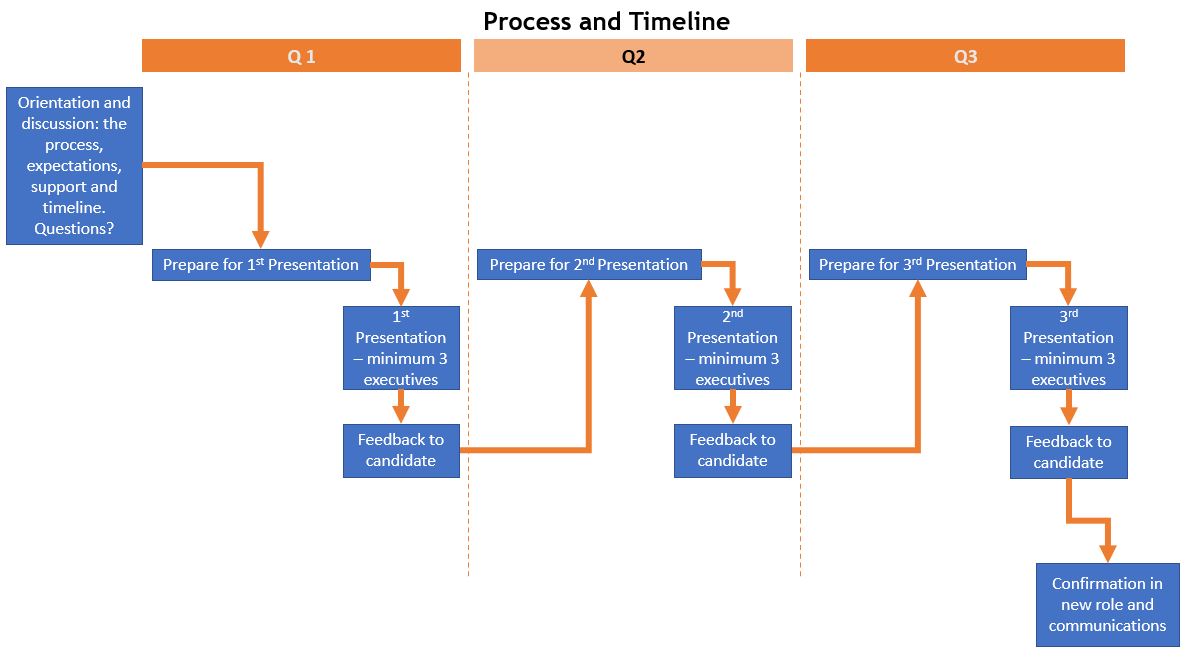
The graphic below outlines the process and shows an example of running the process over a 9-month period. The duration of such a process can vary but watch out for making the period too long – longer than 12 months. It can lead to process fatigue and demotivation of the leader. It is important that the process starts with an orientation to ensure the leader understands how the process will work and what is on the other side of the development period. The leader should be clear on what he/she is signing up for.
Defined learning path
During the development period, there needs to be a few concrete check-in points whereby the leader is demonstrating knowledge, skills and insights gathered and learned over the period. Instead of making the check-in points being general discussions, it is useful to select a few key focus areas for a presentation to be delivered at the end of each of the development periods.
Each check-in event needs to result in specific feedback being captured and shared with the developing leader. The feedback helps him/her to further focus and improve on their learning approach for the remaining learning periods.
The final check-in is usually the final decision-point where the executives present are willing to confirm the promotion of the leader – ending the interim nature of the assignment.
The example below shows how a project or facility leader can be assigned specific areas to learn about over the 9-month period. Each of the areas are important for the normal day-to-day activities of the developing leader and the focus simply means nothing is missed in helping the leader perform well in the role in future. It helps to include the strategic and the “why” part of a role since a new role is often mostly or mainly about the “what” to get done.
Notes
The orientation step which helps the leader understand the design of the development path, the role he or she has and also how to ensure his/her own success making use of available internal and external development resources. Before the orientation session, a leader has typically already understood from his/her manager that they are offered the development opportunity on an interim basis and the leader has agreed to proceed. The leader also needs to know what happens if he/she does not succeed at the end? Will they get a different assignment and what might that be?
Preparing the executives before the check-in events (when check-in events are set up to be a presentation followed by questions and answers). Executives need to understand the design of the development path, the purpose of the focus areas, the development needs of the leader and how they are to capture their feedback to be presented back to the leader after the event.
Feedback to the leader should be specific and be a balance of activities that are good to maintain, which ones to develop further and which ones to start or stop going forward. Specific examples of desirable behaviors or results should be highlighted. A discussion on risk identification and management may also be useful to help the developing leader understand how to adjust own focus to best mitigate and manage risks associated with own development as a leader as well as risks associated with the role..
This process is very useful to help a leader understand what the new role would include when they are meeting all expectations of stakeholders. A leader who feels uncomfortable meeting all those expectations will typically ask to be taken off the development path before the end having realize it is not for him or her. And this allows for re-assignment and solving the leadership vacancy in a different way.
Listening to a presentation by the leader on the assigned topics goes a long way towards providing executives with a sense of comfort (or alarm!) in terms of what can be expected from this leader in this role going forward. While these check-in points should not be the only determinant of how the leader is performing in the new role or estimating future behavior, it is a great way to understand the reasoning a leader applies in making business determinations and decisions and how the leader approach problem-solving when faced with adverse situations.
Knowing what kind of opportunity you would like to pursue next, you can wait for the perfect role to show up online or… you could actively work through your network to get further!
Think about this:
The high level of competition for the role if you apply for a role online! Your experience and education and the design of your CV/Resume would have to be better than all other applicants to get through to the end of the recruitment process!
They estimate that 70% of roles are not advertised, but instead are sourced through networks! This means you could be invited for a discussion or interview just based on the fact that someone recommended you or introduced you to a decision-maker!
Every person you know from past roles, from school or college days, people you met and talked to at conferences, family, friends – could possibly know someone who is connected to a role that would be great for you!
Getting more contacts and making a positive impression on those you meet is important. It is not about pretending or lying, it is more about showing respect and genuine interest in those you meet. When people like the encounters they have with you, they want good things to happen for you and they might be keen to ask people they know to meet you or have a discussion with you. And this is all you need in many cases to get to the next step – a consulting project or a new job!
What does your network look like?
If you take a blank sheet of paper and you try to draw out this graphic below, perhaps you will be able to jot down people’s names for each of the circles and be able to create your starter list. This means the list of people whom you will start with – making contact with them.
The groups of people you know the best are most likely:
Friends, Family members, Classmates (now or from years before), ex-colleagues or trusted current colleagues, neighbors (now or from an earlier address where you lived at one point).
The next level of people you may want to contact include:
People you have met or interacted with on a sports team, or a social organization you joined, or a hobby class you took at some point, people you met and spoke to at a conference.
Priorities:
Looking through the names of people you listed in the worksheet (download available below), who might know people at the companies you are hoping to work for? Who knows about the kind of work you are good at and want to do? Who has the knowledge or experience to help you in your search? Who am I most comfortable talking to? (start there!)
How can your network help you?
What do you tell them ?
When you talk to someone who already knows you, you do not need to introduce yourself. When talking to a contact of someone you know, introduce yourself.
Make sure your message is complete: why are you talking to him/her? What exactly do you hope to get out of the conversation?
Be specific about what you are looking for – i.e. role in sales, working on electric installation projects, etc.
What are your training, certifications, experience, and skills to explain how you plan to successfully deliver in the role mentioned above? (the short version – only mention the most important ones!)
Have your questions ready and be ready to rephrase any questions that are not easily understood by the person you are talking to.
Give the other person time to think about their answers by being quiet after you asked.
Show genuine interest in their advice or suggestions.
Questions to ask
The questions below can be used as a guide as you create your own list of questions to ask your contacts. Do consider how strong your history and relationship is with each person you talk to before you ask any of the questions. Rephrase any questions to allow for cultural differences and preferences and also to match the formality required for your conversation.
Depending on the role of the person or his or her expertise/experience, you may choose different questions for each conversation. Note the specific questions you want to ask each person before you contact him/her. Limit yourself to a reasonable number of questions – something you can fit into a 30-minute call would be best when you talk to someone whom you have not met yet and who is giving you some of his/her precious time for this conversation.
Are you aware of any job vacancies which would fit my skills/experience?
Would you help me by looking out for opportunities you might become aware of and which might be useful to me?
Do you know anyone who might be planning to change jobs where I might be a possible role replacement candidate?
Do you know any companies where my skills and experience may be sought-after?
Are you aware of any new companies moving into the area and/or whom I might be able to contact about a role there?
Would you be willing to help me get an appointment for a discussion with a recruiter at your company?
May I ask for your help in preparing for an interview (given your contacts/knowledge etc)?
Would you be able to help me with more information about a company I would like to target for an unsolicited application?
How would you advise me to proceed with my interest in THIS role or getting a role at Company X?
Would you be willing to be a reference for me?
Would you be willing to review my resume/CV and give me any tips or improvement suggestions?
How do you plan your approach?
Using the attached workbook below, start filling in the names on a sheet
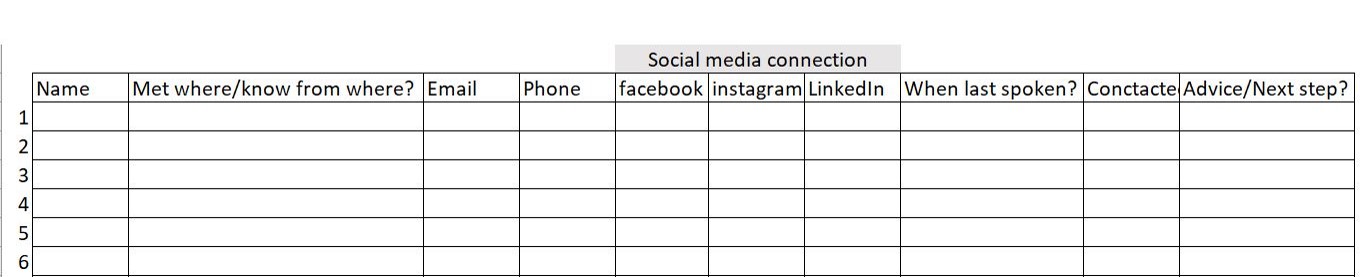
Note contact details you might have or if you are connected with any of them through social media
Start with the people you know the best and explain what kind of opportunity you are looking for and listen to their advice or ideas of who they might know and would connect you with.
After the discussion, capture their suggestions in the worksheet in the “Advice/Next step?” column.
Follow-up on these, contact the person they suggested or introduced you to and ask for a meeting to discuss your interest in the company, work they do, etc.
Each of the tabs in this worksheet (see file above) contains a table for you to capture the names of people you thought of while looking at the groups of people you are connected to. Complete the table for each of the groups you have considered as far as you can. (see example below for someone who identified 3 friends, but has not yet contacted them).
Follow-up
To keep your momentum, monitor your follow-up actions which could range from contacting a suggested person or calling someone another time as agreed during the previous conversation you had with him or her. Set targets for yourself per day and per week to avoid procrastination or letting a contact “go cold”. This could happen if you call too long after the initial call and the person you are contacting may have forgotten that your mutual contact had introduced you to each other.!
Tips:
Networks of contacts and human connections can be a fragile environment and it is important that though your need for them to act on your behalf is high, you need to also maintain a good relationship throughout and continue to be someone whom they would like to help. Very few people HAVE to help you, they will because they want to. Your attitude and way of talking to them will determine how much they will be willing to help you.
Be firm and confident, but not pushy. Sometimes there is a very thin line between those two. And the difference is often the strength of the history of your relationship with that person. If you know him or her for a long time and you have spent a lot of time together, you may be able to be a little pushier to get him or her to introduce you to someone else. When you have had only one or two conversations with someone at a conference, you would not likely have a strong enough relationship to be overly familiar or strong in your approach.
Always be thankful. Even if you have known someone for a long time, if they introduce you to someone or give you a handy tip that leads to a conversation, do let them know how thankful you are for their help.. Also thank people for taking the time to talk to you regardless of the outcome.
Only contact people from a conference or a class you took in the past if you actually spoke to them. It would be quite unusual to simply use a conference or class attendance list and email or contact each person on it regardless of whether you actually spoke to them at the time. Most people might disregard requests for calls or discussions in such cases.
Do not expect your contacts to call you back when they have more information for you. Ask if it would be alright for you to call back within a week or two.
When you had a great conversation with someone, why not add him or her to your list of future contacts? You never know when you may be able to introduce them to a new client or opportunity that fits into their business model!
Before Covid most companies with international interests had several people flying and traveling to other offices and locations to attend meetings, lead initiatives, or train others. While most of us have pretty much remained “grounded” in our countries without the option to travel, company activities continued (as far as it was possible). Something seems more obvious now than perhaps in 2019: We are getting pretty good at training, meeting and mentoring remotely using technology and internet connections. Yet, when we can, will we continue previous practices of sending our leaders and experts to remote locations on a regular basis like we did before? It is said that Ireland lowered carbon emissions by at least 6% during 2020 and some companies have seen business travel costs more than halved over 2020!
Some challenges that companies try to address by flying in leaders and experts from HQ:
We do not have people in all locations with the right experience and skills and HQ experts are needed to support local teams on a regular basis.
We are not exactly sure what the true status of projects are and we would feel more comfortable having one of our trusted staff regularly visit remote locations.
We are not sure that local people understand our strategies and truly commit to realizing performance targets, which means someone needs to visit with them on a regular basis to ensure they do understand our strategies and then review with them how their efforts support these.
We are finding it tough to source local people with the right skills and experiences and those we can find are too expensive in terms of compensation expectations.
The local people speak a different language and their English language skills are not great, which makes it hard to know for sure what they are trying to convey during our calls. We need to see the project/work to understand more clearly what is really happening there.
The local people may not be forthcoming with bad news relating to projects in remote locations and they may possibly favor being cordial over risking our dismay.
The list is not exhaustive, but it does highlight some of the opportunities to find better ways going forward to avoid going back to the level of business travel we previously considered normal.
The term Glocal means to Think Global and Act Local and it is said that Akio Morita of Sony Corporation was the first person to use the term which became popular in the business world in the 1990s. How to think about the big picture and over-arching strategies goals and still be sensitive to local conditions and needs when you implement those big picture ideas? A balance would have to be created and it would be an ever-adjusting type of balance which is not fixed in place. To incorporate (for example) shifts in local legislation or new diversification strategies from HQ. Finding a way to keep this balance in place may lower the need to return to pre-covid business travel levels.
There are at least three ways to address this:
Focus leadership development in a few key areas,
Better teams – adjusting selection and development of staff, and
Better use of technology – making more use of technologies to facilitate remote collaboration.
Better leadership
Having the judgment, problem-solving and decision-making skills to navigate in the space where one has to constantly balance global strategies and goals with local situations and conditions means leaders have to be comfortable with ambiguity, be constantly on the look-out and actively engaged in learning new skills and understanding how others have succeeded or failed in addressing what lies before the leader. Learning how to proactively include all team members including those who are “different” and to do this successfully leaders at HQ and remote locations need to understand their own biases and stereotyping. This will ensure that the skills of the entire team is leveraged in achieving performance goals. Lastly, leaders also need to have the ability to easily shift their perspective from global thinking to local acting and back in order to maintain the balance needed for the decision they need to make at that moment.
Better teams
Working on a diverse team with some team members in remote locations is something we have learned to do successfully over the last year. And this new skill has brought opportunities to get better results through teamwork without having to be present in an office or with the entire team. Will we ask – does this person have to be in the office every day of the week? Or will we consider hiring talent where we find it without feeling he or she needs to be relocated to HQ in order to be an effective member of our team?
To help existing teams be more inclusive and effective some specific or additional training may be needed around diversity. This training can include developing an improved understanding of cultural differences and perspective differences (for example among provinces or states in a country). It often comes down to increasing awareness of own biases and stereotypes that may have settled in our perspectives about groups of people who are very different from our own backgrounds.
Recruiters and hiring managers also have to start including additional skills in requisitions to fill vacancies. Skills like additional language skills – not only English – experience such as having lived and/or worked in a country other than their home countries.
When creating teams to work on performance improvement projects (action teams) – why not include people from different functions, locations and cultures on the team? It is a great way to increase your internal network of employees collaborating and communicating across locations.
All of these aspects can help a team become more global-minded and inclusive while making smarter choices working on local projects which impact broader strategies or targets in the company.
Use technology
In addition to tools for video-conferencing, there are tools which can help monitor progress or quality without having to travel to a location.
1. Hololens2: click this link to see short video of what it can do across various industries – there are ways for clients and HQ personnel to connect with someone using this technology at a remote location.
2. Realwear: click this link to see a short video of how it can be used to get input and advice from a person located remotely.
3. Some locations use drones to get an understanding of general progress on large construction projects and provide overall updates to managers at HQ. Drones can also be used to inspect hard-to-reach places safely.
4. Use a centralized electronic storage solution for files meaning all local files can easily be viewed from remote locations without needing to travel to a site.
While working smarter in these ways is also a way to lower pre-covid GHG and carbon emissions, many employees appreciate the flexibility of remote working options and combined with lower business travel needs it adds to having a better work-life balance. The amount of quality time spent with families and friends has also increased for most. All of which adds greatly to employee well-being. Looking for ways to leverage what we have learned by having to work remotely during 2020 can benefit companies and employees in greater ways than we may be able to realize now.














 The Rethink Shelf