Problem Solving Template


puzzle (2)

It can be frustrating to try and figure out where things went wrong when the outcomes you had hoped for, did not work out. Sometimes it could be an object or piece of equipment that is not working well. It could also be a process that is at fault or perhaps it is human action or inaction that is causing the lack of performance.

This template helps one to work what you know and finding the facts in order to fix the issues that are stopping you from obtaining the right outcomes. This offers a better chance of discovering the root cause that is stopping you from achieving the planned good results.

After defining at the top what the problem is which you would like to solve, the worksheet takes you through a systematic process covering: The What, Where, When and How Big aspects are. Across the top moving from left to right on the columns, the worksheet has space to write down what you can see (what is observed) and it moves to any facts you are aware of which could relate to the observations, then writing down what the differences are between what you have observed and the facts until you finally arrive at the last column where you are able to narrow things down to the most likely causes that things are not working out with the problem you are trying to address.

It may seem tedious at first to complete the information indicated, but when the reasons or causes are less obvious this is a great way to summarize what you know about the situation in one place. We often know more than we realize and we simply need a way to put things together logically to spot the reasons behind a malfunctioning element in a failing piece of equipment or a process.

This tool can be used by an individual or in a group context. Sometimes it helps to have more than one person look at the same information and brainstorm through the elements shown in this template to get to the root cause(s). I also recommend that you retain a copy of this completed template to serve as a “lessons learned” to others.  I believe each one of us and every company/team should continuously strive to learn to remain competitive and innovative (creative). Others may be able to solve future issues by reviewing your completed sheet for the issue you solved.

How to set priorities in an action plan


After a survey, a brainstorming session or a discussion it is often true that you end up with a long list of actions that should be put into an action plan. With many actions, maybe only a small number of people available to execute on those actions and possibly a small budget available for some of the actions, this could seem overwhelming.  The important question is: How can you prioritize the actions so you can make the most of the available resources (people to work on them) and funding (available budget)? And on top of that make sure that the most important actions are completed first?

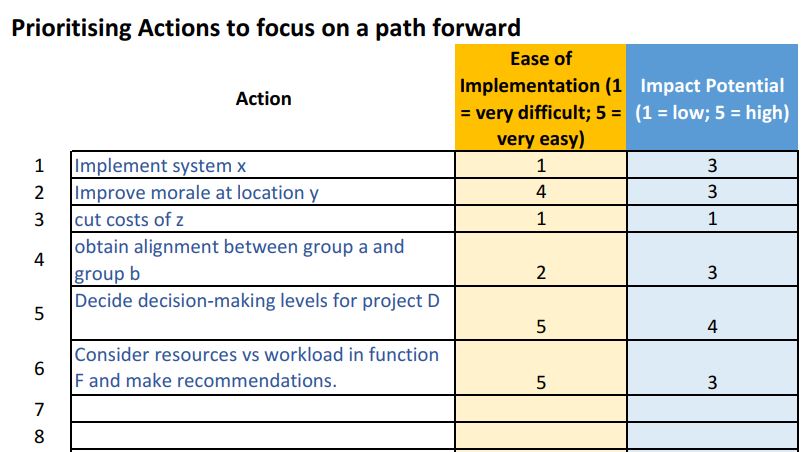
Rate all the projects or activities on two questions:

  • what is the level of impact on your company, project, company if you completed that project/activity? (high means it would me a very big difference (positively))
  • how hard is it to implement this? (referring to available resources, skills and knowledge needed, tools needed, funding needed) (very difficult means you have very limited resources and budget and this project or activity would need more than you have available right now)

Use the scores obtained to plot your planned projects or activities onto this graphic: (the graphic shows an example based on the table and ratings above)

What to focus on?

Use the guide below to understand which of your projects or activities should be a high priority, low priority or medium priority with possible additional research needed.

One the one hand the question is: can you overcome what is difficult about that particular activity or project? Can you (for example) convince someone make more funding available if you present a very solid business case to highlight the value to the company or the project?

Or can you get more people to help? The other question to look into is whether the impact is really as low as you imagine? Speak to others to hear their views of how such a project or activity could possibly benefit more areas than you think. Perhaps the project is much more valuable than you think and it moves into the “green” quadrant meaning it should be a high priority for you to work on and complete.

If your dots appear in one of the yellow sections, you have some questions to ponder. If you can solve the question in each case you may be able to move that particular action into a different “zone” by changing the score. This means you are able to for example make it easier to implement by solving an issue which made it particularly difficult to implement. Or it could mean you realize the business impact is bigger than you previously realized because the company could gain a competitive edge if you implemented that particular action.  Your final action plan for immediate focus areas should contain those actions which finally end up in the green zone on the legend.

Be sure to communicate the reasoning behind your high priority actions to the key stakeholders in the outcomes of the action plan. They may have additional insights to share which could further cause you to change the scoring of actions.

You can use the Action Plan posted here to capture the actions that you will implement, monitor status of and report on regularly.

Coaching Effectiveness Survey


While it is a good idea for coaches to periodically discuss how well the process may be working for those that they are coaching, it is also a good idea for HR/Learning and Development to get feedback on the coaching program on an annual basis. Occasional informal feedback from the person being coached to the coach directly may help the coach improve the person’s coaching experience and outcomes reached.

A formal annual survey helps the department responsible for managing and monitoring the coaching program to understand a few things:

  • General questions that coaching participants may still have about the process or program objectives.
  • How to improve the training of coaches to improve developmental outcomes.
  • How well the relationships are working between coaches and those being coached. Perhaps an intervention may be needed in cases where a high level of dissatisfaction is recorded?
  • Whether the coaching process is working well in general – meetings are held on a regular basis and the right topics are being discussed.

Coaching survey

The coaching survey above (see download option) contains questions you may want to consider for your annual coaching effectiveness survey and it also contains some suggested wording for the introduction email to those who are being coached to explain the survey and its purposes.

Gather the survey feedback and analyze it for overall coaching program effectiveness, but also look at individual responses to see if anyone is having a particularly negative view about his or her coach or the coaching process.  When you take action on individual responses pay close attention to the confidentiality statement you put in the email that went with the survey. Do not reveal someone’s input to his or her coach unless it was expressly established that the survey respondent consent to this course of action. Also use the information gathered from the survey to improve your orientation slides for the next coaching program and to improve future training you offer to coaches.

Other coaching resources that may be useful for setting up your coaching program: preparing for coaching, coaching questions, coaching program orientation slides.

Coaching Program Orientation – Presentation


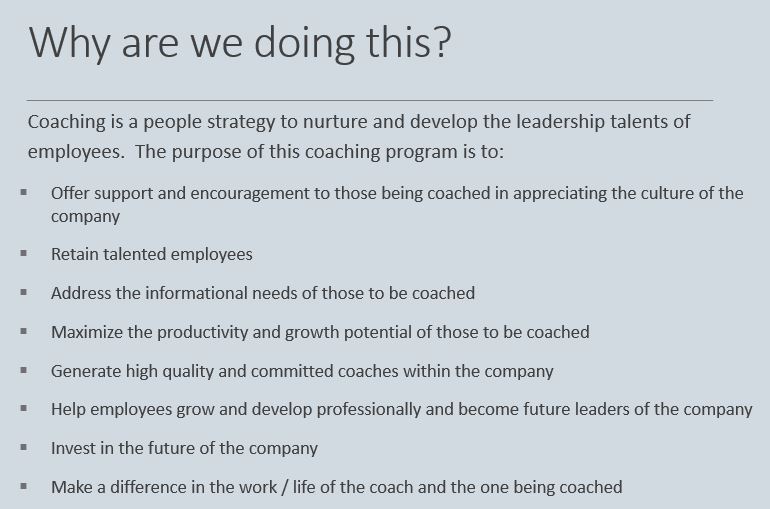
All coaching programs should contain an orientation as one of the starting elements. This session should cover the objectives of the program, what the expectations are for both coaches and those to be coached and any other general information that would be important for the participants of your coaching program. You can choose to combine the two groups for the session or you could choose to do separate sessions for coaches and those to be coached. If you choose the former you may want to add a training or reminder section of any specific coaching aspects that you wish to empathize.

Slides for the orientation meeting

The download file above contains a series of slides to help you get started creating your own. It shows some of the typical questions that coaching program participants may have and answers that may be relevant, but of course subject to your edits to suit your specific needs.

Tips:

  • Be sure to have a Q and A portion to answer any specific questions that anyone may have.
  • The front part of the presentation which sets the scene in terms of “no entitlement to promotion etc.” would be relevant if you have experienced that as an issue in your workforce or talented employee pool. In some cultures that may be seen as “offensive” or even “threatening” that it would be mentioned. So be culturally sensitive when you consider keeping that comment.
  • In the roles section I mention HR as the function supporting the coaching program – depending on your organization that could be your Learning and Development department, your Organization Development (OD) group or any other department/group.
  • Be sure to provide the coaches and those to be coached with all the tools they will need. If not printed and handed out at your orientation session, then perhaps a soft copy on a USB stick or per email after the session. Coaching questions or Preparation for Coaching

Preparing for a Coaching Session


Coaching sessions and programs are more successful when there are clear coaching goals and actions planned are documented. These developmental actions and activities should be reviewed and updated on a regular basis. It helps both the coach and the person being coached to maintain focus on desired outcomes..

Many employees who are new to coaching have misguided expectations about the coaching process and their own role in it. They expect the coach would show up at each session ready to provide them with useful information and advice and all they needed to do was to show up. In reality the coaching process works much better when both parties actively participate and prepare for each session.

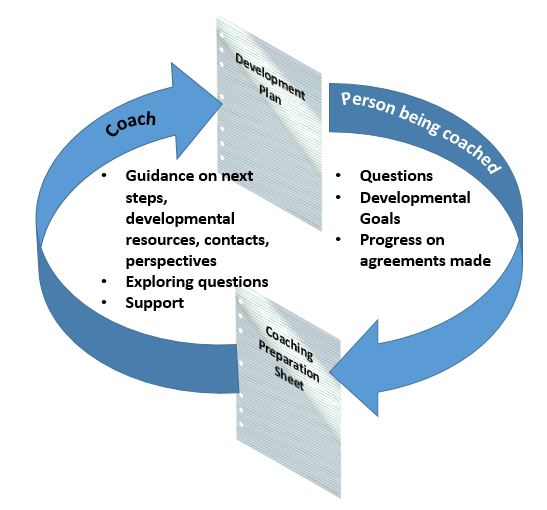
Coaching process JAG

This process graphic shows that each party in the coaching process provides input and participates in the process. The results are written down and shared to ensure a common understanding of the goals and that progress towards goal achievement is maintained.

Preparation worksheet for Coaching

Tips:

  • For those being coached: make sure you get your completed preparation sheet to your coach at least a few days before the session so that the coach can take your feedback into account. This helps him or her prepare to answer your questions and obtain any additional information and resources that may be useful to you at this time and bring it to the session.
  • For coaches: take note of the questions and struggles that may be noted in the preparation sheet. Consider how you can best help address those issues and which resources can you provide to help in the process? What is the best way to approach the coaching session – given those questions, issues and of course the overall goals that had been set for the coaching process?
  • Do remember to look back at previous preparation sheets and also the updated development plan on occasion (maybe once every 6 months) to recognize and appreciate progress made to date and to help motivate those being coached to take the next steps that may be required towards ultimate goal achievement.

Coaching is a shared responsibility between the coach and the person being coached. Only then, does the process yield the best results. And preparation is a key part of this shared responsibility.

Questions for Coaching


Many managers mistakenly think coaching is about “telling” others what they should be doing. While some very inexperienced people may need you to tell them what to do or how to do it, most others need to learn and explore topics and new skills or behaviors with their coaches instead. The hard part for many coaches is to listen and ask the right questions. And also to refrain from taking up most of the airtime during coaching sessions talking about their own lives and their own stories or just offering advice. While children happily accept new information simply because you tell them how things are, adults prefer to explore and learn by comparing and assimilating what you are sharing with what they already know and have learned in their pasts.

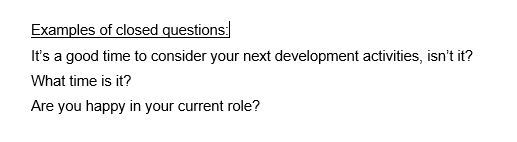
closed question examples
Closed Questions

Coaching sessions is about asking open-ended questions which leads to learning and exploring. Asking the right questions is not an easy assignment to have as a coach. Some questions shut others down while limiting them to “yes” or “no” answers which does not allow for a rich conversation of exploration around the topic concerned. Closed questions are those that can be answered by a simple yes or no answer.

More useful questions to ask :

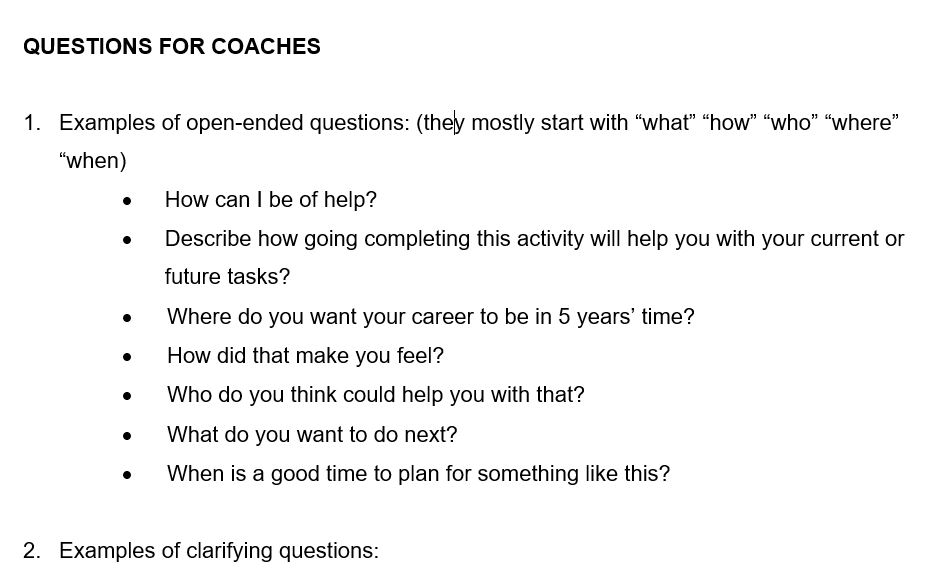
  • Open-ended questions help others expand on ideas and contribute to the conversation vs staying mostly in listening-mode. These kinds of questions can help you discover the other person’s thought processes, motivations and how they feel about a topic or an option.
  • Clarifying questions are helpful to ensure you understood your conversation partner correctly. When people get going on topics that they feel quite excited or passionate about they can sometimes lose sight of how familiar you are with that same topic. To ensure you (the coach) are able to follow along, you may need to pause, look back and clarify any comment made which you were unable to place within the context of the topic being discussed.
  • Paraphrasing. This is a useful technique to summarize what you heard so far and help move the conversation towards a decision or planning a specific path forward (action). It also helps ensure that your impressions of what was said are correct. It can be very validating for someone to hear their own words summarized correctly by another trusted person (in this case you, as the coach).

This list of questions for coaches (which you can download above) can help you to ask the right questions at your next coaching session. I recommend you read through this as you prepare for the session, but do not commit yourself to asking specific pre-determined questions regardless of how the conversation goes. The important part about asking questions at a coaching session is that you (the coach) show up with a mindset of curiosity. That opens up the exploration in the conversation and enables learning to take place which is vital for adults in their learning process.

Use the links to other content which I show below and also the resource I am sharing above as a way to prepare for and get into inquiry mode before the planned coaching session.

These are great questions to consider asking when you coach: Life Coaching Questions    Coaching questions for managers

How to start Coaching your direct reports


I often hear from managers that they don’t know how to approach coaching their direct reports. It appears the word coaching implies to them that they must have some special insights and skills which would qualify them to coach someone else. Most managers do not realize that they actually know a lot about the company, how things work, how things should be working and how it is going generally. Perhaps all they need is a way to get the conversation going?

Sometimes employees have questions, which are easy to address and other times you need time to get back to them with answers.

Coaching may seem a little less daunting if you had this checklist ( see download button above) of topics to discuss with employees as a group or as individuals. There is a lot to be said for group coaching sessions! They can also be very effective in developing a group of people who may roughly all have the similar development needs and questions for you.

As their manager, you can open a conversation covering one of the questions on the sheet and just state “I can imagine you may have some questions or would like to know more about….” (use one of the questions shown on the sheet). Once the conversation is kicked-off it often happens that the employee will start to bring up more specific questions that he or she may have.

coaching process 4 steps

This graphic shows the basic 4 steps that can be used to start and keep a good coaching relationship going. Trust is a key component and building trust is important – honesty, integrity and showing employees that you care about their work, their careers and their well-being all help to build trust.

Coaching can be a highly structured program requiring a lot of specialized communication and coaching skills and training. It can also be simply helping employees understand the basics around their roles, the company and how things work in their environment. It is your role as their manager to coach them and develop their knowledge, skills and competencies on an on-going basis. If you need more training and support with regards to coaching, do talk to your HR or L&D representative. In the interim, this conversation-starting summary sheet may be helpful to you!

Unlocking Insights: The Power of Internal Communication Surveys


Effective internal communication is a two-way street. It’s not just about top-down directives; it’s also about fostering an environment where employees feel heard and valued. By creating open channels for information sharing and feedback, organizations can build trust, boost morale, and drive better decision-making.

Keeping Employees in the Loop

HR often takes the lead in ensuring employees are informed and engaged. However, effective internal communication is a shared responsibility. Whether it’s HR, a dedicated communications team, or a combination of both, the goal is the same: to keep employees informed about company news, changes, and successes. Regularly assessing the impact of your communication efforts is crucial to ensure your messages are landing and driving the desired results.

Internal Communication Checkup Survey

The effectiveness of internal communication should be evaluated periodically. I would not repeat a survey like this one on a monthly basis unless you are going through a specific change initiative in this regard and would like to ensure you have a good understanding of how well your change process is going. Once per year or once in 18 months should be a good evaluation period. Keep it short to optimize your chances of getting good feedback and a high level of participation.

Tips:

  • Ensure your questions are specific and simple – survey respondents should know what exactly you are asking about. Do not combine more than one question into one.
  • Always make a post-survey action plan and share that with survey respondents and other stakeholders in the success of internal communications.
  • If you are an HR Director or in HR Management – stay close to the creation of internal communications. Read everything before it is released or published internally in your area of responsibility. The tone of communications and the contents of messages that are sent internally very closely link to how employees interpret the company’s management sentiments about them and you will often find disconnects started with some internal message that was misinterpreted.

HR Function checkup – Feedback from internal customers


In the same way that companies would approach external customers to gather their views on what is going well and what needs improvement (customer satisfaction), the HR function should reach out to its internal customers to find out how satisfied they are with the services and support that they receive. It is true that there are more than one model for HR service delivery, but that does not change the fact that it is wise to gather feedback on the services and support that you do provide given the structure and focus for HR in your company.

The HR function is often guilty of focusing its developmental and improvement efforts exclusively on helping other departments and neglects using those same skills and expertise to improve the HR function as a whole and developing the people who deliver the HR services to others.

HR Function – Feedback Survey

This survey can help you gather the information you need from your internal customers to help you identify specific areas of excellence in HR and also those areas where improvement may be needed. When improvement is needed it will often imply additional training and development of some HR representatives (HRBPs or Generalists) and may also  include communicating the HR vision and goals more clearly within the HR function. Remember to recognize and reward those who were part of delivering excellent services when you review the survey results.

Tips:

  • Add comment fields next to scores if you want to be certain to capture specific comments about the scores.
  • Do be sure to provide survey participants with feedback on the outcome of the survey and the actions that you plan to take as a result of the survey. This motivates participants to continue providing you with valuable feedback in the future.
  • Create an action plan and communicate that clearly within the HR function so that everyone understands which areas you plan to address and how you plan to do that. It may help to set specific metrics around your planned improvements to make it easier to report progress.
  • Regularly update stakeholders – internal to the HR function and those who are internal customers in your company – on the progress of improvement efforts as you implement the post-survey action plan.
  • Remember to celebrate successes (milestones and outcomes achieved) and be prepared to add additional actions to your plan in cases where your improvement efforts are not reaping the results you had planned for.

Having a standard survey which you use ever year gives the opportunity to track the progress in specific questions over time and helps with trend analysis and showing % improvements over time.

Team Effectiveness Check


The strength of teams lies in their ability to achieve more as a group working together than as individuals working independently on various parts of a project or activity.  The main obstacle to a team achieving the optimal performance level is the ability of the individual team members to work together collaboratively.

You can select the right team members based on the knowledge you need, the skills and competencies you need and the experience levels you need for a project. And the team performance can still be very disappointing if the team members do not communicate effectively, are not sharing information in a comprehensible way, and are not clear on how to coordinate with each other to avoid rework or waste their efforts working on the wrong items.

The success of a team is measured by more than one aspect. Examples include:

  • Achieving project milestones and objectives
  • Satisfied stakeholders
  • How well team members are working together – getting more done with more innovation and inclusiveness in a shorter period of time
Team Success Measures

Phases of a team

Any team will go through developmental phases starting from the first day the team members spend together. If these phases are navigated successfully, they can help team members build a high level of trust which enables the team to achieve a high performance level. The leader of a team has an important role to play throughout the phases of team development to help the team achieve their goals in the most effective and efficient .

Measuring team outcomes

Setting out to measure the progress of a team’s efforts is simply about communicating and then monitoring KPIs (Key Performance Indicators) on a regular basis. KPIs are typically set around costs, time to completion, quality of the product etc.

Measuring the cohesion between team members and how well the team is functioning is not that simple. Every team member most likely has his or her own opinion of how well the team is functioning and where improvements may be needed. Team members also would have opinions about whose “fault” it may be that things are not better. The question is often whether it is a lack of knowledge, a lack of motivation or actually interpersonal conflicts and distrust which is contributing the most to dysfunctions.

Team effectiveness Check

Using this short team effectiveness check, is a great way for leaders to take a quick look at how each of the team members see the team at that moment in time and identify where discussions may be needed to clarify or remove issues that may be hampering team functioning.

The purpose of this quick survey is to gather input from the team on their own perspectives. Remember that a perspective is just how one person sees things at that moment in time. It does not mean that the perspective of one person holds true for the rest of the team. It is important though that you understand whether one or more team members are not feeling included, engaged or unable to contribute based on a lack of internal alignment with other team members on goals etc

As the team leader or team coach, ask your team members to fill this out maybe once a month – more often if you are going through a difficult phase as a team and you are concerned about how well things are going for each team member. I would not do this more than once per week.

Note that your team dynamics will most likely change when you add members, remove members or when your project enters a completely new phase of functioning and performance expectations. At those moments you are likely to see a decline in previously recorded good scores for team effectiveness and functioning.

Use this tool as a way to quickly diagnose where the team is at and use it as a starting point for some team or one-on-one discussions to address concerns raised. Include an external person to facilitate difficult team discussions if you feel it may be helpful – someone from HR/Learning and Development/team coach may be able to use their expertise and skills in group dynamics, conflict resolution and interpersonal relationships to get your team out of a rough spot when it occurs.