Navigating the complex world of data protection can be overwhelming, especially for small organizations like charities and businesses.
The Perils of Data Breaches
When personal data falls into the wrong hands, the consequences can be devastating. Individuals may become victims of identity theft, financial loss, or emotional distress. Trust, once broken, is difficult to rebuild. Organizations face reputational damage, monetary penalties, and legal repercussions. Moreover, a data breach can erode public confidence in digital services, hindering innovation and economic growth. Safeguarding personal information is not just a legal obligation but a moral imperative.
Compliance
The General Data Protection Regulation (GDPR) has set a new global standard for data privacy in Europe. At this time there are several countries worldwide with similar compliance requirements – from Australia’s Privacy Act to California’s Consumer Privacy Act (CCPA), organizations across the globe are grappling with the complexities of safeguarding personal information.
Free draft forms and guidelines
Data protection can be a real headache, especially for small businesses and charities. That’s why this toolkit of draft forms and policies is here to help you get started with practical templates to help you stay compliant without the hassle.
These templates are a great starting point but remember, data protection compliance is more than just paperwork. You’ll need to tailor these documents to fit your unique business and consult with legal experts when required.
Think of these draft documents as your trusty sidekick, providing a solid foundation for your data protection journey.
The toolkit has the following elements:
Data Protection draft Policy Template: Establish clear guidelines for handling personal data.
While these may be a handy starting point, remember, that data protection is about more than just paperwork. To really protect your donors’, your employees’, your vendors’, and customers’ info, you’ll need to build a solid system that covers everything from training your staff to dealing with data breaches to having a process to report incidents, investigate and draw up an incident report and understanding the data you have and know if you have any risks if that data leaks out somehow.
Data protection impact assessments: You need to start out by identifying and managing high-risk data processing activities and making sure you address any high risks you identified in the process. Conduct regular assessments (maybe once a year) to identify potential vulnerabilities and implement appropriate data protection safeguards. [There is a draft form for that in the templates.]
Employee Training: Regular training to ensure staff understands their data protection responsibilities and can identify and prevent potential risks.
Data Minimization: Collect and retain only the necessary personal data and give them examples to help them understand what personal data is.
Rights of those whose data you have: Implement procedures to handle data access requests – they generally have the right to erasure or update of data you store, and other rights include the right to ask to see the personal data you keep on them. [There is a draft form that people can use to request access to the personal data you have]
Supplier Management: Ensure data processors comply with data protection requirements through contracts and oversight.
Incident Response: Develop a clear plan for responding to data breaches, including notification procedures. And make sure everyone knows which number to call or which email to use to report a suspected data breach. [there is draft information in the templates for how to report an incident and also questions to ask when talking to someone reporting a potential data breach.]
Continuous Monitoring and Review: Regularly assess data protection practices to identify and address potential vulnerabilities.
By combining the templates with these additional measures, you can help your organization build a strong foundation for data protection compliance and protect the privacy of your data subjects.
Many homeowners are surprised to learn that their appliances are silently draining their wallets. Appliances like space heaters, water heaters, and home air conditioners are the biggest culprits. But don’t worry, there’s a solution!
By making smart choices about the appliances, you buy and how you use them, you can significantly reduce your energy costs while helping the environment.
Energy Efficiency: Your Pocket’s Best Friend
Electricity is measured in Watts or Kilowatt (kW) and electricity bills usually show charges by kWh – as it is a measure of electricity used over hours.
What are the benefits of paying attention to energy efficiency?
Cost Savings: Energy-efficient appliances consume less electricity, leading to lower energy bills per month and per year. Energy labels can help compare various appliance models being considered for purchase to help you save in the long run.
Product Longevity: Energy-efficient appliances often have longer lifespans, ultimately saving you money as fewer replacements may be needed during 10 years for example. It also lowers electric and electronic waste, benefiting the circular economy – less waste is generated!
Environmental Impact: Reducing your household’s energy consumption helps to lower greenhouse gas emissions.
Do you know which household appliances are secretly draining your wallet? It’s time to shed light on your energy thieves. Before buying new appliances, understand their energy consumption. A little knowledge can save you a lot!
The following graphic illustrates typical energy consumption for common household appliances under high and low usage conditions. By analyzing this type of data for appliances you plan to buy, you can identify potential areas for energy savings over the coming years. You achieve this by making informed decisions about appliance usage and upgrade options and implementing the best energy-efficient alternatives!
Energy Labels
Energy labels are your secret weapon against sky-high energy bills. These handy stickers reveal how much energy each appliance guzzles. By choosing appliance models with the best energy ratings, you’ll not only save money but also help the planet.
How to read energy labels
Source: SEAI 2024
Energy labels reveal how much energy an appliance guzzles, helping you choose wisely. Look for the energy efficiency rating (usually A-G) – the closer to A, the better. This label (see example to the left) shows energy use in kilowatt-hours (kWh) per 1,000 hours. Multiply this by your electricity rate to see the appliance’s cost for every 1,000 hours it is in use. Knowing that, you can pick the appliance that saves you money over the coming years by reducing the amount of energy used!
Let’s do the math!
Imagine your new fridge has an energy label showing it uses 400 kilowatt-hours (kWh) of electricity a year. If your electricity costs 30 cents per kWh, that fridge alone could add up to €120 to your annual bill. Yikes! This is why choosing energy-efficient appliances is a no-brainer.
Calculation example
Kettles might seem harmless, but they can secretly drain your wallet. These little appliances often cause energy spikes that can be easily spotted on your energy monitor. Let’s compare two kettles: Kettle A, an older model, and Kettle B, a newer, energy-efficient one.
The Kettle Challenge: Which Model Saves You Money?
Scenario: Boiling one cup of water (250ml)
Kettle A: Older model, less efficient, with a power rating of 3000 watts.
It takes 2 minutes to boil the water.
Kettle B: Newer model, more efficient, with a power rating of 2000 watts.
It takes 2 minutes and 30 seconds to boil the water.
The energy usage for Kettle B is less than the energy usage calculated for Kettle A.
Conclusion:
Even though Kettle B takes longer to boil the water, it consumes less energy due to its lower power rating. Over time, using a more energy-efficient kettle can result in significant energy savings.
The link below gives you free access to a simple calculation sheet for calculating the cost of using an appliance you have been thinking of buying. The sheet comes prepopulated with some numbers to illustrate how it works. Just type over the numbers in the blue blocks in the sheet using your own information per device/appliance – using your energy costs and the appliance/device energy label information. Use the sheet more than once if you want to compare more than one appliance or device based on energy efficiency ratings.
Investing in energy-efficient appliances is like planting a money tree in your home. They can slash your electricity bills without breaking the bank. Plus, you’ll be helping the planet one watt at a time. So, next time you’re shopping for a new fridge or washing machine, look for those energy-saving labels. Your wallet (and the Earth) will thank you!
Remember that idyllic family vacation – sandcastles, stunning sunsets, and endless movie nights? Every memory captured, every photo snapped, contributes to a hidden cost: a growing mountain of data. We’ve ditched bulky photo albums for high-resolution cameras, amassing gigabytes in the blink of an eye.
Sure, modern technology is fantastic. We access work documents from anywhere, stream music on a whim, and capture travel moments with ease. But have you considered the environmental impact of this constant connectivity and data storage?
The Unspoken Footprint of Our Memory Mountains
Our digital lives require a physical home – data centers. They house several bustling servers to store our information 24/7, and while they’re not inherently bad, their energy consumption creates a significant environmental footprint.
Why? Because we crave constant access. We want to view vacation photos from anywhere, edit documents on the go, and stream movies on airplanes. Data centers make this possible, but accessibility comes at a price. Cooling massive server rooms and powering them around the clock requires a lot of energy, especially if sourced from fossil fuels.
The more data we generate, the bigger the data center footprint becomes. Every photo, movie, and document we store contributes to this ever-growing mountain. The more data, the more energy is needed to keep it accessible.
From Vacation Snaps to Server Saps
The good news is you have the power to make a difference! Here’s how to lower your data footprint:
Family Fun with a Digital Detox Twist
Organize Family Photo Cleanup Sessions: Turn deleting photos into a fun family activity! Let your children participate in selecting the best shots and discuss what makes a good picture.
Discuss the Impact of Data: Talk openly about the environmental impact of cloud storage and how responsible data habits can make a difference. Encourage them to think critically about their downloads and storage.
These small changes, multiplied by millions of families, can create a substantial positive impact. By being mindful of your data habits, you’re not just decluttering your digital life, you’re setting an example and making a positive contribution to the environment.
The good news continues! Data center operators are constantly seeking ways to be more energy-efficient. From better cooling technologies that don’t rely on freshwater to renewable energy sources and sustainable data center designs, these efforts not only reduce operating costs but also lighten the environmental footprint of these facilities.
So, let’s embrace the convenience of modern technology while taking responsibility for our digital footprint. Together, we can create a greener future for our planet, one byte at a time.
“”Is there a better way? Can you avoid printing that page?”
Photograph by Annie Sprat, Unsplash
Many project teams use tablets and television screens to project information during meetings for meeting participants to consider and discuss. And while we have cloud storage and the ability to access and edit or markup files from multiple devices, it appears that printing has not yet lost its appeal for some. If you are not yet ready to consider a working day without a printer, here are some ways to be more sustainable with the way you work on a day-to-day basis.
Removing Waste: Recycling
Have you considered what the end-of-life would be for that page you just printed and may be ready to throw into the trash bin soon? Why not set up a special bin for just collecting paper to be recycled? In some locations, secure bins are available which ensures that sensitive papers are securely stored until they are collected by the supplier and recycled.
Refills
Are you making use of a printer cartridge refill scheme? Instead of throwing used cartridges away, there may be suppliers in your area where you can get refills for your used cartridges.
And talking about printing cartridges – can you use only one colour – black? Having multiple colours may generate additional waste and perhaps you can save the colourful displays for virtual online documents?
Materials used
The paper you use for printing, is it made from environmentally-friendly recycled processes? Why not ask your local suppliers to advise you about recycled paper options available to you?
Habits
If you print on both sides of a page, you could be saving on paper usage and you could be lowering the weight of printed documents being shipped to recipients of your printed materials!
Fewer printers
Do you really need so many printers in your office? Or could you lower the ongoing electric power needs of printers and also encourage more physical movement of people during the day. Asking them to walk a little further in order to retrieve printed pages may be a great way to ensure they move out of a sedentary posture and increase blood circulation. Regular breaks and physical movement are great ways to improve physical and mental well–being at work.
Lower energy usage
Ensure that printers are turned off completely at the end of the working day and over weekends and periods of office closures. This ensures that no power is used in standby mode.
Consider digital solutions
Looking at the processes you use in your office – are you printing notifications or informational posters and is there a way to instead share it with colleagues, suppliers or customers digitally? For example – could suppliers download an electronic file from your website showing how you would like invoices prepared?
Understand your data and set improvement targets
Do you know who prints the most pages in the office? Is there an opportunity to engage with someone on printing more sustainably? Not everyone has been exposed to ways they could lower energy usage or how to avoid creating waste.. It could be great to have a discussion with someone about this.. Improving awareness is often the first step towards more sustainable practices at the office.
Getting together to set targets in your office like “We track our number of printed pages, and we strive to lower it by 10% this month compared to the previous month!” can be great ways to keep everyone focused on lowering your environmental footprint as an office..
In most cases, becoming more aware and conscious of ways that we can become less wasteful and generate less waste can be the first step toward being more innovative and finding new ways to positively impact the world and those around us. What will you do today to lower the waste you generate?
Single-use packaging is intended to be used only once before being thrown away or recycled. Included in this kind of trash would be food packaging, bottles for laundry detergent and other household goods, straws and boxes for tea bags, etc From a global perspective, over 90% of trash is estimated to come from single-use materials. The good news in some countries is that over 50% of packaging is recycled.
The upside-down pyramid for waste shows the more preferred ways to deal with it.
When it comes to waste, the best option is preventing the waste from coming into our homes or office buildings, the 2nd best option is to reuse items somehow, and then comes recycling. Increasing awareness in your team is important – of being more responsible with their purchasing choices and choices regarding trash that passes through their homes or at the office. This workshop can improve awareness of how to reuse items instead of discarding them.
Participating in this workshop will show participants how to look at packaging trash from the perspective of reusing it, and creating a new purpose for single-use packaging. You can open the workshop by reflecting on trash and recycling in your city/location and how they could all help to improve those statistics by being more mindful of the items they bring into their homes (avoiding single-use packaging as much as possible) and also to not be so fast to throw away items that had only been used once at the office.
If you are passionate about having a positive impact on the sustainability habits and thinking of others in your organization, in your family, or among friends, why not get 4-6 people to join you in being creative with packaging that would have otherwise been discarded.
Items you can use in the workshop:
Most households would be easily able to collect some items like small carton boxes and items, printed pages that are no longer needed like advertising leaflets thrown in through mailbox slots, and paper-based packaging used for supporting fruits purchased in supermarkets. In the office, there could be boxes that contained pens and pencils or paperclips.
Two ideas to consider for the activity:
Paper Mache (papier-mâché)
You can make the paste using flour and water (see https://kinderart.com/kitchen/papier-mache-recipes/) tear the collected sheets of paper into strips about 1 inch wide and dip them thoroughly into the paste mixture. Strip off the excess mixture from each strip before applying it. It works well if you pull the strip of paper through to the other side between two fingers. Build up the desired new object by applying only one layer at a time and waiting for that to dry before going to a new layer. Dried objects can be sanded to improve the smoothness of the finished project before you apply an environmentally friendly paint design on top. Ideas of items that might be useful include containers for jewelry, organizing loose containers into a neatly contained area, or creating a container for paperclips and other office items that could be cluttering up desk drawers.
Coffee Stirrers
Make sure the used stirring sticks are free of coffee remains that could interfere with the gluing process. Design ideas could include coasters for cups, glasses, or mugs at the office or at home. You could also build containers for pens or other office supplies. Remember to wait until the glue had dried before putting items on your built items to avoid breakage! And again you might use environmentally friendly paints to finish your coffee stirrer design items.
To limit the space and supplies needed for your workshop team activity, it may be wise to pick one type of project to work on vs trying to cover several types of projects in one space.
Workshop Programme
Welcome, and introductions – if not all participants know each other, allow time for everyone to introduce themselves.
Overview – talk about the reason for the workshop and focus participant attention on sustainability and how sustainability principles relate to the way we think about and how we deal with the packaging associated with purchases. Give them some trash generation and recycling statistics for your local area to help them understand the scale of the issues faced environmentally with how things are going in your area. Introduce the workshop as a way to become more aware and get creative with packaging waste that comes from homes and offices. Creative activities in groups are also great ways to improve the mental health of individuals and feelings of belonging in a team or group.
Activity – introduce the chosen activity and explain the materials available to participants. Make sure people know how much time you have planned for the activity and if there will be follow-up opportunities to complete projects or whether they could take any half-finished projects home to finish them there. Walk around while participants work on their projects and support them with advice where needed. Always make sure that safety is a priority and be sure to explain any dangers such as using cutting devices or opening and closing drawers and cupboard doors in the workshop area.
Closing – when the workshop time is at the end. Thank everyone for participating and being willing to learn new ways of looking at single-use packaging as small steps to help improve the generation of trash in your area. Remind participants of how they could finish up their projects and encourage them to share pictures of completed items with the team/group.
Awareness
The first step to improving any situation is awareness. This kind of team or group activity is a great way to increase awareness of the issues at hand with local trash generation and how each person can make a difference in small ways. Using creative endeavors to address this issue is also enjoyable and can be a great way to improve feelings of mental well-being, which is something we all can use in today’s world.
Your dream job – will it be all that you are hoping for?
When you consider a job change or a pivot, you may need to go and talk to people who are doing that job or role right now to answer some of your questions. Before you make a change you probably would need to understand the qualifications or certifications that are important and maybe understand what a typical day is like in that role? If you don’t have the certifications that would be a great way to make sure you prioritize getting the most essential certifications first. If you don’t like the way the typical day goes in that other role you are thinking about, perhaps it is not for you? Perhaps it is good to know more before you jump?
Desktop research first
A lot of this information is available online if you, for example, search for those job vacancies online – you can find out which qualifications or certifications are most required for the role you are considering changing towards. The job vacancies can also show what kinds of competencies and skills recruiters are looking for. Just bear in mind, sometimes they just ask for the moon and the stars in job vacancies to try and ensure they get a really good person who can satisfy a long wishlist (hard to do in most cases!) So, desktop research only goes so far…
Who can you talk to?
Knowing how the typical day goes in a role like the one you want, is not usually so easy to find out by doing online internet searches. This is where you would need to look to your own network of contacts – family members, friends, colleagues or ex-colleagues, and others in sports teams or clubs with you. When you have gone through all the people you know, and perhaps you did not find any or enough people who can help you, you may have to start looking online. Use social media platforms to find people who are in the role you would like to have. If you use LinkedIn, you might be able to see if you know someone or through your network may be able to contact someone who does what you would like to do in the future. If you have no direct links to a person you can often still reach out to them via a message. Your objective would be: Find someone who now has or someone who did have your dream role in the past so you can ask him/her some questions about it. That way you can have more clarity regarding how much might you love this role you are dreaming about?
Plan your next steps
Before you approach anyone for a meeting or a discussion around the questions you have, what targets and specific objectives do you want to set for yourself?
How many people you should approach with your questions? (Is 3 enough, or is a minimum of 5 your target? How many experts in this role do you need to talk to?) In some cases, it may be hard to answer the question because you don’t know if the first two people will give you quality answers or not? Set yourself a guideline target if you are not sure. (Tip: 15 may be too many! If you have not identified the right people to talk to, you may end up with too many discussions. If you find the right 3 and they are willing to spend 20 minutes with you on your key questions, it may be enough!)
Make a list of the people you know who may be able to answer the questions- we will talk about them in a moment. And think specifically about how they may be able to help. If you just ask just anyone you know or post it on your social media page, you may not get quality answers so think carefully about how each of the names you write down can help you. Is he/she currently in the role you are thinking of changing to? Is he/she a mentor or guide who can help me work out the steps to take? Is he/she working for a company or department that hires people for the role I am interested in? Was he/she in such a role in the past?
Start listing the specific questions which you would like to have answered. Here are some question options to consider:
The questions are about:
Find out what knowledge you might need. Once you know that, you can look for courses or certificates or volunteer options to help you gain the knowledge you need.
Which experiences would be important to have demonstrated in the past to get a role/job like this one? If you do not yet have that, how can you get those experiences? (ask for special assignments in your current role or consider a volunteer role)
Which key competencies or skills does it take to succeed in this role? How do your competencies and skills compare to that? If you have to fill in some learning gaps, how can you do that?
Are you possibly idealizing this role? Are there downsides you have not considered like a lot of travel and being away from your family and friends? Maybe there are some standby or nightshift requirements? Are you aware of that and does that fit in with your decision-making criteria?
In the greater scheme of things – how does this role or job contribute to success in a company? Is there something great about this role that you have not yet realized or understood? Does that motivate you to make time to fill in the knowledge and skills gaps that you discovered?
Keep your momentum
Set yourself small tasks to achieve every week to move forward in understanding more about the role/job you are interested to have in the future:.
What will you do and complete this week?
What will you do the week after?
Which day and at what time of the day each week will you check to see how you are doing against your planning (Did you complete the tasks you set yourself to achieve in the last week?)
To succeed at moving forward you need forward planning, checking back at least once per week to see how far you have come on your plan once you have started. And you need to set yourself targets to achieve in the next few days (be specific) to keep your momentum. That is how you keep your plan alive for moving towards your career move or change!
In interviews, you are sometimes asked to give an example of how you have demonstrated that you are good at a specific competency. Other times you may be asked to explain how your skills have been useful to teams or organizations in the past. The principle is that the experience you have in specific competencies would have been demonstrated by situations you faced in the past.
It is these examples that the interviewer would be looking for when they ask you to provide your answer in the STARR methodology. Using this approach is your best way to give an example that clearly outlines for the interviewer how you faced a situation, recognized what you needed to do, took action, and achieved good results or outcomes.
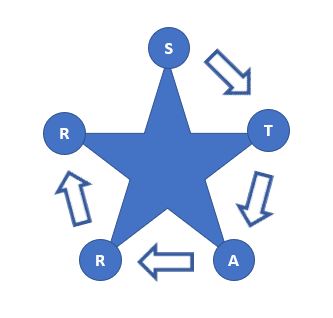
The acronym represents 5 specific topics you need to cover in your answer and if you imagine that 5-star picture in your mind, you may be able to more easily formulate your answers and examples during an interview. It is always a good idea to prepare some examples you can think of before the interview, but you may sometimes need to come up with an answer you did not prepare. Hopefully, this picture and explanation help you succeed with that!
The Acronym
The STARR method works on these headings (in sequence) [it is an acronym for these words]
Situation (when, where, what setting)
Task (what you needed to do, which responsibility you took on)
Action (what you did, which way you used a personal strength or competency)
Result (what was the outcome of your action?)
Reflection (looking back at how it went, what did you learn from it – what went well and what would you do differently if you faced the same situation again?)
Approach
Starting at the top of the star with the letter S, which represents the Situation you were in. This relates to the time when you were able to demonstrate through your actions that you have good proficiency in a specific competency. Once you have completed describing the Situation, you move clockwise to the next letter T. Once you have covered the questions under the letter T, you move clockwise to the next letter, A for action. And so you continue until you finish by including answers to the questions shown under Reflection.
Each of the topics under the STARR letters in the graphic above shows some bulleted questions which will help you ensure you cover the key aspects of that particular term when it comes to your example. from the past.
Example
Here is an example showing how using the questions under each of the topics in the STARR model can be useful in preparing your answers for interviews.
If you need a template to use in formulating your STARR – style examples, click on the link below.
When you are giving examples, you have to be specific instead of staying with general examples, which is often not convincing to those listening to your answers. . Make a story out of your example and base it on some real event that happened in your past to highlight how you were able to demonstrate a specific skill. Using the STARR methodology makes your story more credible and easier for those listening to you to get a full understanding of the capabilities that you have successfully demonstrated in the past.
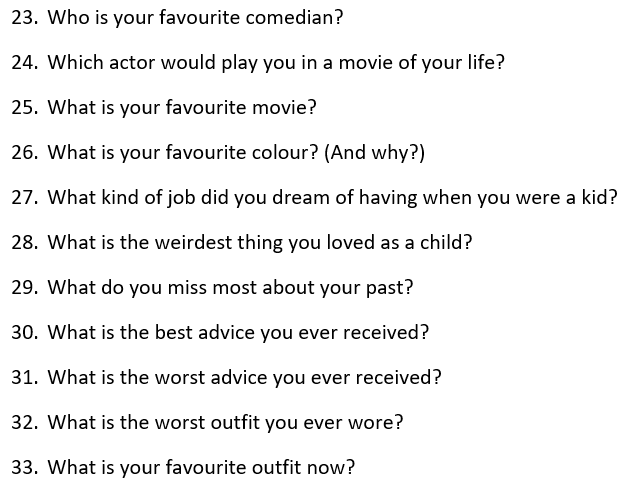
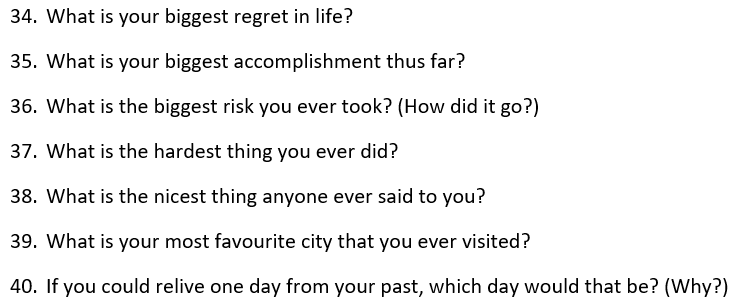
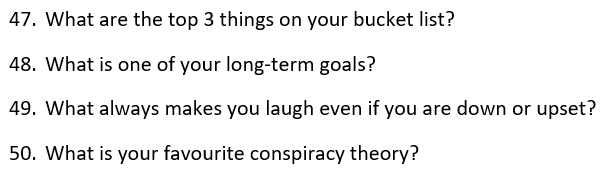
Want to get to know your colleagues or teammates on a project? These may give you ideas for topics to ask about and discuss. Perhaps you are looking for a novel way to get to know your friends or family members better?
Some people have trouble with knowing what to talk about or which topics to ask others about to go beyond the first level of getting to know someone – if we assume the first level would be obvious topics like where are you from, what did you study, what kind of role you are in now, etc.
Pick just a handful of topics at most to avoid the other person feeling interviewed. You could also pick perhaps one to two to ask someone you work with or talk to mostly about work on a regular basis – perhaps just before or after a meeting. It could also be useful during a coffee break. Who knows what surprises you may have in learning to understand someone better?
Be sure to pick the right options for people you barely know – some of the topics are better suited for discussions when you already know someone – like friends or family members. I am sure you will apply common sense and wisdom in selecting fun topics that would match the situation and the person you plan to talk to.
Some of these questions can also be used in group ice breaker exercises or as a fun leg-stretching exercise in the middle of a long day of training or meetings.
Some recruiters like to use a question like these to see how candidates might respond. So, read through these, who knows when you may need to come up with an answer to one of them? 😊
Mentoring usually takes place between someone with experience and someone who needs advice and training in specific areas. Starting the process of mentoring duos sometimes skip the step where they talk about how we agree to go through this process together. What is important to you? What is important to me? What can each of us commit to in order for this to work well for both of us?
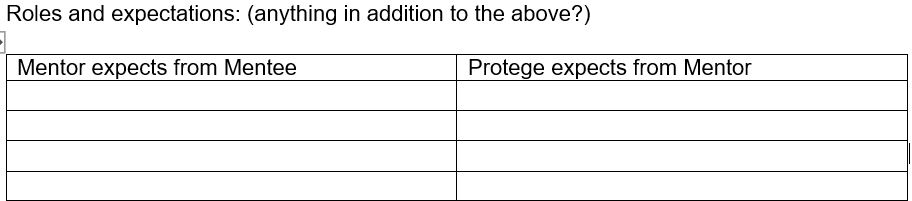
This free template below helps you to structure a conversation around what the mentor and mentee specifically agree to commit to. How many hours per month/quarter would we like to spend talking through specific topics?
Feel free to add additional items which would be important to discuss during the first meeting when you (mentor and mentee) agree on how to proceed. This kind of discussion may seem unnecessary, but covering these items upfront can save a lot of disappointment and misunderstandings later when items you might have imagined would be obviously included in your mentoring agreement vary from what the other person may have thought. It is not a contractual agreement as much as it is a summary of what you do or don’t want to commit to for the duration of the mentoring relationship.
When it comes to time commitments, it is also advisable to agree for the mentoring process to have a set time period – 12 months or 18 months. And when that time comes, review what has been achieved and learned and whether it makes sense to continue the mentoring relationship or to agree to end it at that time.
Clearly defining the development objectives to be addressed helps to steer the direction of mentoring discussions. What is it that the mentee needs to know, needs to be able to do, and would like to be able to understand? The more detailed this section is, the easier it might be for either the mentor or the mentee to recognize when the mentoring relationship has helped to achieve those outcomes and it may be time to evaluate whether it makes sense to end the mentoring relationship or continue it with new development objectives.Considering the agreements discussed during the first section, are there any other expectations that each has of the other and which are useful to mention specifically? For example, the mentor may have the expectation that the mentee would devote time to read specific books or articles every week. Are those expectations realistic for the mentee? If he or she has other obligations which may make it difficult to meet that expectation, it is best to discuss them early on to avoid a misalignment later on in the mentoring relationship.
The full template can be downloaded below – it is a *.pdf file and it can be imported into MSWord for edits.
This file can be very useful to ensure that mentors and mentees are aligned early on in their association which gives their mentoring relationship the best chance to be successful!
This post assumes a few starting points. For one, it assumes that you have a few leaders whom you would like to develop using a few specific developmental areas. When you review this example, you will notice that the areas shown here are typically associated with development of first-time or mid-level leaders. This example can help you take your own leadership development ideas a step further by defining specific steps, and processes which would make it easier to communicate your vision to stakeholders at your company – offering a well-considered program that includes all the elements that are important to developing leaders, their managers, executives considering succession planning, and also new recruits with dreams of building a great career at your company.
Defining outcomes
Which observable outcomes – behaviors – are important for successful leaders to display at your company? Can you define this per competency? Understanding what exact outcomes that your program strives to achieve makes it easier to select the right people for the program (those with development needs in these areas), evaluate the progress of developing leaders in your program (learning to lead with desirable behaviors), and also to understand where specific leaders may need more support with their own personal development plans.
Here is an example of defined outcomes and you will notice the columns to the right have spaces to insert names of possible program candidates. This would be a way to consider nominations when they are discussed by the program committee to decide on the next intake of leaders for the rotational assignment program.
Governance & Structure
Before you start to implement your ideas, take a moment to consider who are the key participants and stakeholders in this program? And have you thought of how you need to support each stakeholder’s needs and prepare them for their expected participation?
Basic processes would include:
Selection (nominations could be an additional process if you would not pre-select possible candidates using seniority or other criteria) – on what basis will multiple raters who know candidates propose and support nominated candidates?
Performance evaluation process – before the program starts and also at key stages during and at the end of each assignment.
Promotions and salary increase eview processes for program participants – checking thatyou are at least paying them at or above local market rates to ensure you are not endangering their retention.
Mentoring process for the benefit of participants – supporting developmental goals.
Performance feedback process to participants and the oversight committee in general.
Orientation process for managers whom program participants would report to during their rotational assignments.
Executive Sponsor for the program
It is important to understand who would be the sponsor at the executive level – involved in ensuring that the program meets strategic objectives and delivers on the agreed benefits. These would be the reasons why the program would be approved for funding and resource allocation like for example a program coordinator etc. Build a relationship with this stakeholder and ensure that he/she has all the information needed to feel comfortable with the progress you are making with the implementation or maintenance of the program on an ongoing basis.
Oversight committee
This may be a group of operational leaders, some group support (functional) leaders, and perhaps a mentor or two. The oversight committee may also be involved in the nomination and/or selection of participants and may also be a part of the audience when program participants are asked to conduct presentations about their projects as part of the program, The oversight committee might also at least annually evaluate possible risks to success and may suggest mitigating actions or improvements to avoid or manage risks to successful outcomes of the program.
Mentors
If you have dedicated internal and/or external mentors meeting with program participants on a regular basis it would be important to involve them by giving them an understanding of the strategic and operational expectations of the program. They would also need to be familiar with the measures of success and how they are defined and evaluated. The success of developing leaders would be very reliant on this group of people offering key support to them. For this reason, mentors should also be asked for (at least) annual feedback on their experiences as mentors and be able to share improvement suggestions and possible risks that need further consideration and action. Mentors should also be able to informally meet with the program manager to monitor program outcomes – understanding how the program is progressing in terms of outcomes achieved, number of development goals closed, number of participants being mentored, number of successful placements in higher roles for those coming out of the program, etc.
Managers of participants
There are aspects of a rotational program that differ from someone having a new team member to support departmental or divisional performance objectives. While the expectation is that these managers would invest their time and resources to accelerate the learning of participating leaders, these program participants will be expected to leave the managers’ groups at the end of the assignment. This concept may be challenged on a regular basis and common arguments include program particianpts being instrumental to maintaining successful client relationships (the client asked for him/her to be on the next project) and how their departures may pose risks to current projects (without his/her key knowledge on this project we cannot guarantee successful outcomes). Such issues would need to be resolved and escalated as needed to avoid participants getting stuck on one rotation.
Program participants
Not everyone considered to have the ability to function at higher leadership levels aspires to those outcomes. It is important to understand the drivers, ambition, and engagement of each participant being considered for participation in the rotational development assignment program. This, on top of his/her performance and development needs being identified and documented in a development plan. . Once a program participant has been confirmed the communication process starts including the next steps, the program contents and objectives, the processes, and what would be required from him/her while on the rotational assignment program. Being introduced to those who are involved in the process would also be important – the new manager for the duration of an assignment and the assigned mentor would be two important links to make. Ensure a feedback loop to understand the success and risks of the program seen from the eyes and experience of program participants.
Annual process(es)
In this example, the annual processes are relatively simple and include an annual intake of new participants, formal communications, obtaining feedback from key stakeholders, presentation by participants about projects they worked on, and talent review discussions on the development of each leader in relation to succession planning objectives and strategies.
Developmental Roles
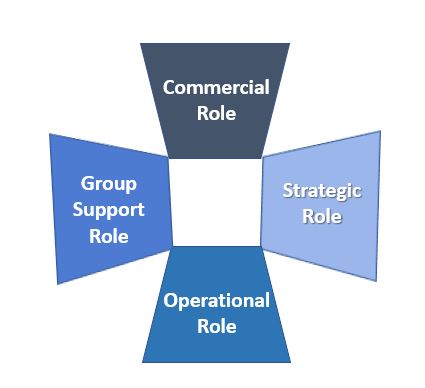
In general, rotational roles fall into these four categories (see graphic below).
Commercial roles could include sales support, marketing, external communications and sometimes includes roles that have direct interfacing with key customers – account roles. A key objective of commercial roles would be to ensure participants understand how money is made, reported, and the levers which could improve profitability, and the processes that are involved in converting operational success to money in the bank. This rotational assignment also provides an understanding of the level of customer satisfaction and where clients would like to see improvements or innovations. For more senior roles in a commercial function, the development objective could include understanding risks and opportunities and establishing a high-level plan to address both with internal initiatives and even external solutions like a merger or acquisition to address challenges and risks to customer satisfaction and the ability to deliver on customer expectations – given observed and expected changes in the marketplace, competitor offerings, etc.
Operational roles usually offer the ability to understand the daily activities and decisions which could lead to meeting or missing operational outcomes. This usually relates to impacts to the Profit and Loss Statements of a company. In these kinds of rotational assignment roles, participants learn to understand the challenges that project teams experience in delivering products or services that are attractive in the marketplace. They also learn how operational delivery can lead to optimal profitability. Concepts like LEAN, Circular economy, and agile are often concepts that are learned during assignments in operational roles.
Strategic roles are often assigned at one of the larger offices or to shadow a senior or executive leader involved in strategic projects and initiatives. During this assignment participants usually learn more about risk management, organizational strategies, and projects. Sometimes they could be involved in supporting due diligence activities for a possible merger or acquisition and may be exposed to considerations regarding organizational structure changes or changes to the legal structure of a company. During these assignments, participants understand how the company evaluates its internal and external strengths and opportunities along with possible organizational weaknesses and risks. In that landscape, the company will set strategies in motion to improve its competitiveness, its financial outcomes (P&L, Cashflow and/or balance sheet), and its ability to outmaneuver the competition in key areas. This could be as a result of acquiring and/or launching new innovative solutions or getting closer to the customers and how customers’ wishes are being met.
GroupSupport roles are often either in Human Resources or possibly in Procurement or any other group support (functional leadership) role where that specific participant can learn to more fully understand the challenges of balancing the needs of its shareholders, customers, employees, and supply chain partners.
How to start
Putting together a Rotational Assignment Program can take some time during the early stages and it would be very important to understand the strategic needs and objectives of the company when it comes to succession planning and key skills needed by the leaders of tomorrow. Talk to as many possible stakeholders as you can to build a successful business case and change plan addressing all concerns and needs of key stakeholders in the success of the rotational assignment plan. Talk to experts who have developed a program like this to garner any tips regarding pitfalls that they needed to navigate. Finally, commit to continue learning as you go. Get feedback and act on it and use the data gathered to drive continuous improvement activities. Use the feedback to ensure the program continues to deliver outstanding benefits in a fast-changing world which impacts your ability to attract and retain key talent on a continuous basis.
Useful posts to help with the preparation and communication of stretch/developmental assignments:


















 The Rethink Shelf