Getting along better with others


thinking writing final

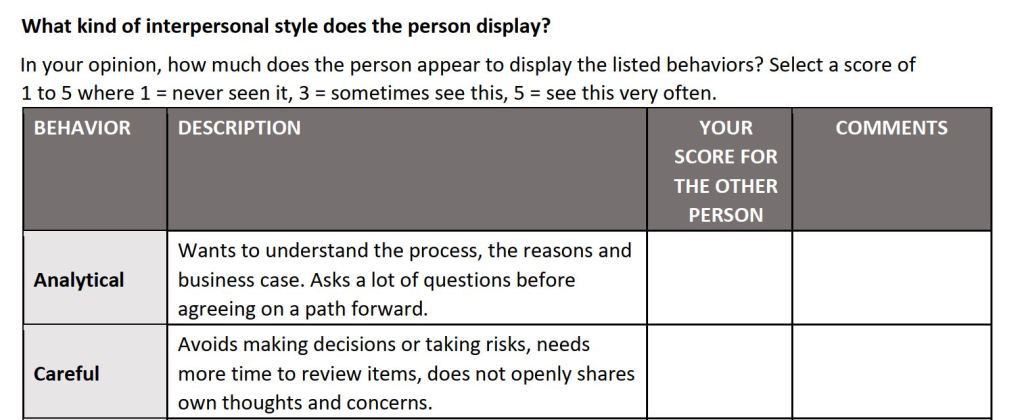
One area that often causes misunderstandings and frustrations in the workplace is when two employees have different interpersonal styles and ways of communicating and they do not get along. Being different from each other mostly means that they do not understand why the other party is doing and saying things in the manner that they do. Most of us do have the ability to make small changes to how we do or say things in order to improve collaboration and interfacing with others and this resource can help by creating awareness, which is the first step towards improvement.

The downloadable document I am sharing can be used for reviewing relationships with customers, other employees, work-related contacts, and even friends or loved ones. It helps you reflect on the interpersonal style that the other person displays in his or her behaviors. Building on this awareness this resource enables you to be more mindful of the best ways to interact with that specific person to have a better relationship with him or her.

Once you have awareness of how you can improve interpersonal relationships with specific people it may still be difficult to make changes to your own behavior for the betterment of the relationship. Should you get stuck once you have done the first part of the exercise, consider asking others for ideas on how you can best approach improvement in the key aspects you came up with. Depending on the current relationship you have with the person you focused on, you may be able to ask him or her directly. For example: “I noticed that you are very detail-oriented. Can you help me understand how I can better provide you with what you need in order for you to feel comfortable with my contribution on the projects that we are working on together?”

Uses for this resource include:

  • Own reflection and then taking action to improve on some of your interpersonal relationships.
  • Discussions with your coach on how to deal with some difficult individuals that you often work with.
  • Team-building – ask each team member to rate themselves on the items shown and then share with each other as a way to get to know each other better and improve interpersonal relationships on the team. (advocating).
  • Team feedback – Depending on the time you have available and the size of the team you may also ask each team member to map out each other team member using this resource. This means each person gets feedback from the entire team on how each team member sees them. The outcome could magnify self-awareness in the team and drive interpersonal relationship improvements across the entire team.

Misunderstandings can lead to a lot of misalignments between team members and can result in rework, which is a waste every project should avoid. Better interactions with others make the workday more fun and go a long way towards employees feeling more productive and effective at work.

Planning Developmental Assignments – Process and Preparing Assignee


global travel5

A decade ago it seemed to be more common for employees to be on developmental assignments for longer periods of time. These days the duration of assignments seems to have become shorter. The required steps are not much different though.

It is vital for the organization to have a clear process around the mobilization, preparation, sustaining, return, development of assignees and there are multiple organizations (internally and possibly externally if outsourced) which need to contribute to the process in order to make the assignment a successful one for the company and the employee

Some of the biggest unintended outcomes of assignments are:

  • The employee (and/or family) did not fully understand what they were getting into and found it too overwhelming at the assignment location – wished to return earlier or resigned.
  • Employee did not understand how the assignment was adding to his or her skill sets or competencies and he or she ended up frustrated and demotivated.
  • Employee on assignment no longer felt connected to the home office and were anxious about what happens after the assignment – wished to return earlier or resigned.
  • Employees (and families) experienced a high level of anxiety associated with the assignments due to inadequate preparation and support before, during and after return to home location.

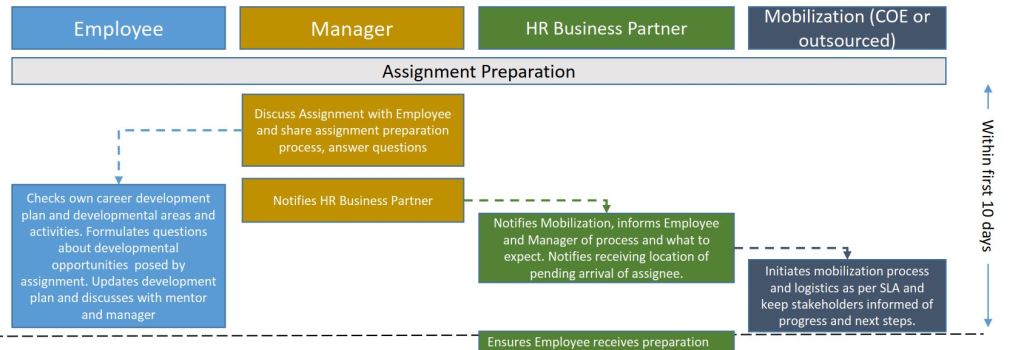
The process flow shared here shows a simplified version of how a developmental assignment should be planned and executed before mobilization, during and after an assignment has ended. It takes into account the logistics part, which may be an internal organization (Center of Excellence) or an outsourced party, the role of the manager, the role of the employee and how the Business Partner can contribute to ensure the entire process yields the desired outcomes. There are also some suggestions for surveys to capture any feedback to identify useful improvements to the process.

Some additional tips:

  • Make sure that managers are clear on the process, the various steps and the specific roles and responsibilities. Most employees will ask their managers for advice and information first. The role of the manager is very important to ensure future retention of the employee by staying in touch and ensuring the employee continues to feel valued by the organization during and after the assignment.
  • Create or outsource a solid assignment preparation program for employees (and families as applicable). This includes cultural awareness training, language training (if applicable) and developing the right mindset and approach to living in a new country for a period of time.
  • Apply attention and diligence when outsourcing logistics and defining the SLAs associated with mobilization. Lost goods, delays in finding accommodation, faulty or missing paperwork can cause a lot of unnecessary distraction and anxiety on the part of an employee on assignment. Conduct regular audits and have discussions with an outsourcing partner/COE using the surveys as a basis to provide input aimed at improving the experience of assignees.
  • Ensure either the Business Partner or the Manager has discussions with the employees to be sent on the assignment to ensure they understand how to leverage the opportunity to improve on their own skill sets/competencies and how they should contribute to the learning of those at the assignment location and again to the learning of those at the home office upon their return.

Preparation and Training

Training and support in these areas (see below) will help each assignee and his/her family – should they accompany the assignee – the best opportunity to understand the assignment requirements and the local culture better. And having an improved awareness will enable the assignee (and family) to have a solid plan of how they would set-up their start-up activities at the new location for a successful assignment experience and conclusion.

Being sent on an assignment is both an opportunity and a responsibility for the assignee. It can bring out the best and worst in a person as he/she (and the family) face huge life changes compared to life at the home office. The experience can lead to increased maturity, improved leadership skills and understanding and increased knowledge and skills if managed properly. As the manager, business partner or any other stakeholder in the process, it is important you ensure there is a clear process mapped out which details the various steps by process contributor and that each stakeholder is acutely aware of the bigger picture while performing own parts.

Use a reality-check worksheet for a Positive Mindset


The success of a leader, a manager or an ambitious employee depends largely on the mindset that he or she operates on. When we are in a positive state of mind we can focus on our goals and collaborate and communicate in positive ways which inspire and motivate others to help us succeed in our goals.

It is unfortunately also possible for us to get pulled away from the positive state of mind when we are in high stress situations for a long period of time and when we allow ourselves to go down a spiral of negative thinking. Successful leaders and managers have learned how to quickly realize when this happens and to start implementing corrective actions and adjustments to their way of thinking. This self-awareness and regulating their own emotions help them rapidly get back to a focused mind and closer to the outcomes that they are planning for.

Expectations and Reality Curves

This model shows the blue path which I call the Expectation Trap or summarized as the kind of thinking that believes “things should not be this way”. This kind of thinking very easily moves us out of a positive mindset and it is aligned with going against reality. We wish that reality was different and we build this on our expectations of how good things should be and how badly others are acting or behaving as if others are actually causing the negative outcomes which we do not want to see.  The green curve is the way out of the negative thinking. It is a different mindset which aligns with 1) doing a reality check and using that as the basis for moving towards a better way of thinking, 2) learning from the past, 3) changing or improving the plans we had before something happened to interrupt our progress and then 4) moving into the new direction with a positive focus and determination.

The first step, doing a reality check – is often the toughest and once a person is already in a negative state of mind it is really hard for him or her to realize that it is necessary to do this.

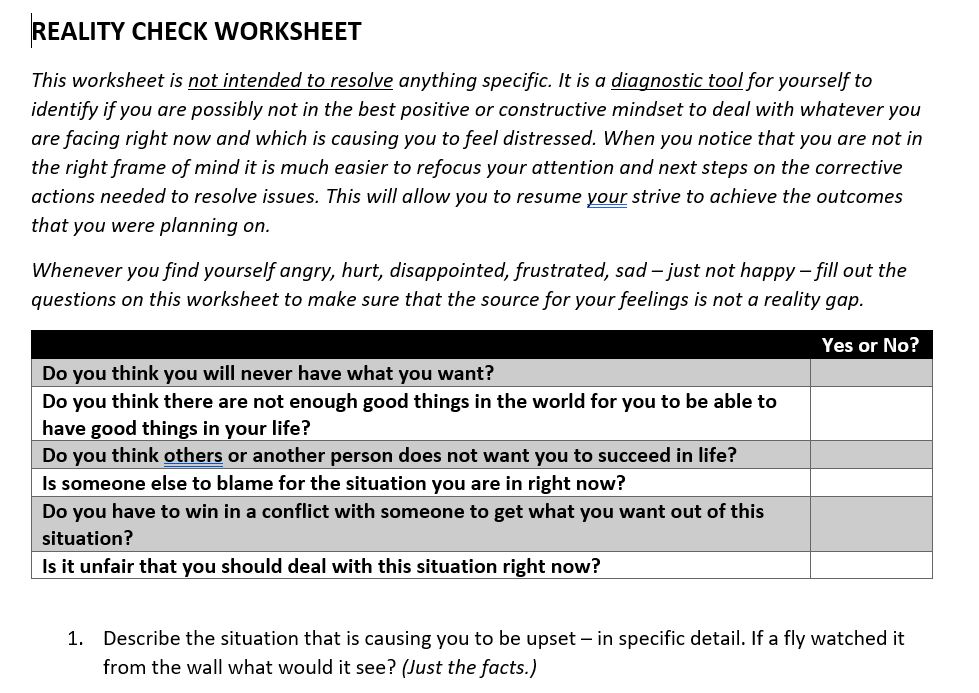
Use the outcomes from this worksheet for further discussions with your mentor/coach or adviser. It may be that you need some coaching or just someone to be a sounding board for you as you talk through the situation and how to resolve it in the best way.

Some tips:

  • Be sure to really connect with the negative feelings when you complete the worksheet. Some people are really good at being able to temporarily switch off their emotions to focus on business – but for this form, do make sure you are connecting with how it feels inside of you when you think about that situation or event that had caused you to feel pulled away from your positive mindset and down the Expectation Trap.
  • Do take the steps necessary to resolve any upsetting situation/event. There is nothing worse than unfinished business behind you. It slows you down and drains you of positive mental energy that you need to accomplish the goal(s) that you have set for yourself. Your coach/mentor or adviser can help you with that if you are not sure how to resolve the upset so you can leave it behind you.

Presentation Feedback Template


Conducting presentations at the end of developmental assignments is a common way for employees to share knowledge and demonstrate the value of his/her contribution to solving a situation or creating a new solution.

Presentations is also a great way to evaluate how much an employee has learned from an assignment, if you are the manager, mentor or L&D Partner supporting that function or project. Just telling someone that he or she did a “good job” at the end is not a substitute for specific and actionable feedback which a structured template can offer those attending the end-of-assignment presentation.

Structure

  • The structure of the end-of-assignment presentation typically would include these topics:
  • About the presenter – brief bio including background experience up to the assignment, role during the assignment and career ambitions and goals.
  • An executive summary of the solution provided or improvement implemented.
  • Brief overview of the Situation that had to be addressed, specific objectives identified and met and the team that were involved in addressing the situation.
  • Outcome achieved including metrics and recognition for support from other people and groups.
  • Summary of key learning points that the employee takes away from the assignment and will use in future
  • Questions and Answers session

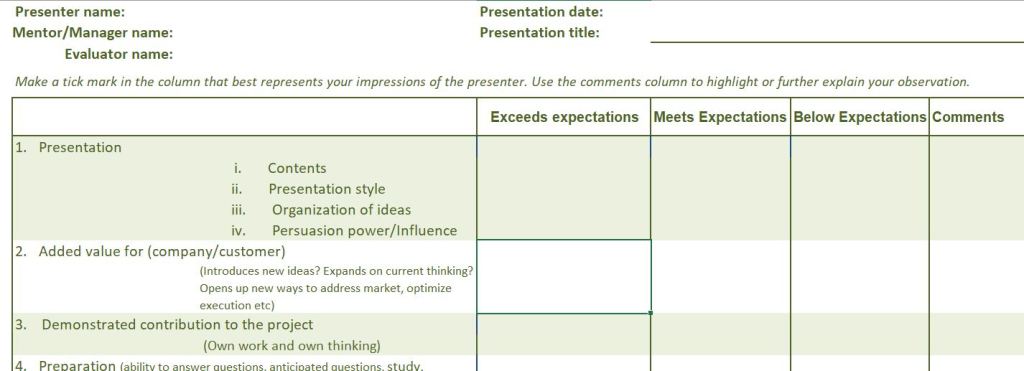
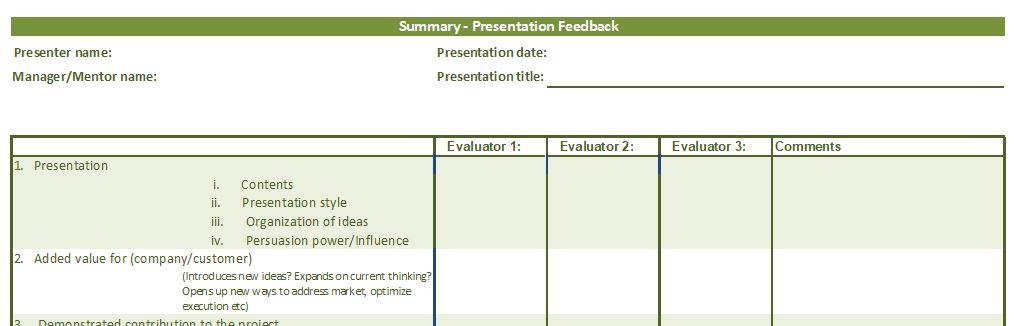
The templates I am sharing include the Presentation Feedback Form which can help those attending the presentation to structure their feedback to the presenter (the assignee) in a consistent way. An HR or Training/Learning/ Development representative can collect all the feedback forms afterwards and collate those into one feedback document for the benefit of the assignee.

The second template is for the HR or L&D person who will combine all of the feedback received onto one Summary sheet which can be shared with the presenter. The feedback can offer helpful developmental suggestions and also recognize the successes and achievements that the presenter was able to demonstrate during the presenttion.

Tips:

  • Customize the first column to include specific details around developmental objectives that were set as a part of the assignment. That way the presenter gets very specific feedback on how well he or she met those expectations through the presentation and handling questions during the session.
  • Be sure to prepare those who would provide feedback so they understand how feedback is to be captured on the form – sometimes they are confused about the columns and you may even prefer to just have one column with a score. Specifically ask them to add comments to help enrich the feedback and make it easier for the presenter to understand how to improve on his or her performance in future.
  • Deliver the feedback in person (vs by email) once the combined Feedback form is completed. Presenters may have further questions on how to interpret the feedback or how to improve on their own performance and should have the opportunity to get guidance and coaching on that during the feedback meeting to optimize the learning opportunity.

Boost Teamwork with an Indoor Scavenger Hunt


Looking to inject some fun and creativity into your workday? A scavenger hunt is a fantastic way to boost team morale, encourage collaboration, and foster a sense of camaraderie. Whether you’re in a bustling office or a quiet workspace, an indoor scavenger hunt can be a refreshing break from the routine, offering a unique opportunity for employees to connect and engage in a fun, competitive activity.

Crafting the Perfect Scavenger Hunt

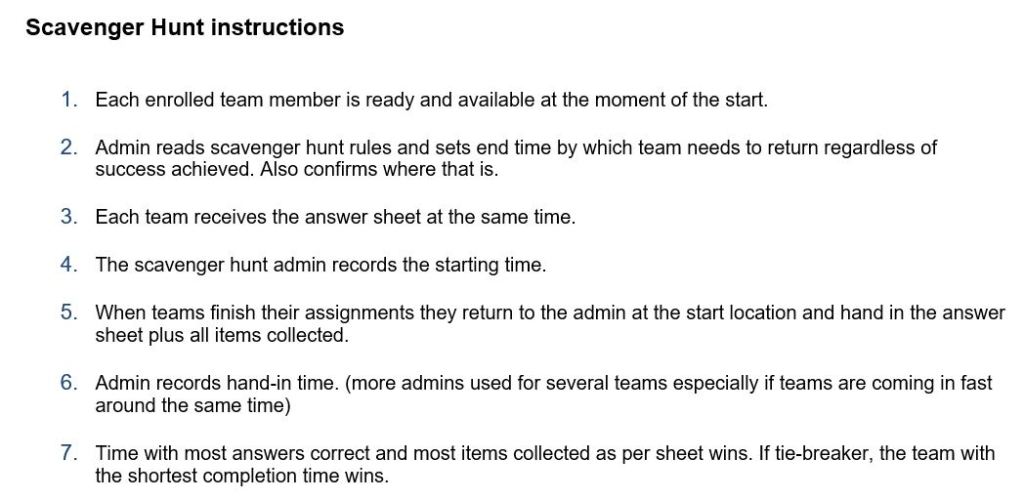
To maximize engagement and fun, tailor the hunt to your team’s size and time constraints. Smaller teams (3-4 people) might require more time to complete challenges than larger groups (5-6 people). Consider dividing larger teams into sub-groups to foster collaboration and friendly competition. The template shown before took around 2 – 2.5 hours for 10 teams of 4 people to complete.

Design a worksheet that includes a mix of questions, physical challenges, and creative tasks. Setting a time limit adds excitement and encourages teamwork. The team that successfully completes the most challenges within the allotted timeframe emerges victorious.

Remember, the goal is to create a fun and engaging experience that brings your team closer together.

When the group is ready, you would first share the instructions with them. Be sure to include areas that they are not to visit or boundaries for the exercise. Include the maximum time they should take to work on the assignment and where everyone should meet at the end of that period – whether they were able to complete the task or not.

Continue reading “Boost Teamwork with an Indoor Scavenger Hunt”

Track and Develop: A Guide to Portfolio Assignments


Dev plan (3)

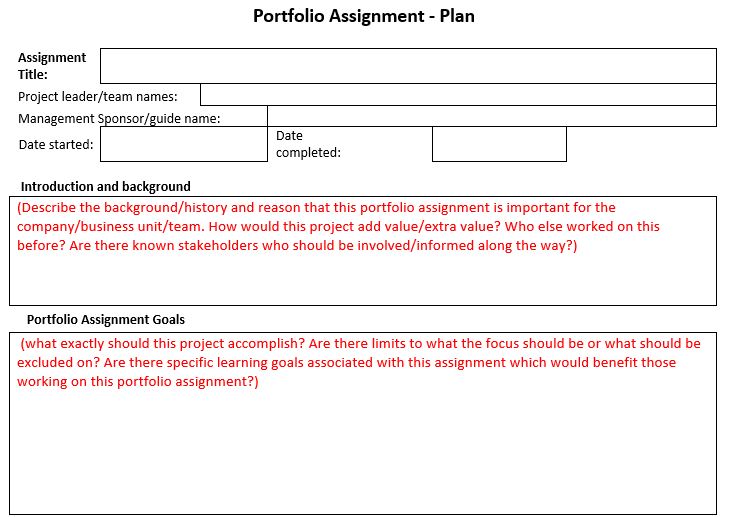
A powerful way to develop employees is to give them a portfolio assignment. This would be something they are asked to do while they remain responsible for their normal daily duties. Motivated employees with the ambition to learn new skills and take advantage of new opportunities to achieve developmental goals typically welcome such assignments. Portfolio assignments are less popular among employees who are less driven to succeed and develop their careers.

Continue reading “Track and Develop: A Guide to Portfolio Assignments”

From Skills Gap to Training Plan: A Strategic Approach


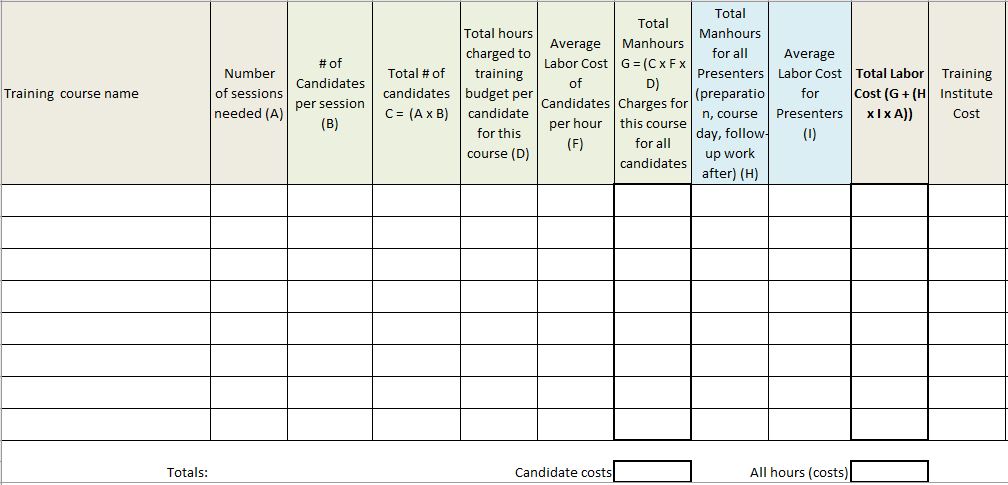
Training departments are usually expected to provide an annual plan showing training classes and learning interventions which will be offered over the course of the year. Managers want to see when they can plan to send employees to attend specific training courses and they also would like to see that the training plan addresses key areas where performance improvement may be needed for their departments or business units. Lastly, there is also usually the need to create a budget for the planned training. All of these focus areas are covered in the templates that can be downloaded below.

What kind of training should you provide?

Consider the following sources of information which could help:

  • Company strategies for growth and developing into new markets or expanding in existing markets – what skills would be needed?
  • Based on current performance – which skills need to be introduced and which skills should be improved upon?
  • Looking at employee career goals, which skills do you need to focus on in order to help move employees to being promotion-ready?
  • Which skills do managers believe would help their teams succeed better given performance targets and customer demands?

Summary of the kinds of Training Needs to Identify

Tools and Templates

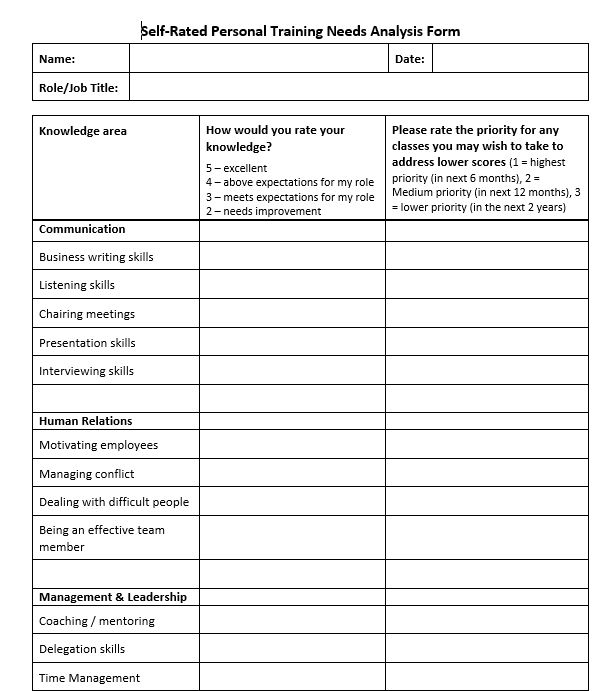
Here are three tools that can help you with conducting a training needs analysis. The first tool highlights individual training needs per employee and is based on employee self assessments. The second tool is a training needs view from a manager’s perspective focusing on the top 3 highest training needs for each employee in his/her group/team/department. The last tool helps you budget for the planned training.

  • Self-rated individual training needs. The quality of the results you obtain from this tool depends on whether you have a good career development tool/framework in place, motivated employees who maintain and work on their own development plans on an on-going basis and whether your managers/supervisors provide quality performance feedback to employees on a regular basis.
  • Manager assessment of department/team. Using knowledge of employee performance in his/her department, the manager selects the top 3 courses that each employee would need to improve own performance and/or to grow further in his/her career. Be sure to share course details with the managers too – what is the duration of the course and what aspects of the topic is covered?
  • Training needs and budgeting. This spreadsheet helps you budget for the planned courses. Check actual spending against this estimate to track the accuracy of your original budget and accurate allocation of items charged to your training budget.

Tips for training needs analysis:

  • Create a training needs analysis process that you follow consistently every year. This helps managers get into a rhythm of providing you with the required information on time for you to submit budget requests for the following year/quarter.
  • Be clear with managers which part of the training costs would be booked to their own budgets. For example – where do employees charge their time when they are in a training class? To your budget or to their manager’s budget?
  • Ask yourself how much training does it make sense to provide internally vs using an external vendor. Make wise trade-offs in terms of training costs, best value for money, expertise needed to provide the training etc.
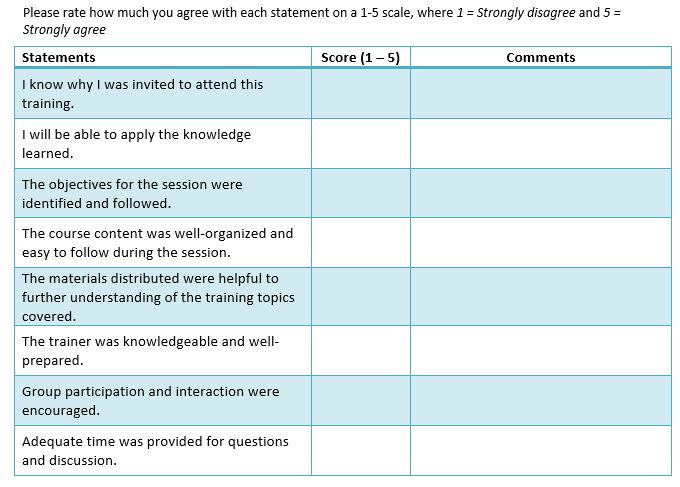
  • Determining the training plan for the following year should also include a good review of the training evaluations and feedback obtained from course participants during the lasts year. Are your current training classes good enough or do they need to be improved or outsourced?

Training Evaluation Forms


Beyond the Basics: The Importance of Effective Training Evaluation

It’s easy to get caught up in the logistics of training – did people show up, did they enjoy the food, was the room comfortable? While these factors are important, they don’t tell us if the training actually worked. To truly measure the effectiveness of a training program, we need to dig deeper.

Focusing solely on surface-level feedback, like how attendees felt about the event or the trainer, is like judging a book by its cover. It might look good on the outside, but what really matters is what’s inside – the knowledge gained, the skills developed, and the behavior changes that occur.

To delve deeper you may want to consider questions like:

Continue reading “Training Evaluation Forms”