Prepare to Negotiate – Tips and a Worksheet


arm wrestle
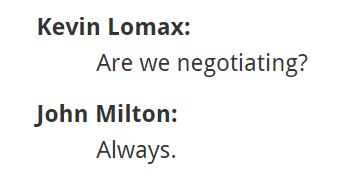
(The Devil’s Advocate, 1997)

The quote from the movie, The Devil’s Advocate, sums it up perfectly. Whether we like it or not, in life we are negotiating more often than we think we are.

Negotiation skills is something that most people can improve upon. There are several training options available if you want to make this a developmental priority. And there are also a few training games which offer you the opportunity to test your negotiating skills in role-plays.

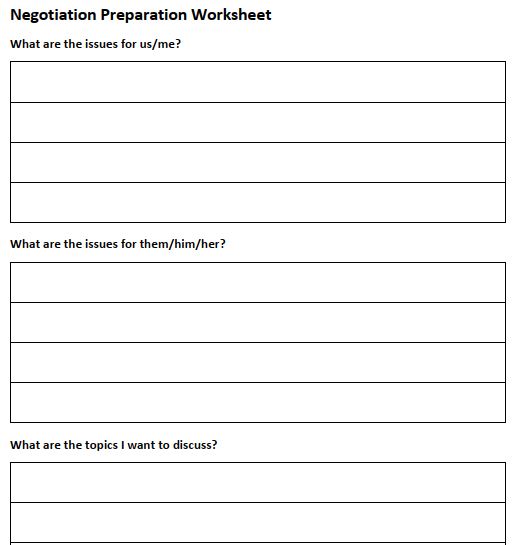
The resource that I am sharing is more generic and it helps you jot down some important notes before enter a negotiating process.

The worksheet, which you can download above, can help both experienced and new negotiators to organize their thoughts and prepare for a negotiation. Having your notes available during the negotiation discussions can help you maintain your focus and avoid distractions or knee-jerk reactions during crucial moments and stages of the discussion.

Uses:

  • Preparing for actual negotiations.
  • In training sessions to train participants on how to prepare and demonstrate the importance of this planning during a role-play later.
  • Prepare for discussion with supervisor/manager on salary increase.
  • Document your thinking going into a negotiation to support a post-negotiation lessons-learned reflection later which can help you and your team to continuously improve upon your past performances.

Cross-cultural Negotiations

When negotiating with someone who is from another cultural background than your own, remember that you will need to watch out for communicational disconnects based on having some of the following misaligment:

  • If the negotiating parties do not have the same first language and at least one party is negotiating in a non-native language there could be misunderstandings around the use of words of phrases. Use simple language and engage with translators if you want to avoid misunderstandings. .
  • Having different cultural views and perspectives, the relative importance of not only items negotiated but interaction with each other (from a relationship perspective) during the breaks or meals during days of negotiation could lead to unintended misunderstandings. Some actions or comments could even negatively impact the trust in the interpersonal relationship.
  • Depending on one’s view of the world, one tends to project your own views onto others as if everyone thinks and reasons like your would. That can lead to using methods of persuasion that would work in your own culture and it may be ineffective with others cultures. . Learn about the culture of key negotiators on the other side and learn what might persuade them vs only looking at your own experience and perspectives.
  • Establishing and maintaining trust can vary from one culture to another. Be slow to distrust the other party from another culture based on limited evidence of low-trust actions. Always engage with a cultural coach to help you correctly interpret the actions and communications from those from other cultures that you may be negotiating with.
  • Remember that negotiations are often not a one-time activity, but a business relationship that may span months or even years depending on how often roles changes at either party’s company. Take time to understand and get to know the other person or party that you often need to negotiate with. The more you know about the person and his or her preferences and views, the more successful your negotiations are likely to be.

Prepare by knowing a few key aspects about the other party

Checklist

Not all negotiations result in a definite outcome. In many cases discussions can take place over a long period of time. The better you are at understanding the other party and what her or she wants and values compared to your own needs and values, the better your chances would be to reach a win-win outcome for both yourself and the other party. And you will be able to leave the door open for successful future negotiations if you pay the right attention to the interpersonal relationship with the other party and not only to getting your own needs met in a win-lose way.

How to set priorities in an action plan


After a survey, a brainstorming session or a discussion it is often true that you end up with a long list of actions that should be put into an action plan. With many actions, maybe only a small number of people available to execute on those actions and possibly a small budget available for some of the actions, this could seem overwhelming.  The important question is: How can you prioritize the actions so you can make the most of the available resources (people to work on them) and funding (available budget)? And on top of that make sure that the most important actions are completed first?

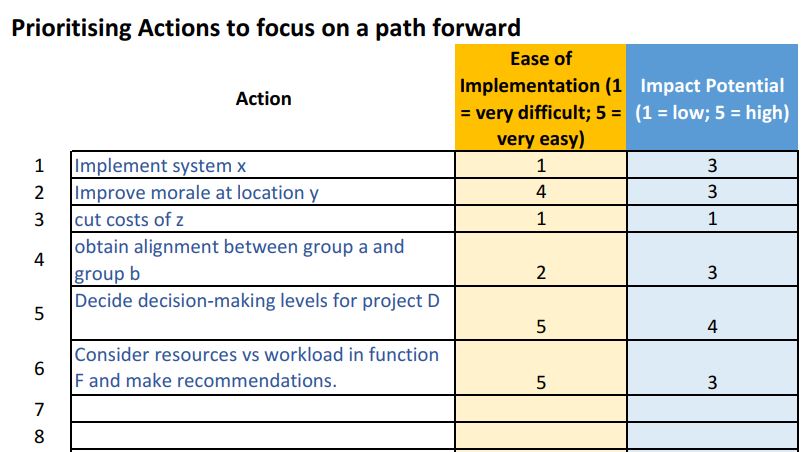
Rate all the projects or activities on two questions:

  • what is the level of impact on your company, project, company if you completed that project/activity? (high means it would me a very big difference (positively))
  • how hard is it to implement this? (referring to available resources, skills and knowledge needed, tools needed, funding needed) (very difficult means you have very limited resources and budget and this project or activity would need more than you have available right now)

Use the scores obtained to plot your planned projects or activities onto this graphic: (the graphic shows an example based on the table and ratings above)

What to focus on?

Use the guide below to understand which of your projects or activities should be a high priority, low priority or medium priority with possible additional research needed.

One the one hand the question is: can you overcome what is difficult about that particular activity or project? Can you (for example) convince someone make more funding available if you present a very solid business case to highlight the value to the company or the project?

Or can you get more people to help? The other question to look into is whether the impact is really as low as you imagine? Speak to others to hear their views of how such a project or activity could possibly benefit more areas than you think. Perhaps the project is much more valuable than you think and it moves into the “green” quadrant meaning it should be a high priority for you to work on and complete.

If your dots appear in one of the yellow sections, you have some questions to ponder. If you can solve the question in each case you may be able to move that particular action into a different “zone” by changing the score. This means you are able to for example make it easier to implement by solving an issue which made it particularly difficult to implement. Or it could mean you realize the business impact is bigger than you previously realized because the company could gain a competitive edge if you implemented that particular action.  Your final action plan for immediate focus areas should contain those actions which finally end up in the green zone on the legend.

Be sure to communicate the reasoning behind your high priority actions to the key stakeholders in the outcomes of the action plan. They may have additional insights to share which could further cause you to change the scoring of actions.

You can use the Action Plan posted here to capture the actions that you will implement, monitor status of and report on regularly.

Analyze how you use your time


“All we have to decide is what to do with the time that is given us.” (Gandalf)

J.R.R. Tolkien, The Fellowship of the Ring

How you choose to spend your time is a good indicator of the activities and people who are most important to you in your life. It shows your priorities clearly. How well do your daily activities reflect your priorities?

Have you faced any of these challenges?

Personal Development. Maybe you have considered taking an evening class to improve your skills or obtain a qualification you need, but you are not sure how you will find time to attend that class because of your busy life.  Taking a closer look at how you spend the time that you do have may help you see opportunities to change your schedule and make more time for career development activities.

Leaders and managers have many priorities to manage and often feel there are not enough hours in every day to accomplish the business objectives they have set for themselves and their teams. Taking a closer look at how you spend every day and every week my give you some interesting insights. You may discover areas where you could refocus yourself or delegate activities to free up more time for those other priorities.

Performance feedback could be indicating that your supervisor/manager feels you are not using your time at the office in productively. This template can also help you discover where he or she may be right and whether you are actually using your time optimally to achieve the performance goals that you and your boss have agreed upon.

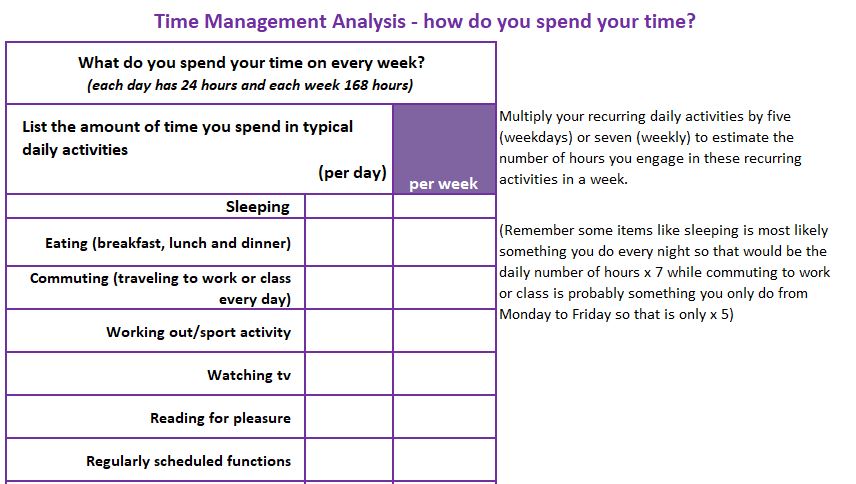
The template, which you can download below, helps you to take stock of what you are doing with all of the time that you have available to you. I once discovered that 30% of my time was at my own discretion and I created a mantra for myself “make the 30% count.” Whenever I caught myself involved in an activity that I had labeled as of low value to me given my own goals and values, I would just remind myself of the mantra and shift my focus to a higher value activity.

Should you need more development in how to be more effective at work, I suggest you look for a class on time management tools. These classes typically focus on how to get better at email management, how to better plan your day to do the right type of activities at the right time of the day (energy management) and also how to get better at keeping track of your highest priorities and making sure that you are working on the right items at various check-in moments with yourself during the day. A coach or a buddy can also help you with this by not only sharing tools with you but also helping to keep you accountable for the goals and outcomes you have committed to.

I hope your efforts to take a closer look at how you spend your time has given you the awareness of how much time you have available to spend at your own discretion. Are you using your time wisely? Are you doing things that will get you closer to the goals you have for your life?

I found one has to repeat these quick checks on a regular basis – maybe every 6 months – to make sure you are still on the path you had set for yourself when it comes to being in charge of the time you have.

Meeting Makeover: Improve Your Meetings with this Template


One of the most frustrating elements of many managers’ calendars are meetings. If you ask people they mostly believe there are too many participants, that meetings take too long, and that some individuals talk too much and venture off-topic. And most people are unable to remember what was decided or which actions came out of the meeting. The tool I am sharing helps a chairperson to prepare for a meeting and it helps him or her communicate the specific overall objectives for the meeting and also for every agenda item.

Some of the meeting maladies mentioned above can be cured simply by creating and distributing an agenda to participants before having the meeting. This tool goes further though – it also helps to create clarity around each agenda item’s purpose in informing participants or driving decision-making to move a project or initiatives forward.

The template you can download above contains an example to illustrate its use. Just replace the agenda items shown with your own meeting agenda items and then complete each column as demonstrated to clarify who is responsible for each agenda item, the purpose of each item, and the allocated time and desired outcome for each of the agenda items.  Do share the objectives, time available and expected outcomes with those who are assigned to each agenda item – it helps him or her be prepared to guide the conversation and discussion accordingly.

Suggestions

  • Even with an agenda and a well-planned meeting there may be times when things need to change as it becomes clear that a critical issue requires to be solved right-away.  Give yourself the leeway to abandon the agenda for a particular meeting to deal with such a highly critical and important issue or set another meeting right after the planned meeting to address the issue.
  • Some successful chairpersons make use of meeting “agreements” or “ground rules” to further improve the quality of the meeting. Some have items such as “each speaker gets a maximum of 1 minute to make his or her point” and “we debate issues and we respect the opinions of others.”
  • To know if your meetings are getting better – get feedback from your meeting participants. Take a few minutes at the end of the meeting to ask what went well and what could be better in future – exactly how. Reviewing the feedback when you plan the next meeting can help you to be mindful of further improvements that can be included going forward.

I hope this tool helps you plan your next meeting and move closer to having productive meetings which helps you progress your project or initiative as you had hoped.

Preparing to give employee feedback – Template


feedback

Feedback: A Two-Way Street

Giving and receiving feedback can be a delicate dance. It can be uncomfortable for both parties involved at times. However, it’s an essential part of growth and development. By getting better at giving feedback, planning what to say and opening the door to an open and honest discussion, we can help employees reach their full potential while driving organizational success.

This template helps a manager or supervisor think through the important aspects of giving feedback to an employee and helps to plan and prepare for the actual feedback meeting.

The template and approach also helps plan positive feedback to employees. This aspect is often neglected, but equally valuable in helping employees understand what specific actions and communications are valued and should be continued.

Some reminders:

  • Never give important feedback via an email or sending this worksheet to the employee. It should always be done in person or at least through a phone or video call. – if an in-person meeting is not possible.
  • The feedback should be given as soon as possible after the event to minimize surprises at the structured annual performance feedback meetings and to ensure the employee still has a good recollection of the situation or event that took place.
  • Do allow the employee to respond once you have shared the feedback to ensure that your message is understood by the employee and to allow you to understand any nuances to the situation which you may not have been aware of.
  • It is always a good idea to agree on a check-in moment at some time in the future. This is an opportunity to see if the employee may have further questions or comments at that time or perhaps he or she has been working on improving a particular skill related to the feedback you had shared and perhaps he or she could have some successes to share with you!

Sharing feedback with an employee, when it is not positive, can be tough to execute even with a tool like this. It depends a lot on your own style for managing conflict and whether you prefer to avoid conflict or situations where people may be upset with you. Take some time to learn more about your own conflict management style if giving feedback to employees remains a challenge for you even when you have used the template to prepare for the conversation.

Crafting a Communication Plan: Your Roadmap to Change Success


Whether it’s a new process, a revamped strategy, or a technological overhaul, effective communication is essential for a smooth transition. A well-crafted communication plan outlines the who, what, when, where, and how of sharing information, ensuring everyone is on the same page and aligned with the change journey. Let’s dive into the key components of creating a powerful communication plan.

Tailoring Your Message to Your Audience

Effective communication means understanding who you’re talking to. Different groups will need different information. Start by identifying everyone who’s affected by the change. This could include employees or different groups of employees, customers, partners, and even the wider community. By mapping out your audience, you can tailor your messages to their specific needs and interests. Think about different functions, think about geographic locations, think about management levels, and think about people outside your company who may be affected.

Communication messages could be intended to explain why things have to change, what is going to change, when and how it is going to change, how the change is going (progress update) and what (if anything) people need to start doing, stop doing or what should change in the way they have acted in the past.

Continue reading “Crafting a Communication Plan: Your Roadmap to Change Success”

Post-survey Action Plan


You’ve got the employee survey results. Great! But don’t just let them gather dust. Find the biggest pain points, make an action plan, and get moving. It’s about turning those numbers into real improvements. Remember, less is often more. Focus on a few key areas instead of trying to fix everything at once. Let your team know you’re listening and planning to make needed changes.

The first template helps you pinpoint exactly what worked and what didn’t. Don’t just list random stuff – get specific. Once you know what to improve, create clear action steps. Make sure you can measure your progress and know when an action is complete by defining what done looks like.

Continue reading “Post-survey Action Plan”

From Skills Gap to Training Plan: A Strategic Approach


Training departments are usually expected to provide an annual plan showing training classes and learning interventions which will be offered over the course of the year. Managers want to see when they can plan to send employees to attend specific training courses and they also would like to see that the training plan addresses key areas where performance improvement may be needed for their departments or business units. Lastly, there is also usually the need to create a budget for the planned training. All of these focus areas are covered in the templates that can be downloaded below.

What kind of training should you provide?

Consider the following sources of information which could help:

  • Company strategies for growth and developing into new markets or expanding in existing markets – what skills would be needed?
  • Based on current performance – which skills need to be introduced and which skills should be improved upon?
  • Looking at employee career goals, which skills do you need to focus on in order to help move employees to being promotion-ready?
  • Which skills do managers believe would help their teams succeed better given performance targets and customer demands?

Summary of the kinds of Training Needs to Identify

Tools and Templates

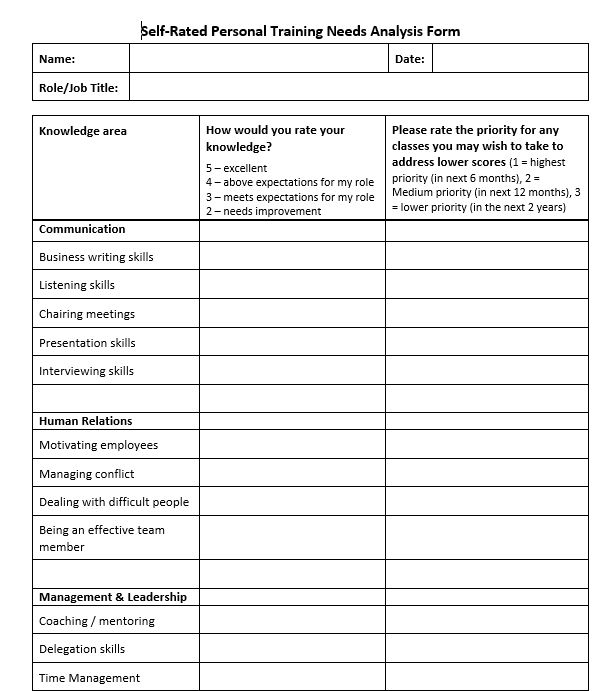
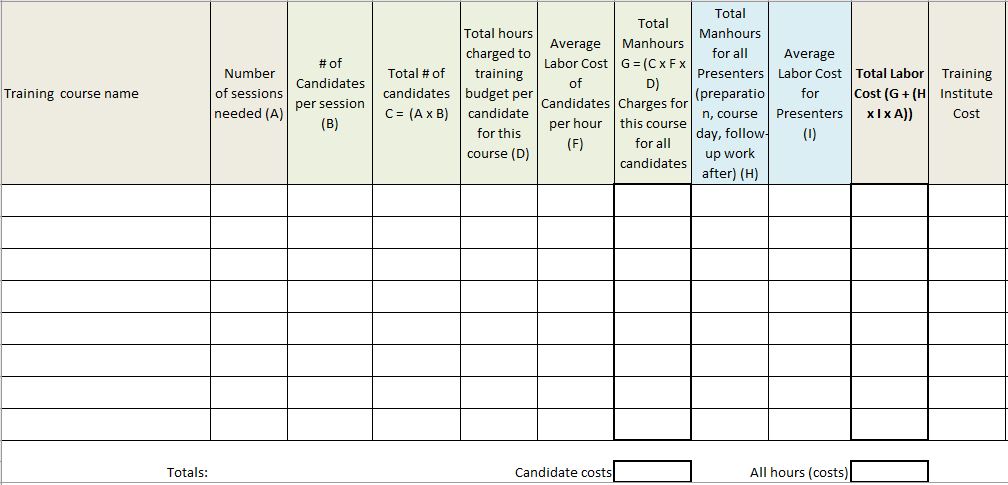
Here are three tools that can help you with conducting a training needs analysis. The first tool highlights individual training needs per employee and is based on employee self assessments. The second tool is a training needs view from a manager’s perspective focusing on the top 3 highest training needs for each employee in his/her group/team/department. The last tool helps you budget for the planned training.

  • Self-rated individual training needs. The quality of the results you obtain from this tool depends on whether you have a good career development tool/framework in place, motivated employees who maintain and work on their own development plans on an on-going basis and whether your managers/supervisors provide quality performance feedback to employees on a regular basis.
  • Manager assessment of department/team. Using knowledge of employee performance in his/her department, the manager selects the top 3 courses that each employee would need to improve own performance and/or to grow further in his/her career. Be sure to share course details with the managers too – what is the duration of the course and what aspects of the topic is covered?
  • Training needs and budgeting. This spreadsheet helps you budget for the planned courses. Check actual spending against this estimate to track the accuracy of your original budget and accurate allocation of items charged to your training budget.

Tips for training needs analysis:

  • Create a training needs analysis process that you follow consistently every year. This helps managers get into a rhythm of providing you with the required information on time for you to submit budget requests for the following year/quarter.
  • Be clear with managers which part of the training costs would be booked to their own budgets. For example – where do employees charge their time when they are in a training class? To your budget or to their manager’s budget?
  • Ask yourself how much training does it make sense to provide internally vs using an external vendor. Make wise trade-offs in terms of training costs, best value for money, expertise needed to provide the training etc.
  • Determining the training plan for the following year should also include a good review of the training evaluations and feedback obtained from course participants during the lasts year. Are your current training classes good enough or do they need to be improved or outsourced?