Problem Solving Template


puzzle (2)

It can be frustrating to try and figure out where things went wrong when the outcomes you had hoped for, did not work out. Sometimes it could be an object or piece of equipment that is not working well. It could also be a process that is at fault or perhaps it is human action or inaction that is causing the lack of performance.

This template helps one to work what you know and finding the facts in order to fix the issues that are stopping you from obtaining the right outcomes. This offers a better chance of discovering the root cause that is stopping you from achieving the planned good results.

After defining at the top what the problem is which you would like to solve, the worksheet takes you through a systematic process covering: The What, Where, When and How Big aspects are. Across the top moving from left to right on the columns, the worksheet has space to write down what you can see (what is observed) and it moves to any facts you are aware of which could relate to the observations, then writing down what the differences are between what you have observed and the facts until you finally arrive at the last column where you are able to narrow things down to the most likely causes that things are not working out with the problem you are trying to address.

It may seem tedious at first to complete the information indicated, but when the reasons or causes are less obvious this is a great way to summarize what you know about the situation in one place. We often know more than we realize and we simply need a way to put things together logically to spot the reasons behind a malfunctioning element in a failing piece of equipment or a process.

This tool can be used by an individual or in a group context. Sometimes it helps to have more than one person look at the same information and brainstorm through the elements shown in this template to get to the root cause(s). I also recommend that you retain a copy of this completed template to serve as a “lessons learned” to others.  I believe each one of us and every company/team should continuously strive to learn to remain competitive and innovative (creative). Others may be able to solve future issues by reviewing your completed sheet for the issue you solved.

Unlocking Insights: The Power of Internal Communication Surveys


Effective internal communication is a two-way street. It’s not just about top-down directives; it’s also about fostering an environment where employees feel heard and valued. By creating open channels for information sharing and feedback, organizations can build trust, boost morale, and drive better decision-making.

Keeping Employees in the Loop

HR often takes the lead in ensuring employees are informed and engaged. However, effective internal communication is a shared responsibility. Whether it’s HR, a dedicated communications team, or a combination of both, the goal is the same: to keep employees informed about company news, changes, and successes. Regularly assessing the impact of your communication efforts is crucial to ensure your messages are landing and driving the desired results.

Internal Communication Checkup Survey

The effectiveness of internal communication should be evaluated periodically. I would not repeat a survey like this one on a monthly basis unless you are going through a specific change initiative in this regard and would like to ensure you have a good understanding of how well your change process is going. Once per year or once in 18 months should be a good evaluation period. Keep it short to optimize your chances of getting good feedback and a high level of participation.

Tips:

  • Ensure your questions are specific and simple – survey respondents should know what exactly you are asking about. Do not combine more than one question into one.
  • Always make a post-survey action plan and share that with survey respondents and other stakeholders in the success of internal communications.
  • If you are an HR Director or in HR Management – stay close to the creation of internal communications. Read everything before it is released or published internally in your area of responsibility. The tone of communications and the contents of messages that are sent internally very closely link to how employees interpret the company’s management sentiments about them and you will often find disconnects started with some internal message that was misinterpreted.

HR Function checkup – Feedback from internal customers


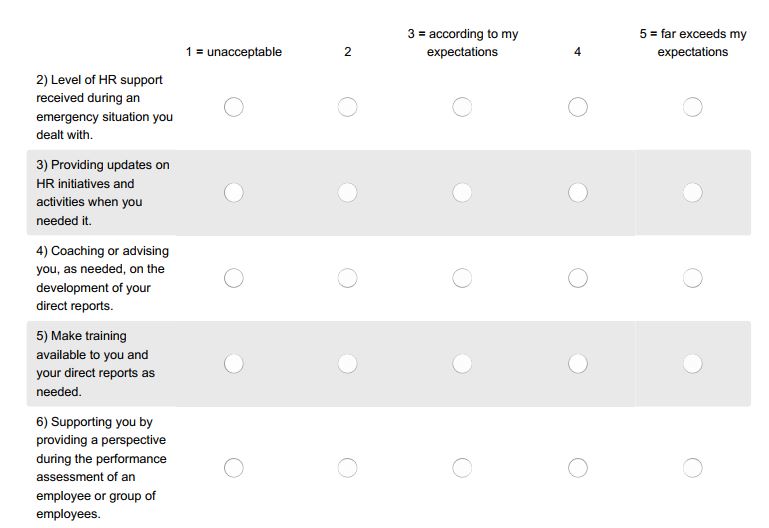
In the same way that companies would approach external customers to gather their views on what is going well and what needs improvement (customer satisfaction), the HR function should reach out to its internal customers to find out how satisfied they are with the services and support that they receive. It is true that there are more than one model for HR service delivery, but that does not change the fact that it is wise to gather feedback on the services and support that you do provide given the structure and focus for HR in your company.

The HR function is often guilty of focusing its developmental and improvement efforts exclusively on helping other departments and neglects using those same skills and expertise to improve the HR function as a whole and developing the people who deliver the HR services to others.

HR Function – Feedback Survey

This survey can help you gather the information you need from your internal customers to help you identify specific areas of excellence in HR and also those areas where improvement may be needed. When improvement is needed it will often imply additional training and development of some HR representatives (HRBPs or Generalists) and may also  include communicating the HR vision and goals more clearly within the HR function. Remember to recognize and reward those who were part of delivering excellent services when you review the survey results.

Tips:

  • Add comment fields next to scores if you want to be certain to capture specific comments about the scores.
  • Do be sure to provide survey participants with feedback on the outcome of the survey and the actions that you plan to take as a result of the survey. This motivates participants to continue providing you with valuable feedback in the future.
  • Create an action plan and communicate that clearly within the HR function so that everyone understands which areas you plan to address and how you plan to do that. It may help to set specific metrics around your planned improvements to make it easier to report progress.
  • Regularly update stakeholders – internal to the HR function and those who are internal customers in your company – on the progress of improvement efforts as you implement the post-survey action plan.
  • Remember to celebrate successes (milestones and outcomes achieved) and be prepared to add additional actions to your plan in cases where your improvement efforts are not reaping the results you had planned for.

Having a standard survey which you use ever year gives the opportunity to track the progress in specific questions over time and helps with trend analysis and showing % improvements over time.

Learning from Leavers: The Power of Exit Surveys -Template


Understanding the Why Behind Employee Departure

Employee turnover can be costly and disruptive. To address this challenge effectively, we must delve deeper into the reasons why people leave. By analyzing exit data and conducting thorough exit interviews, organizations can identify underlying issues and implement targeted retention strategies.

Unexpected employee resignations can often be alarming. More so if the resignations come from star employees whom you had high hopes for in terms of future expert or leadership roles at your company. How will it impact your project and your team, you may wonder? The question I would ask is, was it avoidable?

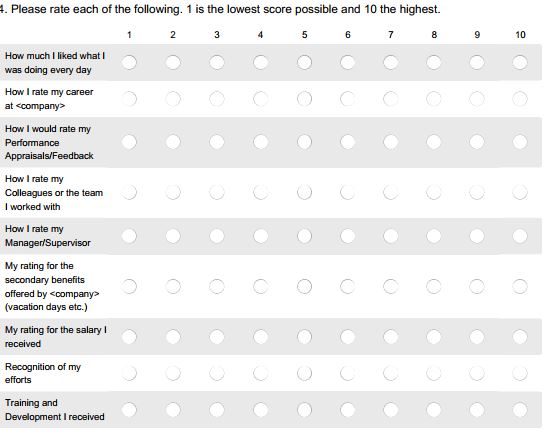
The Exit Interview helps with gathering feedback on employees’ decisions to leave the company and what next steps they are planning to further their careers elsewhere. This structured interview can greatly support your ability to narrow down the reasons for the exit and whether you have any large internal issues to address to avoid more people leaving the company.

While it appears to be a written survey, it works well as an interview conducted in person and then the interviewer (usually from HR) can complete the survey later in order to capture the answers from exiting employees in a structured way. Based on your company set-up and employee conditions you may want to add some questions or statements to be rated. Just avoid overloading the employee with too many questions. Perhaps you can remove some of the existing questions if you decide to add any?

Tips:

  • You could choose to use this as a survey which the departing employees complete independently. I would however recommend that you ask these questions as part of an exit interview conducted in person as it offers the opportunity to ask follow-up questions to clarify answers to make sure you really understand the factors that led to the decision to leave the company.
  • There is a good chance that the departing employee may not tell you the truth. Sometimes they are afraid you may give them a bad reference in the future if a prospective employer calls you up. Other times they may be worried about being the whistle-blower on an existing organizational issue in terms of potential impact on any friends they still have at the organization. It may be worth considering the use of an outsourced vendor to gather feedback from departing employees before or just after they have left.
  • Do take the time to review feedback received from exit interviews to determine whether you or anyone else at your company may need to take action to improve a situation, revise benefits, improve communications to employees on specific topics, etc. These actions may be exactly what is needed to prevent other employees from leaving for similar reasons.
  • Mind confidentiality around these interviews. Be sure to be honest with the departing employee on who will get to know about the information shared and stick to the agreement.
  • Talk to those employees who remain with the company and make sure they understand how much you value their continued service and loyalty to the team/organization. When a prominent person leaves – whether a subject matter expert or a much-liked leader – people may start wondering about their own careers and consider leaving too. Taking employee retention actions and communicating especially to those in key roles will go a long way toward putting people’s minds at rest.

Employee turnover is inevitable, but it doesn’t have to be detrimental. By conducting thorough exit interviews and analyzing the data, you can transform departures into opportunities for growth. By identifying and addressing the root causes of turnover, you can create a more engaged and loyal workforce, ultimately strengthening your organization’s overall performance.

Boost Your Onboarding Game: Survey Your New Hires


Uncovering the Onboarding Experience: The Power of Feedback

Your onboarding process sets the tone for an employee’s entire tenure. To ensure you’re creating a positive and productive experience, gather insights directly from the source: your new hires. By surveying employees during their initial months, you can identify areas of strength and opportunities for improvement, ultimately enhancing employee satisfaction and retention.

Measuring Onboarding Success Over Time

To gauge the effectiveness of your onboarding process, ongoing feedback is essential. By tracking survey results over time, you can identify trends, measure improvement, and pinpoint areas for further enhancement. Comparing responses across different locations can also highlight regional variations and inform targeted interventions.

Leveraging Technology for Effective Feedback

Gathering feedback from new hires is essential for refining your onboarding process. Fortunately, numerous online survey platforms, many offering free plans, can streamline this process. From Google Forms and Microsoft Forms to dedicated HR software, you can easily create and distribute surveys to collect valuable insights. If technology isn’t readily available, a traditional paper survey can also be effective. The key is to capture data that will inform improvements to your onboarding journey.

Tips:

  • Don’t make the survey very long or you will risk lower response rates, questions skipped, or repeated answers.
  • Watch out for questions that seem similar which frustrates survey respondents.
  • Make sure you are asking questions that would generate actionable answers. For example, I advise against asking “Did you feel good on your 1st day at the office?” If the survey respondent answered “no” you would have limited ability to avoid getting that response from future new employees.
  • Do take the time at least once per quarter (or shorter time periods if you are hiring several people) to review, analyze, and summarize the results obtained from the New Employee Surveys. That way you will be able to spot trends and identify specific focus areas for you and your HR/Learning and Development teams to address and improve upon going forward.

Salary Review Simplified: A Practical Template


Fair compensation is essential for attracting, retaining, and motivating top talent. By conducting regular salary reviews, organizations can maintain internal equity and external competitiveness. This template helps to have a practical approach to evaluating employee compensation and making data-driven adjustments.

While large corporations often rely on sophisticated HR software for compensation management, smaller businesses can achieve similar results with a well-structured spreadsheet. This editable template allows for flexibility and customization, making it a practical choice for many organizations managing a smaller pool of employees.

The basic principles for using this tool:

  •  You need to make sure to retain employees and avoid employee turnover by reviewing his or her salary on a regular basis. Typically once per year.
  • Employees need feedback regarding job performance expectations and also their own performance delivered against the expectations. The compensation they receive should reflect not only the market value of the work they do for you but also their own level of delivery against expectations for that role. Performance that exceeded your expectations deserves to be rewarded. You could do it as a discretionary bonus or you could review the person’s annual salary and consider an increase.
  • Some employees bring increase requests to their bosses on a regular basis while others may just be waiting for their bosses to realize how much effort they put in and how many good results they are achieving. Without a solid salary review process which is run uniformly on an annual basis (at least), you could run the risk of not treating all of your employees in the same fair manner when it comes to salary reviews. It could happen that only those employees requesting regular increases are receiving them while those who do not ask, do not.
Continue reading “Salary Review Simplified: A Practical Template”

How to record Job Applicant Interview results


Hiring the right person is crucial for your team’s success. Without a structured approach to evaluating candidates, unconscious biases can creep in, leading to suboptimal hiring decisions. By capturing detailed impressions during the interview process, you can make data-driven choices that benefit your organization.

For instance, the “like me” bias can influence hiring decisions. We all have gut feelings about people, and it’s natural to connect with some candidates more than others. However, relying solely on intuition can lead to hiring mistakes. A structured interview process helps you balance your gut instinct with objective data. By capturing detailed notes and using consistent and defined evaluation criteria, you can make more informed and unbiased hiring decisions.

The downloadable template (below) helps you gather precise feedback from candidates, ensuring their qualifications, experience, and job approach align perfectly with the job’s needs. Avoid making decisions about whether or not to hire a person during the interview. Instead, focus on gathering the relevant data needed to make those decisions. Using a structured interview record can go a long way toward helping you do just that.

Continue reading “How to record Job Applicant Interview results”