Protect Your Organization: Your Risk Assessment Step-by-Step Guide


In today’s world, unexpected things happen. That’s why it’s important to be prepared. This free template download below will help you identify potential problems and figure out how to fix them. You can keep your organization safe and strong by staying ahead of risks.

Remember, this isn’t a one-time thing. You need to keep reviewing and updating this checklist to make sure it’s always relevant. With a little effort, you can create a stronger organization that is able to withstand life’s little surprises.

Here are two examples of big problems that can hurt an organization:

  1. Hackers stealing information: Bad guys can steal important stuff like customer data or company secrets. This can ruin your reputation and cost you a lot of money.
  2. Mother Nature strikes back: Hurricanes, floods, or earthquakes can damage your business and disrupt operations.

A Risk Assessment: Your Roadmap to a Safer Future

In today’s uncertain world, risks are everywhere. From financial losses to reputational damage, the potential consequences can be severe. That’s where a risk assessment comes in. By identifying potential threats and understanding their impact, you can take proactive steps to protect your organization.

So, what exactly is a risk assessment? It’s like a crystal ball, helping you see potential problems before they happen. Think of it as a map that guides you through the dangers ahead. By understanding the risks you face, you can develop strategies to avoid or reduce them.

But how do you do it? It’s actually simpler than you might think. Let’s break it down into two key steps:

  1. Identify the risks: Think about all the things that could go wrong. Financial losses? Safety issues? Reputation damage? Write them down.
  2. Assess the impact and probability: For each risk, figure out how bad it would be if it happened (the impact) and how likely it is to happen (the probability).

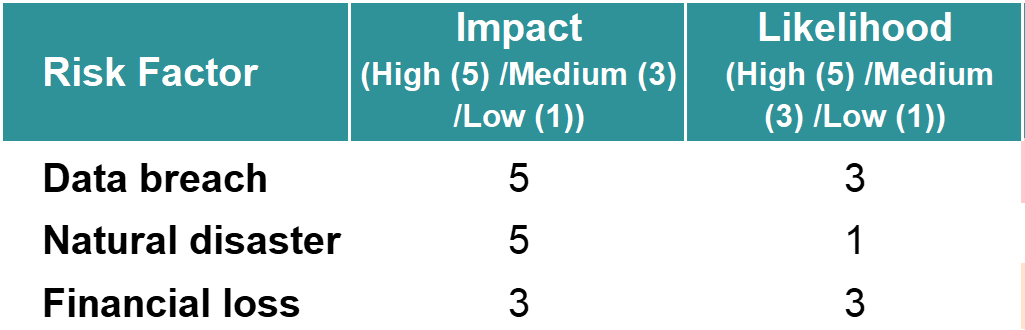
By combining these two factors, you can rank the risks that pose the biggest threat to your organization. Then, you can create a plan to tackle them.

Have a strategy for risk management

A strong risk management plan is like a safety net for your business. By spotting potential problems and having a plan to deal with them, you can protect your money, keep your good name, and build a stronger, more stable company.

  • Find potential threats: By understanding the risks you face, you can take proactive steps to prevent or mitigate them.
  • Protect your assets: Effective risk management helps safeguard your organization’s financial resources, reputation, and operations.
  • Make informed decisions: Risk strategies give valuable insights that can inform smart decisions and resource allocation.
  • Guarantee long-term sustainability: You can build a more resilient and sustainable organization by managing risks effectively.

What is risk?

A risk is simply a potential problem or danger. It’s something that might happen in the future that could cause harm or loss to your organization. Think of it as a threat that you need to be prepared for.

A risk assessment is a proactive tool that helps you discover potential threats to your organization and develop strategies to mitigate their impact. By understanding the risks you face, you can take steps to avoid or manage them effectively, protecting your assets and ensuring long-term success.

Unpacking the two ratings

What is the meaning of risk impact?

Impact refers to the potential consequences or severity of a risk event. It measures the harm or damage that could result if the risk occurs. For example, a high-impact risk might involve significant financial loss, reputational damage, or operational disruption.

How to look at probability or likelihood

Probability refers to the probability of a risk event occurring. It measures the chances that the risk will materialize. For example, a high-probability risk is more likely to happen than a low-probability risk.

By considering both the impact and probability of a risk, you can focus your efforts on mitigating the most significant threats to your organization.

Assessing Risks: A Step-by-Step Guide

Identify Potential Risks:

  • Brainstorm a list of potential risks that could affect your organization. Consider risks that could impact your financial situation, the way you are able to run your organizational processes, your reputational, and risks that relate to legal issues – think about compliance and adhering to legal requirements and regulations.

2. Evaluate Impact:

Assess the potential impact of each risk on a scale of 1-5 where you use either a 1 a 3 or a 5 to rate the impact of every risk you noted in case they happened:

  • 1: Low impact (minor financial loss or inconvenience)
  • 3: Medium impact (noticeable financial loss or disruption)
  • 5: High impact (significant financial loss, reputational damage, or operational disruption)

3. Assess Probability:

  • Estimate the probability of each risk occurring on a scale of 1-5. Use a number 1, 3, or 5 to rate the probability or likelihood that the risks you have would happen:
    • 1: Very low probability
    • 3: Medium Probability
    • 5: High Probability

4. Calculate Overall Risk:

  • The download template below will multiply the impact rating by the probability rating to determine the overall risk level.
  • Rank risks based on the calculated overall risk score. The higher the score, the more important it is to have a plan to avoid it, lower its impact (mitigation), or manage it if there is no way you can avoid it.

5. Develop Risk Strategies

This is where you spot potential problems and make a plan to deal with them. It could be to protect your money, keep your good name, and build a stronger, more stable organization.

Here are some types of strategies that might be needed:

  • Risk Avoidance: Remove or avoid the risk completely by putting some form of protection in place to ensure it can’t easily happen.
  • Risk Reduction: Instead of just letting problems happen, take steps to make them less likely or less harmful. Or you could say it is about implementing measures to reduce the likelihood or impact of the risk.
  • Risk Transfer: Instead of taking on the risk yourself, pass it on to someone else, like an insurance company.
  • Risk Acceptance:  Sometimes, risks are unavoidable. Instead of trying to stop them completely, be prepared for them. Have a backup plan in case things go wrong.

Taking Action: Protecting Your Organization

Once you’ve identified and assessed your risks, it’s time to act. Focus on the risks with the highest scores and implement your mitigation strategies. Remember, a risk assessment isn’t a one-time thing. Review it regularly to make sure it’s still relevant and up to date.

Share your risk assessment with key leaders in your organization. Their insights can help you refine your strategies and check to be sure they align with your overall business goals. By actively managing risks, you’re taking a proactive step toward protecting your organization and securing its long-term success.

Data Privacy Essentials: Your Compliance Starter Kit


Navigating the complex world of data protection can be overwhelming, especially for small organizations like charities and businesses.

The Perils of Data Breaches

When personal data falls into the wrong hands, the consequences can be devastating. Individuals may become victims of identity theft, financial loss, or emotional distress. Trust, once broken, is difficult to rebuild. Organizations face reputational damage, monetary penalties, and legal repercussions. Moreover, a data breach can erode public confidence in digital services, hindering innovation and economic growth. Safeguarding personal information is not just a legal obligation but a moral imperative.

Compliance

The General Data Protection Regulation (GDPR) has set a new global standard for data privacy in Europe. At this time there are several countries worldwide with similar compliance requirements – from Australia’s Privacy Act to California’s Consumer Privacy Act (CCPA), organizations across the globe are grappling with the complexities of safeguarding personal information.

Free draft forms and guidelines

Data protection can be a real headache, especially for small businesses and charities. That’s why this toolkit of draft forms and policies is here to help you get started with practical templates to help you stay compliant without the hassle.

Think of these draft documents as your trusty sidekick, providing a solid foundation for your data protection journey.

The toolkit has the following elements:

Data Protection draft Policy Template: Establish clear guidelines for handling personal data.

Data Breach draft Incident Report: Outline steps to take in case of a data breach.

Auditing and Monitoring draft Procedure: Maintain data protection compliance through regular checks.

Drat Data Subject Access Request (DSAR) Form: Efficiently handle requests for personal data.

Draft Data Protection Impact Assessment (DPIA) Form: Assess the potential risks of data processing activities.

While these may be a handy starting point, remember, that data protection is about more than just paperwork. To really protect your donors’, your employees’, your vendors’, and customers’ info, you’ll need to build a solid system that covers everything from training your staff to dealing with data breaches to having a process to report incidents, investigate and draw up an incident report and understanding the data you have and know if you have any risks if that data leaks out somehow.

  • Data protection impact assessments: You need to start out by identifying and managing high-risk data processing activities and making sure you address any high risks you identified in the process. Conduct regular assessments (maybe once a year) to identify potential vulnerabilities and implement appropriate data protection safeguards. [There is a draft form for that in the templates.]
  • Employee Training: Regular training to ensure staff understands their data protection responsibilities and can identify and prevent potential risks.
  • Data Minimization: Collect and retain only the necessary personal data and give them examples to help them understand what personal data is.
  • Rights of those whose data you have: Implement procedures to handle data access requests – they generally have the right to erasure or update of data you store, and other rights include the right to ask to see the personal data you keep on them. [There is a draft form that people can use to request access to the personal data you have]
  • Supplier Management: Ensure data processors comply with data protection requirements through contracts and oversight.
  • Incident Response: Develop a clear plan for responding to data breaches, including notification procedures. And make sure everyone knows which number to call or which email to use to report a suspected data breach. [there is draft information in the templates for how to report an incident and also questions to ask when talking to someone reporting a potential data breach.]
  • Continuous Monitoring and Review: Regularly assess data protection practices to identify and address potential vulnerabilities.

By combining the templates with these additional measures, you can help your organization build a strong foundation for data protection compliance and protect the privacy of your data subjects.

A closer look at STARR answers


In interviews, you are sometimes asked to give an example of how you have demonstrated that you are good at a specific competency. Other times you may be asked to explain how your skills have been useful to teams or organizations in the past. The principle is that the experience you have in specific competencies would have been demonstrated by situations you faced in the past.

It is these examples that the interviewer would be looking for when they ask you to provide your answer in the STARR methodology. Using this approach is your best way to give an example that clearly outlines for the interviewer how you faced a situation, recognized what you needed to do, took action, and achieved good results or outcomes.

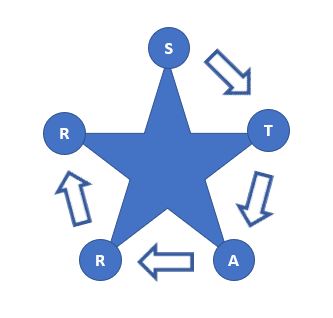
The acronym represents 5 specific topics you need to cover in your answer and if you imagine that 5-star picture in your mind, you may be able to more easily formulate your answers and examples during an interview. It is always a good idea to prepare some examples you can think of before the interview, but you may sometimes need to come up with an answer you did not prepare. Hopefully, this picture and explanation help you succeed with that!

The Acronym

The STARR method works on these headings (in sequence) [it is an acronym for these words]

Situation (when, where, what setting)

Task (what you needed to do, which responsibility you took on)

Action (what you did, which way you used a personal strength or competency)

Result (what was the outcome of your action?)

Reflection (looking back at how it went, what did you learn from it – what went well and what would you do differently if you faced the same situation again?)

Approach

Starting at the top of the star with the letter S, which represents the Situation you were in. This relates to the time when you were able to demonstrate through your actions that you have good proficiency in a specific competency. Once you have completed describing the Situation, you move clockwise to the next letter T. Once you have covered the questions under the letter T, you move clockwise to the next letter, A for action. And so you continue until you finish by including answers to the questions shown under Reflection.

Each of the topics under the STARR letters in the graphic above shows some bulleted questions which will help you ensure you cover the key aspects of that particular term when it comes to your example. from the past.

Example

Here is an example showing how using the questions under each of the topics in the STARR model can be useful in preparing your answers for interviews.

If you need a template to use in formulating your STARR – style examples, click on the link below.

Note:

When you are giving examples, you have to be specific instead of staying with general examples, which is often not convincing to those listening to your answers. . Make a story out of your example and base it on some real event that happened in your past to highlight how you were able to demonstrate a specific skill. Using the STARR methodology makes your story more credible and easier for those listening to you to get a full understanding of the capabilities that you have successfully demonstrated in the past.

Onboarding Plan Template


Onboarding Plan Template

One of the key reasons that companies lose new hires with some experience is that they fail to support these new hires adequately during their first few months. In some companies, it can be quite hard to understand how things work there, how to fit in and be successful, feel valued and included. Having a written onboarding plan from the start is a great way to bring more clarity to the person and also help them understand expectations during the crucial early months in their new roles in the new company.

The onboarding plan can be written as early as during the recruitment process. In one best-case scenario, it was shared with a senior executive right after his interview with the CEO. It was such an unexpected and appreciated action that the executive commented how refreshing he found the transparency and it made him see the hiring company as head-and-shoulders above the competition which led to him accepting the offer and joining the company a few months later.

The Process

While the plan can help clarify the set-up and structure for a new hire, it is important to set up review meetings with the newly hired managers or key hires. In some cases, reviews with an HRBP could be useful to understand for example how performance management is organized and how the process works. Such review moments could also clarify talent development programs and processes, which is useful to know for the new hire regarding his/her own career but also for helping the new hire manage the development actions for those who report to him/her.

Review meetings with the manager that the new hire reports to could help identify priorities and understand where to connect with more people or build additional internal or external relationships. The manager can also answer questions about activities planned to ensure desired outcomes are achieved after 30-days, 60-days, and 90-days as captured in the onboarding plan.

The people side of success

The template captures not only the tasks and activities needed to succeed in a new role but also identifies people with whom to build relationships. These are important relationships and contacts that the new hire would need to establish and maintain to ensure his/her success in the long run. They could be key client contact personnel or contacts from key suppliers or subcontractors. They could also be internal – people who know how things work and who can advise on the best course of action to get something done at that company.

And it is also important to identify people who can be trusted to keep things to themselves and who could advise on who to talk to before moving in specific directions for changes the new hire would like to implement. Either the HR Director/HRBP or the new hire’s manager may be helpful to identify who those contacts may be.

Note that confidants or advisors may also be external people such as professional coaches or consultants.

Accountability

While it is important from a company’s perspective to ensure key new hires are provided with onboarding plans, completing the details and setting priorities to accomplish the outcomes defined in the plan lie with the new hire. The success of the new hire is only partially dependent on helping him/her get up to speed faster by having review meetings and an onboarding plan and giving him or her access to professional helpers and advisors. The new hire remains accountable for his or her own performance and following through on the items recorded in the onboarding plan.

When both the process of onboarding works well and the new hire holds himself/herself accountable for the outcomes produced, the risks of failure due to onboarding gaps are lowered and retention success is more likely in the medium to long term!

Useful posts for new employee/ new manager onboarding and orientations :

https://jo-anngarbutt.org/2015/09/15/new-employee-on-boarding-checklist-template/

https://jo-anngarbutt.org/2016/03/01/starting-right-new-managerleader-and-team/

Researching New Office Locations – checklist


What if a valued customer wants you to do a project or support them from a new location where you do not currently have an office? Yes, research will be needed! But there are so many things that may be important, where would you start? This resource I am sharing is a handy starter-list for the research that HR is often expected to do.

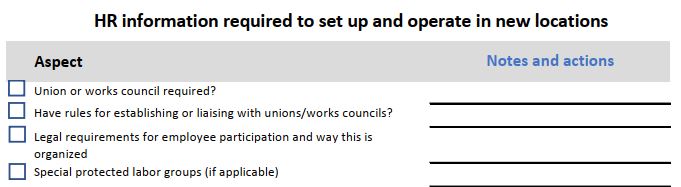
The topics covered in the attached checklist include the following areas:

And in each case, the checklist contains the aspect to the left and leaves you some space to jot down notes pertaining to your company and your plans. (See example below) That way you can quickly create your next-step plans following your research.

Some points to ponder:

  • Trying to answer the question about how much to pay employees you plan to relocate to the new office – calculate their entire package before you start. Add in all benefits they are getting which may not be cash in their hands i.e. health insurance, pension contributions by the company etc. Considering the full package is the starting point, not the annual salary only.
  • Look for local tax breaks that may be available to those you plan to relocate. In some countries they may be able to pay lower personal taxes.
  • If the local language is neither English nor the language spoken at the office your planned expats work now – how can you help them learn the new language? Even if all business is conducted in one language, the planned expats would need to set up their lives locally including trips to the supermarket, making local friends, and finding local information online. Being able to understand some basic words or say some basic phrases in the local language could be very valuable as they get settled there.
  • How can you minimize the carbon footprint of that new location? Limiting flights in and out of that new office and only placing expats there when the work cannot be done remotely or using modern tools and platforms to accomplish business objectives and outcomes.

The shared resource above is a starter-list and may not include all the aspects you need to look at before mobilizing. It is a great tool for doing a high-level review of a location under consideration for a new office or site.

While you can find a lot of the information you need online, I strongly recommend engaging with recognized experts in establishing operations abroad. Laws change, new trends emerge which have not yet made it into laws and websites are not always updated in a timeous fashion. So do your own research (using the checklist above) to understand the “lay of the land”. If you want to go further, engage with experts who may be able to advise on additional aspects and possible solutions which you may have missed in your own first-pass research efforts.

Stakeholders – How to keep them happy


Stakeholders

Not shareholders – they are the ones who own shares in the company. Stakeholders are those groups of people who have a keen interest in the initiative or process that you are working on. It could be because your success or your failure will impact their groups or processes in their groups. It could also be because your initiative could generate risks which they would like to keep an eye on. For some reason, these people or groups care more than the average person or employee about the initiative that you are working on.

It is therefore smart to understand who they are and secondly to understand why they care so much about this initiative. And as a result of what you learn, you can plan to keep them happy and informed. If you don’t, you risk them blocking or stalling progress on your initiative, or (if in executive levels) they may put another person in place to supervise you to make sure their interests are well-managed and protected.

For your success as a project manager of an initiative – find out who the stakeholders are, find out what they need and make sure you meet their needs!

Find out who they are

Which groups have processes that overlap or connect to processes you are managing? Who are the receivers or end-users of what you are creating? Answers to these questions could help you start your list of stakeholders.

Tips:

  • Start outside your organizations – are there any authorities, special interest groups, communities, clients, suppliers who are somehow connected to the product or service that you are providing? They may be stakeholders!
  • Look at the high-level organization chart of your company. Do any of the groups you see contribute to, receive outcomes, or participate in key processes you are managing? If so, add them to your stakeholder list.
  • Look for individuals at management levels who may need to give others updates on your project or processes you manage. They may also be stakeholders.

What do they care about?

Once you have your list of stakeholders with their titles and even down to name level. It is time to validate their interest in your project or process.

What they need:

Why would they care about the outcomes of your process or the way you run the project? Do they need information for their role or group? Or do they use the outcomes from your project somehow?

What they want to avoid:

What outcomes or messages would each of the identified stakeholders want to avoid? Think of anything that would cause them to have to do extra work or have to explain unsatisfactory results.

Make a plan

Use the template below to document a plan that you follow throughout the year to ensure each of your stakeholder groups receive required data, updates or opportunities to provide input or suggestions to your project on a regular basis.

Templates to download

Check-in on a regular basis with your stakeholders whether it is a quarterly survey or a personal call from you. Make sure that you have not missed anything they need to know or be informed about and make sure that they are not dealing with rising frustration due to a lack of updates or output from your team!

Learning how to manage the expectations of stakeholders on an initiative is a great way to learn new skills which will become important as you get promoted to take on more responsibilities. People at higher levels in any organization succeed by keeping aligned with a lot of different personalities and groups and they do this by understanding the needs and concerns of these other parties and then managing that (in a similar way as managing stakeholder expectations) on an ongoing basis.

7 ways to fix your team


If you shine a light on any team you will notice some areas where processes, communication or collaboration can be better. In many cases a team can function well enough even with a few improvement opportunities. Want to do a snapshot checkup on your team? The downloadable tool below can help you identify any specific areas to focus on if you feel your team performance can use a nudge in the right direction.

When teams fail it is usually recognized as a combination of the team not reaching desired outcomes, team members feeling a high level of dissatisfaction and frustration with team processes and other team members and team leaders failing to accomplish their own goals for the team and for their own career growth.

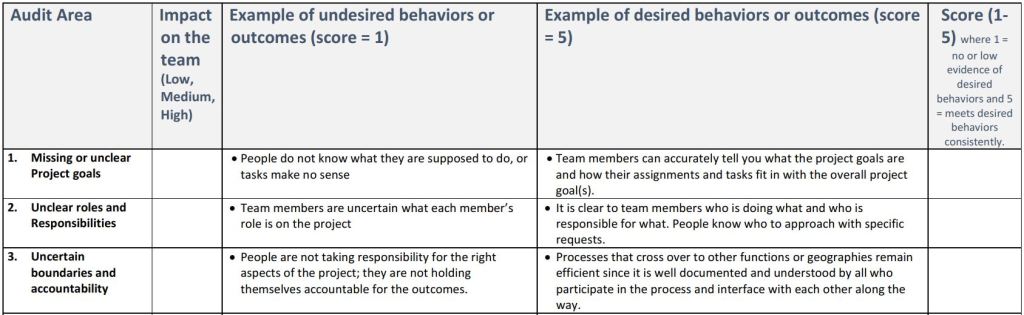
The 7 aspects of teams shown below are classic areas where low performance could lead to team failures.

7 troubles with teams

Taking a closer look

Step 1

The first column to complete is the scoring column. The question would be – how do I know that my team may be experiencing this trouble? The audit list gives you a possible symptom of observable behavior on either side of the scale: desirable (give this a score of 5 if your team shows this behavior) and undesirable (give this a score of 1 if your team shows this behavior). Should your team display behavior that is somewhere between those two opposites select a score between 1 and 5 that you feel is most accurate to describe how far they may be from either end. Perhaps a score of 3 would be appropriate if you see desirable behavior only 50% of the time.

Step 2

Look at the column called impact. When you look at the behaviors defined as undesired and also the other column containing desired behaviors, how much does it impact the outcomes produced by your team when those behaviors are present or not present? Maybe the impact is “high” if you consider how many hours are wasted when that behavior is present? Maybe it is only “medium” which means some time or effort is wasted, but not too much. And it could also be a “low” impact if that particular behavior does not contribute highly to the inefficiencies you experience as a team experiencing a particular aspect from the audit list.

Step 3

Evaluate your results by looking at both the scores column and the impact column. The graphic below shows the way to identify which of the aspects to focus on when it comes to prioritizing an area to address:

The download file above gives you an audit sheet to use in order to capture results for step 1 and 2.

How to fix any of those?

Once you have the priorities from step 3, it is time to take action.

For each of the area that can be addressed, there are some ideas of how to address that area for the team.

The download file above has suggestions for each of the 7 areas that can be addressed.

Remember

Every team has good times and bad times. Just because your team just did very well, it does not mean it will necessarily continue to go well. And just because your team failed last week, it does not mean there is no way to make it a high-performing team!

Use the tool above to take a closer look at your team and I wish you success in mapping out your next steps; helping your team be even better than it was before!

Spotting Employee Flight Risks: A Retention Checklist


20200524 risk ass

It has been said that your most valuable asset walks out of the doors every single day and you can but hope they come back the next day – your employees!

Keeping employees from leaving a company could be as simple as engaging with them, including them, helping them develop new skills and listening to their ideas. While that sounds deceptively simple, not every leader finds it easy to act when they hear that advice.

Get the facts

Understanding Your Team’s Pulse

Before diving into solutions, it’s essential to pinpoint the problem areas. Are employees considering leaving? If so, who’s most likely to exit and why? By asking the right questions and gathering data, you can identify potential risks and take proactive steps to boost employee retention.

The self-audit list below may be a good place to start assessing how much anyone on your team may be tempted to leave your team or the company.

Self Audit template

Completing the checklist requires you to answer yes or no to a series of statements as they would apply to each employee on your team. Once you have completed the assessment, add up the number of “no” answers you have for each employee and use the Score guide at the top of the page to determine whether each employee would be in the low, medium, or high risk from an employee retention perspective.

The next risk to assess is the impact it would have on your project or team if that particular employee decided to leave. Look at each employee (each column) and consider the unique skills and talents that he or she brings to the project and rate the impact that his/her (unplanned) voluntary departure could have – low, medium, or high.

Map it

Where to start? Map the answers from the self-audit sheet onto the graphic below. The risk that each employee could decide to leave on the horizontal access and the impact on the project, in case that employee did leave, on the vertical axis.

Then write down the names of employees that would be in the “green zone” vs the “yellow zone” vs the “orange zone”.

The orange area requires immediate and high focus, and the yellow zone does require focus, but less so. The green zone requires maintenance. Do not assume that because a retention risk is low today it would stay that way for years. Many talented employees get calls and offers from other companies and recruiters all the time! This means you should never stop reminding them why you are happy that they are on your team! And don’t only tell them, show them! Celebrate milestones and successes, recognize them in meaningful ways, and show them how working with your team or company is the right long-term strategy for them. Make sure you offer them advantages towards their overall life goals, their career goals, their work-life balance goals, etc.

Take action

Once you know where to focus, use the last worksheet as a checklist for areas where you can lower the risk that someone may consider leaving the team.

Use one checklist per employee and make sure that you have conversations with each employee about the areas where you either did not know the answers (looking at the self-audit worksheet) or you have not said anything to an employee about a particular area.

When it doesn’t work

Unexpected departures can disrupt teams and projects. That’s why it’s crucial to have a strong bench of talent ready to step up. By investing in employee development and creating clear career paths, you can mitigate the impact of turnover and ensure business continuity.

Taking proactive steps to assess employee retention risk is essential for organizational success. While it doesn’t guarantee zero turnover, it empowers you to identify potential departures early and take steps to improve employee satisfaction and engagement. By investing in your team’s growth and well-being, you’ll create a more stable and productive work environment.
Steps to creating a life you love


sketchguru_20200521195945

When someone wants to change something about his or her life or create new outcomes in key areas, they often need more than just someone telling them to create goals and then implement it. Most people seem to need the steps more clearly spelled out and a workbook or playbook is something they really appreciate.
The steps can be broken down in the steps shown below. The downloadable worksheets link is right here:

Step 1:

Understand the process:

Step 2:

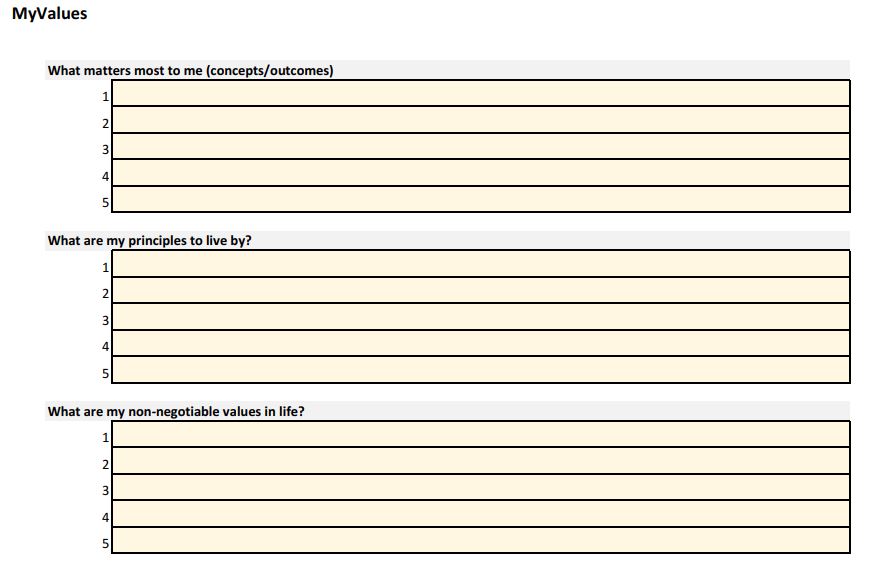
What matters to you?

Being clear on what matters to you makes it easier to understand WHY you would want more of some things in your life and less of others things in your life. While most people think they know the answers to these questions, you will notice how much clearer it gets when you have to write it down and then read it back to yourself.

Step 3:

Do I have time for this?

Most of us would have more time to work on projects that matter to us if we simply started eliminating activities that do not add value to our lives – based on what is important to us. The next two sheets first of all help to highlight how you spend your weeks (typically) and then help you identify how much time you could potentially free up for working on meaningful activities to get you closer to the life that you want for yourself.

Step 4:

What would I like to achieve?

This sheet starts with jotting down new outcomes that one would like to see in some key areas and then it moves to the right planning needed – which activities would do you plan to do in each month? The overall objective is to avoid having competing priorities within the same time of the year. Spacing activities out over a year period helps to ensure you keep focused while making progress in the most important areas over a 12-month period. Note that is is almost always a good idea to pick only maybe two or three projects to work on every month to avoid feeling overloaded and overwhelmed. Those two can lead to feeling demotivated and abandoning all of your plans to create a life you can love.

Step 5:

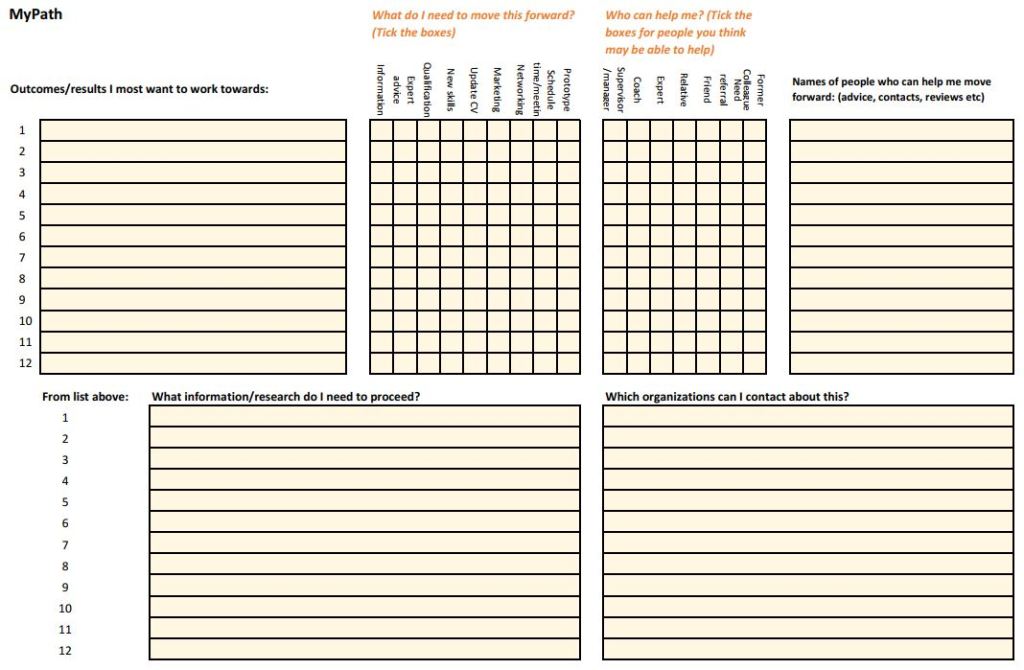
How will I move forward?

This step gets into more detail regarding your plan. There is an area to select what the next step may be for each of the projects you want to work on. It could be that you may need to gather more information or maybe you need to reach out to more people to learn from them or get advice from them- but who? Perhaps you need to build a prototype or get others to give you feedback on your idea? Maybe you need to try to see how it works for you – trying a new way of doing something? The page continues on with identifying whom you know who could help you with advice or maybe introduce you to someone who could help you. And then finally identifying where (place or area of interest) you need to do some research to find out more about what you could explore next and which organizations in your area may be able to help you move forward.

Step 6:

What is my plan for the next few months?

Looking at what needs to be investigated or one over the next few months, this sheet provides a space to keep rack of the top 2 or 3 things you would like to achieve this month to move forward on the projects you have picked for the next few months. There is also a handy check-box which helps you keep track of completed activities versus ones that are still open.

Step 7:

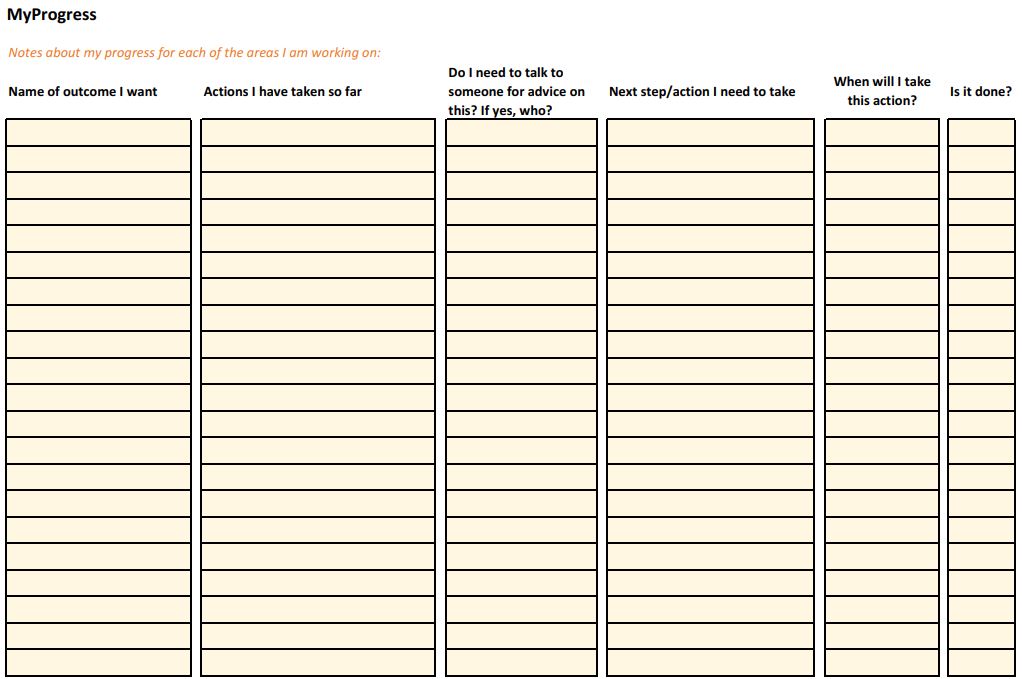
How am I doing?

Sometimes we start on the path of working on life improvement projects and then we get stuck or we get so distracted that we lose our focus. There are many reasons why we might get stuck but getting unstuck is not always easy. This sheet helps you do that.

Taking you from your original objectives, this sheet helps you acknowledge how far you got and what you have completed. Then it helps you think through what the next steps would be. You may need to continue making progress and maybe you need to stop and ask for advice or get more information in order to move forward.

Step 8:

Go back to Step 2 and renew your plans

When you have worked through the sheets and some months have passed it is a good idea to go back and review the reasons you are working on the projects – which are captured in Step 2. Then follow through each of your completed sheets to consider what you might like to change or add to your planning to renew your approach. Some projects end up unfinished because they seem less important once yo have taken more time to do research and talk to people with more knowledge in a specific area. It is okay to decide to abandon these project if they do not matter to you anymore.

Other new projects may be started while a few may continue from your earlier efforts and enter new phases – maybe you are ready to finalize a website or start selling something you have been meaning to put on the market.

I hope these workbook/playbook pages have given you new enthusiasm to plan out and move forward on creating more outcomes in your life that matter to you resulting in having a life that you love!

Assessing Leadership Behaviors: A Scorecard Approach


A leader’s actions speak louder than words. How leaders behave sets the tone for an entire organization. Their focus areas, decision-making styles, and communication approaches significantly impact employee morale, productivity, and overall company culture. To ensure that leaders are aligned with organizational goals, it’s essential to measure their behavior against defined expectations.

The typical approach to measure how leaders are behaving is to obtain input from those around each leader – those who interact with the leader on a regular basis.  The groups of people asked to provide ratings for each leader could be:

  1. People who report to the leader
  2. People who are colleagues of the leader
  3. People who are more senior than the leader
  4. If appropriate – external parties who interact with the leader on a regular basis.

Process of assessing leaders

The process of assessing leadership behavior typically follows these basic steps: Collecting ratings, consolidating the ratings, providing feedback to leaders and using the results to plan further actions as needed.

201906 process

To accurately measure leadership behavior, you need a well-defined process. Begin by outlining the key leadership actions that align with the competencies you want to assess. Once established, develop a feedback mechanism that captures input from peers, subordinates, and superiors. Remember, open communication is essential. Clearly communicate the purpose of the assessment to all stakeholders involved. By being clear about the task, the purpose, and the methodology, you can ensure better responses during the evaluation process.

The resource above can be downloaded. It is a set of behavioral statements that can be shared with those who need to provide ratings and comments. The scores or ratings relate to actual behavior observed against desired behaviors for each leader that they interact with on a regular basis. Some people automate their chosen feedback gathering using a free tool like http://www.surveymonkey.com

Process notes:

  • Behaviors used for ratings have to be very well defined so that they can be observed and do not require someone to guess at the intentions or motivations of the leader. A behavior must be observable or produce visible results.
  • Ask raters to add comments to help you interpret the scores. This understanding enables the creation of realistic follow-up actions after the results are available.
  • Ratings should not be requested too often – raters get “survey fatigue” and your results become less meaningful.
  • The objective is for the tool to support the leaders by providing helpful and actionable feedback. The tool also helps to understand how the change initiative is progressing towards desired milestones.

You will notice in the shared resource (tool) example that leadership behaviors were defined in 4 categories: Commitment Behaviors, Communication Behaviors,  Teamwork/Collaboration Behaviors, and Safety Behaviors. Your categories will be determined by your own change initiative and you will need to also define the specific behaviors that are desirable for leaders given your project. Simply use the downloaded Excel sheet and type over the category names and behavior definitions to create your own Leadership Behavior Scorecard.

Important watch-outs:

  • Be careful when you consolidate the results from various raters. If you had agreed to keep rater identities confidential, summarize the results by subgroup. Provide an average per subgroup for each of the behavioral elements. Do not provide a subgroup score if there were less than 3 raters.
  • Follow-up actions should also include recognition/appreciation for those leaders who are role-modeling the desired behaviors in the organization.
  • Consider using some examples from the higher ratings to create case studies for the organization. It is easier for leaders and employees to understand how to apply desired behaviors when they receive actual examples that illustrate how decisions were made or implemented using the desired behaviors. An example makes it easier for others to follow.

The tool is relatively simple to use, but it is vital that it is designed well and introduced correctly into the organization. Assessment tools can be seen as a negative element if the objectives and the way results will be used are not communicated appropriately.