Ice Breaker Questions


meeting (2)

Starting a meeting or dealing with the after-lunch session involving a group of people often requires that you use some sort of ice breaking exercise or activity to help participants get to know each other better, have some fun and in many cases move around the room a bit. Most facilitators have their own set of ice breaking activities and exercises in their mind in case they need it. If you are new at it, you may need some inspiration and this post may be for you!

How would you go about it?

There is a list of questions you can download below. Use them and then you have a few ways to use them for ice breaking activities:

  1. Use it to start the meeting and incorporate the introductions and capture expectations at the same time. Ask each participant to share his/her name, location, role, expectations for the session/day and then answer one of the questions on the list. (There is a reason to ask them to share their answer to one of the questions AFTER they stated their expectations – so you have time to write down their expectations on a flip-chart before the next participant starts sharing)
  2. Use it at the start of the meeting. Ask participants to get up and move around the room while introducing themselves to others they encounter along the way. Sharing their answer to the question you gave the group and asking the other person to share his/her answer to the same question. Let them mingle in this way for about 5 to 10 minutes (depending on the size of your group). Ask them to return to their seats and ask a volunteer (or a few) to share the most surprising response they heard.
  3. If the group is small (12 people or less). Ask each person to provide an answer to the question you selected on a post-in note. Collect all of them. Read out the answer and have participants try to guess who responded in this way. (Rules for this exercise includes that the writer of the answer cannot participate in guessing who wrote it).
  4. If you have more time, you can do this: Give the group a question and ask them to first consider how they would answer it and write their own answers down on a post-it note. Then you ask them to walk around in the room and when they encounter another meeting participant, to guess what the other would have answered then have the other reveal how they really did answer the question. The other then guesses the first person’s response and again the first person would reveal how he or she really did answer that question. Encourage them to briefly discuss why they guessed the answer in the way that they did. It can get to deeper discussions about assumptions we make about people – whether we already know them or not. You can time the interactions and give them a signal when to move on to a new conversation participant to engage with around guessing each other’s answers. When everyone has completed the conversations you can debrief the group with questions like: How often were you right in what you guessed the other person would say? Did you learn anything surprising from those you talked to ? (aspects of his/her personality that you had no idea about?) How accurate do you think guessing is when it comes to how other people think?

Ice breakers can be really effective in breaking down barriers to making contact with people you have never met before at a meeting or training event. Yes, extroverts mostly don’t have any difficulties approaching and talking to strangers, but introverts often do. These kinds of exercises help everyone to get to know each other without feeling too inhibited during the initial contact moments.

Problem Solving Template


puzzle (2)

It can be frustrating to try and figure out where things went wrong when the outcomes you had hoped for, did not work out. Sometimes it could be an object or piece of equipment that is not working well. It could also be a process that is at fault or perhaps it is human action or inaction that is causing the lack of performance.

This template helps one to work what you know and finding the facts in order to fix the issues that are stopping you from obtaining the right outcomes. This offers a better chance of discovering the root cause that is stopping you from achieving the planned good results.

After defining at the top what the problem is which you would like to solve, the worksheet takes you through a systematic process covering: The What, Where, When and How Big aspects are. Across the top moving from left to right on the columns, the worksheet has space to write down what you can see (what is observed) and it moves to any facts you are aware of which could relate to the observations, then writing down what the differences are between what you have observed and the facts until you finally arrive at the last column where you are able to narrow things down to the most likely causes that things are not working out with the problem you are trying to address.

It may seem tedious at first to complete the information indicated, but when the reasons or causes are less obvious this is a great way to summarize what you know about the situation in one place. We often know more than we realize and we simply need a way to put things together logically to spot the reasons behind a malfunctioning element in a failing piece of equipment or a process.

This tool can be used by an individual or in a group context. Sometimes it helps to have more than one person look at the same information and brainstorm through the elements shown in this template to get to the root cause(s). I also recommend that you retain a copy of this completed template to serve as a “lessons learned” to others.  I believe each one of us and every company/team should continuously strive to learn to remain competitive and innovative (creative). Others may be able to solve future issues by reviewing your completed sheet for the issue you solved.

How to set priorities in an action plan


After a survey, a brainstorming session or a discussion it is often true that you end up with a long list of actions that should be put into an action plan. With many actions, maybe only a small number of people available to execute on those actions and possibly a small budget available for some of the actions, this could seem overwhelming.  The important question is: How can you prioritize the actions so you can make the most of the available resources (people to work on them) and funding (available budget)? And on top of that make sure that the most important actions are completed first?

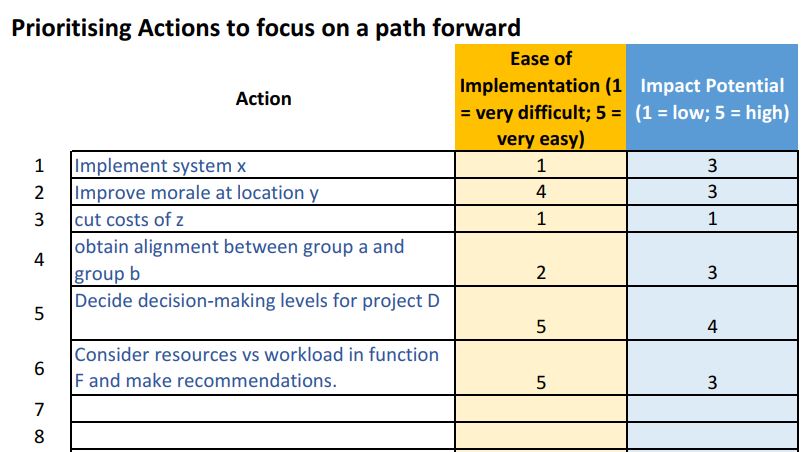
Rate all the projects or activities on two questions:

  • what is the level of impact on your company, project, company if you completed that project/activity? (high means it would me a very big difference (positively))
  • how hard is it to implement this? (referring to available resources, skills and knowledge needed, tools needed, funding needed) (very difficult means you have very limited resources and budget and this project or activity would need more than you have available right now)

Use the scores obtained to plot your planned projects or activities onto this graphic: (the graphic shows an example based on the table and ratings above)

What to focus on?

Use the guide below to understand which of your projects or activities should be a high priority, low priority or medium priority with possible additional research needed.

One the one hand the question is: can you overcome what is difficult about that particular activity or project? Can you (for example) convince someone make more funding available if you present a very solid business case to highlight the value to the company or the project?

Or can you get more people to help? The other question to look into is whether the impact is really as low as you imagine? Speak to others to hear their views of how such a project or activity could possibly benefit more areas than you think. Perhaps the project is much more valuable than you think and it moves into the “green” quadrant meaning it should be a high priority for you to work on and complete.

If your dots appear in one of the yellow sections, you have some questions to ponder. If you can solve the question in each case you may be able to move that particular action into a different “zone” by changing the score. This means you are able to for example make it easier to implement by solving an issue which made it particularly difficult to implement. Or it could mean you realize the business impact is bigger than you previously realized because the company could gain a competitive edge if you implemented that particular action.  Your final action plan for immediate focus areas should contain those actions which finally end up in the green zone on the legend.

Be sure to communicate the reasoning behind your high priority actions to the key stakeholders in the outcomes of the action plan. They may have additional insights to share which could further cause you to change the scoring of actions.

You can use the Action Plan posted here to capture the actions that you will implement, monitor status of and report on regularly.

Coaching Effectiveness Survey


While it is a good idea for coaches to periodically discuss how well the process may be working for those that they are coaching, it is also a good idea for HR/Learning and Development to get feedback on the coaching program on an annual basis. Occasional informal feedback from the person being coached to the coach directly may help the coach improve the person’s coaching experience and outcomes reached.

A formal annual survey helps the department responsible for managing and monitoring the coaching program to understand a few things:

  • General questions that coaching participants may still have about the process or program objectives.
  • How to improve the training of coaches to improve developmental outcomes.
  • How well the relationships are working between coaches and those being coached. Perhaps an intervention may be needed in cases where a high level of dissatisfaction is recorded?
  • Whether the coaching process is working well in general – meetings are held on a regular basis and the right topics are being discussed.

Coaching survey

The coaching survey above (see download option) contains questions you may want to consider for your annual coaching effectiveness survey and it also contains some suggested wording for the introduction email to those who are being coached to explain the survey and its purposes.

Gather the survey feedback and analyze it for overall coaching program effectiveness, but also look at individual responses to see if anyone is having a particularly negative view about his or her coach or the coaching process.  When you take action on individual responses pay close attention to the confidentiality statement you put in the email that went with the survey. Do not reveal someone’s input to his or her coach unless it was expressly established that the survey respondent consent to this course of action. Also use the information gathered from the survey to improve your orientation slides for the next coaching program and to improve future training you offer to coaches.

Other coaching resources that may be useful for setting up your coaching program: preparing for coaching, coaching questions, coaching program orientation slides.

Coaching Program Orientation – Presentation


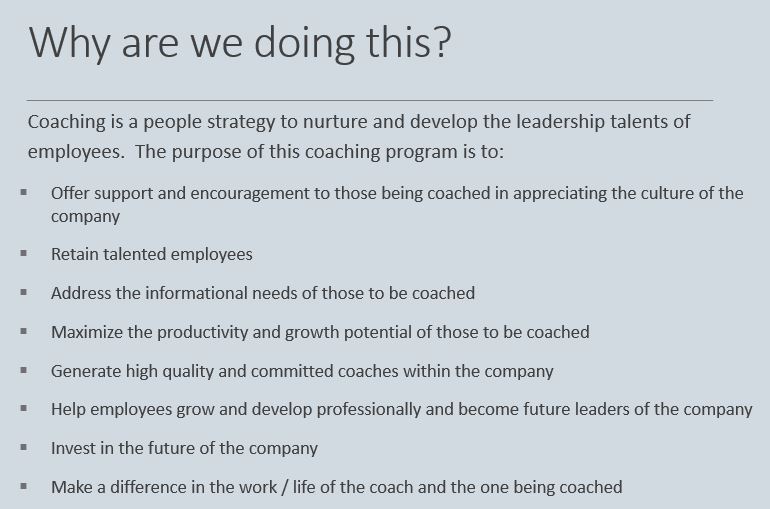
All coaching programs should contain an orientation as one of the starting elements. This session should cover the objectives of the program, what the expectations are for both coaches and those to be coached and any other general information that would be important for the participants of your coaching program. You can choose to combine the two groups for the session or you could choose to do separate sessions for coaches and those to be coached. If you choose the former you may want to add a training or reminder section of any specific coaching aspects that you wish to empathize.

Slides for the orientation meeting

The download file above contains a series of slides to help you get started creating your own. It shows some of the typical questions that coaching program participants may have and answers that may be relevant, but of course subject to your edits to suit your specific needs.

Tips:

  • Be sure to have a Q and A portion to answer any specific questions that anyone may have.
  • The front part of the presentation which sets the scene in terms of “no entitlement to promotion etc.” would be relevant if you have experienced that as an issue in your workforce or talented employee pool. In some cultures that may be seen as “offensive” or even “threatening” that it would be mentioned. So be culturally sensitive when you consider keeping that comment.
  • In the roles section I mention HR as the function supporting the coaching program – depending on your organization that could be your Learning and Development department, your Organization Development (OD) group or any other department/group.
  • Be sure to provide the coaches and those to be coached with all the tools they will need. If not printed and handed out at your orientation session, then perhaps a soft copy on a USB stick or per email after the session. Coaching questions or Preparation for Coaching

Preparing for a Coaching Session


Coaching sessions and programs are more successful when there are clear coaching goals and actions planned are documented. These developmental actions and activities should be reviewed and updated on a regular basis. It helps both the coach and the person being coached to maintain focus on desired outcomes..

Many employees who are new to coaching have misguided expectations about the coaching process and their own role in it. They expect the coach would show up at each session ready to provide them with useful information and advice and all they needed to do was to show up. In reality the coaching process works much better when both parties actively participate and prepare for each session.

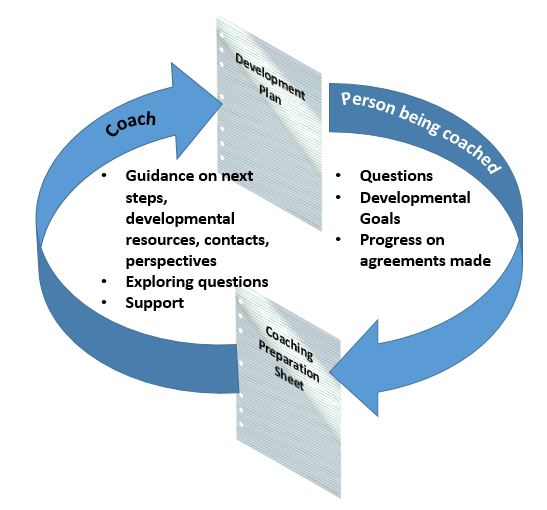
Coaching process JAG

This process graphic shows that each party in the coaching process provides input and participates in the process. The results are written down and shared to ensure a common understanding of the goals and that progress towards goal achievement is maintained.

Preparation worksheet for Coaching

Tips:

  • For those being coached: make sure you get your completed preparation sheet to your coach at least a few days before the session so that the coach can take your feedback into account. This helps him or her prepare to answer your questions and obtain any additional information and resources that may be useful to you at this time and bring it to the session.
  • For coaches: take note of the questions and struggles that may be noted in the preparation sheet. Consider how you can best help address those issues and which resources can you provide to help in the process? What is the best way to approach the coaching session – given those questions, issues and of course the overall goals that had been set for the coaching process?
  • Do remember to look back at previous preparation sheets and also the updated development plan on occasion (maybe once every 6 months) to recognize and appreciate progress made to date and to help motivate those being coached to take the next steps that may be required towards ultimate goal achievement.

Coaching is a shared responsibility between the coach and the person being coached. Only then, does the process yield the best results. And preparation is a key part of this shared responsibility.

Unlocking Insights: The Power of Internal Communication Surveys


Effective internal communication is a two-way street. It’s not just about top-down directives; it’s also about fostering an environment where employees feel heard and valued. By creating open channels for information sharing and feedback, organizations can build trust, boost morale, and drive better decision-making.

Keeping Employees in the Loop

HR often takes the lead in ensuring employees are informed and engaged. However, effective internal communication is a shared responsibility. Whether it’s HR, a dedicated communications team, or a combination of both, the goal is the same: to keep employees informed about company news, changes, and successes. Regularly assessing the impact of your communication efforts is crucial to ensure your messages are landing and driving the desired results.

Internal Communication Checkup Survey

The effectiveness of internal communication should be evaluated periodically. I would not repeat a survey like this one on a monthly basis unless you are going through a specific change initiative in this regard and would like to ensure you have a good understanding of how well your change process is going. Once per year or once in 18 months should be a good evaluation period. Keep it short to optimize your chances of getting good feedback and a high level of participation.

Tips:

  • Ensure your questions are specific and simple – survey respondents should know what exactly you are asking about. Do not combine more than one question into one.
  • Always make a post-survey action plan and share that with survey respondents and other stakeholders in the success of internal communications.
  • If you are an HR Director or in HR Management – stay close to the creation of internal communications. Read everything before it is released or published internally in your area of responsibility. The tone of communications and the contents of messages that are sent internally very closely link to how employees interpret the company’s management sentiments about them and you will often find disconnects started with some internal message that was misinterpreted.

HR Function checkup – Feedback from internal customers


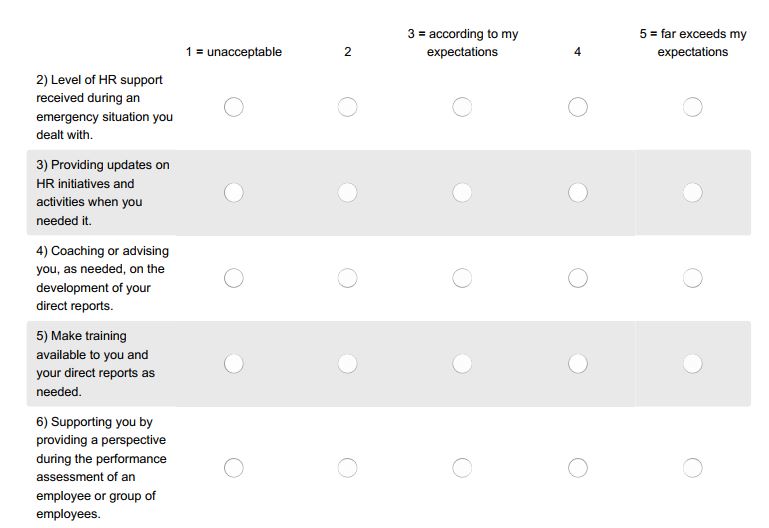
In the same way that companies would approach external customers to gather their views on what is going well and what needs improvement (customer satisfaction), the HR function should reach out to its internal customers to find out how satisfied they are with the services and support that they receive. It is true that there are more than one model for HR service delivery, but that does not change the fact that it is wise to gather feedback on the services and support that you do provide given the structure and focus for HR in your company.

The HR function is often guilty of focusing its developmental and improvement efforts exclusively on helping other departments and neglects using those same skills and expertise to improve the HR function as a whole and developing the people who deliver the HR services to others.

HR Function – Feedback Survey

This survey can help you gather the information you need from your internal customers to help you identify specific areas of excellence in HR and also those areas where improvement may be needed. When improvement is needed it will often imply additional training and development of some HR representatives (HRBPs or Generalists) and may also  include communicating the HR vision and goals more clearly within the HR function. Remember to recognize and reward those who were part of delivering excellent services when you review the survey results.

Tips:

  • Add comment fields next to scores if you want to be certain to capture specific comments about the scores.
  • Do be sure to provide survey participants with feedback on the outcome of the survey and the actions that you plan to take as a result of the survey. This motivates participants to continue providing you with valuable feedback in the future.
  • Create an action plan and communicate that clearly within the HR function so that everyone understands which areas you plan to address and how you plan to do that. It may help to set specific metrics around your planned improvements to make it easier to report progress.
  • Regularly update stakeholders – internal to the HR function and those who are internal customers in your company – on the progress of improvement efforts as you implement the post-survey action plan.
  • Remember to celebrate successes (milestones and outcomes achieved) and be prepared to add additional actions to your plan in cases where your improvement efforts are not reaping the results you had planned for.

Having a standard survey which you use ever year gives the opportunity to track the progress in specific questions over time and helps with trend analysis and showing % improvements over time.

What are your Values -TEMPLATE


Before you can select goals and development objectives for your life and your career, you need to know what you value above all else in your life. Deciding how to spend your time, how to use your energy and where to focus your efforts – all of that starts with knowing what matters to you. Only when you know what you value the most, are you ready to make deliberate choices that reflect what matters to you the most.

Values drive how you spend your time and how you make choices and decisions for activities and events that are important to you. Your values are especially helpful with choosing among options – which events to attend, what to do first, which actions to take next etc. When it comes to decision-making: select options that align best with your values and avoid options that are not aligned with your values or may even be opposites to your values.

This tool (see download option above) an help you define your own values; it contains a list of statements to guide you on your quest. Instructions on how to use the template can be found at the top of the worksheet. First you read through the statements and then put a Y for yes in the first column to indicate those statements which most appeal to you from a gut-feel perspective. (It seems or feels right to you; knowing yourself and what you find important in life). The next step is to look at only the ones you have selected with a Y – put a score between 1 and 10 next to the selected items using the column to the right of each statements to indicate how important that selected statement (representing a value) is to you. The highest scores indicate your highest values. Rephrase or clarify any of the value statements if they do not fit 100% with how you see it.

Tips:

  • Feel free to add more statements or words at the bottom of the list if you think of values that are not shown. I find that these lists are good at helping one start-up the process and then your own ideas and words start to pop into your mind. This then enables you to complete the process without needing to use the listed statements.
  • Once you have your list of top 5 values, check that against how you spend your time and ask yourself if your choices reflect your values or not. If they do, great. If they do not, what will you change to ensure you spend your time in a way that reflects your values better?
  • Look at people you spend time with. Are you surrounded by people who share your values or do they have different values? If their values are aligned with yours, great. If their values are not aligned with yours, what will you do to ensure that you are able to live up to your own values?
  • Your job and the company you work for/the office environment – do you feel that your values are compatible with the environment and how leaders are behaving? Are people (employees and customers) being treated in a way that you feel is aligned with your values? I am not suggesting that you resign tomorrow if there is a disconnect between your values and status quo. Instead I would like to pose a question… what can you do to positively impact how things are being done right now? And what do you think are the best steps to take if you do not see any improvement over time or a better alignment with your values?

It is not easy to hold yourself accountable in this way; knowing what your values are and being honest with yourself about how well your life choices align with your values.  It is possible that some people will get upset with you when you consciously start making different choices with the way you spend your time and the things you are interested in or willing to do. The benefit of making decisions with your values in mind is that you will be able to take a more direct line to accomplishing your goals.  This will impact time management, prioritizing preferences and cutting out those items that distract you from achieving the goals and objectives that you have set for yourself.

Analyze how you use your time


“All we have to decide is what to do with the time that is given us.” (Gandalf)

J.R.R. Tolkien, The Fellowship of the Ring

How you choose to spend your time is a good indicator of the activities and people who are most important to you in your life. It shows your priorities clearly. How well do your daily activities reflect your priorities?

Have you faced any of these challenges?

Personal Development. Maybe you have considered taking an evening class to improve your skills or obtain a qualification you need, but you are not sure how you will find time to attend that class because of your busy life.  Taking a closer look at how you spend the time that you do have may help you see opportunities to change your schedule and make more time for career development activities.

Leaders and managers have many priorities to manage and often feel there are not enough hours in every day to accomplish the business objectives they have set for themselves and their teams. Taking a closer look at how you spend every day and every week my give you some interesting insights. You may discover areas where you could refocus yourself or delegate activities to free up more time for those other priorities.

Performance feedback could be indicating that your supervisor/manager feels you are not using your time at the office in productively. This template can also help you discover where he or she may be right and whether you are actually using your time optimally to achieve the performance goals that you and your boss have agreed upon.

The template, which you can download below, helps you to take stock of what you are doing with all of the time that you have available to you. I once discovered that 30% of my time was at my own discretion and I created a mantra for myself “make the 30% count.” Whenever I caught myself involved in an activity that I had labeled as of low value to me given my own goals and values, I would just remind myself of the mantra and shift my focus to a higher value activity.

Should you need more development in how to be more effective at work, I suggest you look for a class on time management tools. These classes typically focus on how to get better at email management, how to better plan your day to do the right type of activities at the right time of the day (energy management) and also how to get better at keeping track of your highest priorities and making sure that you are working on the right items at various check-in moments with yourself during the day. A coach or a buddy can also help you with this by not only sharing tools with you but also helping to keep you accountable for the goals and outcomes you have committed to.

I hope your efforts to take a closer look at how you spend your time has given you the awareness of how much time you have available to spend at your own discretion. Are you using your time wisely? Are you doing things that will get you closer to the goals you have for your life?

I found one has to repeat these quick checks on a regular basis – maybe every 6 months – to make sure you are still on the path you had set for yourself when it comes to being in charge of the time you have.